The scream came from the sky—a sound that froze the blood and shattered the nerves of soldiers and civilians alike. It was the Jericho Trumpet, the siren mounted on the Junkers Ju 87 Stuka, a dive bomber that became the most recognizable symbol of Nazi terror during World War II. As it plunged toward its target, the aircraft seemed to shriek with malevolence, a psychological weapon as potent as its bombs. But behind the myth lay a machine with serious flaws, a design that had crashed on its first test flight and was considered obsolete by the time war broke out. Yet, the Stuka would go on to wreak havoc across Europe, from the blitzkrieg in Poland to the frozen wastes of Russia, leaving a legacy of fear that endures to this day.
In the years before the war, the Stuka’s development was anything but smooth. Hermann Pohlmann, its designer, had based the aircraft on the earlier Junkers K-47, but the demands of dive bombing required a much stronger airframe. The first prototype crashed on January 24, 1936, when its entire tail section broke off during a dive, killing the test pilot and his engineer. This disaster forced Pohlmann to redesign the tail, replacing the twin fins with a single rudder—a change that improved strength but restricted the rear gunner’s field of fire. Other innovations, like a sliding rudder and a rotating tail, were tested but ultimately abandoned. The Stuka’s evolution was a series of compromises, each solving one problem while creating another.
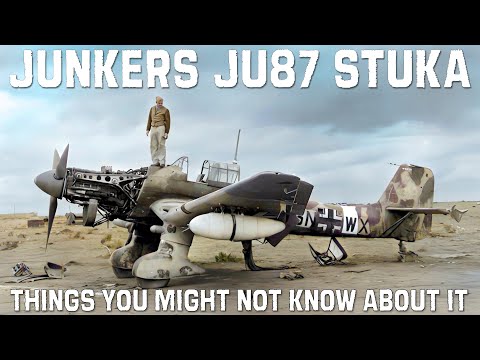
Despite these setbacks, the Stuka entered service in 1937 and quickly proved its worth in the Spanish Civil War, where its pinpoint accuracy impressed German commanders like Wolfram von Richthofen. The secret to its precision was the dive brake, which allowed the Stuka to plummet at a steep angle and release its bomb with deadly accuracy. But this accuracy came at a cost: the aircraft was slow, cumbersome, and vulnerable to enemy fighters. Its fixed landing gear, while providing stability during dives, added drag and made it an easy target. And the physical toll on its crew was immense—dive bombing subjected them to up to five times the force of gravity, often causing temporary blindness and loss of consciousness.
When World War II began on September 1, 1939, the Stuka was at the forefront of the German blitzkrieg. Three Stukas from Geschwader 1 dropped the first bombs of the war at Dirschau, and within days, the Luftwaffe had decimated the Polish air force. The Stukas bombed railways, supply depots, and refugee columns, spreading terror and chaos. Warsaw was bombed into submission, and the word ‘blitzkrieg’ entered the English language. The Stuka had become a symbol of German invincibility.
But the aircraft’s weaknesses were soon exposed. During the Battle of Britain, the Stuka met its match in the Spitfire and Hurricane. On August 19, 1940, after suffering heavy losses, Göring ordered the Stukas withdrawn from front-line operations. The aircraft that had terrorized Poland and France was now too vulnerable to operate without strong fighter protection. Yet, the Stuka’s story was far from over. It would find new life on other fronts, where its ability to provide close air support would be pushed to the limit.
In the Mediterranean, the Stuka found a new hunting ground. Operating from bases in Sicily, Stukas sank or crippled several British warships, including the carrier HMS Illustrious, which was hit by six bombs and barely survived. The British called the waters beyond the range of their fighters ‘Stuka sanctuaries,’ a testament to the aircraft’s dominance in the absence of enemy air cover. In North Africa, Rommel’s Afrika Korps relied heavily on the Stuka’s precision bombing to break through British lines. The desert sand wreaked havoc on engines and airframes, but the Stukas persisted, their crews adapting to the harsh conditions.
Then came Operation Barbarossa. On the first day of the invasion of the Soviet Union, June 22, 1941, Luftwaffe Stukas and bombers destroyed 1,811 Soviet aircraft, most of them on the ground. The scale of the victory was unprecedented. Within a week, over 4,000 Soviet planes had been wiped out. The Stuka was once again the spearhead of the blitzkrieg, diving on tanks, troop columns, and communication lines. But the vastness of Russia stretched the Luftwaffe to its limits. Crews flew six or more missions a day, and the freezing winter turned bombs into duds and engines into blocks of ice.
Yet the Stuka adapted. Hans-Ulrich Rudel, the most decorated German pilot of the war, flew the Ju 87G ‘Tank Buster,’ armed with two 37mm cannons, and destroyed over 500 Soviet tanks. Rudel’s exploits became legendary, and his aircraft, with its underwing cannons, became a symbol of German defiance in the face of overwhelming odds. But for every Rudel, there were dozens of crews lost to enemy fighters, anti-aircraft fire, and mechanical failure.
By 1943, the tide had turned. The disaster at Stalingrad and the failure of Operation Citadel at Kursk marked the beginning of the end. The Stuka, now obsolete, was still thrown into battle, often with devastating losses. During the Battle of Kursk, Stuka crews claimed up to 60 Soviet tanks destroyed in a single day, but such victories could not change the outcome. The Luftwaffe was being bled dry, and the Stuka was no longer the hunter it once was.
The final chapter came in 1944-45. With the Allies advancing from the west and the Soviets from the east, the Stuka was reduced to desperate missions. In April 1945, the last Stukas attempted to destroy the bridges over the Oder River to slow the Soviet advance on Berlin, but the mission failed. The Jericho Trumpets fell silent, and the aircraft that had once terrorized Europe was reduced to a relic. Today, only two complete Stukas survive, one in the RAF Museum in London, a silent witness to a time when the sky itself seemed to scream.
But the story of the Stuka is not merely one of technical specifications and tactical doctrines. It is also a story of men—young pilots who climbed into cramped cockpits, knowing that each dive could be their last. The physical demands of dive bombing were brutal: at the bottom of a dive, the crew experienced forces that blurred their vision and threatened to pull them into unconsciousness. To survive, they relied on an automatic pull-out system that would recover the aircraft even if the pilot blacked out. It was a grim testament to how dangerous the Stuka’s signature maneuver truly was.
And yet, for all its flaws, the Stuka inspired a strange affection among those who flew it. Veterans spoke of the aircraft as a trusted companion, predictable and sturdy, a machine that brought them home despite punishment that would have destroyed lesser planes. The inverted gull wings, which gave the Stuka its distinctive silhouette, also gave the pilot an unmatched view of the ground below—a crucial advantage when aiming a bomb at a tank or a bridge. It was, in the words of one pilot, ‘an honest aircraft.’
This affection extended even to the enemy. British and Soviet pilots who faced the Stuka learned to respect its precision, even as they exploited its vulnerabilities. One RAF fighter ace recalled that shooting down a Stuka felt less like a victory and more like putting down a wounded animal. The aircraft was so slow and ungainly that it seemed almost unfair to attack it with a modern fighter. But war is rarely fair, and the Stuka’s crews paid the price for their aircraft’s shortcomings.
Perhaps the most poignant chapter of the Stuka’s story is its role on the Eastern Front, where it became a lifeline for surrounded German troops. During the winter of 1942-43, Stukas flew supply missions into the encircled pocket at Stalingrad, landing on makeshift airstrips under Soviet fire to deliver food, ammunition, and medicine. These missions were suicidal, and many aircraft were lost. But for the soldiers trapped in the cauldron, the sight of a Stuka descending through the snow was a glimpse of hope—a reminder that they had not been forgotten.
As the war dragged on, the Stuka’s missions grew more desperate. In the final months of the conflict, some Stukas were fitted with makeshift weapons—cluster bombs, incendiary canisters, even crude rockets—in a futile attempt to halt the Soviet juggernaut. The pilots who flew these missions knew they were expendable. Yet they flew anyway, driven by duty, loyalty, or simply the inertia of war. The Jericho Trumpet, once a symbol of terror, now sounded more like a dirge.
When the end came, it came swiftly. The last Stuka mission of the war was flown on May 8, 1945—the day of Germany’s surrender—by a handful of aircraft attempting to evacuate wounded soldiers from a besieged pocket near Prague. The mission was a failure, and the aircraft were either shot down or scuttled by their crews. The Stuka, the weapon that had defined the blitzkrieg, died as it had lived: in fire and chaos.
Today, the Stuka exists only in museums and memories. The single surviving example at the RAF Museum in Hendon stands as a stark reminder of a time when the sky itself seemed to scream. Children climb on its wings and pose for photographs, unaware of the terror it once inspired. But for those who lived through the war, the Stuka remains a symbol of something darker—a testament to the power of fear, and the cost of technological hubris.
But the Stuka’s legacy is not confined to the past. Its distinctive silhouette—the inverted gull wings, the fixed landing gear, the long canopy—remains instantly recognizable, a ghost that haunts the collective memory of the twentieth century. For the men who flew it, the Stuka was more than a machine; it was a companion, a weapon, and sometimes a coffin. For those who faced it, it was a terror that came from the sky, a shrieking harbinger of death.
In the end, the Stuka was a product of its time—a brilliant solution to a specific problem, but one that could not adapt to the changing nature of war. Its story is a cautionary tale about the limits of technological innovation and the dangers of relying on fear as a weapon. Yet, it is also a story of human courage and endurance, of men who flew a flawed aircraft into battle because they believed in their cause, however misguided.
As the last Stuka rests in its museum, its engines silent, its guns cold, it serves as a reminder of a time when the world was at war and the sky was filled with the sound of screaming. Visitors gaze at it with a mixture of awe and unease, sensing the dark history that clings to its metal skin. The Jericho Trumpet is gone, but its echo lingers.
What do you think? Does the Stuka deserve to be remembered as a technological marvel, a symbol of terror, or a tragic failure? Share your thoughts in the comments below.
Report this article
Select a reason for reporting:






