October 1944. The Canadian prairies stretched endless under a cold drizzle as a transport truck rumbled through the gates of a prisoner-of-war camp outside Medicine Hat, Alberta. Inside, thirty-seven German women—radio operators, nurses, and clerks of the Reich—braced for the cruelty their propaganda had promised. They had been captured in France, shipped across the Atlantic, and now stared through barred windows at a land that seemed to swallow the horizon. None of them expected what waited on the other side of that fence.
Sergeant Malcolm Fraser, a broad-shouldered man with kind eyes, had prepared a feast. Not tin mess kits, but ceramic plates, cloth napkins, and small vases of prairie wildflowers. And at the center of it all, a dessert none of them had ever seen: individual tarts with deep purple filling, their crusts golden and flaky. The aroma alone was enough to make nineteen-year-old Gertrude Schäfer’s eyes fill with tears. “Why would they feed us like this?” she whispered. “We are their enemies.”
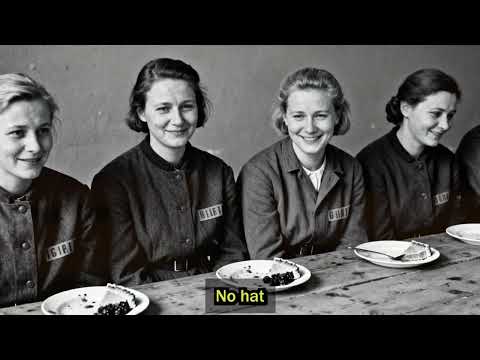
Among the prisoners was twenty-three-year-old Dorothea Keller, a former communications specialist from Stuttgart. She clutched a canvas bag holding a comb, a family photograph, and a wooden cross her mother had pressed into her hands two years earlier. As she stepped down from the truck, she met the calm gaze of Captain Dorothy Whitmore, one of the few female officers in the Canadian military. “You are prisoners, but you are also under our protection,” the captain said in measured English. The words meant little to most, but the tone—free of hatred—registered something unexpected.
The women were led to a clean barracks with a wood stove already burning. Elfrieda Zimmermann ran her hand along a rough wool blanket and whispered, “This is better than our quarters in France during the retreat.” The others nodded silently, their faces hollow with exhaustion.
In the dining hall, the women sat frozen before the feast. Then Dorothea, driven by months of hunger, picked up her fork. The first bite of warm chicken and fresh bread brought tears to more than one face. But it was the dessert that truly captivated them. Hildegard Schmidt, a former nurse from Munich, cut a small piece of the purple tart and closed her eyes as the flavors registered. “My God,” she whispered. “What is this?”
Corporal Joseph Crowchild, a young Cree man in Canadian uniform, stepped forward. “Saskatoon berry pie,” he said slowly. “This berry grows on the prairies. My people have picked these berries for thousands of years—long before Canada, long before Germany, long before this war. The berries remember only the sun and the soil. They do not know about enemies.”
Dorothea took her first bite, and the taste exploded across her tongue—sweet and tart, familiar and foreign. Around her, the other women were having the same experience, their faces showing surprise and delight. In that moment, something shifted. The walls of propaganda began to crack.
The days that followed established a pattern that confused the German women more than harsh treatment ever could have. Each morning, the wood stove was already stoked. Breakfast appeared with porridge, brown sugar, and sometimes eggs. Sergeant Fraser arranged for extra blankets and medical care without seeking gratitude. Private René Dupuis taught English with inexhaustible patience. Mrs. Beatrice Campbell, a volunteer cook, brought hair ribbons, German novels, and small comforts that spoke of a woman’s understanding.
But the most surprising kindness came from Corporal Crowchild, who taught the women about the prairie landscape—which plants healed, which could be eaten, which told stories of the seasons. His lessons were quiet rebellions against the idea that enemies couldn’t share knowledge.
As November arrived and temperatures dropped, Mrs. Campbell invited volunteers to help in the kitchen. Hildegard was first, then Elfrieda, eager to spend time near Private Dupuis. Dorothea hesitated, but curiosity won. Within a week, seven women were learning to knead bread and roll pie crust under Mrs. Campbell’s patient instruction. “Knead it like this, more pressure. No, dear, fold it gently.” The words became meaningful through action, their English expanding to include terms no textbook could teach.
But more than language was exchanged in that warm kitchen. Mrs. Campbell shared stories of her mother’s immigration, of adapting old-world recipes to new-world ingredients. In return, the women began to share their own—Gertrude’s grandmother’s stolen Christmas recipe, Lieselotte’s mother’s potato pancakes. The turning point came when Mrs. Campbell announced they would make Saskatoon berry pie together, using preserved berries from her cellar. As the pies baked, filling the kitchen with that distinctive sweet-tart aroma, something shifted. They were no longer quite prisoners and captor. They were simply women sharing the universal language of food.
When the pies emerged golden and perfect, Hildegard took her first bite and smiled—really smiled—for the first time since her capture. “This tastes like hope,” she said in halting English.
But December brought news that shattered the fragile peace. Allied forces had liberated concentration camps, and the newspapers arrived in the common room with photographs that needed no translation: skeletal figures, mass graves, horrors beyond imagination. Dorothea felt the room tilt. She had known about labor camps, but this—this was something else entirely. “This cannot be real,” Hildegard whispered. “It must be propaganda.” But her voice carried no conviction.
Elfrieda turned away and vomited. Gertrude wept with helpless sobs. Lieselotte sat frozen, her face drained of color. That night, no one slept. They lay in their cots listening to each other cry—the grief of discovering that everything they believed about their country had been built on lies.
The weeks that followed were the darkest since their arrival. Many stopped coming to the kitchen. Several refused meals until Captain Whitmore insisted that self-destruction would not atone for anything. It was Mrs. Campbell who finally broke through, inviting six of the women to her family’s Thanksgiving dinner. Her son had died at Dieppe fighting against German forces, yet her husband George greeted them with weathered kindness. Their daughter Margaret helped serve the meal with gentle efficiency.
At the center of the table sat a large Saskatoon berry pie, its crust decorated with cut-out leaves. Mr. Campbell said grace, thanking God for the food, for peace that would eventually come, and for the opportunity to share their table with strangers who needed kindness. Mrs. Campbell translated, then added her own words: “You are not responsible for knowing what you were deliberately kept from knowing, but you are responsible for who you choose to become now with the knowledge you have.”
When the pie was served, Gertrude took her first bite and began to cry again. But these were different tears. “This tastes like forgiveness,” she whispered. Mrs. Campbell reached across the table and squeezed her hand. “No, dear, this tastes like a future worth choosing. Forgiveness is something you give yourself by deciding to be better than what came before.”
Spring arrived with the news that the war in Europe was ending. Hitler was dead. Germany had surrendered. Captain Whitmore called an assembly to discuss repatriation, and the women faced a profound uncertainty. That evening, they gathered in their barracks for a discussion that lasted until dawn. Dorothea articulated thoughts she hadn’t fully realized: “What Germany are we returning to? The cities are destroyed. Our families are scattered or dead. The country we thought we were serving never actually existed.”
Hildegard raised practical concerns: “But this is not our home. Canada is a foreign country. We are prisoners, not immigrants.” Elfrieda, who had grown close to Private Dupuis, spoke quietly: “Perhaps belonging is not about where you were born. Perhaps it is about where you are allowed to become who you truly are.”
By morning, they had reached no consensus, but Dorothea knew with sudden certainty that she wanted to stay in Canada. She approached Captain Whitmore with an extraordinary request: “Is there any possibility that some of us might be permitted to remain in Canada rather than return to Germany?”
Captain Whitmore’s response was carefully measured. “I cannot promise anything, but I will make inquiries with Ottawa.”
The Canadian government had procedures for displaced persons, but nothing specifically addressed prisoners of war who wished to remain. The situation was unprecedented. While they waited for official word, Mrs. Campbell began working with her church to identify potential sponsor families. The response surprised everyone. Families who had met the German women during church visits, local farmers needing help with spring planting, business owners looking for workers—all stepped forward. The Campbell family offered to sponsor Dorothea personally. Private Dupuis, with courage that impressed everyone, approached his own family about sponsoring Elfrieda. His parents, devout Catholics who believed in redemption, agreed without hesitation.
But not all wanted to stay. Hildegard decided to return to Germany to search for her younger sister, last known to be in Hamburg when the firebombing destroyed much of the city. Lieselotte felt a duty to her mother, alive but living in desperate conditions in the Soviet zone. Gertrude, young and uncertain, chose to return with the older women, needing to witness what Germany had become before deciding her future.
The official response from Ottawa arrived in late June. The women who wished to remain could apply for landed immigrant status under displaced persons provisions, provided they had Canadian sponsors and means of support. Of the thirty-seven who had arrived at Camp Medicine Hat, fourteen chose to remain. Twenty-three prepared for repatriation.
The day of departure was emotionally wrenching. Women who were leaving and those who were staying embraced with tears, knowing they might never see each other again. They had survived capture, imprisonment, and the shattering of everything they believed. Now they chose different paths, but all carried the same memories—of unexpected kindness, of Saskatoon berry pie, and of discovering that enemies could become friends when given the chance.
Twenty-five years later, in the summer of 1970, Dorothea Keller Campbell stood in her sunny kitchen in Medicine Hat teaching her two grandchildren how to make Saskatoon berry pie. She had married Mrs. Campbell’s nephew in 1948, built a good life as a translator, and raised two sons who knew they were Canadian but also carried German heritage without shame.
“Oma,” her granddaughter Emma asked, “why do you always make such a big deal about this pie? It’s just dessert.”
Dorothea smiled, her hands dusted with flour. “Because this pie saved my life—not my physical life, but my soul. Let me tell you a story.”
She told them about arriving as a frightened prisoner, expecting cruelty and receiving kindness. About the night she first tasted Saskatoon berry pie and realized the propaganda was false. About learning that Germany had committed terrible crimes, and the shame that followed. And about Mrs. Campbell’s words: forgiveness comes from choosing to be better than what came before.
Her grandson Thomas listened with intensity. “So, you were a bad guy?” he asked with eight-year-old directness.
Dorothea knelt to his eye level. “I was a person who served bad people without understanding what they truly were. That doesn’t make me evil, but it makes me responsible for learning and doing better. That’s what this pie represents. Every time I make it, I remember that kindness is stronger than hatred, that people can change, and that home is where you choose to build a life worth living.”
The pies went into the oven, and the familiar aroma filled the kitchen. Dorothea thought about the other women—Hildegard, who found her sister and became a nurse in West Germany; Elfrieda, who married René Dupuis and lived just thirty miles away, raising four children who spoke both French and German. Some who returned to Germany never wrote, their fates unknown.
When the pies emerged golden and perfect, Dorothea cut three slices. As they ate together, she watched her grandchildren and saw the future she had chosen. They would grow up knowing that people were more than their worst moments, that nations could transcend their darkest chapters, and that something as simple as a purple prairie berry could carry the taste of redemption.
The Saskatoon berries, as Corporal Crowchild had told her long ago, remembered only the sun and soil. They didn’t know about enemies. And in that forgetting, in that sweet-tart taste of a land that welcomed her, Dorothea had found not just a home, but a way to finally forgive herself.
Thomas finished his slice and licked purple filling from his thumb. “So the pie is like a promise?” he asked.
Dorothea nodded. “A promise that we can always choose kindness.” Outside, the prairie wind moved through the wheat, and Emma pressed her nose to the window.
That evening, Dorothea wrote a letter to Hildegard in Hamburg. She had written every year, never knowing if it arrived. This time, she sealed a dried Saskatoon berry inside the envelope.
Weeks later, a reply came—the first in twenty-five years. Hildegard’s sister had survived. They had opened a small bakery, and every autumn they made something they called Präriepflaumenkuchen, though no one in Hamburg knew why.
Dorothea read the letter twice, then set it beside her mother’s wooden cross. The berries, she thought, had traveled farther than any of them.
What small act of kindness in your own life still tastes like hope?
Report this article
Select a reason for reporting: