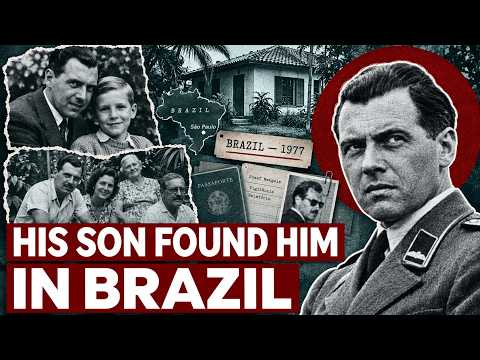
The old man is crying at the gate. Rolf Mengele, 33, a lawyer from West Germany, steps out of a Volkswagen onto Alvarenga Road, a dusty, potholed street on the edge of São Paulo. It’s October 1977. In front of him is a house that he’ll later say looked more like a hut. And standing at the gate in tears is the father he’s met only once before—when he was a boy, and the man was introduced to him as Uncle Fritz.
That father is Josef Mengele, the SS doctor of Auschwitz. He’s been on the run for more than 32 years. West German prosecutors want him arrested, and Israeli agents have tried and failed to catch him. He’s accused of sending people to the gas chambers and of running experiments on hundreds of pairs of twins. He’s become one of the most notorious Nazi fugitives alive.
Rolf has come with a list of errands from his father: a Latin dictionary, spare razor parts, books by Ovid. He’s also come with a question he’s carried since he was 16. What he doesn’t know is that the passport in his pocket, stolen from a friend who looked a bit like him, will one day be found by a neighbor and reported to Nazi hunters. And he doesn’t know that the decision he makes during this visit—to say nothing—will help keep the world chasing a ghost for years after his father is dead.
So what does a son do when he finally finds the man the whole world is hunting? Rolf confronted him and got no remorse. Then he protected him anyway. That choice between loyalty and justice shaped everything that happened next: the death on a Brazilian beach, the six-year cover-up, the bones in a cemetery under someone else’s name, and a blood sample Rolf held back for more than a year.
This story is pieced together from Rolf’s own account to the journalist John Ware, the papers and diaries Rolf let two biographers use, an Israeli police summary of the case, American diplomatic and forensic accounts, Brazilian journalism, and the reporting of the people who hunted Mengele in 1985.
To understand what Rolf was walking into at that gate, we have to start with the man who wasn’t there for his childhood.
Rolf was born in 1944. His mother was Irene Schönbein, who’d married Josef Mengele in July 1939. By the time Rolf was born, his father was already working at Auschwitz. Mengele had been posted there in May 1943, and he stayed until the camp was evacuated in January 1945 as the Soviet army closed in.
The legend around him is so large that it sometimes swallows the record. The United States Holocaust Memorial Museum notes that Mengele was one of about 50 doctors at Auschwitz. He wasn’t the highest ranking. Camp doctors took turns at the selections, sorting new arrivals into those who’d be worked and those who’d be killed at once. And the museum says Mengele did this no more often than his colleagues. Survivors often remembered him as the man who selected them anyway.
But what made him infamous was his own research. He served as chief physician of the so-called Gypsy family camp at Birkenau, where Romani families were held, and he set up his research facility there. In 1944, the remaining Roma in that camp were murdered. He collected twins from the arriving transports, measured them, drew large amounts of their blood, and sometimes had them killed so their bodies could be compared and their organs sent to Germany.
How many twins passed through his hands is genuinely uncertain. The Holocaust Museum says hundreds of pairs. The historian Nikolaus Wachsmann has estimated as many as a thousand sets. Other accounts go as high as 1,500. One witness, Miklós Nyiszli, testified that he watched Mengele kill 14 twins in a single night.
Ella Lingens, a Viennese doctor who’d served on Mengele’s staff at Auschwitz, later summed him up for the ABC reporter John Martin in a few words: “Arrogant, absolutely arrogant. Coldness, absolute cold yet intelligent, no compassion.”
When the war ended, Mengele simply slipped away. He posed as an ordinary army officer and ended up in an American prisoner of war camp. He didn’t have the SS blood group tattoo, and nobody realized he was on a list of wanted war criminals, so the Americans let him go in the summer of 1945. He worked under a false name as a farm hand in Bavaria. Then, in 1949, using forged papers in the name of Helmut Gregor, he sailed from Italy to Argentina.
His wife never followed him. Irene and Joseph divorced by proxy in 1954, and she raised Rolf in Germany. His mother told the boy his father had died in the war. That’s why the first meeting between them was so strange.
In 1956, Mengele traveled from South America to Switzerland for a ski holiday. Rolf, about 12 years old, joined him there with his aunt Martha, the widow of Joseph’s brother. The man on the slopes was introduced to Rolf as Uncle Fritz. John Ware, who co-wrote the Mengele biography with Gerald Posner, places Rolf at 12 and the 1956 date fits that. In a piece written much later, Posner remembered him as 16. So even the people closest to the family records don’t agree on every detail. Either way, the boy had no idea who he was skiing with.
The truth arrived a few years later. Rolf learned at 16 that his uncle was his father and that his father was the Auschwitz doctor. The arithmetic puts that around 1960, the year Israeli agents captured Adolf Eichmann in Buenos Aires.
Meanwhile, the man himself had made a rather remarkable decision. In November 1956, he walked into the West German embassy in Buenos Aires with his original birth certificate and came out with an Argentine identity document in his real name. He was living briefly as Joseph Mengele, openly. Years later, the German ambassador said Bonn had told him to ignore the case because there was no legal arrest order and no extradition request. About two years after that, Mengele married Martha, his late brother’s widow. So for a few years in the late 1950s, the most notorious doctor of the Holocaust was barely hiding at all.
That changed fast at the end of the 1950s, and the reasons it changed are the reasons Rolf would one day have to travel on someone else’s passport. In 1959, West German prosecutors finally sought his arrest. Mengele moved to Paraguay, where he obtained citizenship. Then in May 1960 came the Eichmann kidnapping, and the old confidence evaporated. By October 1960, he’d slipped into Brazil under a new name, Peter Hochbichler, with help from an Austrian Nazi sympathizer named Wolfgang Gerhardt.
Years later, in 1985, the Paraguayan dictator Alfredo Stroessner told an American television reporter that Mengele left sometime in the 1960s, adding, “I believe he went to Brazil.” That was true, though it came a quarter century too late to help anyone.
Gerhardt placed him with a Hungarian immigrant couple, Geza and Gitta Stammer, on a farm in Nova Europa in São Paulo state. Mengele became their farm manager. They later bought land together, and he held a half share. In 1963, according to the Israeli police summary of the case, Gitta Stammer noticed that a newspaper photograph of Josef Mengele looked very much like the man running her farm. When it came out, he admitted who he was. She wanted him gone. But then, the same summary says, a man who introduced himself as the manager of the Mengele Company arrived and offered $3,000 to let him stay. Gitta Stammer later told reporters she’d been warned by Gerhardt that their lives would be in danger if they spoke. In 1985, she called Mengele a cold scientist and said of herself, “I feel I was a donkey for never reporting him.”
That money is the thread that ties Rolf’s family to the whole escape. Back in Günzburg, the Bavarian town where the Mengeles lived, the family ran Karl Mengele and Sons, a maker of farm machinery that in 1985 employed about 1,200 people and reported $82 million in revenue the year before. A long time family friend and company man, Hans Sedlmeier, acted as the go-between. One professor later reported that Sedlmeier told him he’d secretly funneled modest amounts of money to the fugitive for years. According to Time, the family sent him between $100 and $175 a month.
Günzburg, a town of about 19,000, had every reason to stay loyal. Time magazine described the family in 1985 as a fair employer and a generous donor to the town. And when the story broke, some Mengele relatives in Munich took their nameplates off their doorbells. Time noted that no member of the family had publicly expressed an iota of remorse.
That family money didn’t make Mengele rich. Rolf later told the German magazine Bunte that his father’s poverty, ironically, may have been what protected him. And the hunters? Their record is uncomfortable for several governments, and each deserves to be judged by the same standard.
Israel came close. In July 1962, according to the Israeli journalist Ronen Bergman, Mossad operatives Rafi Eitan and Zvi Aharoni saw a man they believed was Mengele leaving a farm near São Paulo. They were planning to seize him. Then they were called back to deal with Egypt’s missile program, and the operation died. Bergman writes that from 1963 until 1977, Mossad chiefs and Israeli prime ministers made Nazi war criminals the lowest priority. He quotes Meir Amit, the agency’s chief after 1963: “I prefer to deal with threats of the present than ghosts of the past.” Read charitably, and Amit’s own words invite that reading, it was triage rather than indifference. A small state choosing the dangers in front of it over the crimes behind it. Read less charitably, it meant the survivors were left waiting.
West Germany had issued its arrest warrant, but the ambassador’s own account of being told to look away in 1956 hangs over its record. And the United States had released him in 1945 without realizing who he was. The journalist John Martin, who chased Mengele for ABC News, later wrote about the Cold War shadow over American inaction, pointing out that the US had recruited hundreds of former Nazi scientists after the war, which fed suspicion, amplified by Soviet propaganda, that Washington didn’t really want him found.
So, by the mid-1970s, one of the most hunted men of the Holocaust was living in a modest house outside São Paulo using the identity card of Wolfgang Gerhard, who’d handed it over in 1971. His friendship with the Stammers had fallen apart. His new protectors were an Austrian couple, Wolfram and Liselotte Bossert, who said they’d been introduced to him by Gerhard in 1970. The Israeli police summary dates Liselotte’s help to after she met Rolf in 1977, so the timing isn’t settled. Their children called him Uncle Peter.
Then, in 1977, Hans Sedlmeier arranged a secret visit from the fugitive’s only son. Among the things his father asked him to bring was a book by his friend Hans Ulrich Rudel, a man who, according to the papers a German magazine later published, had helped him in South America. The planning is preserved in letters between father, son, and Sedlmeier. In them, Mengele wrote that he had “no minutest inner desire to justify” what he’d done. He told his son to travel on a false passport, and if he thought he was being followed, to hang around town for a few days and then fly home without coming near him. Sedlmeier, the old family fixer, added a warning of his own. The world had changed, and his father’s old assumptions no longer held.
On October 10th, 1977, Rolf flew on a charter to Brazil. He carried his own passport, a second one stolen from a friend who resembled him, and $5,000 in cash. He spent a night in Rio de Janeiro, took a commuter flight to São Paulo, and then three separate taxis to the Bosserts’ home, presumably to make him harder to follow. The last leg was in the Bosserts’ Volkswagen. That’s how he arrived at the house on Alvarenga Road.
John Ware, one of the two biographers Rolf confided in, described what Rolf found there. Not the arrogant officer of the survivors’ memories. In Rolf’s words, “the man who stood before me was a broken man, scared creature.” Mengele gave his son his own bed and slept on the floor.
Rolf hadn’t come for a holiday. He’d come to ask about Auschwitz. According to Rolf’s account, his father’s answers came in layers. Auschwitz, he said, had been something like a field hospital. He’d selected people who were fit to work, which in his telling meant he’d saved them. The twins, he insisted, owed their lives to him. He said he had never personally harmed anyone. He said he’d only done his duty and that he hadn’t invented Auschwitz.
When Rolf asked why he hadn’t simply turned himself in and faced a court, Mengele replied, “There are no judges, only avengers.” At one point, the old man turned the question back on his son: “Don’t tell me that you, my only son, believe what they write about me?”
Rolf had hoped, he later said, that his father would at least tell him he’d tried to get transferred to the front, that he’d wanted out. He never said it. Instead, he offered racial theories that Rolf, an educated man, considered unscientific. Eventually, the two agreed to stop talking about it. Mengele promised to write everything down for his son, a full account. He never did, apparently afraid that such a document might fall into the hands of the authorities.
Rolf’s own verdict was blunt: “Unfortunately, I realized that he would never express any remorse or feeling of guilt in my presence.” The sources don’t fully agree on how long he stayed. Ware’s account, based on Rolf’s own telling, says 14 days. The Israeli police summary says about a week. By Rolf’s account, it ended at the airport, where Mengele seemed preoccupied with whether they were being watched. Rolf knew he’d never see him again. He’d already decided he wouldn’t turn him in, and he’d also decided he didn’t want a relationship with him.
About a month later, a letter arrived from Brazil. In it, Mengele wrote, “Now I can die in peace.” Rolf now knew exactly where one of the most wanted Nazis on earth was living. He had the address, he had the Bosserts’ names, he had letters in his father’s handwriting, and he went home to West Germany and said nothing.
We can’t know everything that went on in his head, and no source can tell us. But he did explain himself later, more than once. In 1985, he told Bunte that he didn’t support his father, but didn’t want to betray him either. As Time summed it up, he deplored his father’s methods, but couldn’t bring himself to condemn him. Gerald Posner, who worked closely with Rolf’s family papers, later put Rolf into a category of his own among the children of Nazi leaders. Not a defender like Rudolf Hess’s son Wolf, not a rejector like Hans Frank’s son Niklas, who exposed his father’s crimes, Posner called Rolf “the divided,” a man carrying two truths he couldn’t reconcile, the stranger he barely knew and the perpetrator he couldn’t betray.
There’s a hard way to read that. While Rolf stayed silent, the survivors of those experiments were still alive, still waiting for a trial. And one of the very few people who could have helped bring that trial about knew the address. A softer reading points out that he was a son, not a policeman, and that the institutions with actual power from Bonn to Jerusalem had done far less with far more. Where you land probably depends on what you think a son owes a stranger who happens to be his father.
What’s not in dispute is what the silence led to. On February 7th, 1979, Mengele went to the beach at Bertioga, a resort on the Brazilian coast with the Bosserts. He was 67. According to the Israeli police summary, the sea turned rough while the family was swimming at around 5:30 in the afternoon local time. Liselotte Bossert got her children ashore and saw Mengele far out in the water. She swam out and pulled him in, but he was already gone. He’d suffered a stroke in the water and drowned. Her husband Wolfram was taken away by ambulance.
The rest of that night was a run of small official failures. A heavy thunderstorm delayed things for hours. An ambulance for the body arrived around 11:00 at night local time and reached the morgue at about 2:00 in the morning. There, the Bossert family presented identity papers in the name of Wolfgang Gerhard. In the words of the Israeli police summary, the doctor on duty did not examine the body, did not photograph it, and did not take fingerprints. The death was recorded under the wrong name. And Josef Mengele was buried in the cemetery at Embu outside São Paulo as Wolfgang Gerhard.
The Bosserts didn’t call the police. They wrote to the family. And Rolf, when the news reached him, went back to Brazil, collected most of his father’s belongings from the couple, his diaries and papers among them, and went home. His first reaction, he told John Ware, was relief. He’d been caught in a conflict he couldn’t resolve between loyalty to his father and the evidence against him. A trial would have been important, he said, but for him it would have been far harder. Now there would never be one.
From 1979 onward, the Mengele family and a handful of friends in Brazil knew that the Angel of Death was dead and buried. Almost nobody else did. And over the next six years, the hunt for him didn’t fade. It grew.
Before we follow that hunt, a quick word from us. This story involves a lot of dates, names, and conflicting accounts. And we’ve tried hard to flag where the sources disagree. If you spot something we’ve got wrong, tell us in the comments and we’ll pin a correction so everyone sees it.
In January 1985, on the 40th anniversary of the liberation of Auschwitz, survivors of Mengele’s twin experiments gathered and staged a mock trial of him in Israel, going back over details of their ordeal that the world had half forgotten. Among the twins who’d survived his program was Eva Kor, who’d been 10 years old when she and her sister Miriam were taken into his program. The twins lobbied the United States Congress to demand that Mengele be found, arrested, and tried. It worked in the sense that governments finally moved together. In May 1985, West Germany, Israel, and the United States agreed to cooperate in tracking him down. The rewards on offer had climbed to about $3.4 million. ABC’s John Martin counted no fewer than 55 American network television stories on Mengele in six months. He and his foreign editor set off on a search across six countries and more than 30,000 miles.
Rolf’s cousin Dieter Mengele told Martin, “I think he’s dead.” Martin didn’t believe him. Few people did. According to the Frankfurt prosecutor, the family had been asked by Mengele’s associates in South America not to report the death, partly for the associates’ own safety, and partly, he said, so that Israel would keep wasting money chasing a phantom. Whether that second motive was real or the prosecutor’s interpretation, the effect was the same. For six years, investigators were hunting a man who’d been under a stone with the wrong name on it the whole time.
The threads that finally unraveled the secret came from several directions. In late 1984, the Nazi hunters Serge and Beate Klarsfeld passed on a tip that Rolf had traveled to Brazil in 1977 on a false passport. They said it came from a Berlin associate, a neighbor of Rolf’s, who’d secretly entered his apartment and found the passport. Separately, Hans Sedlmeier had reportedly talked to a German professor about the money he’d been sending. On May 31st, 1985, acting on a tip from an informant, West German police raided Sedlmeier’s home in Günzburg. Among the papers they seized was a letter from Wolfram Bossert informing him of Mengele’s death. That led straight to Brazil.
Brazilian police picked up the Bosserts, who, under questioning, led them to the grave at Embu. On June 6th, 1985, the grave was opened with the exhumation broadcast on Brazilian national television. István Dácsi, a Hungarian-born forensic dentist who joined the US Foreign Service and was posted in São Paulo at the time, was assigned to follow the case. He later said the Americans weren’t told in advance and didn’t like the spectacle at all. In his words, “Of course we didn’t like that, to put it mildly.”
Four days later, on June 10th, Rolf finally broke his silence. From Freiburg, where he practiced law, he issued a short statement of about 100 words. He said he had no doubt the body exhumed at Embu was his father’s. He said he’d been told of the death when it happened 6 years earlier. He said he had remained silent until now out of consideration for the people who’d been in contact with his father, and he expressed his profound sympathy to the victims and their relatives.
Not everyone was impressed, and for good reasons. Skeptics noted that the death was revealed just as the United States, West Germany, and Israel had launched a major international manhunt. Simon Wiesenthal, who’d been hunting Mengele for years, said the whole matter “looks like a play with a perfect script.” He first put the odds of a hoax at 99% then lowered them to 40. Mark Berkowitz, a surviving twin, said Mengele had a phobia about water, so how could he have drowned while swimming? A coroner in Santos claimed the man he’d seen in 1979 looked like he was in his early 50s, not 67. Serge Klarsfeld asked why anyone would keep such incriminating letters lying around in the first place. Rolf’s cousin Dieter offered the family’s own explanation to a local newspaper: “We did not want to risk the necks of the people who’d helped.” On the Brazilian side, the police superintendent Romeo Thuma pushed back against the conspiracy talk, arguing that some of the witnesses were virtually illiterate peasants, hardly the material for an elaborate hoax.
So was it a hoax? The answer came from a dentist, a microscope, and a diary. Forensic teams from Brazil, West Germany, and the United States, with experts sent by the Simon Wiesenthal Center as well, went to work on the skeleton. There were no fingerprints, of course, only bone. The German team labeled more than 40 features of the skull. Steven Dachy, the American dentist, noticed something they hadn’t marked, a small hole in the left cheekbone. “What the hell is that hole doing there?” he remembered thinking. A Brazilian pathologist’s microscope showed it came from a long-running sinus infection that had drained through the face.
On June 21st, 1985, São Paulo’s police chief announced that the remains had been identified. Dachy kept digging. Mengele’s own diaries mentioned a root canal treatment in a kind of informal code. Dachy decoded it, tracked down the two dentists who treated him, and found x-rays in one dentist’s files. Asked by John Martin whether there was any doubt it was Mengele, the American forensic odontologist Lowell Levine answered, “Absolutely not.” The US Justice Department accepted the dental identification in 1986.
Rolf, meanwhile, made a choice that suggests, I think, how far his loyalties had shifted. He gave the German magazine Bunte photographs, letters, and documents from his father’s years on the run, and according to Time, he did it free of charge. Bunte said it would pass syndication fees to Auschwitz survivors and victims’ descendants. Rolf also lent the papers to West German prosecutors, and he let Posner and Ware use his father’s diaries and personal papers for their biography without any payment. Those diaries, historians who studied them reported, showed a man who never regretted Auschwitz and still believed the racial theories that had justified it.
The bones were identified, the son had spoken, and the papers were out. Even so, the case stayed formally opened for another seven years, and more than one of those years was spent waiting on Rolf. At Israel’s request, German prosecutors wanted one final genetic check before declaring the case closed. The British geneticist Alec Jeffreys at the University of Leicester could compare DNA from the bones with blood from a close relative. The obvious relative was Rolf. By then, Rolf had changed his family name to Jenkel, and according to news reports at the time, he refused for more than a year to give a blood sample. The Washington Post, citing government sources, reported that the family agreed only after German authorities threatened to exhume the bodies of other Mengele relatives to get genetic material. The prosecutor in charge, Hans Eberhard Klein, denied that. He said no pressure was put on the son, though he admitted he’d considered taking material from Mengele’s parents. You’ll have to weigh those two accounts for yourself. They can’t both be entirely right.
Rolf gave his blood early in 1992. Jeffreys tested two bones. The upper arm bone yielded no usable DNA. The upper leg bone did. Compared with Rolf’s blood and genetic material from his mother, the result was clear. In April 1992, Klein announced in Frankfurt, “We conclude beyond every reasonable doubt that it is Mengele.” Israel’s Justice Ministry said the test led to that conclusion without any doubt. So the son whose silence had hidden his father’s death for six years was, in the end, the person whose blood proved it.
That left the body itself. Nobody wanted it. Posner had urged Rolf to bury his father properly and to visit Auschwitz. Rolf refused to accept the remains. In Posner’s words, he had no desire to have anything more to do with his infamous father, even in death. The family turned down repeated Brazilian requests to take the remains back to Germany. So the skeleton of Josef Mengele sat unclaimed. At one point in a large blue plastic sack on a shelf in the São Paulo police morgue, later at the city’s Institute of Forensic Medicine, largely forgotten for decades.
By 2017, Dr. Daniel Romero Munoz, head of legal medicine at the University of São Paulo’s medical school and one of the original identification team, got permission to use the bones in his forensic courses. Students studied the skeleton and matched it to the documented life. A fractured left pelvis that lines up with Mengele’s army record of a motorcycle accident at Auschwitz. The tiny hole in the cheekbone from years of sinusitis. “The bones will be helpful to teach how to examine the remains of an individual,” Munoz said. The historian Maria Luisa Tucci Carneiro hoped the course would teach history and ethics, too. Not everyone found comfort in that. Csilla Guertz, a 92-year-old Auschwitz survivor, said simply, “I don’t know what I feel. These are memories I cannot erase from my mind.”
The people who sheltered him mostly escaped serious consequences. Liselotte Bossert, a teacher at a German-speaking school in São Paulo, was convicted of what Brazilian law calls ideological falsehood over the false papers used for the burial. But the conviction was overturned on appeal because the statute of limitations had run out. Decades later, a Brazilian journalist named Bettina Anton, who’d been one of Bossert’s kindergarten pupils, tried to interview her old teacher for a book. Bossert, then about 90, would only talk at the gate and hinted that it was still dangerous. Anton’s question in that book still stands: “How could a criminal of that magnitude and the people who helped him go completely unpunished in Brazil?” Bossert, for her part, said she’d never been tempted by the reward money.
And the survivors? Eva Kor, one of those twins, took her own path. About eight years after the bones were found, she wrote a document of forgiveness to a former Auschwitz doctor. “As I did that,” she said later, “I felt a burden of pain was lifted from me.” Not every survivor wanted that path, and none of them ever got a courtroom. Gerald Posner had even filed a lawsuit without fees against Germany and the Mengele family on behalf of twin survivors. It failed. He gave part of his book’s profits to Berkowitz instead.
So, what happened after Mengele’s son found him hiding in Brazil? He asked his father the only question that mattered and got excuses instead of an answer. He went home and kept the secret out of a loyalty he could never fully explain, even to himself. When his father drowned, he felt relief. He kept quiet for six more years while governments spent money and survivors spent hope on a search for a dead man. Then, when the secret was blown open by a raid on someone else’s house, he turned over the papers, publicly expressed sympathy for the victims, refused to bury his father, gave up his name, and finally, reluctantly, gave the blood that closed the case.
He wasn’t responsible for a single thing that happened at Auschwitz. He was a baby when it was running, but he did hold for a few years a power that the survivors would have given almost anything for. He knew where Josef Mengele was, and he chose not to use it. Did Rolf Mengele owe the world his father, or did he owe his father his silence? Tell us where you’d draw that line in the comments.
Report this article
Select a reason for reporting:






