Dr. Elena Vasquez had spent twenty years restoring historical photographs, but she had never seen anything like this. On a humid August morning in 2024, she sat in her Cambridge studio, examining a 1901 portrait of the wealthy Thornton family. The image was a masterpiece of early 20th-century portraiture: Richard Thornton, his wife Katherine, their three daughters in white dresses, and a young boy standing between the parents. Behind them, their brownstone mansion rose against a carefully manicured garden.
Elena had been hired to digitally restore the photo, which had suffered water damage and fading over the decades. She scanned it at high resolution and began the painstaking work of removing stains and enhancing details. Then, while working on the background, she noticed something unusual. In the deep shadows beneath a massive oak tree at the edge of the frame, there appeared to be a figure—someone easily overlooked or dismissed as a trick of light.
Elena zoomed in and applied advanced digital enhancement, carefully lightening the shadowed area while preserving detail. Her breath caught as the image resolved. It was a woman—a Black woman—dressed in the simple attire of a domestic servant.
She stood partially hidden behind the tree trunk, but her posture was deliberate, not accidental. And she was holding a baby wrapped in white cloth. The woman’s face, now visible through digital enhancement, held an expression Elena found difficult to interpret: sorrow mixed with something else—perhaps pride, or defiance.
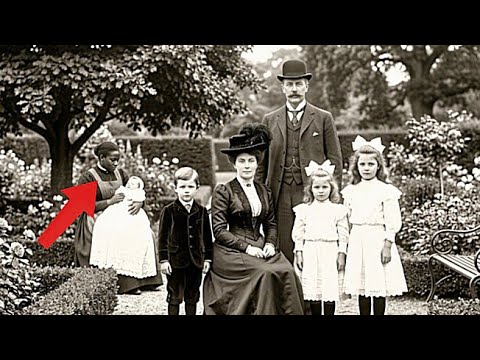
Elena pulled back from the screen, her mind racing. The presence of a Black domestic worker in a portrait of a wealthy white family wasn’t surprising for that era; many such photos included servants positioned at the edges or in the background to signify the family’s status. But something about this woman’s placement felt intentional yet hidden. Something about the way she held the infant suggested more than mere employment.
Elena focused on the baby in the woman’s arms. The infant’s features were difficult to discern, but the child appeared light-skinned. Then she examined the young boy standing with the Thorntons—about five years old, with light brown hair and features that matched the head of the household. A theory began to form in Elena’s mind, one that made her heart pound.
She pulled the original work order from the historical society. The photo had been donated by Thornton descendants as part of a larger collection documenting prominent Boston families. The accompanying documents identified the main subjects: Richard Thornton, his wife Katherine, their daughters Margaret, Elizabeth, and Annie, and their nephew James, whose parents had supposedly died in an epidemic, leaving him orphaned. But there was no mention of the woman in the shadows or the infant she held.
Elena spent the rest of the day researching the Thorntons. Richard Thornton had been a successful textile merchant, one of Boston’s wealthiest men in the early 1900s. The family was prominent in society, attending prestigious churches and holding positions on charitable boards. Katherine came from an old Boston family with colonial roots. They employed numerous domestic servants, as was customary for households of their standing.
Elena found census records indicating several Black servants working in the Thornton household in 1900 and 1910, but identifying the woman in the photo would require more research. As evening fell, she printed a high-resolution copy of the enhanced image and pinned it to her wall. She couldn’t look away from the woman in the shadows, from the baby in her arms, from the expression on her face that seemed to Elena like someone trying to reclaim something that had been taken from her—even if only through a photograph.
Something significant had happened in this family, something deliberately hidden from view for over a century. And Elena was determined to uncover the truth.
The next morning, Elena called the Boston Historical Society and spoke with the curator who had sent her the photo. Dr. Patricia Chen listened intently as Elena described her discovery. “I’ve examined hundreds of photographs from this period,” Elena explained. “The woman’s placement seems intentional. She’s not casually in the background—she’s carefully positioned to be visible but easy to miss, especially in a lower-quality print.”
Patricia was intrigued. The Thornton family had donated the collection only six months earlier, claiming they were simply clearing out an old estate and thought the historical society might want the materials. They had shown no particular interest in the contents.
“Do you think there’s a story here worth pursuing?” Patricia asked.
“I’m certain of it,” Elena replied. “But I’ll need access to more records—employment documents, birth certificates, anything that might help identify the woman in the photo and the infant she’s holding.”
Patricia agreed to help. Together, they began searching through the Thornton family papers donated with the photographs. They found business ledgers, social correspondence, property records, and household account books spanning from 1890 to 1920. In a household ledger from 1901, they found regular payments to several domestic servants, including an entry: Clara Washington, cook and maid, $8 per month plus room and board. The record began in 1899 and continued until 1902, then stopped abruptly with a single word written in the margin: “Dismissed.”
Elena felt a wave of realization. Clara Washington. She photographed the page, carefully noting the dates. If Clara had been dismissed in 1902, and if she was the woman in the 1901 photograph, then something significant must have happened in that household.
They continued searching and found something even more telling in a collection of personal letters. A letter from Katherine Thornton to her sister in Philadelphia, dated March 1901, contained a paragraph that made Elena’s hands tremble. “We have received Richard’s nephew, James, as you know, following the tragic loss of his parents. The boy is adjusting well to our household, though the circumstances of his arrival have been complicated by unfortunate rumors. I assure you these rumors are entirely unfounded. James is our kin, and we are providing him with the upbringing he deserves. We have had to make certain domestic adjustments to ensure propriety is maintained.”
The letter was carefully worded, but Elena could read between the lines. Rumors. Domestic adjustments. A defensive claim that James was kin. This was a family managing a scandal.
Patricia found another crucial piece of evidence in the Boston city clerk’s birth records. There was indeed a James Thornton born in February 1896, registered as the son of Richard Thornton’s deceased brother. But when Patricia requested the death certificates of James’s supposed parents, she found something strange. They had died in 1898, not 1896. If James had been born in 1896, he would have been two years old when his parents died—not a newborn orphan as the family narrative suggested.
“That doesn’t make sense,” Patricia said, spreading the documents on the table. “The timeline is wrong. Look at this—James’s birth certificate lists his place of birth as Boston, but his parents supposedly lived in New York at the time. Why would the mother come to Boston to give birth?”
Elena studied the birth certificate more closely. Something about it seemed off. The handwriting was slightly different from other certificates from the same period, and there was a notation in the margin that had been partially obscured. “This certificate has been altered,” Elena said quietly. “Someone changed the original information.”
They sat in silence, the implications mounting. A child born in 1896, raised as a nephew, an altered birth certificate, dismissed servants, and a photograph showing a Black woman holding an infant in the shadows of the family garden. The pieces were beginning to form a picture, though not yet a complete one.
Elena needed to know more about Clara Washington—the woman who had worked in the Thornton household and then been abruptly dismissed. She needed to trace James Thornton’s fate after 1901 and understand why this family had gone to such lengths to hide the truth.
Elena spent the following week searching for any record of Clara Washington. The search was difficult; Washington was a common surname among Boston’s Black population, and Clara had left few traces in official records. But Elena was persistent, and the picture gradually began to emerge.
Clara Washington had been born in Virginia in 1875, the daughter of formerly enslaved people who had moved north after the Civil War. She arrived in Boston in 1897, seeking work as a domestic servant. By 1899, she was employed by the Thorntons as a cook and maid in their Beacon Hill mansion.
Elena found Clara’s name in the 1900 census, listed as living at the Thornton address. The census described her as single, Black, twenty-five years old, and working as a domestic servant. But Elena almost missed a handwritten notation in the margin of the census form: “Infant daughter, not enumerated.” The notation was unusual, suggesting the enumerator hadn’t been certain how to classify the child within the household.
The breakthrough came when Elena located birth records from Boston Lying-In Hospital, an institution that provided maternity care to women of all social classes in the early 1900s. Among the February 1896 records was an entry for Clara Washington, a twenty-one-year-old Black woman who had given birth to a son. The father’s name was listed as unknown. But there was more. A note attached to the hospital record, written by the attending physician: “Patient employed by R. Thornton family. Infant to remain with mother and Thornton household per family arrangement. Fees paid by Thornton family.”
Elena’s theory was now solidifying. Clara had given birth to a son in February 1896 while working for the Thorntons. Richard Thornton had paid the hospital fees, and somehow, that infant had become James Thornton, the orphaned nephew.
Elena needed to know what happened to Clara after her dismissal in 1902. Using city directories and church records, she traced Clara’s movements: a boarding house in Boston’s South End in 1903, then nothing. No census records, no employment records, no death certificate. Clara Washington had vanished.
Then Patricia found something that changed everything. In the archives of the African Methodist Episcopal Church in Boston, she discovered a baptismal record from 1896 for James Washington, son of Clara Washington. The baptism had taken place weeks after the hospital birth, and the record clearly listed the child’s surname as Washington, not Thornton.
The church records also contained something else: a letter from Clara to the pastor, dated 1902. Patricia photographed it and sent it to Elena immediately. Elena read Clara’s words with growing emotion.
“Reverend Williams, I write to you in desperation. I have baptized my son James six years ago, and I have raised him with all the love I could despite the difficult circumstances of his birth. His father, a man of standing, has provided support while demanding complete secrecy about his paternity. Now that man’s wife has decided my presence in their household is no longer acceptable. She insisted I be dismissed, and worse, she told me that James will remain with them, to be raised as one of their own. She says I am unfit to be his mother, that he deserves a better life than one with a Black woman. She offered me money to leave quietly, to never speak of James’s true parentage, and to never attempt to see him again. Reverend, he is my son. I carried him, birthed him, nursed him, raised him for six years, but I have no legal right to him. I am a Black woman with no family, no resources, no power. The Thorntons have everything: wealth, influence, lawyers. If I fight them, they will destroy me, and perhaps harm James in the process. If I accept their terms, I lose my child, but perhaps I secure for him a life of opportunity I could never provide. I do not know what to do. I pray God guides me, gives me strength, and shows me a way to be just to my son, even as my heart breaks.”
Elena wiped her tears. The letter was dated October 1902—the same time Clara was dismissed from the Thornton household. Clara had faced an impossible choice: fight for her son and likely lose, harming his future, or leave and let him grow up in privilege, never knowing his true mother.
The 1901 photograph took on new meaning. It had been taken just a year before Clara was forced to leave. The image showed Clara standing in the shadows holding a baby. But which baby? Was there another child? Or was the photo’s date wrong?
Elena needed to look at the photograph again more carefully and to know what happened to James Thornton as he grew up. Did he ever learn the truth about Clara? Did he wonder about his origins? And most importantly, did Clara ever try to see her son again, or did she disappear from his life forever?
Elena returned to her studio and opened the enhanced image on her computer screen. She had been so focused on identifying the woman in the shadows that she hadn’t examined every detail. Now she looked closely at the baby in Clara’s arms. Using maximum magnification, she studied the infant’s features and the white christening gown. Then she compared this baby to the young boy standing with the Thornton family. The boy was James, five years old. Elena’s breath caught. The baby in Clara’s arms could not be five years old. It was clearly only a few months old. But if James was born in 1896, he would have been five in 1901—the same age as the boy in the main picture.
Elena felt a chill run down her spine. There were two children in this photograph: James, the five-year-old boy standing with the Thorntons as their nephew, and a much younger infant in Clara’s arms. She called Patricia immediately.
“There’s another child,” Elena said urgently. “Clara is holding a baby who is not James. I need to find birth records from 1900 or 1901 for any child connected to the Thornton family.”
Patricia understood at once. They met again at the historical society and began a systematic search of birth records from 1900 and 1901. This time, they knew what patterns to look for: any birth to a Thornton, any notation about servants, any altered or unusual records.
It took two days, but they found it. In March 1901, months before the photograph was taken, a birth was recorded at Boston Lying-In Hospital: a daughter born to Clara Washington, a Black domestic servant. As before, Richard Thornton paid the hospital fees. The father’s name was listed as unknown, but the handwriting matched the entry for James’s birth five years earlier. Clara had given birth to a second child in 1901—also fathered by Richard Thornton. The baby in the photograph was Clara’s daughter.
Elena wondered aloud: “Where is this child? What happened to her?”
Patricia began searching adoption records, death certificates, and anything that might trace the fate of Clara’s daughter. The search was difficult; adoption records from that era were often sealed or lost, and many children born to unwed mothers vanished from official documents.
Then Patricia found something in the records of the Boston Home for Colored Children, an orphanage operating in the early 1900s. In the intake records for September 1901, there was an entry for an infant girl, approximately six months old, surrendered by her mother, Clara Washington. The child was healthy, and adoption was pending.
The timeline fit perfectly. The photograph was taken in the summer of 1901, showing Clara holding her infant daughter. By September, just months later, Clara had been forced to surrender the child to an orphanage. But it didn’t end there. A note attached to the intake record read: “Adopted October 1901. Child placed with a family in New York. Records sealed at family’s request. Generous donation received from anonymous benefactor to support orphanage operations.”
Elena understood. The Thorntons had arranged for Clara’s daughter to be adopted, paying to expedite the process and seal the records. They had removed the second child from Clara’s life just as they had done with James. But they had left Clara one thing: the photograph. They allowed her to stand in the shadows of their garden, holding her baby daughter one last time, a record of her motherhood even as they prepared to take the child away.
“The photograph wasn’t just a family portrait,” Elena said quietly. “It was Clara’s last chance to be seen as a mother, even marginally, even in the shadows. Someone in that family—perhaps Richard himself, or even Katherine—recognized that Clara deserved at least that much.”
Patricia nodded slowly. “But why keep the photograph? Why not destroy it if it contained evidence of their secrets?”
“Because someone wanted the truth to survive,” Elena replied. “Perhaps Richard, out of guilt. Or perhaps Clara herself, who might have been given a copy. The photograph was donated to the historical society by Thornton descendants who didn’t even know what they had. The secret was hidden in plain sight for over a century, waiting for someone to notice.”
Elena looked again at the image on her screen. Clara Washington, standing in the shadows, holding her daughter, her face a mixture of sorrow and defiance. A woman who had lost everything but had left behind a silent testimony. Elena knew she would spend the rest of her career searching for Clara’s descendants, for James’s fate, for the daughter adopted away. But for now, she had given Clara a voice.
What do you think happened to Clara’s children—did James ever learn the truth, and did Clara’s daughter ever find her way back? Share your thoughts in the comments.
Report this article
Select a reason for reporting:






