At 80,000 feet, moving at three times the speed of sound, the SR-71 Blackbird was untouchable. It could outrun missiles, outfly enemy jets, and photograph the Soviet Union with impunity. But on a cold January morning in 1966, that invincibility shattered in an instant.
Test pilot Bill Weaver and reconnaissance expert Jim Zwayer were pushing the Blackbird to its limits—Mach 3.2—when without warning, one engine exploded. “It was like being in a train wreck,” Weaver later recalled. The aircraft began to disintegrate around them.
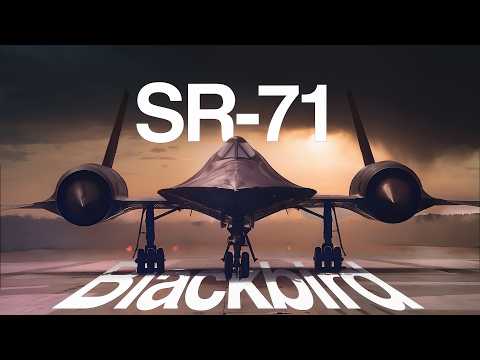
The story of the SR-71 begins years earlier, at the height of the Cold War. In 1957, the Soviet Union was mass-producing intercontinental ballistic missiles, and America desperately needed intelligence. The CIA turned to Lockheed’s Skunk Works and its legendary engineer Kelly Johnson.
Johnson’s team had already designed the U-2 spy plane, but Soviet radar had improved. “We knew the U-2’s days were numbered,” said one CIA official. The race was on to build a spy plane that could fly higher and faster than anything before.
Project Archangel demanded the impossible: a plane that could fly at 25,000 feet, exceed 2,000 mph, and be nearly invisible to radar. Eleven months and ten designs later, Johnson’s team had a breakthrough. By flattening the fuselage and adding stealth features, they reduced the radar cross-section by 90%.
On February 11, 1960, the CIA approved a $96 million contract for twelve A-12s. But just three months later, a U-2 was shot down over the Soviet Union. “The technology was catching up to us,” admitted one official. The pressure to deliver the Blackbird was immense.
Building a Mach 3 aircraft required revolutionary materials. Titanium, the only metal that could withstand 600°F temperatures, was sourced from the Soviet Union through shell companies. “We had to invent new machining techniques,” said engineer Ben Rich. The fuel, JP-7, was so stable you could put out a match in it.
By 1964, the SR-71 was ready. Test pilot Bob Gilliland took it supersonic on its first flight. “It was a great honor,” he said. The Blackbird was a marvel—but tragedy still lurked.
On that January morning in 1966, the Blackbird was flying at 78,000 feet when the catastrophic engine failure struck. Weaver fought the controls as the aircraft yawed violently. “I knew we were just along for the ride,” he said. Within seconds, the SR-71 began breaking apart.
Weaver ejected—or was thrown clear—into the thin, freezing air near the edge of space. “I thought I was having a nightmare,” he recalled. “Then I realized I wasn’t dreaming, so I must be dead. Then I realized I wasn’t dead, and somehow I was out of the plane.”
His parachute opened automatically. Miles away, Jim Zwayer’s chute deployed too, but the violent breakup had already broken his neck. He was dead before hitting the ground.
Weaver landed in New Mexico, 1,200 kilometers from Edwards Air Force Base. A phone call soon reached the accident investigation chief. “I’ll accept a collect call from a Mr. Bill Weaver,” he said, stunned. Weaver had survived.
The investigation revealed that optimizing the Blackbird’s performance had made it less stable. The loss of control caused catastrophic structural failure. But Skunk Works engineers refused to give up. By 1967, they had solved the design flaws, and the SR-71 became fully operational at Beale Air Force Base.
A new generation of elite pilots was assembled for the 9th Strategic Reconnaissance Wing. “None of us had ever seen the plane,” one pilot remembered. “It was breathtaking when we realized what we were going to do.”
The Blackbird could fly at Mach 3—faster than a rifle bullet—and cruise at 80,000 feet. Its engines produced 160,000 horsepower, swallowing 3,000 cubic meters of air per second. “You have so much power,” said one pilot. “It’s smooth, it’s quiet, it’s just delicious.”
Navigation relied on the stars. “It’s the world’s greatest planetarium show,” another pilot joked. “You can see the curvature of the Earth—350 miles in every direction.”
Ironically, the Blackbird would never fly active missions over the Soviet Union, the very target it was built for. Instead, in March 1968, it was called to Vietnam. Its high-resolution radar mapped a Viet Cong supply area, enabling B-52 strikes that ended the siege of Khe Sanh.
Soon the SR-71 became America’s primary reconnaissance asset, monitoring crises from the 1973 Arab-Israeli War to Soviet fleet movements. “We were sentinels for the free world,” said one crew member.
But the Blackbird was no longer invisible. In 1968, enemy radar tracked it for the first time, and surface-to-air missiles grew more effective. On August 26, 1981, North Korea fired a Soviet-made guided missile at an SR-71 piloted by Maury Rosenberg.
“The time from missile launch to impact was less than fifty seconds,” Rosenberg recalled. He turned hard left, away from North Korean airspace. “I saw the missile pass by on the right and explode,” he said. “At Mach 3, that’s only two seconds from impact.”
The Blackbird survived, exactly as Kelly Johnson had predicted: even when detected, it was simply too fast to catch. No SR-71 was ever lost to enemy fire—an unmatched record.
By 1990, satellites had become the future of reconnaissance. The Blackbird program was canceled. On its final flight, the SR-71 set a speed record that still stands: Los Angeles to Washington, D.C., in one hour, four minutes, and twenty seconds. “Many of us believed the retirement was premature,” said one pilot.
Just months later, Saddam Hussein invaded Kuwait. “The system we really needed was the Blackbird,” a commander admitted. But it was gone.
Today, the SR-71’s stealth technology lives on in the B-2 bomber and F-117 Nighthawk. Five decades after its first flight, the Blackbird remains the fastest and highest-flying manned air-breathing aircraft ever built. “It was the embodiment of perseverance, ingenuity, and patriotism,” said one engineer.
Its greatest legacy? Helping keep the peace when the world stood on the brink of nuclear war. “You give men and women a task, and the authority and resources, and it’s amazing what you can create,” reflected a crew member.
The SR-71 Blackbird proved that the impossible is possible. But as we look to the future of aviation, one question remains: Will we ever see its like again? Share your thoughts in the comments below.
Report this article
Select a reason for reporting:






