It was just a family photo from 1882 — a black family, formal and dignified, posing in a Southern photography studio. At first glance, it looked like countless other portraits from that era. But when genetic historian Dr. James Okafor zoomed in on the youngest girl standing at the edge of the frame, he went completely silent. What he found in her eyes was not just a physical trait. It was a biological key — one that had survived slavery, erasure, and generations of silence.
One eye was dark brown. The other was unmistakably blue-gray. In a black child from 1882, this was a genetic anomaly that no one had noticed for over 140 years. James recognized it instantly: Waardenburg syndrome, a hereditary condition that causes heterochromia and a white forelock. But this wasn’t just a medical curiosity. It was a thread that could unravel an entire erased family history.
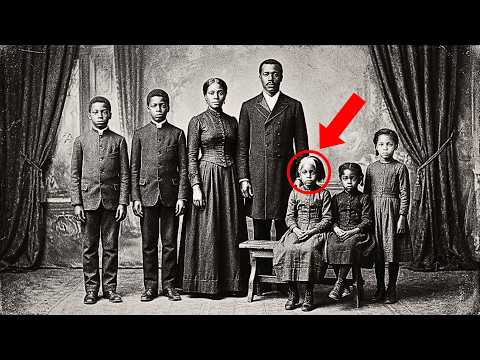
Diane, the woman who brought the photograph, knew almost nothing about her ancestors. The image had been passed down through four generations of women, always with the same vague instruction: “Keep this. It matters.” No names. No documents. No oral history. Just a silent command from the past.
James spent the afternoon scanning every millimeter of the photo. He found the same genetic marker in the girl’s older sister — a white forelock hidden in her hair. Then he looked at the mother, whose face was partially shadowed. With digital enhancement, a thin strip of lighter hair appeared at her temple. She was the carrier. The mutation had come through her.
The next step was the Freedmen’s Bureau records. After hours of searching, James found a labor contract from 1866. The contracting party was a woman named Eliza. Beside her name, in a Bureau agent’s handwriting: “One eye brown, one eye gray blue, distinctive.” James’s hands went still on the keyboard. He had a name. A birth year. A location. And a genetic fingerprint that no document could erase.
Then came the slave manifest from 1849. A girl, age 18, named Eliza. Beside her description: “Eyes different.” Two words that had waited 175 years to mean something. James called Diane immediately. “I found her,” he said. “Her name was Eliza, and I know where she came from.”
But documents alone couldn’t answer the deepest question: Where did Eliza come from before Charleston? Before South Carolina? That answer would require Diane’s own DNA — and a letter that had been sitting in an archive for over a century, waiting to be read.
Diane agreed to the genetic test without hesitation. Patricia’s lab ran a full mitochondrial DNA sequence, tracing her maternal line directly — mother to mother to mother — as far back as the data could reach. The results took eleven days.
When Patricia called James with the preliminary findings, her voice carried that careful, restrained excitement he had learned to recognize. “The mitochondrial haplogroup is L3,” she said. “A subclade the database associates with a very narrow geographic corridor — West Africa. Sierra Leone.”
James leaned forward. Patricia continued, her tone sharpening with precision. “And James — the Waardenburg mutation in this lineage matches a variant documented in exactly one population group in the existing literature.” She paused. “The Mende.”
James knew the name. Most historians of the Atlantic slave trade did. The Mende people of Sierra Leone had been among the most heavily targeted ethnic groups during the final decades of the legal transatlantic trade — a period of intensified raiding that preceded the British naval blockade of the West African coast. Their communities, their language, their social structures had been violently disrupted by the trade.
They were also, as Patricia’s database confirmed, the only documented population in West Africa where that specific PAX3 mutation had been recorded in more than one individual. The science and the history were converging on the same point on the map.
James spent two days reading everything he could find about the Mende — their villages, their history of resistance, their presence in the documented records of the trade. Then, while searching the digitized collection of the Amistad Research Center in New Orleans, he found something he had not been looking for.
A letter. Handwritten. Dated 1891. Addressed to no one by name. The writer identified herself only as a woman who was once called by another name.
It was written in careful, deliberate English — the English of someone who had learned the language as an adult in a country that was not her own. It had been donated to the archive in 1934 by a family in Charleston, cataloged, and rarely accessed since.
James read it twice before he was certain of what he was holding. The woman described her childhood in a village near a river. She described being taken at night, with other members of her family, by men who spoke a language she did not understand. She described a ship. She described arriving somewhere cold and unfamiliar. She described learning a new name — Eliza — because the name she had been given at birth was considered unpronounceable by the people who now claimed to own her.
And near the end of the letter, in a passage that made James set down his coffee cup and sit very still, she wrote:
“My mother had eyes that did not match. One dark as river mud, one pale as morning sky. She told me your mother had the same. She told me it was a sign that we came from a particular place, and that no matter how far we were taken, that sign would follow us.”
James read that sentence four more times. Then he picked up the phone and called Diane. He read her the letter over the line, all of it. When he reached the passage about the eyes, she made a sound he could not quite name — not a word, not a cry, something in between. He waited until she was ready to speak.
“She wrote it herself,” Diane said finally. “In her own hand. She remembered everything — her village, her mother, the name she was born with.”
“She didn’t write that name in the letter,” James said. “I think she was protecting it. Keeping it private. But she described the place — the river, the geography.”
He had spent the previous evening cross-referencing those details against mid-19th-century maps of Sierra Leone. The river she described — its width, its proximity to the coast, the type of tree she mentioned growing along its banks — was consistent with the Sewa River in the southern region. The Sewa River Valley had been a Mende heartland for centuries.
Patricia’s DNA results. The Waardenburg variant. The letter. The geography. They all pointed to the same place, the same people, the same origin. A family photographed in a South Carolina studio in 1882, with no name recorded and no history attached, had come from the banks of the Sewa River.
James sat with that thought for a long time. Then he began preparing what he would tell Diane the following morning — and what it would mean for the search that was only just beginning.
Diane came to James’s office one last time on a Thursday morning in October, almost exactly six weeks after she had first walked in with the photograph pressed against her chest in the rain. She sat across from him at the same desk, and the photograph lay between them, still in its cardboard envelope, still in the careful condition four generations of women had preserved.
James laid everything out in order — the Freedmen’s Bureau record, the labor contract, Patricia’s DNA analysis, the letter from the Amistad Research Center, the historical maps. Each document was a step in a staircase that descended one generation at a time, from a photography studio in South Carolina in 1882 to a village on a West African riverbank sometime in the 1830s.
Diane listened without speaking. She looked at each document. She held the printed copy of the letter — the original too fragile to handle — and read the passage about the mismatched eyes twice. When James finished, she looked at the photograph for a long time.
“She didn’t know,” Diane said quietly. “The little girl. She didn’t know what her eyes meant.”
“No,” James said. “She couldn’t have. But her great-grandmother knew. She wrote it down.”
Diane looked up. “She wanted someone to know. She wrote it in a language that wasn’t hers, in a country that wasn’t hers, and she left it for someone to find.”
James nodded. “You found it. It just took 140 years.”
But even as he said it, he knew the work was not finished. Eliza’s given name — the one she had been born with on the Sewa River, the one she had refused to write into a letter that might be read by strangers — was still out there, buried in records that no one had yet thought to connect to her. And there was something else, something Patricia had mentioned in passing during their last call that James had not been able to put out of his mind.
“There’s a second branch,” Patricia had said. “The mitochondrial line is clean, but when I ran the autosomal markers, I found something unexpected. Diane has a significant percentage of DNA that doesn’t match the Mende profile at all. It’s consistent with a European contribution — but not from the era you’d expect. Not from the 18th century. From much later.”
James had asked her what she meant.
“I mean it entered the line within the last three or four generations,” Patricia said. “Someone in Diane’s family tree, after slavery, married or had a child with someone of European descent. And the markers suggest that person was already connected to the family before that. There’s a pattern of shared DNA that shouldn’t be there.”
James had spent the night before Diane’s visit chasing that thread through the 1880 census and the 1900 census, cross-referencing the household where Eliza’s descendants had lived in Charleston. The records were sparse, as they always were for black families in that era, but one name kept appearing in the margins — a name written in a different hand, on a document that should not have contained it.
He pulled the census page up on his monitor and turned it toward Diane.
“There’s something I haven’t told you yet,” he said. “Something the DNA turned up that the documents didn’t.”
Diane set down the letter. Her hands folded in her lap, the way the mother in the photograph had folded hers, and she waited.
“The genetic test showed two lines in your ancestry,” James said. “The maternal line, Eliza’s line, is Mende. That’s clear and confirmed. But there’s a second line, a European line, and it didn’t come in through a distant ancestor. It came in much more recently — within the last hundred years or so. And it appears to connect to a specific family in Charleston.”
He pointed to the census record. “This is the household of a man named Thomas Ashford. He was a photographer. In 1882, he operated a studio on King Street in Charleston.”
Diane’s eyes moved from the screen to James’s face. “A photographer,” she repeated.
“The cabinet card format, the painted garden backdrop, the quality of the mounting — all of it matches the work of a professional studio in Charleston in the early 1880s. And Thomas Ashford’s studio was one of only three in the city that served black clients during that period.”
He paused, letting her absorb it.
“The DNA suggests that Thomas Ashford is connected to your family line. Not as an enslaver — he was born in 1850, too young for that. But as something else. Someone who knew Eliza’s family well enough to be photographed with them. Or someone who was already part of their story before that photograph was ever taken.”
Diane was silent for a long moment. Then she said, very quietly, “He took the picture.”
“I think he did,” James said. “And I think the reason there’s no studio stamp on the back — the reason it was scraped away — is that someone didn’t want his name connected to that family. Not because of shame. Because of protection.”
“Protection from what?” Diane asked, her voice barely above a whisper.
James pulled up a death certificate from 1923. “Thomas Ashford was murdered,” he said. “The case was never solved. But the file mentions a ‘colored woman’ who was seen leaving his studio the night before. She was never identified.”
Diane’s breath caught. “Eliza?”
“Or one of her children,” James said. “The timing fits. And it explains why the studio stamp was scraped off—to erase any connection between Ashford and the family. Someone was protecting them both.”
Diane looked back at the photograph, at the little girl with the mismatched eyes. “She was still wearing the dress from the portrait,” she said. “The night he died.”
James nodded slowly. “We may never know exactly what happened. But the DNA doesn’t lie. Thomas Ashford is part of your family’s story. And now you know where to look for the rest of it.”
Diane held the photograph against her chest again, both arms wrapped around it. “What do I do now?” she asked.
“You go to Sierra Leone,” James said. “You find the river. And you look for the name Eliza left behind.”
She nodded, tears finally spilling over. “I will.”
What would you do if a single photograph unlocked a century of silence? Share your thoughts in the comments below.
Report this article
Select a reason for reporting:






