In 1945, the country that gave the world the Renaissance, the Roman Empire, and two thousand years of art and architecture was eating grass. Not metaphorically—literally. In the villages of Calabria, Sicily, and Campania, families boiled weeds to survive. Bridges were bombed, factories destroyed, roads reduced to rubble by retreating German forces and Allied bombing campaigns targeting strategic industrial centers across the peninsula. The war cost Italy not only its dignity as a nation but its basic infrastructure—the roads, railways, ports, and power systems that any modern economy depends on to function. But the rubble of 1945 wasn’t just physical. It was generational.
Italy entered the war as an ally of Nazi Germany, switched sides in 1943, and emerged from the conflict occupied by foreign armies, politically divided, and economically devastated. A nation of 45 million people had to rebuild from almost nothing. The most pressing problem wasn’t steel or concrete. It was 4 million human beings with no work and no place to go.
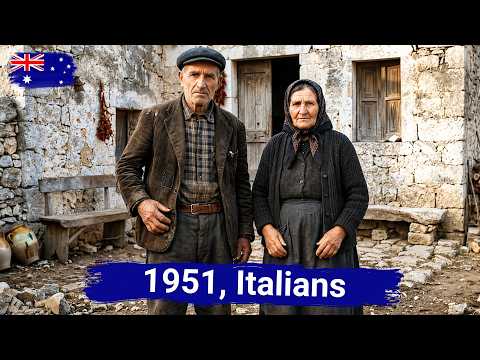
Southern Italy—the Mezzogiorno—had been poor long before the war. Regions like Calabria, Sicily, Basilicata, and Campania never industrialized like the north. Land was divided among heirs for generations until individual plots became too small to feed a family. The sharecropping system kept rural workers in perpetual debt to absentee landowners. By 1949, a report submitted to the Italian Ministry of Migration stated plainly that Italy’s population exceeded its economic resources by roughly 4 million people. The Marshall Plan provided $1.5 billion in American aid between 1948 and 1952. It helped stabilize the north. But it barely reached the south.
The question wasn’t whether millions of Italians would leave. It was where they would go and what they would build when they arrived.
Italy in 1945 wasn’t one country. It was two. North of Rome, in the industrial triangle between Milan, Turin, and Genoa, reconstruction moved relatively quickly. Factories reopened. Fiat resumed production. Chemical and textile industries began to recover. But south of Rome—in the Mezzogiorno, the land of the midday sun—recovery was a word that belonged to others. In Calabria, at the tip of Italy’s boot, farms were small and exhausted. In Sicily, the Mediterranean’s largest island, thousands of families were landless, working estates owned by aristocrats who had held the same land since the Middle Ages. In Basilicata, one of the poorest regions in all of Europe, writer Carlo Levi published a harrowing 1945 novel called Christ Stopped at Eboli, describing isolated villages so completely forgotten by the Italian state that they seemed like a separate civilization. The book shocked Italian readers. But it surprised no one who had lived there.
The statistics behind this human suffering were stark. Between 1945 and 1951, unemployment rates in southern Italy reached levels that left entire generations of men economically idle. Southern unemployment remained three times the northern rate throughout the 1950s and 1960s, with wages 40% below the national average even after recovery began elsewhere. Young men in their twenties had no realistic hope of owning land, finding steady work, or building a life within the borders of the country where they were born. What they had was energy, determination, and a willingness to go anywhere—anywhere that would take them.
Between 1876 and 1976, 25 million Italians left the country permanently. The question in 1950 wasn’t whether they would leave, but where they would go.
Australia needed workers and declared its slogan: “Populate or Perish.”
On the other side of the world in 1945, Australia faced its own crisis—though of a completely different kind. The country had survived World War II, but the experience exposed a terrifying vulnerability. Japan bombed Darwin in 1942. Japanese submarines entered Sydney Harbor. A continent of 7.5 million people spread across 3 million square kilometers was within reach of invasion. The lesson Prime Minister Ben Chifley and Immigration Minister Arthur Calwell drew from that harsh experience was simple and blunt. Australia was too empty to be safe. Calwell’s response was a policy summed up in three words: “Populate or Perish.” The goal was to increase Australia’s population by 1% annually through immigration, providing the labor needed for postwar reconstruction while building the human mass required to defend the continent.
The immigration program that followed was one of the most ambitious in twentieth-century history. Between 1945 and 1970, Australia welcomed more than two million migrants from Europe. Priority always went to the British. Calwell and his successors worked within the White Australia Policy, which had been federal law since 1901 and explicitly restricted Asian immigration while favoring European settlers. But the British were busy rebuilding their bombed cities, and the numbers arriving from the United Kingdom were never enough. Australia began looking for alternatives. It started with the Baltic states and Poland, whose displaced persons camps were teeming with skilled workers who had no place to return to, then turned to the Netherlands and West Germany, and eventually to Italy.
The Immigration Department officially stated that Italians technically deserved the same treatment as other European nationals. What this bureaucratic language concealed was a deeper anxiety about whether southern Italians—dark-skinned, Catholic, non-English-speaking—were really the kind of Europeans Australia aspired to attract.
Before we continue, don’t forget to comment with your thoughts on the content and subscribe to the channel. Thank you for your support, and let’s continue our discussion.
Italy and Australia signed a historic migration agreement. In March 1951, the two governments signed a bilateral assisted migration agreement that would permanently change both countries. The deal was straightforward in its mechanics but extraordinary in its scope. Australia agreed to subsidize 25% of each migrant’s travel costs. The Italian government contributed another 25%. The remaining 50% was offered to the migrant as a repayable loan. In return, assisted migrants had to work for two years in jobs directed by the Australian government—in factories, farms, or construction sites, wherever labor shortages were most acute. The initial annual cap was set at 15,000 migrants per year. In the first full years of the agreement, numbers far exceeded that figure. Between 1951 and 1955, more than 102,000 Italians arrived in Australia. In the five years that followed, between 1956 and 1960, another 97,000 came. The 1950s became the most prominent decade of Italian immigration to Australia. 193,791 Italians in a single decade, making Italians the second-largest migrant group in Australia after British and Irish arrivals.
The Australian Security Intelligence Organization (ASIO) actively participated in screening applicants. Its stated position in a 1951 document was that membership in the Italian Communist Party was grounds for automatic rejection. With the Italian Communist Party being the largest in Western Europe at the time, this created a screening apparatus that rejected thousands of applicants for political rather than economic reasons.
What the agreement produced, despite its bureaucratic mechanics and political anxieties, was a human wave. From Calabria and Sicily, from Naples and Palermo, from tiny mountain villages whose names Australian immigration officials could barely pronounce, ships began to fill. The ships carried hundreds of thousands of Italians toward the south. The journey from Italy to Australia in the 1950s was not like the misery of Irish famine ships or the horror of the transatlantic slave trade. It was something different—long, disorienting, and burdened with a particular kind of sadness that had no single name.
The men and women who boarded ships at the port of Naples or Genoa in the early 1950s were not fleeing certain death. They were leaving the only world they had ever known without any certainty of return, sailing to a country most of them could not locate on a map. The voyage took about 30 days at sea, heading south through the Mediterranean, passing through the Suez Canal, across the Indian Ocean, and arriving at Australian ports in Melbourne, Sydney, and Fremantle. Many migrants had never seen the ocean before boarding the ship. Many could not read or write. Most did not speak English. A large portion had never left their home provinces, let alone their country.
The ships that carried them were converted passenger liners and military transport vessels, used in civilian service for mass migration programs in the 1950s. The Toscana, Sydney, Flaminia, Neptunia, Fairsea, and Australis were among the vessels that made dozens of voyages between Italian ports and Australian harbors during the peak migration years. Conditions varied. Second-class cabins and assisted passage tickets were crowded. The food was unfamiliar. The combination of tropical heat and Indian Ocean waves caused widespread seasickness.
Between 1947 and 1971, 373,966 Italians came to live in Australia. They arrived at Station Pier in Melbourne, at Circular Quay in Sydney, and at Fremantle Harbor in Perth. And the first place most of them saw upon setting foot on Australian soil was not a city, a factory, or a welcoming committee. It was a camp.
Bonegilla became Italy’s first taste of Australia. Ten kilometers east of Wodonga in northern Victoria, on flat land bordered by the Murray River plains and the foothills of the Great Dividing Range, a former Australian Army camp had been converted with minor modifications into Australia’s largest migrant reception center. The Bonegilla Migrant Reception and Training Centre opened in 1947. Between that year and its closure in 1971, approximately 310,000 migrants from 35 different countries passed through its gates. For the majority of Italian migrants who arrived in Australia during the 1950s, Bonegilla was the first place they experienced after disembarking from their ship.
The facilities were basic to the point of punishment. Accommodation was in former army wooden huts with corrugated iron walls, lacking heating in the harsh Victorian winter and becoming stifling in summer. Rooms were designed to hold 20 people with no internal partitions. Communal bathrooms, pit toilets, and mass dining halls were the norm. The food was humiliating. Where Italian migrants expected pasta, olive oil, fish, and espresso, they were served cold lamb chops with unfamiliar sauces, overcooked vegetables, and tea. One migrant later recalled being served cubes of pale vegetables floating in water.
Between October 1951 and June 1952, 5,325 Italian migrants arrived at and passed through Bonegilla. By July 1952, more than 1,000 of them had spent over four months in the camp without work. Frustration reached a breaking point on a July evening when a group of Italian men marched from Block 11 toward the administration office, smashing windows and setting fire to two huts along the way. To end the riot, the Australian government sent in 200 soldiers. Within weeks, Italian cooks were appointed to the Italian sections, with supplies of olive oil, tomato paste, pasta, and coffee provided.
The men who burned the huts had, without realizing it, begun changing what Australians eat.
Italian workers built the Snowy Mountains Scheme underground. On October 17, 1949, a controlled explosion in the bedrock near Adaminaby in the New South Wales mountains officially launched the most ambitious engineering project in Australian history. The ceremony was attended by Governor-General Sir William McKell, Prime Minister Ben Chifley, and Chief Engineer William Hudson. Chifley declared that Australia stood on the threshold of a new era of major industrial and rural development. What he did not say—what the official language of the occasion could not fully accommodate—was that this project would have been impossible to build with Australian workers alone.
The Snowy Mountains Hydro-Electric Scheme required the construction of 16 major dams, nine power stations, 80 kilometers of aqueducts, and 145 kilometers of tunnels bored through solid granite mountains. It was, at the time of its conception, the largest single engineering project being undertaken anywhere in the Southern Hemisphere. It took 25 years to complete, from 1949 to 1974. The workforce that built it numbered more than 100,000 people from over 30 countries. About 70% of them were migrants. Germans, Italians, Norwegians, Greeks, Poles, and Irish worked alongside Australians on a project that paid relatively good wages by the standards of the time and demanded physical courage every single day. Working in tunnels at the heart of the Snowy Mountains granite was cold, dark, deafeningly loud, and extremely dangerous. 121 men died in industrial accidents over the course of construction. William Hudson told his multinational workforce in a phrase that entered Australian historical memory: “You are not Czechs or Germans anymore. You are Snowy men.”
The camps that housed workers near Cooma, Adaminaby, Cabramurra, and throughout the mountains became unexpected crucibles of cross-cultural contact. Men who had been enemies in war ate together, trained together, and buried their dead together. The Snowy Mountains Scheme is recognized today as the cradle of Australian multiculturalism.
Australians rejected Italian food, coffee, and olive oil. When Italian migrants began establishing small businesses in Melbourne, Sydney, and Adelaide during the 1950s, the reception from Australian consumers was not warm. It was suspicious, dismissive, and in some cases openly hostile. Australia in the 1950s lived on lamb, white bread, and boiled vegetables. Its idea of a restaurant meal was limited to a quick lunch at a pub. Its preferred drinks were beer and tea. The idea that anyone would voluntarily consume olive oil—then available in pharmacies as a remedy for earache—or eat a dish called spaghetti, or drink a small black coffee at room temperature, was considered by many Australians as evidence of eccentricity rather than sophistication.
Italian migrants in Carlton, just north of Melbourne’s city center, began opening small grocery stores and delicatessens on and around Lygon Street from the late 1940s onward. King & Godfrey, one of the area’s oldest grocers, began stocking Italian goods—Parmesan cheese, canned tuna, olives, dried pasta, olive oil, and table wine—during the 1950s, to serve Italian customers exclusively. The broader Melbourne market was not interested yet.
The espresso machine arrived before the migrants in significant numbers. Rinaldo Massoni, founder of Florentino in Melbourne’s city center, imported the first commercial espresso machine in 1929. But it was the postwar migration wave that brought coffee-drinking culture, the rituals, and the twice-daily café stop to Australian streets. By the early 1950s, Italian cafés in Carlton and in Sydney’s Surry Hills and Leichhardt were serving espresso almost exclusively to Italian customers. The general Australian public would not discover what they were missing for another 20 years. And when they did, the Italians who had been dismissed as undesirable had already built the institutions that would define the country’s culinary identity.
Lygon Street in Carlton slowly transformed into Australia’s “Little Italy.” By the early 1960s, Carlton—a dense suburb less than two kilometers north of Melbourne’s city center—had quietly become something Australia had never seen. Streets between Lygon Street and Rathdowne Street, between Grattan Street and Victoria Street, were lined with Italian shops, grocery importers, coffee cafés, barbershops, and small restaurants. Italian could be heard in the streets. Italian newspapers were sold in corner stores. Weekend afternoons brought bocce games to the parks, and the smell of garlic and espresso drifted from kitchens where women cooked in patterns unchanged from their villages in Calabria and Sicily.
The Italian community settled in Carlton for practical reasons that had nothing romantic about them. Housing was cheap. The suburb was close to the factories and construction sites where Italian men found unskilled work in the early years after arrival. The University of Melbourne was nearby, meaning a steady stream of students who eventually discovered that eating in Italian restaurants was cheaper, more exciting, and more enjoyable than anything else available in Melbourne at the time. Toto’s Pizza opened in 1961 on Lygon Street, the first pizza restaurant in the entire country. It served Neapolitan-style pizza with simple tomato sauce and fresh mozzarella to Australian customers who were initially bewildered. By the end of the decade, the restaurant had long queues on Friday and Saturday nights.
By 1982, when Italy won the World Cup, Lygon Street was closed entirely for celebration. Tens of thousands of people—Italians and Australians—filled the street for hours. Food, wine, and noise flowed from every open door. The suburb that had been viewed as a foreign enclave 20 years earlier became Melbourne’s most popular destination.
Italy changed everything Australians eat, drink, and build. By 1971, 289,476 people born in Italy were living in Australia. They were the largest non-British migrant group in the country. And their impact on Australian life was not limited to food, coffee, or language. It extended to the physical structure of the nation’s cities, the nature of the labor movement, agricultural practices, the wine industry, and the basic shape of what it means to be Australian.
The Snowy Mountains Scheme, completed in 1974 after 25 years of construction, was, according to the Department of Climate Change, Energy, the Environment and Water, “the most important project undertaken as part of the postwar reconstruction program and an enduring symbol of Australia’s identity as a multicultural, independent, and resource-rich country.” Its 16 dams, nine power stations, and 145 kilometers of tunnels were built largely by migrant hands. Italian workers were among the most numerous, most skilled, and most present throughout the project’s history.
In the Barossa Valley of South Australia, where German settlers had planted vineyards in the 1840s, Italian migrants arrived with different grape varieties, different pruning techniques, and winemaking traditions stretching back 2,000 years. In the vegetable gardens of the Swan Valley in Western Australia, the Lockyer Valley in Queensland, and the Mildura region of Victoria, Italian horticultural knowledge transformed Australian agricultural productivity. Vegetables, fruits, and herbs Australians had never grown. Zucchini, eggplant, garlic, basil, and fresh tomatoes grown for taste rather than transport began appearing in suburban gardens and eventually in stores.
Today, nearly one million Australians declare Italian ancestry in the national census. The food they left behind—coffee traditions, pasta, pizza, olive oil, and wine—has merged into Australian life to the point that most people consume them daily without connecting them to the ships that docked at Station Pier, or the men who spent their first Australian nights in unheated huts at Bonegilla, or the 121 workers who died while tunneling through granite in the dark.
What remains is the quiet arithmetic of that transformation. A nation that once boiled weeds now orders flat whites and margherita pizzas without a second thought. The grandchildren of Bonegilla carry surnames that no longer sound foreign, and the tunnels beneath the Snowy Mountains still hum with the current their grandfathers wired.
“You are not Czechs or Germans anymore. You are Snowy men.” Hudson’s words echo through every generation that followed.
The ships are gone, the camps are museums, and the olive oil sits on supermarket shelves beside Vegemite. But the question lingers: when you next sip an espresso or bite into a crust of sourdough, do you taste the journey of those who crossed oceans with nothing but grit—or have we forgotten the price of our daily bread? Share your thoughts below.
Report this article
Select a reason for reporting:






