Step into a world that seems both impossibly distant and achingly familiar. It is the turn of the 20th century, and Paris is not just a city—it is the beating heart of the modern age. The air hums with the promise of progress, the streets pulse with the rhythm of a thousand footsteps, and the light—that soft, golden light—bathes everything in an aura of prosperity and joy. This is the Belle Époque, a fleeting moment when peace and innovation danced together, and Paris was the ballroom.
But these are not the black-and-white memories you’ve seen before. These are rare, breathtaking photographs, meticulously brought to life in vibrant color, revealing the City of Light as it truly was—alive, vivid, and spectacular. You are about to witness the past not as a relic, but as a living, breathing world.
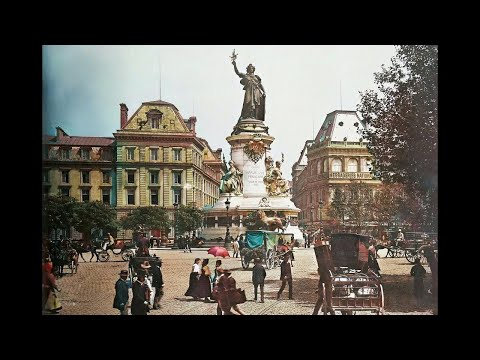
The grand boulevards, designed by Haussmann, stretch out like arteries of progress, lined with elegant cafés and opulent theaters. The Eiffel Tower, barely a decade old, stands as a bold declaration of French ingenuity, its iron lattice now gleaming in the sunlight. Every corner holds a story, every face a secret.
In the bustling streets, horse-drawn carriages share the road with the first automobiles, a sign of the rapid changes sweeping through society. Women in flowing dresses stroll past men in top hats, their conversations a symphony of French elegance. The air is filled with the scent of fresh bread and roasted chestnuts, mingling with the faint, exciting smell of gasoline—the future.
But beneath the glittering surface, Paris is a city of contrasts. While the wealthy enjoy the fruits of the Belle Époque, the working class toils in the shadows, their stories often forgotten. These photographs capture it all—the splendor and the struggle, the joy and the hardship. They are windows into a world on the brink of transformation, where tradition and modernity collide.
As you gaze upon these images, you’ll feel the heartbeat of a city that has captivated the world for centuries. The Belle Époque was a time of optimism, a time when anything seemed possible. And now, through the magic of color, you are invited to step back into that moment, to walk the same streets, to breathe the same air.
But this is only the beginning. The story of Paris in color is a journey through time, and we are just opening the door. What secrets will these rare photographs reveal? What stories will they tell? Stay with us, as we delve deeper into the spectacular Paris of the 1890s and 1900s—a city that will forever be the epitome of beauty, innovation, and romance.
Look closer at the faces in the crowd. A flower seller leans against her cart, her apron dusted with petals, her eyes crinkled in a smile that has survived more than a century. Beside her, a young boy in a cap clutches a bundle of newspapers, shouting headlines that once felt urgent and are now history. These are not actors or models—they are ordinary Parisians, caught in an extraordinary moment.
The camera, still a marvel to most, drew curious glances. Some subjects stiffened, unsure how to pose; others laughed, treating the strange box on a tripod as a joke. A few turned away. But the ones who looked directly into the lens—those are the faces that stay with you. They seem to ask, across the years: do you see us? Do you understand what we were?
Wander with them along the Seine, where booksellers hawk their wares from green wooden boxes and couples linger on the quays. Here, a painter sets up his easel at dawn, chasing the same light that now illuminates these restored images. There, a soldier in a crisp uniform exchanges a glance with a woman in a feathered hat—a fleeting, private moment preserved by chance.
And then there is the spectacle of the great exhibitions, where the world came to Paris to marvel. Electric lights—still a wonder—trace the outlines of grand pavilions. Crowds gather beneath the newly built Grand Palais, its glass roof shimmering like a promise. This is the future arriving in real time, and Paris is determined to be its capital.
Yet even as the city celebrates, shadows lengthen at the edges of the frame. A newsboy’s hollow cheeks. A laundress bent over her work. A veteran with a missing sleeve, standing quietly at a corner. The Belle Époque was beautiful, but it was not kind to everyone—and the camera, in its honesty, refuses to look away.
These photographs are more than images; they are time machines. Each one asks you to step inside, to hear the clatter of hooves and the hum of early engines, to smell the coal smoke and the perfume. The past is not silent. It is simply waiting for someone to listen.
Follow the light down a narrow side street, away from the boulevards, and the city changes its voice. Here the cobblestones are slick with morning damp, and laundry hangs between windows like festival banners. A concierge sweeps her doorstep with fierce pride, though the building behind her leans with age. This is the Paris the postcards rarely showed—and it is every bit as real.
In a workshop near the Marais, a cabinetmaker runs his palm along a plank of walnut, testing its grain. His apprentices work in silence, save for the rasp of tools. Across the river, in a printing house, ink-stained hands feed paper through presses that will carry the day’s scandals and poetry to every kiosk in the city. Progress, it turns out, is built by calloused hands.
Then evening falls, and the city transforms once more. Gas lamps flicker to life along the boulevards, casting pools of amber on the pavement. Cafés spill their patrons onto the terraces, where arguments about art and politics rise and fall like the tide. A violinist plays for coins; a waiter balances a tray of absinthe like a tightrope walker. For a few hours, every Parisian is a philosopher, and every night feels endless.
It is in these cafés that the century’s new ideas take shape. A young writer scribbles in a notebook, unaware that his words will outlive empires. A scientist sketches a diagram on a napkin, explaining radio waves to a skeptical friend. And somewhere in the crowd, a woman in a plain gray dress listens intently, saying nothing—but remembering everything. The future is being written in the margins, one conversation at a time.
Meanwhile, the grand theaters glow. At the Opéra, carriages queue beneath the ornate facade, depositing patrons in silks and furs. Inside, the chandelier rises, the orchestra swells, and for a moment the audience forgets the world outside. But outside, the world is changing faster than any opera plot—motorcars honking, telephones ringing, aeroplanes sputtering over the rooftops.
And there, on a balcony overlooking the boulevard, a small family gathers to watch the lights. The father points at an airship drifting past the moon; the child laughs and claps. It is a scene so ordinary and so perfect that the photographer almost misses it. Almost.
The shutter clicks. Another moment is saved. And the story of this luminous, restless city marches on—toward a future no one can yet imagine, and a past we are only beginning to see.
Now the reel slows, and we come to the quiet frames—the ones taken at dawn, when the boulevards are empty and the city seems to hold its breath. A street sweeper leans on his broom, watching the sun climb over the rooftops. A baker rolls up his shutters, yawning. These are the hours when Paris belongs only to itself.
And then, the final image. A crowded square on a holiday afternoon, flags snapping, children chasing hoops, a man in a straw hat laughing at something we will never hear. The photographer has caught them all in the same golden second—strangers bound forever by a square of light. They could not have known that war was only a few summers away, that the world they loved was already slipping through their fingers.
But that is not what the picture says. The picture says: we were here, and we were happy, and the sun was warm. That is all any of us can leave behind.
So the journey ends where it began—with a city that refuses to be just a memory. The Belle Époque is gone, its carriages and gas lamps replaced by engines and electric glow. Yet stand on any Parisian corner at dusk, and you can still feel it: the hum, the promise, the beautiful, reckless belief that tomorrow will be brighter than today.
The past is not silent. It is simply waiting for someone to listen. And now that you have listened, Paris will never look the same again.
Which of these faces stayed with you the longest—and what do you imagine their story was?
Report this article
Select a reason for reporting:






