The candle flame leaned toward him, steady, and did not go out. That was the first impossible thing. A cold, dry draft was coming out of a hole in the solid granite wall, 212 feet beneath the Black Hills of Dakota Territory. It was October 14, 1889, a little after half past ten in the morning. The drill had rung true for sixty feet, then it began to ring wrong.
When the wall fell inward, a piece the size of a kitchen table dropping away into darkness, the men at the bottom of the Lady Alice shaft knew something was beyond. They just didn’t know what. They lowered a boy on a rope because he was the lightest one on the crew and nobody trusted what was below. His name was Tom Oates. He was fifteen years old.
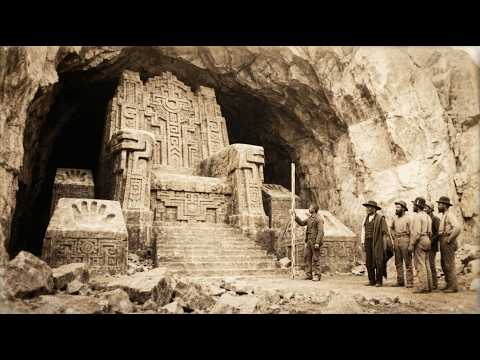
The lamp landed on fingers first. Each finger was as long as his forearm. He laid his own hand inside the palm, and it sat there like a coin on a dinner plate. Beyond that block stood another block with another hand on top of it. Across the room stood two more. And between them, rising out of the lamplight and up into the dark, was a throne.
It stood thirty feet high. Eighteen feet across from the outside of one arm to the outside of the other. Nine stone steps climbed toward it, each one the height of an ordinary stair, and they stopped at a sheer carved wall with the seat lying on top, eleven feet above the floor. Every surface was cut with deep, square-cornered lines that turned and doubled back on themselves. High on the back, a great disk with rays around it looked out over the room.
There were no joints in it anywhere. No mortar, no pins, no courses of block. The steps, the seat, the arms, the back, and the two stepped towers on either side had all been cut out of one mass of fine black stone. And the mountain around that stone was granite.
Tom Oates shouted up the hole. His uncle, the mine captain William Trevena, came down the rope next. He stood at the foot of the steps for some time. Then he took out a folding rule and did the only thing he could think of. He began to measure.
The next evening, the superintendent of the company wrote to his directors in London that the shaft had broken into an unstable cavity in the rock and would have to be closed. Inside a week, it was closed. The company went on to lose the fortunes of a great many English investors in the largest mining scandal the Black Hills ever produced. And in all the courtrooms and newspaper columns that followed, nobody ever mentioned a throne.
The men who saw it kept their own papers. And there were people living less than a hundred miles away, people who had just that summer been pressed to sign away most of what remained of their land, who did not need any papers at all. The Lakota already had a name for what was under Palmer Gulch. It had been written down in Washington in Lakota by a Lakota man twenty months before Tom Oates ever went down that rope.
All of this sits today in a single place, or it did for a short while. It is a file that was never meant to be a file. Its pieces came from a mine captain, a stone cutter, a Lakota writer in Washington, a reservation doctor, a forest surveyor, a man who worked the numbers on Mount Rushmore, a government geologist, and an engineer with a winch. Hardly any of them ever saw what the others had written.
Those papers only began to come together in the summer of 1972 on a folding table in Rapid City, South Dakota. And the only reason anyone opened the first box at all is that it was wet.
On the 9th of June that year, a wall of rain stalled over the eastern Black Hills. Fifteen inches fell in about six hours. Canyon Lake Dam failed after dark. Rapid Creek went through the middle of town, and by morning 238 people were dead. In the weeks after, when the living had been accounted for and the mud was being shoveled out of everything else, the county began to go through what it had kept in a rented storage building beside the creek.
Old court records, tax rolls, and the leavings of dead companies had been standing there in water to the second shelf. They were carried up to a school gymnasium, spread out on tables and turned over by hand so they would not rot. One of the people turning them was a deputy in the clerk’s office named Helen Halvorson. She was fifty-eight, a widow, and she had spent thirty years making sure that papers went into the boxes where they belonged.
On the third week, she came to box 31. On the label it said Harney Peak Consolidated Tin, Receivers Papers, and below that, in a different hand, the words Lady Alice, do not sell. The receiver’s inventory was on top, a list of hundreds of claims, most of them marked as worthless by a tired accountant in the 1890s. But under it was a small, cloth-bound book that had no business in a court file, swollen with creek water.
And when she peeled it open to dry, she found a page of measurements and folded inside the back cover, in pencil, a drawing of an enormous chair with a very small man standing at its foot.
The man who wrote that book was a Cornish tin captain, a very long way from Cornwall. Tin was the one metal the United States did not have. By the 1880s, the country was canning its meat and milk by the hundreds of millions, and nearly every sheet of tin plate came across the ocean. A real American tin mine would have been worth more than a gold mine.
In 1883, two local men named S. H. Ferguson and L. W. McDonald staked a mica claim in the Southern Black Hills and called it the Etta. In that coarse rock, assayers soon found cassiterite, the ore of tin. A group in New York organized the Harney Peak Tin Mining, Milling and Manufacturing Company, and the word went out across the world that America had its Cornwall after all, and that it lay in the shadow of the highest mountain east of the Rockies.
The hills it lay in had been Lakota land by treaty only fifteen years earlier. The Fort Laramie Treaty of 1868 set aside the Black Hills for the Lakota and their allies in language that said no white person would be permitted to settle there or even pass through. Six years later, George Armstrong Custer led a thousand men into the Hills and they reported gold at the grassroots. In 1877, after the fighting, Congress took the Hills by statute from the people who had been promised them.
They were He Sapa, the place where their own accounts say they came up out of the ground at Wind Cave, the center of the world they knew. To the men who now owned the mining claims, they were a geological opportunity.
By the spring of 1889, Hill City was a town of wooden false fronts about five miles from Harney Peak, and the English had come. A first attempt to sell the Dakota tin mines in London in 1887 had been torn apart by the British financial papers, which called the thing a bubble and were not far wrong to worry. But in 1889, a second company got its shares listed. It was called the Harney Peak Consolidated Tin Company Limited.
Among its large stockholders were H. Seaton Kerr, a member of Parliament, and Lord Thurlow. With English money, it began buying up everything that looked as if it might hold tin until it controlled something like eleven hundred claims, and it drew up plans for a five-hundred-ton mill at Hill City. What it did not yet have was proof of ore in the quantities it had promised. That was the job of the shafts.
One of the smallest of those shafts stood at the head of Palmer Gulch, about four miles southeast of town, on a claim named the Lady Alice. Harney Peak stood almost directly above it to the south, a pale crown of granite spires that could be seen from everywhere. A surface vein of the coarse tin rock had shown good color there, and the company wanted to know whether it held at depth.
The shaft was six feet by four, timbered and sunk with hand drills and giant powder, and by October it was down over two hundred feet. The man in charge of it was William Trevena, the mine captain. He was fifty-two and he came from Camborne in the far west of Cornwall, where the tin mines run out under the sea. He had gone underground at eleven years old, and when the price of Cornish tin collapsed, he emigrated with whole villages of men like him to the mines of the American West.
The company hired him for the word Cornish as much as for anything he knew. He kept a day book, as every Cornish captain did, a small cloth-covered volume holding the depth, the ground, the water, and the men on every shift. He put nothing in it that he had not seen.
He had brought his sister’s son with him from Camborne, a boy of fifteen named Tom Oates, who turned the drill steel for the older men and who could fit in places they could not. The second man was Alexander Mearns, a granite cutter from Aberdeen, forty-seven years old, from a trade so proud in that city that its men could look at a block and name its quarry. The company had brought him out to lay the foundations for the great mill. While he waited for his masons, he would ride out to the shafts to look at the rock, the only subject that interested him, and on the morning of the 14th of October, he happened to be at the collar of the Lady Alice.
The third was the one who wrote the letter. Frederick Ashby was thirty-eight, the superintendent appointed from London to watch over the company’s money. He had an office above a hardware store in Hill City and a good English overcoat. He was no villain. He had a stock price to protect, nervous directors, and a mine that was not yet producing any tin. A shaft full of something that could not be explained on a claim his company had just called rich was the last thing he needed.
At twenty past ten on that Monday morning, the men at the bottom of the Lady Alice were drilling into the west wall to cut a small station for the pump. The ground had been solid granite for sixty feet. The steel rang true for a time, and then it began to ring wrong. Trevena, up at the collar, felt the change in the rhythm of the hammers before he heard the shout.
When he got down the ladders, a piece of the wall, the size of a kitchen table, had fallen inward and away. A cold, dry draft was coming out of the hole. He held a candle to it. The flame leaned toward him steady, and it did not go out. He dropped a stone through and counted and heard it strike after less than a second. Nine feet, more or less. Then he looked around for his nephew.
Trevena wrote the question that night and never answered it: How did it come here? Two possibilities, he noted. Either the stone was brought in through a way he had not found, or the room came afterward around the stone. He did not know which was stranger.
Helen Halvorson spent her last years with the file on a folding table. She read Bushotter’s sheet, Mearns’s arithmetic, Lindahl’s payslip, Moe’s drawing. They fit together, and no one had planned it. Then Emma Little Moon’s letter arrived from Pine Ridge: You have found the file. We did not lose it.
She visited Palmer Gulch once, in 1975. The third depression had a concrete cap. She turned to face the way the throne faces and saw nothing but trees.
Somewhere under the Black Hills, in the cold and the dark, a seat still faces east. Bushotter’s grandmother never said it was empty.
What do you think those nine steps were for? Tell us in the comments.
Report this article
Select a reason for reporting:






