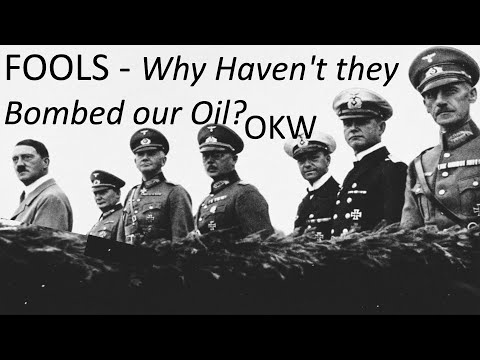
May 12, 1944. A date that would alter the course of World War II. On that day, Allied bombers finally unleashed their fury on Germany’s synthetic oil plants—the very facilities that Nazi commanders later admitted were the Reich’s Achilles’ heel. “If Germany’s synthetic oil plants were attacked six months sooner, the war would have ended six months earlier,” confessed Field Marshal Erhard Milch, head of the Luftwaffe’s production. Yet for years, the Allies had ignored this critical vulnerability. Why?
The answer lies in a perfect storm of strategic necessity, technological limitations, and bureaucratic inertia. As German generals sat in Allied interrogation rooms after the war, they were utterly dumbfounded. “The only mistake the Allies made was not targeting oil sooner,” spat one. Another, when asked what target should have been prioritized, growled: “From the beginning—oil, oil, and more oil.” Their frustration was palpable. The Allies had the power to cripple the German war machine far earlier, yet they hesitated. This is the story of that hesitation—and the three reasons behind it.
To understand the delay, we must first grasp the scale of the task. Germany’s oil infrastructure was vast and heavily defended: 25 synthetic oil plants and 59 petroleum refineries, all within the range of Allied bombers—but only if the bombers could reach them. The first condition was bomber bases. The Eighth Air Force, operating from England, could cover only a portion of the targets. It wasn’t until the Fifteenth Air Force was established in Italy at the end of 1943 that all 84 plants fell within striking distance. But even then, the Allies lacked the sheer number of aircraft needed.
By January 1944, the Allies had only 2,350 operational heavy bombers. That number would swell to 3,800 by May—a force large enough to sustain continuous attacks. “The Allies knew the magnitude of the task and could not start the oil attacks until they knew they had the forces needed to destroy the oil facilities,” a 1945 Mediterranean Air Force document explained. But there was a third, more formidable obstacle: air supremacy.
Without control of the skies, the bombers would have been sitting ducks. The German Luftwaffe, though battered, was still lethal. In early 1944, bomber attrition from German fighters stood at a crippling 3% per mission. It wasn’t until the Allies introduced long-range escort fighters like the P-51 Mustang and P-47 Thunderbolt that the tide turned. By June 1944, attrition had plummeted to a mere 0.3%. “The German air force must be defeated before oil facilities can be attacked,” a December 1944 intelligence summary bluntly stated. The Allies had to win the air war first.
But was that the whole story? Critics argue that the Allies could have started oil bombing earlier—perhaps as early as January 1944—with the 2,300 bombers they had then. The cost in lost crews would have been higher, but the payoff could have been decisive. As one post-war report noted, the oil campaign proved “the most effective of all strategic bombing and the most decisive to Germany’s defeat.” The delay, some insist, was a missed opportunity of catastrophic proportions.
Yet the decision was not made in a vacuum. The Allies were also preparing for D-Day, and transportation targets—railways, bridges, and roads—were prioritized to support the invasion. “Rail attacks were immediate, whereas the effects of an oil attack would not be seen for a few months,” explained a 1944 air intelligence summary. The invasion was imminent; the oil campaign could wait. Or so they thought.
As we delve deeper into this story, we will explore the strategic debates, the personalities involved, and the what-ifs that still haunt historians. The delay in bombing Germany’s oil facilities remains one of the most controversial decisions of World War II—a decision that may have cost the world six months of war.
The question of whether the Allies could have started the oil campaign earlier is not merely academic. It forces us to confront a uncomfortable truth: the men who made these decisions were not omniscient. They were operating with incomplete intelligence, competing priorities, and the constant pressure of a war that demanded immediate results.
Consider the situation in January 1944. The Eighth Air Force had just endured a brutal winter. Missions deep into Germany were costing crews at an unsustainable rate. “The bomber losses were simply too high to justify striking targets that were even more heavily defended than the aircraft plants,” one operations officer later recalled. The oil plants, with their flak towers and fighter traps, were the most protected targets in the Reich. To send bombers there before the Luftwaffe had been broken would have been, in the words of one planner, “a suicide mission with no guarantee of success.”
But there was another factor at play—one that rarely appears in the official histories. The Allies did not fully understand the fragility of Germany’s synthetic oil industry until late 1943. The plants were marvels of chemical engineering, converting coal into liquid fuel through the Bergius process. Intelligence analysts assumed they were resilient, capable of withstanding heavy bombardment and resuming production quickly. “We underestimated the vulnerability of the hydrogenation plants,” admitted a senior intelligence officer after the war. “We thought they could bounce back. They couldn’t.”
This misjudgment had profound consequences. Had the Allies known in early 1943 what they discovered in mid-1944—that a handful of well-placed bombs could shut down a synthetic oil plant for weeks—the entire strategic bombing campaign might have taken a different course.
Yet even with perfect intelligence, the decision would have been difficult. The Combined Bomber Offensive was not a single, unified effort. It was a fragile coalition of American and British air forces with radically different doctrines. The Americans believed in daylight precision bombing of specific industrial targets. The British preferred nighttime area bombing of cities. “Getting the RAF to agree to prioritize oil was like herding cats,” one American planner complained. “They wanted to burn Hamburg. We wanted to hit the refineries. We compromised, and the result was that neither objective received the full weight of our effort.”
The British had their own reasons for skepticism. Bomber Command’s Arthur Harris was openly contemptuous of what he called “panacea targets.” He believed that only the systematic destruction of Germany’s cities could break the enemy’s will. Oil, he argued, was just another distraction. “Harris fought the oil campaign tooth and nail,” a historian noted. “He saw it as a threat to his strategy and his resources.”
But Harris was not entirely wrong. The British experience with precision bombing had been disastrous. Early war raids on German dams and factories had resulted in heavy losses with little to show for it. The night bombing campaign, brutal as it was, at least produced visible destruction. “We knew we were hitting something,” a British bomber commander explained. “With oil, we had no idea if we were making a difference until months later.”
This uncertainty was perhaps the most insidious obstacle of all. The effects of an oil attack were not immediate. A factory could be rebuilt. A city could be burned and still function. But oil—oil was different. “It took time for the damage to cascade through the system,” a post-war analyst observed. “A refinery bombed in January might not show results until April. The planners wanted immediate feedback. They didn’t get it with oil.”
And so the Allies hesitated. They bombed aircraft factories, ball bearing plants, and transportation networks. They waited for the Luftwaffe to weaken. They waited for the invasion of Europe to be launched. They waited—and in waiting, they may have prolonged the war by months.
The consequences of this delay were not lost on the men who fought the war. “We were winning the air war, but we weren’t winning it fast enough,” admitted a senior American planner. “Every month we delayed the oil campaign, the Germans produced more fuel, more tanks, more planes. We were bleeding them, but we weren’t cutting their artery.” The artery, of course, was oil—and it remained open far longer than it should have been.
By the time the Allies finally struck the synthetic oil plants in May 1944, the results were immediate and devastating. Within weeks, German fuel production plummeted. “The effect was immediate and dramatic,” a post-war report concluded. “The total aviation fuel source curve trended downward after the attacks started.” Had those attacks begun in January, the curve might have hit zero by November 1944—months before the actual collapse.
But the delay was not merely a matter of missed opportunity. It was a lesson in the fog of war—the difficulty of making life-or-death decisions with incomplete information, competing priorities, and the relentless pressure of time. “We were fighting a war on multiple fronts,” a British staff officer recalled. “Every decision had a cost. We chose to support the invasion first. It was the right call at the time—or so we believed.”
Yet the nagging question remains: what if? What if the Allies had gambled on oil in January 1944? What if they had accepted higher bomber losses for the chance to strangle Germany’s fuel supply? “The destruction of Germany’s 25 synthetic oil plants would have been worth a higher bomber loss rate,” one analyst argued. “The war might have ended six months earlier.”
As the war entered its final year, the Allies finally understood what the Germans had known all along: oil was the key. The synthetic plants were the Reich’s weakest link, and once they were targeted, the entire German war machine began to seize up. Tanks ran dry. Planes were grounded. Ships stayed in port. “Lack of fuel dramatically affected their war effort,” a 1946 report noted. “It was the most catastrophic blow to any German hope.”
But the story of the oil campaign is not just about bombs and fuel. It is also about the men who made the decisions—and the ones who questioned them. “The only mistake the Allies made was not targeting oil sooner,” Field Marshal Milch said after the war. His words echo through history as a stark reminder of what might have been.
In the end, the delay in bombing Germany’s oil facilities was not the result of a single mistake, but a combination of factors: the need for bases, the need for bombers, the need for air supremacy, and the need to support the D-Day invasion. Each was a legitimate concern. Each played a role. But together, they created a perfect storm of hesitation that may have cost the world six months of war.
As we look back on those critical months of 1944, we are left to wonder: was it worth the wait? The answer, like so much in war, is complicated. The Allies won the war, but they won it later than they might have. And the men who fought and died in those final months might have been spared had the oil campaign begun earlier.
The oil campaign’s success proved the German generals right. Within weeks of the first strikes, synthetic fuel production collapsed by 90 percent. “The effect was immediate and dramatic,” a post-war report concluded. Had those attacks begun in January, the aviation fuel curve might have hit zero by November 1944—months before the actual collapse.
Yet the delay was never a simple mistake. It was the fog of war made manifest: incomplete intelligence, competing doctrines, and the relentless pressure of D-Day. “We chose to support the invasion first,” a British staff officer recalled. “It was the right call at the time—or so we believed.”
The men who made those decisions were not omniscient. They weighed bomber losses against uncertain payoff, and they guessed wrong. Milch’s confession—“oil, oil, and more oil”—remains history’s quiet indictment.
So here is the question that still haunts historians: would you have gambled your bomber crews in January 1944 for a chance to end the war six months early? Share your thoughts below.
Report this article
Select a reason for reporting:






