He didn’t yell. He didn’t storm off. Clint Eastwood just went quiet—and that silence was louder than any scream. For over sixty years, that calm, squinted stare has ruled Hollywood, a whisper of steel that says more than a thousand words. But behind the legend is a man who demands one thing above all: respect for the craft. And when that line is crossed, Eastwood doesn’t forget. He keeps a list.
It’s not about bruised egos or tabloid drama. It’s about wasted time, wasted talent, and the one sin Clint can’t forgive: treating filmmaking like a game. The five stars on his personal blacklist learned that the hard way. Their clashes are the stuff of Hollywood legend—and they’ll change how you see them forever.
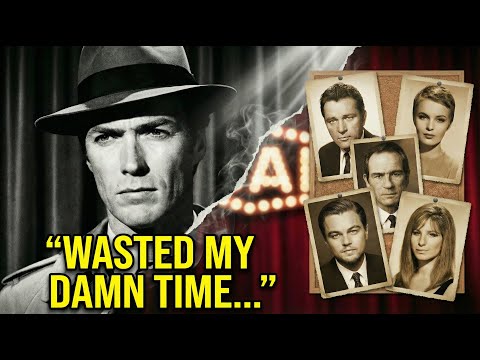
On a quiet soundstage in 1968, the air was thick with tension. Richard Burton, the Shakespearean titan with a voice like thunder, was stumbling through a pivotal monologue in Where Eagles Dare. Clint Eastwood, the rising symbol of icy toughness, stood off-camera, arms folded, watching. Take after take, Burton fumbled, the smell of last night’s whiskey still on his breath. For Eastwood, who showed up before sunrise with lines locked in, it was pure torture.
“I’m getting paid by the picture, not by the hour,” Clint smirked when a crew member asked if he was mad. Everyone knew what that meant. He was furious. Burton’s chaos—the late arrivals, the hangovers, the smug jabs about their film being “just a paycheck movie”—had crossed a line. Eastwood never worked with him again. “Talented guy. Wasted talent,” he later summed up, three words that cut deeper than any rant.
If Burton was a storm of alcohol, the next name was a hurricane of tears. Jean Seberg, the fragile star of Paint Your Wagon, was battling her own demons—FBI persecution, personal heartbreak—and it spilled onto the set. Clint, stepping out of his comfort zone to sing on screen, needed a steady co-star. Instead, he got emotional chaos. Seberg would lock herself in her trailer, too upset to perform, while Eastwood stood on his mark, ready to go.
One choreographer described it perfectly: “Clint was always on his mark, while Jean was either missing or in tears.” But what truly sealed her fate wasn’t the delays. After the film underperformed, Seberg hinted that Clint’s “wooden acting” hurt its success. For Eastwood, loyalty doesn’t end when the cameras stop rolling. Public criticism from a co-star was unforgivable. He never spoke ill of her, even after her tragic death, but whenever her name came up, he’d quietly change the subject. That silence said it all.
Then came Tommy Lee Jones—a full-on collision of alpha energy. On In the Line of Fire, Jones dove so deep into his method that he kept his menacing stare locked on Clint even after “Cut!” Crew members remember the tension vibrating through the set. Eastwood, who flips his character off like a switch, saw it not as dedication but as disruption. “Life’s too short for that kind of nonsense,” he muttered to an assistant after one particularly heated take.
But it was Jones’s refusal to respect the chain of command that truly crossed the line. He’d challenge the director’s vision, dig in his heels, and fight for his own way. For Clint, that was chaos disguised as passion. After the film wrapped, whenever casting directors suggested Jones for a role, Eastwood would just shake his head. “Let’s look at other options.” The door closed for good.
But if Jones brought too much fire, the next name brought something Clint found even more exhausting: too much thought. Leonardo DiCaprio arrived on the set of J. Edgar loaded for battle—stacks of books, pages of notes, a deep psychological map of J. Edgar Hoover. He wanted to discuss motivation, nuance, the hidden meaning behind every pause. Clint wanted a performance. Just one, clean, honest take.
The clash was inevitable. DiCaprio, a methodical perfectionist, asked for take after take, chasing what he called the truth of the character. Eastwood, the master of instinct, believed the first take was the truth—and every repeat killed it a little more. One crew member recalled a devastating emotional scene where Leo nailed it on the first try. Raw. Real. Cinematic gold. But he wasn’t satisfied. By the sixth take, Clint had quietly wandered off to the craft services table, sipping coffee, waiting for it all to end.
“Some people want to climb the mountain. Others want to analyze the mountain, measure it, and write poems about it. I just want to get to the top and enjoy the view,” Clint later said—one perfect line that summed up the entire divide. He respected Leo’s dedication, but he never wanted to relive it. When casting directors later floated DiCaprio’s name, Eastwood’s answer was calm but final: “Great actor. Not for me.”
And then there’s the name at the very top. The one that still makes Clint’s jaw tighten. Not a co-star. Not even a collaborator. Barbara Streisand—the symbol of everything Eastwood believes has gone wrong with modern Hollywood. Where he prizes instinct and speed, she demands total control, endless tinkering, dozens of takes for a single perfect shadow. One producer joked, “Clint could finish an entire film in the time it took Barbara to shoot one scene.” Clint didn’t deny it.
The tension went public in 1992 when Unforgiven faced off against The Prince of Tides at the Oscars. Two films. Two philosophies. Two worlds colliding. When Streisand was snubbed for Best Director, Clint reportedly said privately, “Maybe if she spent more time making decisions and less time obsessing over details, she’d have finished more than three films in fifteen years.” Streisand fired back, questioning whether his famous one-take style came at the cost of emotional depth. For Eastwood, that hit deep. She had attacked the very core of his craft.
Then fate handed him the ultimate answer. The Bridges of Madison County—a project Streisand had labored over for years—fell into Clint’s hands. He stripped the script bare, cut the excess, and focused on one simple, heartbreaking love story. Fast. Quiet. Truthful. The result was a masterpiece, one of the most haunting romances ever filmed. He never gloated publicly, but those close to him knew: Bridges was his mic drop. Simplicity had beaten perfectionism at its own game.
To this day, the two legends keep their distance. Clint still takes subtle digs at her school of filmmaking, once saying, “At a certain point, you’re not finding truth anymore. You’re manufacturing it.” And that, in the end, is what Clint Eastwood’s blacklist is really about. Not grudges. Not gossip. Survival. A quiet, unshakable code built on instinct, speed, and authenticity—and a refusal to let anyone, no matter how famous, smother the raw honesty of the moment.
But the story doesn’t end with a list of names. It ends with a question that every actor in Hollywood eventually has to answer: when the camera rolls, what do you trust—your gut or your notes? Eastwood made his choice decades ago, and he’s never wavered. The actors who understood that choice became legends alongside him. The ones who didn’t became cautionary tales whispered on soundstages.
Gene Hackman, who won an Oscar under Clint’s direction in Unforgiven, once said that Eastwood’s set felt almost eerily calm. “There’s no drama. No shouting. He just tells you what he needs and lets you find it.” That trust, Hackman explained, was terrifying at first—because there was nowhere to hide. No fifth take to save you. You had to be ready. You had to be alive in the moment.
And that’s the paradox of Clint Eastwood. The man who demands so little in terms of retakes demands everything in terms of presence. He doesn’t want your homework. He wants your instincts. He doesn’t want your analysis. He wants your truth. For actors raised on method acting, on endless rehearsal and psychological excavation, that’s a foreign language. For others, it’s a liberation.
Hilary Swank put it best. After winning her second Oscar for Million Dollar Baby, she told interviewers that Eastwood’s one-take philosophy changed her forever. “When you know you only have one shot, you come alive in a way you can’t when you’re doing twenty. There’s an urgency. A rawness. It’s like walking a tightrope without a net.” She paused, then added with a smile, “Most directors protect you from that fear. Clint throws you into it—and somehow, you fly.”
That’s the Eastwood paradox in a nutshell. He doesn’t coddle. He doesn’t coach. He doesn’t sit you down for a three-hour conversation about your character’s childhood. He just points the camera, says “Action,” and expects you to bring the truth. If you can’t, he’ll find someone who can.
But here’s the part that rarely gets mentioned: Eastwood isn’t cruel. He’s not vindictive. He doesn’t blacklist actors out of spite. He does it out of self-preservation. After sixty years in the business, he knows exactly what kind of environment allows him to create. And he refuses to compromise that environment for anyone—not for a Shakespearean legend, not for a fragile starlet, not for a modern method-acting icon.
One longtime producer who worked with Clint on three films explained it this way: “Clint doesn’t hate these people. He just doesn’t have time for them. And in his world, time is the only currency that matters.” That’s not arrogance. That’s clarity. After decades of watching Hollywood waste millions on bloated productions and endless reshoots, Eastwood built his own way of working—lean, fast, honest—and he’s protected it like a fortress.
So what happens when a young actor, hungry and talented but raised on a diet of endless takes and emotional workshops, steps onto an Eastwood set for the first time? According to those who’ve witnessed it, there’s a moment of panic. A look of confusion. Wait—we’re moving on? But I wasn’t finished! And then, slowly, something shifts. The actor realizes that the safety net is gone. That there’s no take twelve waiting to save them. And in that moment, they either rise to the occasion or crumble.
Eastwood has seen both. He’s watched seasoned veterans freeze under the pressure of his one-take rule. He’s watched newcomers deliver the performance of their lives because they had no time to overthink. And through it all, he’s stayed the same—calm, squinted, utterly unimpressed by fame or reputation.
“You can have all the talent in the world,” he once told a young director who asked for advice. “But if you can’t show up on time, know your lines, and trust your instincts, you’re useless to me.” That’s the Eastwood gospel. Not glamorous. Not trendy. But it’s built an empire that’s lasted six decades—and counting.
The blacklist isn’t a grudge. It’s a mirror. It reflects exactly what Clint Eastwood values and what he refuses to tolerate. And in a town full of people who talk endlessly about passion and process, Eastwood just keeps working. Quietly. Efficiently. Truthfully.
Maybe that’s the real lesson hidden inside the list. The five names—Burton, Seberg, Jones, DiCaprio, Streisand—aren’t villains. They’re mirrors of a vanishing Hollywood, one where ego, chaos, and endless perfectionism slowly strangled the raw magic of the first take. Eastwood never asked for perfection. He asked for presence.
And that’s why, at ninety-plus, he still steps onto a set before sunrise, coffee in hand, ready to shoot. No drama. No excuses. Just the work.
“You can have all the talent in the world, but if you can’t show up and trust your gut, you’re useless to me.” Six decades later, that code still stands—quiet, unshakable, and utterly unforgiving.
So here’s the question that lingers long after the credits roll: if Clint Eastwood handed you one take and no safety net, would you fly—or would you freeze?
Report this article
Select a reason for reporting:






