Emma Rodriguez had always loved visiting her grandfather’s estate in Santa Fe, New Mexico, but today felt different as she sorted through decades of accumulated memories in the sprawling adobe house. Following her grandfather Miguel’s recent passing, the family had gathered to organize his extensive collection of photographs, documents, and artifacts that chronicled their family’s long history in the American Southwest. The late afternoon sun streamed through the traditional vigas overhead, casting long shadows across the hardwood floors as Emma carefully examined each photograph in her grandfather’s prized collection. Miguel had been the family historian, meticulously documenting their lineage and preserving stories that stretched back to the earliest Spanish settlements in New Mexico.
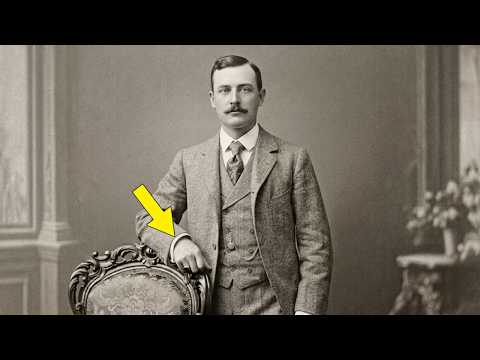
She paused at a formal studio portrait dated 1901 featuring a distinguished man in his 30s wearing an elegant three-piece suit. The sepia-toned photograph showed remarkable clarity for its age, and every detail of the subject’s appearance was captured with precision. According to the notation on the back, this was Joaquin Rodriguez, her great-great-grandfather, photographed in Santa Fe just after the turn of the century. Emma had seen this photograph countless times during family gatherings, listening to stories about Joaquin’s success as a merchant and his reputation as one of Santa Fe’s most respected citizens.
But today, examining the image with fresh eyes and better lighting, something caught her attention that she had never noticed before. On Joaquin’s left hand, clearly visible as he rested it on the arm of an ornate chair, was an unusual ring that seemed oddly out of place for a prosperous New Mexican merchant of 1901.
The ring appeared to be made of a dark metal, possibly iron or steel, with an intricate design that didn’t match the typical gold or silver jewelry favored by wealthy Hispanic families of that era. Most intriguingly, the ring bore what appeared to be symbols or markings around its band, symbols that didn’t look Spanish, Mexican, or American.
Emma reached for a magnifying glass from her grandfather’s desk and studied the ring more closely. The symbols were definitely intentional, carefully crafted, and appeared to tell some kind of story or convey specific meaning.
“That’s strange,” she murmured to herself, her voice echoing in the quiet room.
Her family had always prided themselves on their well-documented Spanish colonial heritage, tracing their lineage back to the earliest settlers who had arrived with the Oñate expedition in 1598. Every piece of jewelry, every family heirloom, had been cataloged and explained over the generations, but this ring was different. It didn’t fit the narrative of their family’s carefully preserved history, and its unusual design suggested origins that had nothing to do with Spanish colonial New Mexico.
Emma felt a familiar excitement building. The same feeling she got when working on complex historical research projects for her job as a museum curator in Denver. She carefully photographed the portrait from multiple angles, paying special attention to the mysterious ring. Something told her that this small detail, overlooked for over a century, might unlock secrets about her family that no one had ever suspected. The formal pose, the careful positioning of Joaquín’s hands, the prominent display of the ring, it all seemed too deliberate to be coincidental.
As the sun set over the Sangre de Cristo Mountains, Emma realized she was about to embark on an investigation that would challenge everything she thought she knew about her family’s history.
The next morning, Emma called her Aunt Carmen, the current family matriarch and keeper of the Rodriguez family genealogy. At 78, Carmen possessed an encyclopedic knowledge of family history and had spent decades researching their Spanish colonial roots, even traveling to Spain to trace their ancestry back to Andalusia.
“Tia Carmen,” Emma said, trying to contain her excitement as she held the phone. “I’m going through Abuelo Miguel’s photographs, and I found something interesting in the 1901 portrait of Joaquin.”
“Ah, that beautiful photograph.” Carmen’s voice warmed with pride. “Your great-great-grandfather was such a handsome man and so successful. He owned three general stores and was very respected in the territory before statehood. What did you find, Mija?”
Emma hesitated, wondering how to explain her discovery without sounding dramatic. “He’s wearing a ring that looks unusual for that time period. It’s made of dark metal with symbols that don’t look Spanish or Mexican. Have you ever noticed it before?”
A long pause stretched across the phone line. Carmen had examined every family photograph countless times, creating detailed family trees and documenting every piece of family history for the younger generations.
“A ring with symbols?” Carmen repeated slowly. “Emma, I’ve studied that photograph for years. I helped your grandfather identify and catalog all the family portraits when I was working on our genealogy project. What kind of symbols?”
“They’re hard to make out, but they look like they might be letters or characters from a different alphabet. The ring itself doesn’t look like typical Hispanic jewelry from that era.”
Another pause. “Mija, could you bring that photograph to me? I have Joaquin’s personal papers that came down through the family. Maybe there’s something I missed, some explanation I overlooked.”
As Emma drove from Santa Fe to Carmen’s home in Albuquerque, her mind raced with questions. How could such a prominent detail in a family photograph have gone unnoticed for so long? And what could the mysterious symbols possibly mean in the context of their well-documented Spanish colonial heritage? The familiar landscape of northern New Mexico stretched around her. The same high desert terrain her ancestors had called home for over four centuries. But today, everything felt different, as if she was seeing her homeland through new eyes that had glimpsed something that challenged the foundation of her family’s identity.
Carmen’s adobe home in Albuquerque’s Old Town was filled with carefully preserved family documents, photographs, and artifacts that represented generations of New Mexican Hispanic culture. As a retired librarian and amateur historian, she had turned her home into an unofficial family archive.
“Show me this mysterious ring.” Carmen said as Emma spread the 1901 photograph across her dining room table. She reached for her reading glasses and a powerful magnifying glass she used for examining old documents. After several minutes of careful study, Carmen’s expression grew puzzled.
“You’re absolutely right, Emma. There is something unusual about this ring. The symbols are definitely intentional, and they don’t match anything in our family’s documented history.”
Carmen walked to a large filing cabinet and withdrew a folder thick with documents. “These are Joaquin’s business papers, personal letters, and legal documents from the territorial period. I’ve read through everything multiple times while researching our family history. Let me see if there’s any mention of unusual jewelry or anything that might explain this ring.”
They spent the next two hours carefully examining documents, but found no mention of the ring or anything that might explain its origin. The papers confirmed what the family had always known. Joaquin was a successful businessman, respected community member, and proud descendant of Spanish colonists. But there was no hint of any connection to other cultures or traditions that might explain the strange ring with its mysterious symbols.
Determined to understand the ring’s significance, Emma decided to research the broader historical context of 1901 New Mexico Territory. She drove to the University of New Mexico’s Center for Southwest Research, where she had conducted research during graduate school and maintained relationships with several historians specializing in the territorial period.
Dr. Patricia Valdez, a professor of Southwestern history whom Emma had known for years, welcomed her into her office filled with books, maps, and artifacts from New Mexico’s territorial era. A respected scholar in her 50s with graying hair and intelligent dark eyes, Dr. Valdez had spent her career studying the complex cultural interactions in the American Southwest.
“Emma, how wonderful to see you. I heard about your grandfather’s passing. My condolences. Miguel was a treasure trove of family history. What brings you back to our archives?”
Emma showed her the photograph and explained her discovery of the unusual ring. Dr. Valdez studied the image carefully, her expression growing increasingly intrigued.
“This is fascinating,” Dr. Valdez said, adjusting her glasses to examine the ring’s details. “The symbols definitely aren’t Spanish, and they don’t match any of the Native American symbolic traditions I’m familiar with from this region.”
She turned to her computer and began searching through digital archives of territorial era photographs and documents. “The early 1900s were a time of significant cultural complexity in New Mexico Territory. While the dominant narrative focuses on Hispanic and Anglo populations, there were actually many other groups present that history has largely overlooked.”
Dr. Valdez pulled up several historical documents on her screen. “For instance, there were small communities of immigrants from the Middle East, Eastern Europe, and even Asia who came to New Mexico during the mining booms and railroad construction in the late 1800s. Many of these groups assimilated quickly and their stories were forgotten.”
Emma leaned forward, intrigued. “Are you suggesting Joaquin might have had connections to one of these immigrant communities?”
“It’s possible,” Dr. Valdez replied. “The symbols on the ring could be from any number of cultural traditions. Let me show you something.” She opened a file of photographs from the territorial archives. “These are images from various New Mexican communities between 1880 and 1910. Look at the diversity of people and cultural artifacts present in what most people assume was simply a Hispanic and Anglo frontier society.”
The photographs revealed a surprising multicultural landscape. Lebanese merchants, Chinese railroad workers, Jewish traders, Italian miners, and various other immigrant groups who had made New Mexico their home during the territorial period.
“Dr. Valdez, is there any way to identify what cultural tradition these symbols might represent?” Emma asked, pointing to the ring in the photograph.
“We’d need to consult specialists in various cultural traditions and writing systems,” Dr. Valdez replied. “But I have colleagues who might be able to help. The symbols could be Arabic, Hebrew, Cyrillic, or from any number of other traditions.”
She made several phone calls arranging for Emma to meet with professors specializing in Middle Eastern studies, Eastern European history, and Asian cultural traditions. “If this ring does represent a hidden aspect of your family history, we should be able to identify its origins.”
As Emma left the university, she realized that her simple question about an unusual ring was opening up entirely new possibilities about her family’s past. The carefully documented Spanish colonial heritage might be only part of a much more complex story.
Emma’s first appointment was with Dr. Amara Hassan, a professor of Middle Eastern studies who specialized in Arabic calligraphy. “The symbols are intriguing,” Dr. Hassan said, “but they’re definitely not Arabic script. However, the metalwork style reminds me of jewelry traditions from the Levantine region.”
Next, Dr. John Kowalski examined the photographs with equal intensity. “These aren’t standard Cyrillic characters, but there are elements that suggest possible Polish or Russian influences,” he said, pulling out reference books on historical Slavic jewelry.
Finally, Dr. Lisa Chen studied the images carefully. “The symbols aren’t Chinese or Japanese, but their vertical arrangement suggests possible East Asian influence,” she noted, showing Emma examples of traditional Asian metalwork.
Emma realized the ring’s symbols represented a complex puzzle incorporating influences from multiple cultural traditions. “Whoever created this ring might have had exposure to multiple cultural traditions,” she concluded. “That’s actually quite remarkable for New Mexico in 1901.”
Back at the Center for Southwest Research, Emma discovered a listing in the 1900 territorial census: Abraham Kowalchik, jeweler, age 45, born Poland, living just three blocks from Joaquin’s main store. His shop specialized in custom metalwork—exactly the kind of establishment that might have created an unusual ring.
At the New Mexico State Archives, Emma found Kowalczyk’s detailed business records. “Custom ring commission for J. Rodriguez,” read an entry dated September 15, 1901. “Special design incorporating symbols from customer’s heritage.”
Dr. Kowalski translated the jeweler’s notes: “Customer requests ring incorporating symbols from family heritage—Spanish colonial, Sephardic Jewish, and Moorish traditions. Symbols represent family name, religious protection, and historical connection to Al-Andalus.”
Emma felt a chill of recognition. “Sephardic Jewish? But our family has always identified as Catholic Hispanic colonists.”
Dr. Kowalski continued reading. “Customer explains that family heritage includes ancestors who were conversos—Jews who converted to Christianity during the Spanish Inquisition but maintained cultural traditions in secret.”
Emma stared at the documents, her understanding transformed. The carefully preserved narrative of Spanish colonial heritage was true but incomplete. Her ancestors had carried the additional burden and richness of hidden Jewish identity preserved through centuries of persecution.
What secrets might your own family photographs be hiding?
Report this article
Select a reason for reporting:






