My name is Abigail, and for three years, I haven’t spoken a single word. It’s not a choice—it’s a prison. Selective mutism, the doctors call it, triggered by trauma so deep my voice simply vanished. I live with my husband Josh’s family, where his mother, Aurora, treats me like a ghost she can punch. She talks at me, never to me. She calls me broken, ungrateful, embarrassing. And Josh? He just watches. “You’re lucky I don’t charge you rent,” Aurora sneered this morning, standing in the doorway as I scrubbed the kitchen stove. “The least you can do is act grateful. Oh, wait—you can’t even say thank you.” I kept my head down. Reaction is fuel, and I had none to give.
Josh came home from work just as I set the table for dinner. He didn’t look at me—he never does when his mother is watching. Aurora swept in like a queen arriving at court. “This smells like overcooked chicken,” she announced, lifting the lid with disdain. “You’re such a hopeless case in the kitchen, Abigail. I don’t know how my son can eat this crap.” I cooked every night, cleaned every day, handled the laundry, the groceries, the mail—but it was never enough. Josh just kissed her cheek and said, “Thanks, Mom, looks great.” She beamed as if she’d prepared the meal herself. I ate in silence, the taste of shame stronger than any food.
That night, I heard Aurora tell Josh in the next room that she was doing everything to tolerate my presence, but maybe it was time to “reconsider the agreement.” All he said was, “I’ll think about it.” I didn’t sleep. The next morning, something unexpected happened: Mave came home. Josh’s younger sister had been abroad for years, and she was the only one who ever showed me kindness. She’d even learned a little sign language for my sake. When she walked through the door, arms wide open, I almost cried. “Abigail! God, it’s good to see you. You look tired, but still beautiful.” Relief constricted my chest. She noticed the tension—of course she did.
Later, in the garden, Mave handed me a cream-colored envelope. A wedding invitation. Her wedding. “I wanted to give this to you in person,” she said. “I want you there.” My hands shook as I clutched the card to my chest and mouthed, Thank you. That night, Aurora spotted the envelope and muttered, “Not everyone needs to be included in everything.” I wanted to scream, but I just picked up my fork and kept eating.
The night before the wedding, I laid out a simple blue dress—nothing flashy, just enough to avoid attention. The next morning, I woke early, did my hair, and put on light makeup. When I stepped into the hallway, the house was too quiet. No shoes by the door, no jackets, no keys. They were gone. Josh and Aurora had left without me. My phone buzzed with a message from Mave: Can’t wait to see you! Let me know when you’re on your way. My mouth went dry. I had no idea where the venue was—Aurora had thrown the invitation away. Panic rose, that familiar suffocating silence tightening my throat. But this time, something broke through: anger. I wouldn’t let them erase me. Not today.
I scrolled through Mave’s messages until I found it: Maple Ridge Vineyard, Sunday at 1 p.m. I ordered a ride, typed a note to myself—I’m coming, Mave. I won’t let you take this away from me.—and for the first time in years, I felt determination. The car dropped me off at the vineyard, where guests in soft blues and warm grays streamed into the ballroom. I clutched my purse, willing my legs to move. My instincts screamed at me to disappear, but I thought of Mave’s laughter, her kindness. I went inside.
The hall was decorated with white roses and eucalyptus, fairy lights strung across wooden beams. I scanned the room, hoping to find Mave before Aurora did. Then she appeared in a floor-length ivory dress that shone like a painting. Her eyes met mine, and she hurried over. “Abigail,” she whispered, pulling me into her arms. “You finally did it.” I nodded, my throat tight, and typed on my phone: You look beautiful. She read it with glassy eyes. “Thank you. I’m so glad you’re here.” In that instant, I forgot everything else—Josh, Aurora, the years of silence.
But the reception hadn’t even begun. Aurora spotted me first, her lips curving into a sour grin as she leaned down to whisper to Josh. He chuckled. They hadn’t expected me to show up—I was the ghost they’d tried to bury. The ceremony was short and beautiful, Mave beaming the entire time. During cocktail hour, I sipped sparkling water near the patio, watching bees circle the flowers. Then I felt the tension. Aurora and Josh approached from behind. “Now, now,” Aurora said calmly, holding a wine glass. “You really showed up.” Josh smiled thinly. “I didn’t think you’d figure out where it was. Smart girl.” I didn’t move. I didn’t blink. Aurora leaned forward. “You don’t belong here, you know that, don’t you? Mave invited you out of pity, but today isn’t your day, so don’t make it your business.” She turned on her heel and left.
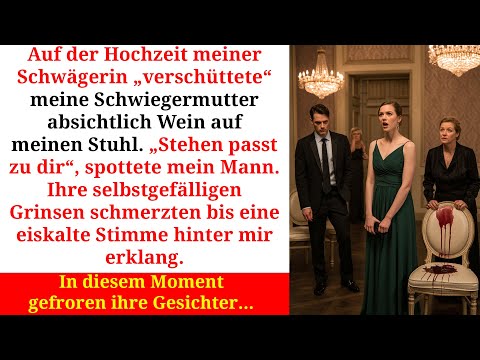
I found my assigned seat at the back of the hall—Abigail written in gilt on a white card. Relief washed over me. But minutes later, when I returned from the bathroom, my chair was soaked in red wine. Aurora stood next to it, waving the nearly empty glass. “Oh no, I’ve spilled something,” she said with mock surprise. “Clumsy.” Josh burst out laughing. “Guess someone’s not allowed to sit now.” A few guests looked over in confusion. I froze. Staff brought a new chair, but Aurora raised her hand sharply. “Stop it. She was about to leave.” I didn’t move. “You don’t want to cause a scene, do you?” she hissed. “Silence works better at home.” Josh leaned back, grinning. “Honestly, Abigail, why did you even come?” Tears welled in my eyes. Not now, not here. I turned and headed for the exit.
But before I reached the door, I heard a voice behind me. “Abigail, wait.” Mave. She hurried over, her heels clicking sharply. “What happened? Why are you leaving?” I showed her my phone: Aurora poured wine on my chair. Josh laughed. She said I don’t belong here. Mave gritted her teeth. She slowly turned around, her gaze locking on Josh and Aurora, who were now chatting with another guest as if nothing had happened. She let go of my hand and marched across the room. Josh looked up in surprise. “What’s wrong?” he asked, smiling as if it were a toast. “What’s wrong with you?” she snapped, her voice trembling. “She’s your wife. She is sick because of you. And you are doing this.” The room fell into complete silence.
Mave turned to her mother, her chest heaving. “Mom, you are just incredible.” Aurora’s face twisted. “What did you say to me?” she barked. Mave didn’t hesitate for a second. She delivered a sharp, heavy slap to Josh’s face. A loud crack echoed through the entire hall. Someone in the crowd gasped.
“You can’t laugh at her pain,” Mave hissed. “You can’t erase it.” Josh rubbed his cheek, stunned. “It was just a joke,” he stammered. Mave slapped him again, harder, on the other cheek. “I’m not kidding.”
Aurora stepped forward, trembling. “Mave, stop—you’re ruining this.” Mave laughed bitterly. “You ruined her. You silenced her. You bullied her every single day, and you’re proud of it.” The event coordinator rushed over, flustered. Aurora pointed a shaking finger at me. “They both need to go,” she declared. “You’re not serious,” Mave said coolly. “Yes. I am.”
Security and staff intervened, escorting Josh and Aurora out the side door. Aurora tried to plead with Mave, but she didn’t respond. She simply stood tall, protecting me like a soldier shielding the wounded. As the doors closed behind them, Mave turned to face the guests. “Please accept our apologies for the interruption. We’ll resume the reception shortly. Thank you for your patience.” Applause erupted—hesitant at first, then stronger.
Mave came back to me, her hands shaking. “I’m so sorry, Abigail,” she whispered, hugging me. “I should have seen it sooner.” I couldn’t speak, but I didn’t have to. I held her tight, and for the first time in years, I let my tears flow freely in public. Not a single person turned away.
The music grew louder, laughter slowly returning. Mave took my hand. “You’re going to stay until the very end. I’ll find you a different seat.” After the reception ended, I stood outside under the fairy lights, clutching my purse, unsure what came next. I had no home to return to. Not really.
Mave found me on a bench near the hydrangeas, her heels dangling from her fingers, two glasses of sparkling cider in her hands. “I’ve already called someone,” she said. “There’s a company apartment from my husband’s hospital. It’s empty. It’s yours for now.” I typed on my phone: I can’t accept this. “You can and you will,” she said. “You’re not staying in that house another second.”
She placed a glass in my hand. “To the first step,” she said. “Freedom.”
That night I slept in a clean bed with fresh sheets, in a quiet apartment where no one banged on the door or told me how lucky I was. I still couldn’t talk—but I could breathe.
Mave texted early the next morning about a meeting with an attorney. 2 p.m. I’ll pick you up. I didn’t argue. We sat in a small downtown Boston office across from a woman named Elena Scott, who specialized in domestic violence and disability claims. She read the summary Mave had sent. “You’ve been through more than enough, Abigail,” Elena said softly. “But we’re going to help you get your life back.”
She handed me a pen and a stack of forms: petition for divorce, declaration of abuse, petition for damages—medical expenses, emotional trauma, housing instability. I signed each one, my hands barely steady. “They might try to contest this,” Elena warned. “But with the video evidence from the wedding, the witness statements, and your diagnosis, we have a strong case.” I typed: I don’t want to see her. Never again. “You don’t have to,” she said.
Over the next few weeks, I stayed in the apartment and slowly began to recover. Mave came by often—sometimes with groceries, sometimes just to watch a movie. We didn’t have to talk much. She always seemed to know what I was thinking. Josh never contacted me directly. Aurora tried once, with an email full of tearful apologies. I deleted it without reading past the first line.
The divorce was finalized quickly. Thanks to Elena’s work and the publicity from the wedding, Josh didn’t fight back. Aurora insisted I owed her for years of housing and care, but the judge rejected her claim entirely. Instead, the court ordered them both to pay a substantial sum in damages. “They were the primary cause of her condition,” Elena had said. The court acknowledged it. When the verdict was read, I felt no satisfaction—only relief. A door had finally closed.
Three months later, I was in the kitchen making coffee when Mave walked in, grinning. “You’re getting good at keeping the peace in this house,” she teased. “Smells wonderful.” I smiled and poured her a cup. She sat down and slid a folder across the table. Inside was a flight schedule, a job offer, and a visa application.
“I’m three months pregnant,” she said, rubbing her belly. “When the baby comes, I’m going back to work, and I need someone I trust. Someone I believe in.” I stared at her. “I want you to come with us to California. My husband owns a private wellness clinic. He’s offered you a full-time position—nanny and administrative assistant. It qualifies you for a long-term visa.”
I shook my head in amazement. She reached across the table. “You deserve a fresh start, Abigail. A life that isn’t just about surviving.” I typed slowly: What if it goes wrong? I’m not ready. “You don’t have to be ready,” she replied. “You only have to say yes.” I said nothing. But I nodded.
The weeks that followed blurred into paperwork, phone calls, and quiet evenings on Mave’s porch. Elena handled everything—the visa, the passport, the travel stipend, the one-bedroom guest house in Marin County waiting beside Mave’s own. “You’re not just surviving anymore,” she told me on our last call. “You’re building.”
California was slower, warmer, easier. I started part-time at the clinic—scheduling, childcare, errands. No one rushed me. No one mocked my silence. Twice a week, I met with a speech therapist, and though my mutism hadn’t lifted, something inside me had loosened. Sometimes, alone in the guest house, I would hum a single note—then stop. But it was more than I’d done in years.
One evening, Mave and I sat on her porch watching the sun sink low, her baby asleep inside. She turned to me. “You know what’s funny? You’re the strongest one in this family.” I smiled and typed: Not strong. Just tired of being small. She shook her head. “You’re not small. You’re just getting started.”
I don’t know if I’ll ever be fully healed. Selective mutism isn’t curable—you learn to live with it. But I’m not the girl who sat at that table too scared to breathe. I’m not finished, and I’m not alone. One day I’ll argue back. For now, I’ve found people who listen—and that’s a start.
What would you have done if you’d been sitting in that wine-soaked chair?
Report this article
Select a reason for reporting:






