The frozen ground trembled. In the pre-dawn blackness of December 16, 1944, a thunderous artillery barrage shattered the silence of the Ardennes Forest, jolting Lieutenant Lyle Bouck and his 21 men from their icy foxholes. They had been told this was a quiet sector—a place to rest, to regroup, to wait out the winter. But as shells rained down around them, Bouck knew instantly that this was no ordinary bombardment. “This isn’t just some spoiling fire,” he thought. “This is something much bigger.” He was right. It was the opening salvo of Hitler’s last great gamble: Operation Wacht am Rhein, the Battle of the Bulge.
Bouck, just 20 years old and the second youngest in his platoon, commanded the Intelligence and Reconnaissance Platoon of the 394th Infantry Regiment—handpicked men chosen for their sharp minds and deadly aim. Their mission was simple: hold the crossroads at Lanzerath, a tiny Belgian village that stood between the German Sixth SS Panzer Army and the vital supply port of Antwerp. If the Germans broke through here, they could split the Allied forces and change the course of the war. Twenty-two men against an entire armored spearhead.
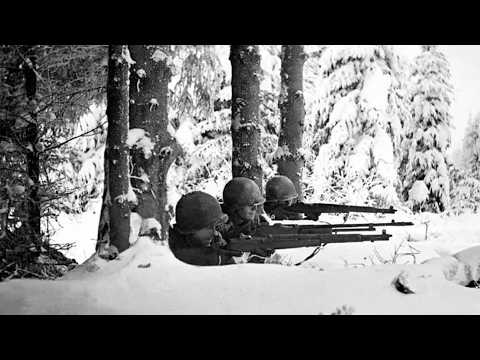
As the shelling finally lifted, the men of the I&R platoon braced themselves. They had spent weeks patrolling this sector, studying the terrain, digging foxholes into the frozen earth. Now, those preparations would be tested. Through the swirling snow, a column of German paratroopers—the elite 9th Fallschirmjäger Regiment—was spotted marching north along the main road, some 500 strong. They outnumbered the Americans more than twenty to one.
Bouck held his fire. The Germans were exposed, but he wanted to wait until they were closer. Then, a young girl emerged from the village, pointing directly at the Americans’ hidden positions. An order was shouted. The Germans scattered. And Bouck gave the command: “Fire!”
A hail of bullets tore into the column. Germans fell into the ditches, scrambling for cover as the Americans poured fire from their foxholes and a jeep-mounted .50 caliber machine gun. The first assault was repulsed, leaving dozens of enemy dead on the snow. But the reprieve was brief. Within hours, another wave came—this time a frontal charge up the wooded slope. “They came up this hill in a line of skirmishers,” Bouck later recalled. “When they reached the fence, we just fired on them. It was kind of like a manslaughter.”
Eight minutes of carnage left the hillside littered with bodies. The Germans withdrew, but the Americans knew they would return. By afternoon, a third attack struck, heavier and more determined. The platoon’s machine gun jammed, ammunition ran low, and one by one, men were wounded. Private Kalil took a rifle grenade to the face; others were hit by shrapnel. Still, they held.
As dusk approached, Bouck made a decision: they would hold until nightfall, then retreat. He sent two men to request a formal withdrawal, but neither made it back. Then, just as the sun dipped below the horizon, the final blow came—not from the front, but from the flank. Germans had infiltrated through Lanzerath and now stormed the tree line from the right, catching the Americans off guard. Bouck saw movement in the corner of his eye. “I knew it wasn’t my guys,” he said. “So I started firing.”
But it was over. A German soldier thrust his rifle into Bouck’s foxhole and opened fire, wounding Private Sakanakis in the face. The surviving Americans were taken prisoner. As Bouck was marched into Lanzerath, he glanced at his watch. He was hours away from his 21st birthday—the age his aunt had once predicted would mark the start of a long life. He would live to see it, but only as a prisoner of war.
The stand at Lanzerath lasted over twelve hours. The I&R platoon had lost one man killed and fourteen wounded, but they had inflicted dozens of casualties and, more importantly, delayed the German advance long enough to disrupt the entire timetable of Kampfgruppe Peiper. The Germans, convinced they had faced a much larger force, halted for the night. That delay would prove fatal to Hitler’s last gamble. Yet for decades, the story of the 22 men who held the line was forgotten—until historians and survivors finally brought it to light.
But the story did not end with surrender. For the men of the I&R platoon, captivity was its own kind of battle—a long, grinding ordeal of hunger, cold, and uncertainty that would stretch across the final months of the war. Bouck and his men were marched east, away from the Ardennes, through villages and towns now choked with the wreckage of the German offensive. They had no way of knowing whether the gamble had succeeded or failed, only that they were alive, and that survival itself had become a full-time occupation.
The winter of 1944–45 was brutal. Prisoners were packed into cattle cars and freight sheds, given barely enough bread and watery soup to keep moving. Frostbite claimed fingers and toes. Men who had fought like lions on the ridge now fought simply to stand upright each morning. Bouck, still a lieutenant, quietly organized his men, insisting they share whatever food came their way and keep each other talking, keep each other human. It was the same discipline that had held the line at Lanzerath, applied now to the quieter war of endurance.
Back in the Ardennes, the delay at Lanzerath rippled outward in ways the prisoners could not yet see. Kampfgruppe Peiper, waiting impatiently for the crossroads to be cleared, lost precious hours. Fuel ran short. The timetable that Hitler had staked everything on began to slip, then to collapse. By the time Peiper’s armored column finally rolled forward, the Americans had used those hours to reinforce the very bridges he had been ordered to seize. The great dash to the Meuse never came. The bulge in the Allied line was eventually squeezed shut, and the last German offensive in the West sputtered out in the snow.
For decades, none of this was known. The men of the 394th came home, married, took jobs, raised families. They rarely spoke of Lanzerath—partly out of modesty, partly because the battle had been swallowed by larger, more famous stories. The Bulge was remembered for Bastogne and the 101st Airborne, for Patton’s dramatic turn, for the frozen fields and the desperate stands. A tiny platoon on a forgotten ridge did not fit the headlines.
Then, slowly, the record began to change. Veterans of the 9th Fallschirmjäger, interviewed by historians, spoke with grudging admiration of the fire that had poured down from the wooded slope. German officers’ accounts confirmed what the Americans had always suspected: the resistance at Lanzerath had convinced them they faced a battalion, not a platoon, and that conviction had cost them the day. Piece by piece, the story of twenty-two men and their twenty-year-old lieutenant was reassembled from memory and archive.
In 1981, the platoon finally received the recognition it had earned. The Presidential Unit Citation was awarded to the men of the I&R Platoon, and individual decorations followed—a Distinguished Service Cross for Bouck and three others, five Silver Stars, nine Bronze Stars with Valor. It made them, by the measure of decorations for a single action, the most highly decorated American platoon of the entire Second World War.
Bouck himself lived a long life, the long life his aunt had promised. He returned to Lanzerath in later years, walking the ridge where his foxholes had been, standing quietly in the snow. “We were just doing our job,” he would say, as if twelve hours against a thousand men were an ordinary day’s work. But the men who served under him knew better, and so did the Germans who fought against them. On a small hill above a Belgian village, a handful of Americans had bought the time that helped save the Allied line—and then gone home to forget, until history finally remembered for them.
Yet the passage of years did not soften every memory. In the decades after the war, Bouck found himself returning again and again to one detail: the two men he had sent for the withdrawal order, who had vanished into the snow and never come back. Their fate remained a wound that never fully closed. He had ordered them out of the foxholes, and they had obeyed without hesitation. That was the burden of command, and it followed him long after the medals were pinned and the speeches given.
The men themselves scattered across America, carrying their own private versions of that December day. Some kept in touch, exchanging Christmas cards and the occasional phone call. Others fell silent, unwilling to revisit the cold, the fear, the faces of the dead. One veteran confessed that for years he could not bear the sight of snow. Another refused to speak of Lanzerath even to his own children, who grew up knowing only that their father had fought in “some battle in Belgium.”
It was this silence that historians found so striking when they began their research. The men had not been ignored so much as they had ignored themselves, declining to claim the credit that was theirs. When a young researcher first contacted Bouck about the action, the old lieutenant was genuinely puzzled that anyone cared. He suggested, politely, that there were far more important battles to study.
But the record, once opened, could not be closed again. German veterans of the 9th Fallschirmjäger were located and interviewed, and their testimony proved decisive. One former paratrooper described the American fire as “murderous” and admitted that his regiment had assumed it faced at least a full battalion. “We could not believe so few men could stop us,” he said. Another recalled the young medic who fell with a head wound, and the terrible precision of the American riflemen.
The reunion, when it finally came, was an unlikely and deeply human affair. In the 1990s, survivors of the I&R platoon and veterans of the German units they had fought met at Lanzerath. Old enemies shook hands in the same village square where Bouck had been marched into captivity. There were tears, and there was laughter, and there were long silences that said more than either. The hillside where the foxholes had been was quiet, covered each winter in the same fresh snow that had once concealed the defenders.
Bouck, asked by a filmmaker what he wanted people to remember, did not speak of decorations or tactics. “I want them to remember that ordinary men can do extraordinary things when they have to,” he said. “We were scared. We were cold. We did what we could.” It was, perhaps, the most honest epitaph the platoon could have asked for—spoken by a man who had held a crossroads for twelve hours and then spent a lifetime insisting it was nothing special.
And so the final chapter closed—not with a parade, but with quiet handshakes in a Belgian square and a plaque that few tourists would ever notice. The men of the I&R Platoon had done their duty, and history had finally done its own. Twenty-two Americans had stared down an armored army and bought the time that broke Hitler’s last gamble. They asked for nothing more than to be remembered honestly.
Today, the foxholes above Lanzerath are soft with grass and snow, the crossroads quiet. But stand there on a December morning, and you can almost hear the crack of rifles and the shouted orders. “We were just doing our job,” Bouck insisted to the end. Perhaps that is the truest kind of heroism—ordinary men, refusing to yield, when everything depended on them.
So here is the question we leave with you: if you stood on that ridge, outnumbered a thousand to one, would you have held the line—or would you have run? Tell us in the comments below.
Report this article
Select a reason for reporting:






