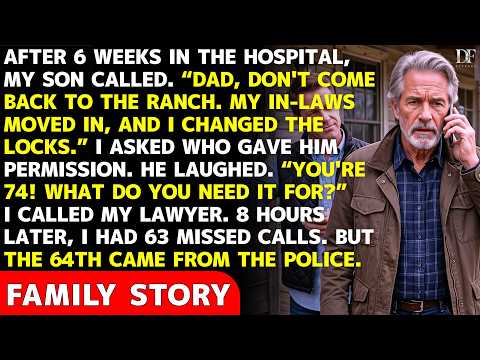
The call came at seven in the morning, on the very day they were finally letting me out of that hospital bed.
Six weeks I had lain there, breathing through a tube, counting ceiling tiles, dreaming of my own porch. And my son’s voice came through the phone bright as a salesman with a quota.
“Dad, don’t come back to the farm. I’ve moved Lorette’s family in and I’ve changed all the locks.”
I sat on the edge of the bed with my boots already laced, the discharge papers in my lap, and the room did a slow, terrible tilt.
“You did what, son?”
“It’s settled. Mom’s folks needed a home, and at your age and in your shape, a big farm is the last thing you need to worry about.”
I asked him who gave him permission. The laugh that came back at me is a sound I expect to hear in my last hour on earth.
“Permission? Dad, you’re seventy-four years old. What do you need that farm for anymore?”
Then the line went dead, and the dial tone hummed cheerful as a hymn.
I will tell you what did not happen, because it matters to me that it did not. I did not weep. I did not shout, and I did not call my boy back to beg a key out of him.
Something colder and older than grief stood up inside me—the part of a man who has buried a wife, calved in a blizzard, and signed papers before.
And it said one word. Lawyer.
Nella, the nurse who had fussed over me like a stray lamb for six weeks, stood in the doorway with my discharge folder and watched my face do whatever it was doing.
“Nella,” I said, “my son has locked me out of my own farm, and I need to make a telephone call to a woman in town.”
She did not waste a second on pity. Pity is a luxury item, and that girl deals in necessities.
“Then we’ll get your friend Theron on the phone right now, Mr. Vandever. And you’ll make your call sitting down, because your color is scaring me.”
I called Augusta Ridgeway from that bed with the sun coming up on my discharge day. She had done my family’s legal work since the year my son got his driver’s license, and she has the kind of honesty that does not bother to dress up.
When I finished telling her, her voice came through the wire calm as a pond at daylight.
“Zebulon, listen to me. You do not go to that farm. You do not touch a gate, a lock, or a door. Your friend brings you to my office, and we work from here—in the light, with the paper.”
Paper. I had spent ten months praying I would never need it. And my son had spent six weeks proving I would.
By nine o’clock I was sitting in her office with my hat in my lap, and Pauline, her paralegal, had my file open on the desk like a field dressed for surgery.
Augusta did not comfort me, and I will love that woman to my grave for skipping it. She set the trust in front of me—the Vandiver Heritage Land Trust, recorded at the county clerk’s office the spring before—and walked me through my own protection like a general walking a wall.
“The farm is in the trust. You are the trustee. Your son has no authority. He never had any. Everything he has signed is paper he had no right to sign.”
She put a pen in my hand, and I signed directives with a hand that surprised me by holding still. The first went to my bank. The second went to a company in Lexington that had been quietly circling my south field.
And then, with the ink still wet on my rescue, my telephone—face down on my lawyer’s desk—began to buzz against the wood.
Brant. It buzzed, stopped, and buzzed again before Pauline had even reached for her pen.
For the rest of that morning, my son was the insect and the wood and the summer sound of it. He called the way a man knocks on a door he has locked himself out of—faster, slower, harder, gentler, in every rhythm panic knows.
I did not answer. Pauline wrote down the time of every call on a legal pad, and the column grew like a fever chart.
It was the sheriff who finally reached me. The sixty-fourth call. And what he told me turned my blood to creek water.
My son had gone at my equipment shed with a pry bar—and laid hands on Odell Brockwell, the hired man who had guarded my tools and my cattle for twenty years.
I set the phone down and looked out the window at a spring morning that did not know it had become the first day of my life without illusions.
Home was eight days away. And I had one question left for the law to answer: what happens to a son who mistakes a father’s silence for a signature?
The sheriff’s name was Trenton Yates, and he had a voice like gravel deciding to be polite. He told it clean and short, the way men who have delivered hard mornings learn to do.
The incident at the shed. Odell’s shoulder. What Brant had shouted at a uniformed deputy with a camera riding on his chest—words the sheriff called, with delicacy, extremely clarifying.
Then he asked—not ordered, asked—whether my attorney would share the ownership records and the papers my son had been circulating. There were questions in it now beyond a shed door.
Augusta took the telephone from my hand, and I let her, because my hand had stopped belonging to me around the word custody.
“Sheriff, you will have everything through this office, in order. The trust, the deed, the bank records, and the young man’s paper. All of it.”
When she set the phone down, the room was still in the way rooms are still after weather. I sat looking at Pauline’s legal pad—the column of times, the number sixty-three written at the bottom of a list I had never answered.
My son had spent the whole morning telephoning the moment his father’s protection ran out. He had counted himself out one call at a time, in my lawyer’s handwriting.
Theron drove me to his house that afternoon because I could not yet go home, and I will not pretend those were easy days. I slept in a spare room under a quilt that smelled of somebody else’s cedar chest, and I woke each morning reaching for a porch that was not there.
But the law’s letters traveled faster than my son’s explanations.
They arrived at my own front door on Monday afternoon in the hands of a courier, and I heard about it later from Beauregard Ainsworth himself—across my kitchen table, months on, with his hat in his hands.
He had read the notice standing in my parlor. He read it twice, the way a man checks a wound. The farm belonged to a trust. The trust belonged to Zebulon Vandever. Zebulon Vandever had never consented to their presence—not to the lease that did not exist, not to the people residing in the house without the owner’s invitation.
Beauregard told me he sat down in my chair because his knees had filed a protest. And then he said the sentence that cost him more than any sentence of his life.
“We are squatters in a sick man’s house. And my son-in-law painted the sign.”
He did what a man of his generation does with a paper that ruins him. He telephoned the name printed at its head.
Augusta took his call herself. She confirmed the architecture in four plain sentences, and then she did a thing my son had never once thought to do for those people—she told them the truth about their position without enjoying it.
No one was coming to throw their furniture in the lane. There would be time for an orderly leaving.
Beauregard asked her one question, and she said his voice broke on it like a stick over a knee.
“Ma’am, did the old gentleman ever once agree to any of this?”
“Mr. Ainsworth, he did not know your family was in his house until his son telephoned him this morning and laughed about the locks.”
Philomena cried—not the decorative kind, the kind that comes up out of the floor of a woman. She cried for the bedroom she had been given, and for the photograph of herself under the gold letters, and most of all for the sentence she kept repeating: that she had touched another woman’s life with her moving boxes and called it a blessing.
It was Lorette, though, who went the color of paper.
Her father, careful with money the way farmers are with seed, asked her a question in my kitchen, and he asked it the way a man asks about a fire he can see from the road.
“Daughter, the Tennessee money—the seventy-two thousand we put into this move, into his hands for the expenses and the future he described. Where is it tonight?”
And Lorette, who had believed her husband’s story the way she had believed in the sign over the gate, looked at the telephone on the wall like it might answer for her.
“Dad, I don’t know. He told me it was handled. He told me everything was handled.”
Seventy-two thousand dollars, handled the way the spring had been handled—into debts and the bottomless pockets of a failing business.
Tobin said the room divided right there into people who had been robbed and the woman who had married the robber and only just found out she had been robbed first.
The telephone call came that night. Collect, from the county facility, and the family gathered around my kitchen telephone like mourners around a radio in wartime.
Brant’s voice came through with a jailhouse echo on it, already building his courthouse of excuses. The lawyer had ambushed him. The bank had conspired. His father had gone crazy in a hospital bed and signed the family farm into the hands of vultures.
Beauregard took the telephone from his daughter’s hand, and I have been told his voice did not rise at all—which is how I know it was the most dangerous voice that night.
“Son, you told us the man agreed. You told us he was honored. We sold our house on your word, and we have been sleeping in a stolen bed on your word, and my wife cried in a dead woman’s kitchen on account of your word. Do not speak to me about vultures.”
There was more. There was Lorette crying into the telephone that she had told her parents her husband was a man of his word. And there was Brant, at the end of his rope and still blaming the rope, saying the sentence his wife repeated to me weeks later with her eyes dry as paper.
“If my father had just stayed in that hospital, none of this would be happening.”
A family decides things in moments like that the way a house settles—all at once.
The Ainsworths decided that night that they would leave my house of their own free will, with their heads up, and that their quarrel over seventy-two thousand dollars was with Brant Vandiver and nobody else.
On Tuesday, Beauregard drove to Theron’s house, where I was camped in the spare room like a refugee from my own life, and he carried a plastic storage box with the lid taped shut. He set it on the kitchen table with the care of a man carrying a christening cake.
“Zebulon, this is your wife’s things. The blanket with the stitching on top, the way your man Odell said it was found. My family packed your house into boxes, and I am not a man who leaves another man’s wife in a box in a shed.”
My hands went into that box like a man’s hands go into river water after something precious dropped—and the blanket came up in them. Araminta’s stitches. Her uneven flowers along the border that she used to apologize for and I used to kiss.
I cried into that blanket in front of my son’s father-in-law, and I did not apologize for it. And he stood there with his hat in his hands and cried some himself.
“We were lied to, Zebulon. But that does not make us innocent of enjoying it. We are leaving your house, and we will settle our money with the man who took it, and you will not pay a cent of our trouble. That is my word—whatever words are worth in your family this spring.”
I held out my hand to him—the hand that had signed the trust—and we shook like men signing something older than paper.
That night I laid Araminta’s blanket across the foot of Theron’s spare bed and slept under the good smell of cedar and cotton, in the first peace I had known since February.
My son came out of the county’s hands on Friday with a list of conditions and four days of jailhouse food in his face. Augusta telephoned me the news, and I will tell you my first feeling honestly: it was not triumph. Triumph is a young man’s dish.
It was grief wearing a cleaner shirt—because whatever else the paper said, the man walking out of that building unrepentant was the boy I taught to ride a bicycle in the lane he later locked me out of.
The conditions were plain and sensible, and Pauline read them to me like a weather report for a season I would be living in. No contact with Odell Brockwell. No setting foot on Vandever Farm except by written schedule through the lawyers.
My son had been home an hour when he telephoned Theron’s house. Theron, bless the man, looked at me across his kitchen and let me decide with my own hand whether to take it.
I took it. A father takes it. That may be the diagnosis of my life.
“You had me arrested, Dad.”
No hello. No son’s voice softening at the edges. Just the indictment, first thing, like a man reading the weather he intends to blame for the flood.
“I had you warned, Brant,” I said. “By your mother, by me, by every fence post on that farm. You arrested yourself—in front of a camera, with a pry bar, on another man’s shoulder.”
“Odell came at me.”
“Odell is sixty-some years old and held a telephone while you were hurting him.”
He made a sound then that I have heard from him since he was nine years old and caught with the good jam on his chin—the sound of a boy deciding facts are a conspiracy.
“That lawyer of yours has you turned around so far you can’t see your own family. I was improving that house. I was building something. You’d rather see me in a cell than see this family move forward.”
I looked at Theron’s kitchen wall, at a calendar with a red barn on it, and I felt the tiredness come over me that is not in the body.
“Son, moving forward is not a direction you can steal in.”
He hung up on me. It is a small sound, a click, and I have heard it twice now in one spring from the same hand.
And I expect the second one cost him more than the first—because the first one still had a locked house behind it.
What arrived the following week was an invoice. My son had billed me for locks, paint, and furnishings—presented now as a debt owed by me to him. He had billed me for invading me.
I laughed until the laughing turned on me, and Theron had to put the kettle on for something to do with his hands.
Augusta’s answer went back like ice water in an envelope. “Mr. Vandever owes his son nothing for the privilege of having been robbed in good taste.”
Then Tobin came to Theron’s door with his phone and an envelope—messages, dated and timed, proving the plan was laid before my birthday. And a birthday card, hidden behind a truck seat, in crayon: Come home soon.
I held that card the way a man holds a bird with a broken wing.
They left my house on Friday. Odell climbed to the loft and found my sign, my wife’s chair, and the pink stakes—all kept. “All present and accounted for, Mr. Zebulon.”
I signed for my own house on Monday, and Theron drove me home. Odell had glued the loose rung and oiled the wood until it shone.
“A house should have its chair ready when its man comes home.”
I put the birthday card under the strawberry magnet on my refrigerator, and I sat in Araminta’s chair while the light went down over ground that answers to my name.
A man can refuse his son and keep his soul. The two were never the same account.
So tell me, friends—when the gate is yours again, what do you hang on it first?
Report this article
Select a reason for reporting:






