The sky tore open with a sound that would haunt a generation. It started as a distant whine, then grew into a piercing, bone-rattling scream—the infamous Jericho Trumpets of the Junkers Ju 87 Stuka. For the soldiers and civilians below, that sound meant only one thing: death was diving toward them, and there was nowhere to hide.
This was the weapon that spearheaded the Nazi blitzkrieg, a symbol of terror that struck fear into millions across Europe. But behind its fearsome reputation lay a story of innovation, failure, and a design that was already outdated when World War II began.
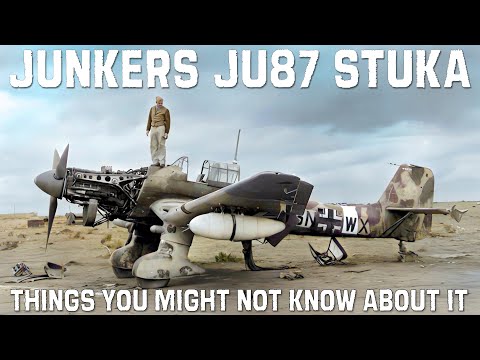
The Stuka’s origins trace back to the Junkers K-47, a civilian aircraft built in 1927 when Germany was forbidden from producing military planes. Its robust design and twin-tail configuration caught the eye of Hermann Pohlmann, who would become the Stuka’s chief designer. By 1935, the first prototype took flight, but it was far from perfect.
Disaster struck on January 24, 1936, when the prototype crashed during a dive test. The entire tail assembly simply broke off, killing the test pilot and his engineer. Pohlmann had no choice but to redesign the tail, but his solution—a single vertical stabilizer—created a new problem: it drastically reduced the rear gunner’s field of fire. The Stuka was vulnerable from behind, a flaw that would later prove deadly.
Despite these issues, the Stuka entered service and quickly proved its worth in Poland. On September 1, 1939, three Stukas from Geschwader 1 dropped the first bombs of the war. The Luftwaffe’s coordinated air and ground attacks shattered Polish defenses, and the Stuka became the poster child of blitzkrieg. Its accuracy was unmatched: diving nearly vertically, it could place a bomb with pinpoint precision, something conventional bombers couldn’t dream of.
But the Stuka had a fatal weakness. It was slow, cumbersome, and nearly defenseless against modern fighters. When pitted against the Royal Air Force’s Spitfires and Hurricanes during the Battle of Britain, the Stuka suffered devastating losses. Göring was forced to withdraw the dive bombers from frontline operations, a humiliating setback.
Yet the Stuka’s story was far from over. It would go on to serve in North Africa, the Mediterranean, and the vast expanses of the Eastern Front, where it would take on new roles—including that of a tank buster. And it was there, in the hands of pilots like Hans-Ulrich Rudel, that the Stuka would carve its most enduring legend.
But the question remains: how did a plane that was obsolete at the start of the war become one of its most feared weapons? The answer lies in the men who flew it and the desperate innovations that kept it relevant until the very end.
In the hands of pilots like Hans-Ulrich Rudel, the Stuka found a new purpose. Rudel, the most decorated German pilot of the war, flew over 2,500 missions and destroyed more than 500 tanks, a feat unmatched by any other pilot in history. His exploits turned the Stuka into a legend, even as the tide of war turned against Germany.
By 1943, the Eastern Front had become a war of attrition, and the Stuka was pressed into service as a tank buster. Equipped with two 37mm cannons under the wings, the Ju 87G “Kanonenvogel” proved devastating against Soviet armor. Rudel himself claimed to have knocked out 12 tanks in a single day during the Battle of Kursk. But these successes came at a terrible cost.
The Stuka was still slow and vulnerable. Soviet fighters, particularly the Yak-9 and La-5, hunted them relentlessly. Entire squadrons were decimated, and by late 1944, the Luftwaffe was running out of experienced pilots. The production of the Stuka ceased in October 1944, but the remaining aircraft continued to fly until the war’s end.
One of the last major Stuka operations was during the Soviet advance on Berlin in April 1945. With the Red Army crossing the Oder and Neisse rivers, the Stukas were ordered to destroy the bridges at Küstrin. It was a desperate mission. The bridges were heavily defended by anti-aircraft guns, and the Stukas were without fighter cover. The attack failed, and the few remaining Stukas were lost.
Today, only two complete Stukas survive. One is at the RAF Museum in Hendon, London, and the other is in the United States. They stand as silent witnesses to a weapon that, despite its flaws, left an indelible mark on the history of warfare. The Jericho Trumpets may have fallen silent, but the memory of that terrifying scream lives on.
Yet the story of the Stuka is not simply one of technical specifications and combat statistics. It is also a story of human psychology—of how a weapon can become something more than a machine, transformed into a symbol that lives in the minds of those who faced it. For the soldiers huddled in trenches and the civilians fleeing along bombed-out roads, the Stuka was not just an aircraft; it was the sound of impending doom.
Veterans of the campaigns in Poland and France described the experience in visceral terms. The scream of the Jericho Trumpets, they said, seemed to bypass the ears and strike directly at the spine. Men who had endured artillery barrages found themselves paralyzed by that sound, unable to move, unable to think, waiting for the earth to open up beneath them.
This psychological impact was no accident. The sirens were designed specifically for terror, mounted on the fixed landing gear struts to maximize the auditory assault. Some German pilots reportedly found the noise unsettling themselves, a grim reminder that they were part of a machine built not just to destroy but to unnerve.
But as the war dragged on, the Stuka’s role evolved in ways its designers never anticipated. In the frozen wastes of the Eastern Front, where temperatures plummeted to -40 degrees Celsius, the aircraft proved surprisingly resilient. Ground crews worked miracles in impossible conditions, warming engines with improvised heaters and coaxing frozen machinery back to life.
It was here, in the vastness of Russia, that the Stuka’s limitations became most apparent—and its adaptability most remarkable. With the introduction of the Ju 87G variant, armed with two 37mm cannons, the Stuka transformed from a dive bomber into a precision tank killer. The Kanonenvogel, as it was known, could punch through the armor of Soviet T-34s with a single well-placed burst.
Hans-Ulrich Rudel became the embodiment of this new role. His exploits were legendary even during the war, and his survival seemed almost supernatural. Shot down multiple times, wounded repeatedly, he kept flying. By the war’s end, Rudel had destroyed 519 tanks, sunk a battleship, and earned the Knight’s Cross with Golden Oak Leaves, Swords, and Diamonds—Germany’s highest military decoration.
But Rudel was the exception. Most Stuka crews faced the grim reality of attrition. The Luftwaffe’s pool of experienced pilots shrank with each passing month, and replacements arrived with barely a fraction of the training their predecessors had received. By 1944, the average Stuka pilot had fewer than 50 hours of flight time before being thrown into combat.
The aircraft themselves were wearing out. Airframes accumulated stress fractures from countless dives, and spare parts became increasingly scarce as Allied bombing campaigns targeted German factories. Mechanics cannibalized damaged planes to keep others flying, a desperate measure that could only delay the inevitable.
In Italy, the Stuka faced a new kind of war. The Allied advance up the peninsula was slow and bloody, but the Luftwaffe’s ability to contest the skies had been shattered. When the Allies landed at Anzio in January 1944, German forces mounted a ferocious counterattack, but the Stukas that supported it operated under constant threat from Allied fighters.
The end came swiftly for many Stuka units. As the Allies pushed into Germany itself, the remaining aircraft were thrown into hopeless missions against overwhelming odds. Bridges, supply depots, and troop concentrations were targeted with diminishing returns, the Stukas’ effectiveness blunted by fuel shortages and the constant threat of interception.
The final weeks of the war reduced the Stuka to a ghost of its former self. Airfields were overrun, fuel reserves evaporated, and the few remaining aircraft flew missions that were little more than suicide. In the chaos of Berlin’s fall, some Stukas were reportedly flown by teenage pilots of the Hitler Youth, boys who had barely learned to fly before being sent against Soviet tanks.
When the guns finally fell silent in May 1945, the Stuka’s story seemed to end. The production lines were dismantled, the squadrons disbanded, and the men who had flown them scattered to the winds. Some were captured, some fled west, and some simply vanished into the ruins of a defeated nation.
Yet the aircraft itself refused to disappear entirely. In the decades after the war, a handful of Stukas were recovered from crash sites and battlefields, their twisted frames pulled from Russian marshes and Norwegian fjords. Restorers painstakingly rebuilt them, piece by piece, until the angular shape of the dive bomber emerged once more.
Today, the last surviving Stuka in Western Europe sits in the RAF Museum at Hendon. Its thick, almost friendly profile belies the terror it once inspired. Children who climb the museum’s exhibits and peer into its cockpit have no memory of the scream that once sent armies fleeing. For them, it is simply an old airplane, a relic of a war their great-grandparents fought.
But for those who lived through those years, the Stuka remains something else entirely. It is the sound of the world ending, the memory of a time when death came from the sky with a shriek that could not be blocked out. The Jericho Trumpets are silent now, but they echo still in the minds of those who heard them.
Perhaps that is the true legacy of the Stuka—not its technical specifications, not its combat record, but its ability to burrow into the human psyche and remain there. It was a weapon designed for terror, and in that grim purpose, it succeeded beyond its creators’ wildest dreams.
What do you think? Was the Stuka a technological marvel or a flawed design that should never have flown? Share your thoughts in the comments below.
Report this article
Select a reason for reporting:






