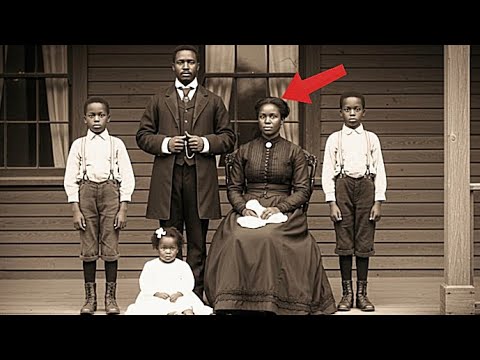
Look closely at this photograph. A Black family from South Carolina, dressed in their Sunday best, captured in the summer of 1912. The father’s hand rests on his wife’s shoulder. Three children sit perfectly still, their eyes fixed on the camera. Behind them, a modest wooden porch. Nothing unusual, nothing remarkable—or so it seemed for over a century.
But when a team of historians digitized this image in 2023, they noticed something that made them catch their breath. A silver compass half-hidden in the father’s vest pocket. Its needle pointing not north, but directly at the youngest child. And in the mother’s hands, a handkerchief folded into a pattern that hadn’t been seen since the days of the Underground Railroad. These weren’t fashion choices. They were codes, signals—a message hidden in plain sight for over a hundred years. A message that would expose one of the most dangerous secrets of the Jim Crow South. What this family was really doing could have gotten them killed. And the truth behind this photograph is about to rewrite everything we thought we knew about resistance in America.
The photograph appeared at a small estate auction in Charleston, South Carolina, on a humid September morning in 2023. Dr. Helen Graves had almost skipped the event. The auction house specialized in antique furniture, not historical documents, and she had a conference call scheduled for noon. But something in the catalog listing caught her attention: a collection of photographs from a demolished house in the rural low country, some dating back to the early 1900s.
She arrived late, slipping into the back row just as the auctioneer held up a wooden box filled with sepia-toned images. “Lot 47,” he announced. “Assorted photographs circa 1910 to 1920, unknown subjects, starting at $50.” Helen raised her paddle almost without thinking. She won the lot for $75.
That evening, in her cramped office at the university, she spread the photographs across her desk. Most were unremarkable—stiff portraits of unidentified families, faded landscapes, a few damaged beyond recognition. But one image made her pause.
It showed a Black family of five standing on a wooden porch. The father wore a dark suit, his posture rigid but dignified. The mother sat in a chair, her hands folded in her lap holding what appeared to be a white handkerchief. Three children surrounded them—two boys and a girl, the youngest no more than five or six.
Helen studied their faces. There was something in their expressions that didn’t match the formal pose. A tension around the eyes, a guardedness that seemed deliberate. She turned the photograph over. On the back, in faded pencil, someone had written: “The Crossing, summer 1912.”
The Crossing. Helen frowned. She knew every major Black community in the low country from that era. She had never heard of any place called The Crossing.
She pulled out her magnifying glass—a habit from decades of archival work—and leaned closer to the image. That’s when she saw it. In the father’s vest pocket, barely visible against the dark fabric, was the glint of something metallic. She adjusted her desk lamp and looked again. A compass—a silver compass. And its needle wasn’t pointing north.
Helen spent the next three hours examining the photograph under every light source in her office. The compass was real, she was certain of it now. She could make out the delicate engravings on its casing, the thin black needle suspended behind glass. But what disturbed her was the direction. In every compass she had ever seen, the needle pointed north—magnetic north, always. This needle pointed downward, toward the bottom of the photograph, toward the youngest child.
She told herself it had to be a trick of the angle, a distortion from the old camera lens. But the more she studied it, the more intentional it seemed. The father’s body was angled slightly, his vest pulled open just enough to reveal the compass—as if he wanted it to be seen.
And then there was the handkerchief. Helen had almost missed it at first. The mother’s hands were folded so naturally, the white cloth seemed like nothing more than a decorative accessory. But under magnification, she could see that the handkerchief was folded into a precise geometric pattern. Triangles nested within triangles, forming a shape she recognized from her graduate research.
It was a quilt code. During the era of the Underground Railroad, certain quilt patterns were believed to carry hidden messages for escaping slaves. A bear’s paw meant to follow animal trails; a North Star meant to travel at night. The patterns were stitched into quilts and hung on clotheslines—visible signals that guided the way to freedom.
But by 1912, the Underground Railroad had been defunct for nearly 50 years. Slavery had ended. The codes should have been obsolete. So why was this woman holding one in her hands?
Helen pulled up a database of census records and began searching for Black families in rural South Carolina in 1912. She cross-referenced property records, church registries, and tax documents. Nothing matched. It was as if this family had never existed.
She stared at the photograph until her eyes burned. Five people frozen in time, hiding something so dangerous they had erased themselves from history. Helen picked up her phone and called the only person she trusted with something this explosive.
The line rang four times before a gravelly voice answered. “Helen? It’s nearly midnight. What’s wrong?”
Marcus Webb had spent thirty years as a forensic archivist for the Smithsonian before retiring to a cabin outside Beaufort. He had an encyclopedic memory for Southern records and, more importantly, a talent for recognizing when history had been deliberately buried.
“I need you to look at something,” Helen said. “A photograph. 1912. A family that doesn’t exist in any record I can find.”
She described the compass, the handkerchief, the inscription on the back. There was a long silence on the other end of the line. When Marcus spoke again, his voice had changed.
“Say the pattern again. The handkerchief. Describe it exactly.”
Helen held the magnifying glass steady. “Triangles inside triangles. Like a star, but broken—one point longer than the others.”
Marcus exhaled slowly. “That’s not a quilt code, Helen. That’s a track pattern. The old railroad men used it to mark safe houses along the coastal routes. A broken star meant the house was compromised but the family inside was still moving.”
Helen’s hand tightened around the phone. “Moving where?”
“North, usually. But in 1912, in the low country? There was only one place that mattered.” He paused. “The Crossing wasn’t a town. It was a network. A second Underground Railroad, run by Black families who never stopped operating. They moved people out of the Jim Crow South for decades after the Civil War. And if this photograph is real, Helen, then you’re holding proof that it existed.”
Helen’s mind raced. “Why would they photograph themselves? That’s a death sentence if anyone decoded it.”
“Because they weren’t advertising,” Marcus said. “They were leaving a record for the people who came after. A family portrait was the safest place to hide a message. Nobody looked twice at a Black family posing for a picture in 1912. But the compass pointing at the youngest child—that’s a marker. It means the child was the next link in the chain. Whoever received this photograph would know where to go.”
Helen looked at the little girl in the image, her hands folded in her lap, her eyes steady and unafraid. Five or six years old, and already carrying the weight of a secret that could get her killed.
“I need to find out who they were,” Helen said. “Their real names. Where they lived. What happened to them.”
“Then you need to start with the auction house,” Marcus replied. “Find out whose house was demolished. Whoever kept that photograph for a hundred years knew what it was. They were protecting it.”
Helen hung up and pulled up the auction catalog on her laptop. The listing was sparse—just an address and a date. But the address was enough. She typed it into a property search and waited.
The screen loaded. A single result appeared. The house had belonged to a woman named Cora Bellamy. She had lived there alone until her death in 2022, at the age of 103.
Helen stared at the name. Cora Bellamy. No husband, no children listed in the obituary. But the photograph in Helen’s hands showed a family of five. A mother, a father, three children.
She zoomed in on the youngest child’s face, the one the compass pointed toward. The girl’s eyes were wide and dark, her chin lifted slightly. Helen looked at the obituary photo of Cora Bellamy—a wrinkled face, silver hair pulled back, eyes that still held the same steady gaze.
It was her. The little girl in the photograph had lived to be 103 years old.
And she had kept the family’s secret for a century.
Helen drove to the demolished lot the next morning, where only a cracked foundation remained. A neighbor pointed her toward the county historical society, and there she found a locked trunk labeled with Cora’s name—donated, unopened, forgotten.
Inside lay a journal, its pages brittle as autumn leaves. The handwriting was careful, deliberate. “They called us the Crossing,” Cora had written. “Not a place. A promise. When the law said we were free but the night riders said otherwise, we carried our people out. Three at a time. One family at a time.”
Helen read until her eyes blurred. The father in the photograph was Cora’s uncle, a barber named Elijah. The compass had belonged to his own father, who had guided runaways before the war. “The needle points to the one who carries the next name,” Cora wrote. “I was the next name. I was five years old, and I carried the list of safe houses sewn into my hem.”
Marcus came to see the journal that evening. He turned the pages slowly, his jaw tight. “They moved over two hundred people between 1900 and 1930,” he said quietly. “Farmhands, teachers, children. The records never showed it because no one lived to file a report.”
Helen looked back at the photograph—the ordinary porch, the ordinary family, the extraordinary courage. “She kept it hidden her whole life,” she said. “Never spoke of it. Never told a soul.”
“She told us,” Marcus said, tapping the journal. “She just waited a hundred years for someone to look close enough.”
The photograph now hangs in the state museum, its codes finally decoded. But Helen still wonders how many other families left messages no one has read yet. How many ordinary portraits hide a compass, a folded cloth, a whispered promise?
So look again at the old photographs in your own family’s attic. What if one of them is trying to tell you something?
Report this article
Select a reason for reporting:






