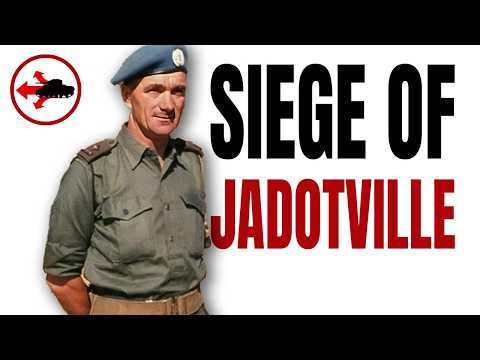
In the heart of the African jungle, a small band of Irish soldiers stood alone against a force ten times their size. They were outnumbered, outgunned, and abandoned by their superiors. Yet, they were about to make history.
Commandant Pat Quinlan, a seasoned officer, sensed danger the moment his company arrived in the sleepy mining town of Jadotville. The locals were hostile, the rules of engagement were suffocating, and the enemy was closing in. He ordered his men to dig deep trenches and stockpile supplies, ignoring the ridicule of his peers. “Dig, and keep your rifles loaded,” he told them. His instincts would soon be their only salvation.
On September 13, 1961, while most of the men attended mass, the attack came. A hail of gunfire and mortars rained down on the Irish compound. But Quinlan’s preparations paid off. The first wave of over 600 attackers was repelled with devastating fire. The Irish inflicted heavy casualties, and not a single soldier was killed. The enemy, led by French and Belgian mercenaries, fell back in disarray.
But this was only the beginning. The Katangese forces, thousands strong, encircled the Irish position. Wave after wave of attacks crashed against the defenses, supported by aerial bombings and strafing runs. Yet the Irish held. For three days, they fought with dwindling ammunition and water, their calls for reinforcements ignored.
Quinlan negotiated a ceasefire to collect the dead, but the truce was repeatedly broken. With no relief column in sight and supplies running out, he faced an impossible choice. “We can’t hold out much longer,” he told his men. “But we will not go down without a fight.”
The world watched as the siege tightened. Would Quinlan’s luck hold, or would his small band be overrun? The answer would shock everyone.
On the morning of September 17, the situation inside the Irish compound had grown desperate. The trenches were littered with empty shell casings, the water drums had run dry, and the men were reduced to rationing their last few rounds. Quinlan walked among them, his face grim but steady, checking each position one final time.
The mercenary commanders, sensing the end was near, sent a messenger under a white flag. They demanded unconditional surrender. Quinlan gathered his officers. “We’ve done everything asked of us and more,” he said quietly. “But I won’t throw away these men’s lives for pride.” The decision was made.
When the white flag rose over the compound, the Katangese forces surged forward, expecting to find a broken and beaten enemy. Instead, they found the Irish standing in perfect formation, rifles stacked, uniforms still neat despite days of relentless combat. The mercenaries stared in disbelief. These men had held off thousands with nothing but grit and discipline.
As prisoners, the Irish were treated with a strange mixture of resentment and respect. The mercenary leaders, many of them veterans of other colonial wars, privately admitted they had never seen a defense so skillfully conducted. One Belgian officer reportedly told Quinlan, “You should have been on our side.” Quinlan said nothing.
Back in Ireland, however, the story was different. The men of A Company returned home to silence. There were no parades, no medals, no speeches. Instead, there were whispers. “They surrendered,” people said. “They gave up.” The nuance of the situation, the impossible odds, the lack of support, none of it mattered to a public hungry for heroes who never waved a white flag.
Quinlan himself rarely spoke of Jadotville afterward. He continued his military career quietly, never seeking recognition. But his men never forgot. They knew what they had done. They knew the truth.
Years later, as military historians began to examine the siege in detail, the narrative slowly shifted. Quinlan’s perimeter defense became a case study at officer academies around the world. The Battle of Jadotville was reclassified from a shameful surrender to a tactical masterpiece. But for the men who lived it, the scars of being forgotten ran deeper than any bullet wound.
And as for Commandant Pat Quinlan, he would carry the weight of that day for the rest of his life, a hero who was never allowed to be one.
Yet the story of Jadotville did not end with Quinlan’s quiet retirement. In the decades that followed, a handful of his veterans began to speak. They wrote letters, gave interviews, and pressed the Irish government to acknowledge what had happened. “We didn’t run,” one of them said. “We held for six days against thousands. We deserve the truth to be told.”
Their campaign gained little traction at first. Ireland in the 1970s and 80s had little appetite for revisiting the Congo. But the men persisted, and slowly, historians took notice. Declassified documents revealed that Quinlan’s requests for reinforcements had been repeatedly denied, not ignored by accident but because his superiors believed the relief column would never reach him in time.
In 2005, the Irish government finally issued a formal statement. It stopped short of an apology but acknowledged that the men of A Company had faced “extraordinary circumstances” and had “performed their duties with courage and discipline.” For the surviving veterans, it was a small victory, though many had already passed away.
Then came the film. In 2016, a major motion picture brought Jadotville back into the public eye. Suddenly, the men who had been shunned were being celebrated. Schools invited them to speak. Towns held ceremonies. Quinlan’s widow, Carmel, accepted a posthumous award on his behalf, her hands trembling as she held it.
But the recognition came with a bitter edge. Some of the veterans wondered why it had taken so long. Why had their commander died without ever hearing his country say he was right? Why had they been made to feel ashamed for so many years?
And still, the deeper questions lingered. The siege had been fought in the shadow of the Cold War, a chessboard of uranium and influence. The men on the ground had been pawns in a game they never fully understood. They had fought for peace in a war that was never really theirs.
Today, a small monument stands in Jadotville, now known as Likasi. It bears the names of the Irish soldiers who held the line. Few tourists visit it. But those who do often stand in silence, imagining the sound of gunfire and the heat of the African sun.
The men of A Company are nearly all gone now. But their story remains, a testament to what a small group of determined soldiers can do when the world has turned its back on them.
In the years since the film’s release, the surviving veterans of A Company have become unlikely celebrities. They attend reunions, shake hands with strangers, and listen as young officers thank them for their example. “We were just doing our job,” they say, but their eyes betray the weight of history.
Commandant Quinlan’s son, Pat Jr., has become a keeper of the flame. He speaks at schools, museums, and military academies, telling the story his father never told. “He wasn’t a man who sought glory,” Pat Jr. says. “He sought to bring his men home. And he did.”
The siege of Jadotville is now taught alongside Thermopylae and Rorke’s Drift as a masterclass in defensive warfare. Military strategists pore over Quinlan’s trench layouts and supply discipline. His handwritten orders, preserved in the Irish Military Archives, reveal a mind that anticipated every enemy move.
But for the men who were there, the lessons are more personal. They learned that courage is not the absence of fear, but the will to act despite it. They learned that loyalty to one’s comrades can outlast any official neglect. And they learned that history, though slow, can sometimes correct itself.
In 2021, on the sixtieth anniversary of the siege, a ceremony was held at the Irish National War Memorial Gardens. The President of Ireland laid a wreath. The army band played. For the first time, the men of A Company were officially honored as heroes.
Some of the veterans wept. Others stood stone-faced, lost in memory. One old soldier, leaning on a cane, whispered to his grandson, “We didn’t do it for medals. We did it for each other.”
And so the story of Jadotville closes, not with a surrender, but with a reckoning. The white flag that once brought shame now flies in museums as a symbol of survival. The trenches are long gone, overgrown by jungle, but the line they held remains unbroken in memory.
What do you think? Should soldiers who surrender against impossible odds be celebrated as heroes, or does the word ‘surrender’ always carry a stain?
Report this article
Select a reason for reporting:






