Dr. Maya Richardson had seen thousands of photographs from the Jim Crow South, but the moment she zoomed in on the groom’s hand, her breath caught. The image was a formal engagement portrait from 1909, two young Black people posed with dignified seriousness. But Thomas Wright’s fingers were arranged in a deliberate, unnatural configuration—thumb extended, index and middle fingers pointed downward, ring and pinky curled inward. It was no accident. It was a signal.
Maya’s pulse quickened as she recognized the pattern. She had read about such codes in obscure oral histories, whispered accounts of secret protection networks operating under the noses of white authorities. This was a message, a declaration, a warning. And it had been hiding in plain sight for over a century.
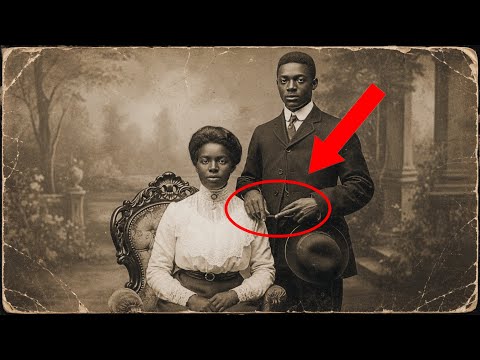
The photograph had arrived that morning in an email from a woman named Jennifer Matthews, a descendant of the couple. “Family heirloom, can you help date this?” the subject line read. But Maya, a historian specializing in African American life in the Jim Crow South, knew immediately that this was no ordinary heirloom. The studio stamp read Morrison Photography, Atlanta, Georgia, 1909—one of the few Black-owned studios of the era. The woman, Clara Bennett, sat in an ornate chair, her lace-trimmed blouse and Gibson Girl hairstyle speaking of education and relative prosperity. Behind her, Thomas Wright stood in a tailored suit, his hand resting on her shoulder.
At first glance, the gesture seemed protective, even tender. But Maya had spent fifteen years studying the quiet resistance of Black communities under segregation. She had learned to read the unspoken language of survival. That hand position was not casual. It was a code, one she had encountered only in fragments—a signal meaning under protection.
She spent the next two hours comparing the image with dozens of other engagement photographs from Black Atlanta between 1900 and 1920. None showed a similar finger configuration. This was unique. Deliberate. A message meant for someone.
Maya replied to Jennifer, asking for the couple’s names. The response came within minutes: “The woman is my great-great-grandmother, Clara Bennett. The man is Thomas Wright, who became her husband. I don’t know much more than that. Why? Is there something unusual about it?”
Clara Bennett. The name triggered a memory. Maya pulled open her filing cabinet and began searching through primary sources. Twenty minutes later, she found it: a brief mention in a 1909 issue of the Atlanta Independent. “Miss Clara Bennett, teacher at the Auburn Avenue School, was called upon to give testimony regarding the tragic events of March 15th.”
March 15th, 1909. Six months before the photograph was taken. Maya’s hands trembled as she searched the newspaper archives. The front page of the March 16th edition carried the headline: “Community in Mourning. Robert Johnson Lynched.” The article described how a young Black man had been accused of speaking disrespectfully to a white woman. A mob had dragged him from his workplace, beaten him, and hanged him from a tree near the railroad tracks.
But buried in the fourth paragraph was a sentence that changed everything: “Miss Clara Bennett, a witness to the initial confrontation, has stated that young Mr. Johnson’s words were misconstrued and that he meant no disrespect.”
Clara Bennett had witnessed the incident that led to a lynching—and she had been willing to publicly state that the accusations were false.
Maya immediately called Jennifer Matthews. “Did your family ever mention that Clara Bennett was in danger? That she was threatened?”
There was a long pause on the other end of the line. “My grandmother used to say that Clara was the bravest woman who ever lived. She said Clara saw something terrible and refused to stay quiet, even when people told her she should. Grandmother said Clara had protectors, men who watched over her day and night, but she never explained what it all meant.”
Maya felt her pulse quicken. “Did she ever mention Thomas Wright? What he did for a living?”
“She said he was a soldier, that he came back from the army and worked as a railroad porter, but there was something else about him, something grandmother would start to say and then stop herself, like it was a secret she wasn’t supposed to tell.”
After the call ended, Maya dove deeper into the archives. She found Clara’s employment records: 23 years old in 1909, teaching reading and arithmetic to Black children in a two-room schoolhouse. Her evaluations described her as dedicated, intelligent, and principled. Then Maya found the incident report from March 15th. Robert Johnson, age 19, had been working as a delivery driver. He had made a delivery to a store where a white woman was shopping. According to multiple Black witnesses, Johnson had simply said, “Excuse me, ma’am,” when passing her in the narrow aisle. The woman’s husband, who arrived moments later, claimed Johnson had been insolent and threatening.
Clara Bennett had been in the store purchasing supplies for her classroom. She had seen and heard everything. And, unlike the other witnesses, who understood the mortal danger of contradicting a white person’s story, Clara had gone to the police and then to the newspaper to state what actually happened.
It hadn’t saved Robert Johnson. Nothing could have saved him once the accusation was made. But Clara’s testimony had been published, creating a record that challenged the official narrative.
Maya found more newspaper articles from the following weeks. Anonymous letters to the editor praising Clara’s courage. A brief notice that Clara had received threatening messages. A terse statement from the school board supporting her continued employment despite recent controversies. Then, in an article dated April 3rd, she found something that made her sit up straight: “Members of the community have expressed concern for Miss Bennett’s safety. Unnamed report that protective measures have been implemented.”
Protective measures? Unnamed sources? Maya looked again at the photograph, at Thomas Wright’s hand with its strange finger configuration, at the serious expressions on both faces, at the deliberate formality of the pose. This wasn’t just an engagement photograph. This was a message, a declaration, a warning to anyone who might be watching.
Maya needed to know more about Thomas Wright. She started with military records, searching through databases of African American soldiers who had served in the early 1900s. She found him in the records of the 25th Infantry Regiment, one of the Army’s all-Black units. Thomas Wright had enlisted in 1903 at age 18 and served for five years, stationed at Fort Huachuca in Arizona Territory. His service record noted him as reliable, disciplined, and a skilled marksman. He had received an honorable discharge in 1908 and returned to Atlanta, his hometown.
But what had he done after returning? “Railroad porter,” Jennifer had said. Maya searched employment records and city directories. She found Thomas listed at an address on Auburn Avenue, the heart of Black Atlanta, working for the Southern Railway Company. Then she found something unexpected. In the membership records of the Wheat Street Baptist Church, one of Atlanta’s prominent Black churches, Thomas Wright was listed not just as a member, but as part of something called the Brotherhood Committee.
The term was vague, giving no indication of what the committee actually did. Maya called Dr. James Peterson, a colleague who specialized in Black churches and their role in community organizing during the Jim Crow era. “James, have you ever heard of something called a Brotherhood Committee in early 1900s Black churches?”
“Brotherhood committees were common,” James replied. “Usually they organized charity work, helped families in need, that sort of thing. Why?”
“What if they did something else, something they couldn’t talk about openly?”
There was a pause. “You’re talking about protection groups, self-defense organizations. They existed, Maya, but they were extremely secretive. If white authorities had known about organized groups of Black men preparing to defend their community, it would have been seen as insurrection. The consequences would have been catastrophic.”
“How would they have operated?”
“In complete silence. They would have used codes, signals, met in secret. Members would have been carefully vetted. They would have been ready to protect specific individuals under threat, to gather intelligence about potential violence, to create networks of safe houses. They were essentially underground resistance cells operating inside churches and fraternal organizations.”
Maya felt the pieces beginning to align. Thomas Wright, a trained soldier, returns to Atlanta and joins a Brotherhood Committee. Clara Bennett witnesses a lynching and publicly contradicts the justification for it. Clara receives threats. And then, months later, Thomas and Clara pose for an engagement photograph where his hand is positioned in a way that looks nothing like any other photograph from that era.
She needed to find out what that hand position meant. Maya reached out to Dr. Leonard Washington, a historian who had written extensively about coded communication among enslaved people and their descendants. She emailed him the photograph, highlighting Thomas’s hand position. His response came the next morning: “This is extraordinary. That hand configuration matches descriptions I found in oral histories of signals used by protection groups in the early 1900s. The extended thumb, the pointed fingers, the curled pinky—it’s a deliberate sign. I’ve seen references to it meaning ‘under protection’ or ‘guarded.’ It was a way of communicating that someone was not alone, that harming them would bring consequences. Where did you find this?”
Maya’s heart raced as she typed her response, explaining everything she had discovered about Clara and Thomas. Leonard called her within the hour. “Maya, what you found is remarkable. These protection networks have been largely lost to history because they had to be so secret. If you can prove that this photograph was a deliberate message—that Thomas was signaling Clara’s protected status—then you’ll be documenting something incredibly important.”
“But why make it visible in a photograph? Wasn’t that risky?”
“Think about it strategically. A photograph is a record, it’s evidence. If something happened to Clara, that photograph would prove she wasn’t just some random target. It would show she had organized protection. That might not have prevented violence, but it would have changed its meaning. It would have turned an attack on her into an attack on the organization protecting her. It raises the stakes.”
Maya understood. The photograph was both shield and sword. And it was only the beginning.
Maya spent the next week piecing together the world Clara and Thomas had inhabited. She found Thomas wasn’t the only veteran at Wheat Street Baptist—at least eight other men in the congregation had served in the Army’s Black regiments, all returning to Atlanta between 1906 and 1909, all listed on the Brotherhood Committee. She built a timeline: the lynching, Clara’s testimony, the threats, the protective measures, the September photograph.
Then she found the marriage license. Thomas and Clara wed on October 2nd, 1909, and the witnesses included four men—all Brotherhood Committee members, all veterans. The November Atlanta Independent reported that the five men accused in Robert Johnson’s death had been convicted of manslaughter. Clara had testified, and she had lived to see justice.
Maya pulled the trial transcripts. Clara’s recorded words were steady: “I am certain of what I saw and heard. Robert Johnson was murdered for something he did not do. That is the truth.” During those three weeks, Thomas and two other committee members had taken leave from their jobs. A newspaper photograph showed them along the back wall of the courtroom—dark suits, alert postures. They had been Clara’s shield, her proof that she was not alone.
Jennifer invited Maya to her home, where a locked wooden box yielded letters in Thomas’s hand. One, dated September 1909, read: “My hand on your shoulder is not just because I love you, though I do with all my heart. It is a signal to anyone watching that you are under our protection. Let them see it. Let them understand. You will never be alone.”
Maya traced their lives onward: they took in Robert’s younger brother David and paid his tuition through the Brotherhood Committee; Clara became a school principal; Thomas coordinated witnesses for the NAACP. The codes passed down through generations, appearing in photographs from 1912, from voter registration drives in 1920, from sit-ins in 1961.
The exhibition, Courage and Code, opened in February 2024. Four generations of Clara’s descendants stood before the photograph. “They look strong,” Jennifer’s youngest grandchild said. “They were,” Jennifer answered. “They were.”
That evening, Maya opened a new document and began typing. There were more photographs to analyze, more codes to decipher, more hidden histories waiting in attics and albums. Clara and Thomas had left a message across time—and the world had finally learned to read it.
So now the question turns to us: when you look closely at the world around you, whose quiet protection are you noticing—and what message will you leave for those who come after?
Report this article
Select a reason for reporting:






