What happens when the charming man on the silver screen becomes someone completely different behind a locked door? The answer, as we’re about to discover, is a chilling reminder that fame can hide many things—but it cannot erase every witness.
For decades, Hollywood has sold us a dream: the handsome hero, the lovable rogue, the sensitive artist. But for some of the industry’s most celebrated leading men, that dream was a carefully constructed illusion, one that crumbled the moment the cameras stopped rolling. Behind the glittering premieres and adoring fan letters, another story unfolded—one of violence, control, and silence.
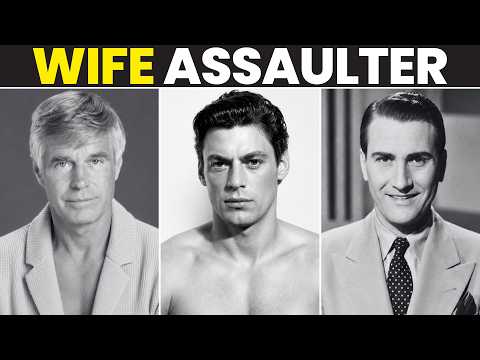
Some of these men were convicted in a court of law. Others were arrested, accused in sworn filings, or named by relatives years after their deaths. When a claim was denied or never proven, we will say so. This is not a list built on rumor or gossip. It is a journey through the shadows of Hollywood’s Golden Age, where the line between performance and reality blurred into something far more dangerous.
Fame can hide many things, but it cannot erase every witness.
Take George Peppard, the suave star of Breakfast at Tiffany’s who later commanded the small screen in The A-Team. His characters controlled every room they entered. According to his wife, actress Elizabeth Ashley, that control followed him home. She described a marriage that began as a romantic sacrifice and soon became a source of resentment and isolation. Peppard was never criminally convicted based on her account, but Ashley’s memoir paints a portrait of a man who was talented, charismatic, and kind in certain moments—but also violent, abusive, and deeply affected by alcohol.
That combination is important. Harmful partners are rarely frightening every second of every day. The loving periods can make the destructive ones more confusing and can persuade someone to remain in a damaging relationship.
Then there’s Humphrey Bogart, whose marriage to actress Mayo Methot was so volatile that Hollywood reporters nicknamed them the Battling Bogarts. This was not a simple story of one innocent partner and one violent partner. Accounts describe alcohol-fueled aggression from both people, including objects being thrown, property being damaged, and physical confrontations. Methot was reported to have attacked Bogart on multiple occasions. She allegedly stabbed him during one confrontation and threatened him during another. Yet witnesses also recalled seeing bruises on Methot’s face and observing Bogart physically fighting with her.
Heavy drinking became part of the couple’s public legend. Their fights were treated as colorful Hollywood entertainment, almost like scenes from a screwball comedy. But there is nothing charming about two intoxicated people becoming physically dangerous inside their home.
And then there’s Wallace Berry, one of the highest-paid and most recognizable actors of early Hollywood. He often played rough but lovable men, characters whose harsh exteriors concealed warm hearts. Gloria Swanson’s account of their marriage presented a far more disturbing version of that roughness. In her memoir, she alleged that Berry sexually assaulted her during their wedding night. She also claimed that after she became pregnant, he secretly gave her a substance that caused her to lose the pregnancy.
Berry died years before Swanson published the account and therefore never responded to those specific allegations. There was no criminal trial establishing what happened. The story rests on Swanson’s testimony, which should be identified clearly. Yet memoir testimony is still historical evidence, especially in an era when women had little chance of challenging powerful men publicly.
Hollywood’s silence machine was already operating at full power.
These are just the first few names in a long and troubling list. The stories that follow are even more disturbing, involving men whose violence ended inside a courtroom—and others whose secrets were buried so deep that they remained hidden for decades.
If these hidden stories are already changing how you see classic Hollywood, stay with us. The most shocking cases are still ahead.
Charlie Chaplin created one of cinema’s most beloved characters, the Little Tramp—gentle, vulnerable, and forever protecting people weaker than himself. But his marriage to Lita Grey produced divorce accusations that shocked even scandal-loving Hollywood. Grey was a teenager when she became involved with Chaplin, who was in his thirties and already internationally famous. After she became pregnant, they married.
In her divorce complaint, Grey accused Chaplin of cruelty, humiliation, coercion, and degrading sexual demands. The filing became one of the most sensational legal documents of its time. Chaplin disputed damaging claims made against him, and the divorce ended through a settlement rather than a criminal conviction. Even without declaring every allegation proven, the power imbalance is impossible to miss.
Grey’s age, pregnancy, dependence, and Chaplin’s fame limited her choices. She later described feeling controlled and emotionally overwhelmed while living under the expectations of a man admired across the world.
Chaplin’s career was damaged temporarily, but his artistic reputation ultimately survived. The Little Tramp remained a symbol of human kindness. Grey’s experience remained far less celebrated. The contradiction is uncomfortable: Chaplin built his greatest performances around sympathy for powerless people, yet his young wife alleged that he used power against her.
Johnny Weissmuller became the screen’s most famous Tarzan. His powerful body, athletic ability, and famous jungle call transformed him into an international action star. His marriage to actress Lupe Velez became nearly as famous, but for far darker reasons. Velez was fiery, emotional, and unwilling to remain silent when angry. Weissmuller was physically imposing and reportedly struggled with jealousy.
Their relationship developed into a cycle of shouting, separation, reconciliation, and physical confrontation. Contemporary accounts and later biographies described violent fights between them, sometimes occurring where other people could hear or witness the chaos. Velez reportedly fought back rather than quietly accepting Weissmuller’s behavior, which allowed newspapers to present the conflict as amusing entertainment between two passionate celebrities.
But calling the violence mutual does not make Weissmuller’s actions harmless. He was an exceptionally strong athlete whose body had been marketed as a symbol of masculine power. Any physical confrontation between them carried an obvious imbalance and risk.
Their turbulent marriage ended in divorce. Weissmuller’s Tarzan image survived while Velez’s personality was often used to blame her for everything that occurred. She became the wild woman in Hollywood stories, making it easy to excuse the man beside her. The marriage demonstrates an old public relations trick: when a woman reacts loudly to mistreatment, focus on her reaction until the original behavior disappears.
Artie Shaw was primarily known as a bandleader, but he also appeared on screen and married several famous actresses, including Lana Turner and Ava Gardner. His talent made him one of the defining entertainers of his generation. His marriages, however, developed a reputation for cruelty, volatility, and control. One of Shaw’s wives, novelist Kathleen Winsor, submitted an affidavit describing frightening behavior during their marriage. Contemporary reporting said she accused him of screaming at her and physically attacking her. Those claims appeared in legal proceedings, although they did not produce a criminal conviction.
Shaw’s relationships with other women were also described as emotionally punishing. Ava Gardner later discussed abusive relationships in her life, and accounts of her marriage to Shaw described constant criticism. He reportedly mocked her education and intelligence, leaving her feeling ashamed rather than supported.
Shaw was brilliant, demanding, and famously restless. He repeatedly abandoned successful bands, professions, and marriages when they no longer satisfied him. That behavior was often described as artistic perfectionism. For the women living with him, the same qualities could feel like contempt.
Because Shaw married glamorous, independent stars, the public assumed those women possessed equal power. Yet celebrity did not protect them from private humiliation. A famous actress could still be made to feel stupid, frightened, or replaceable inside her own home. Shaw’s music remains extraordinary. Recognizing that achievement does not require ignoring the allegations surrounding his marriages.
Sammy Davis Jr. overcame racism, physical injury, and industry prejudice to become one of America’s most versatile entertainers. He sang, danced, acted, and performed impressions with astonishing skill. Yet one early marriage has been described as frightening from almost the moment it began. Davis married singer Loray White in 1958. Biographical accounts have described the marriage as partly arranged to protect his career while he was involved with actress Kim Novak. Interracial romance threatened both performers in an era when studios and powerful industry figures carefully controlled stars’ private lives.
According to one published account, Davis became heavily intoxicated during the wedding period and physically attacked White while they were traveling to their hotel. The marriage quickly collapsed and lasted only a matter of months. Because the relationship may have begun as a professional arrangement, it is sometimes treated as an odd Hollywood story rather than a serious human event. But a marriage of convenience does not remove a partner’s right to safety.
Fear and violence do not become less real simply because love was not the original reason for the wedding.
Davis later acknowledged many personal failures, including substance misuse and destructive behavior. His life also included extraordinary generosity and courage. Both sides can exist in the same person. Hollywood biographies frequently present his early marriage as evidence of the pressure racism placed on him. That pressure was real and cruel. Yet it should explain the environment without excusing alleged violence against White. Being harmed by a powerful system does not grant someone permission to harm a person with even less power.
Mickey Rooney’s story is a reminder that an arrest is not a conviction. When police intervened over an alleged domestic incident, prosecutors ultimately declined to pursue the case. Rooney was never found guilty. Yet the seriousness of the allegation should not be reduced to another colorful anecdote about his eight marriages.
John Drew Barrymore inherited a famous name but was repeatedly overwhelmed by alcohol arrests and violent behavior. His daughter, Drew Barrymore, has spoken openly about growing up without a stable relationship with her father. The curse, in reality, is often untreated trauma moving from parent to child.
Robert Blake was acquitted of murder in criminal court, but a civil jury later found him liable for intentionally causing his wife’s death. Two legal proceedings, two different results—both must be remembered.
Bing Crosby’s son Gary accused his father of severe physical punishment and emotional cruelty. Other family members disputed the harshest portrayal. The story reveals how audiences often attack the victim who challenges a beloved star’s image.
Lex Barker, another Tarzan, was accused by Lana Turner’s daughter, Cheryl Crane, of repeated sexual abuse during her childhood. Barker died before the allegations were published and never responded. No courtroom tested the claim, but excluding it would repeat the silence Crane described.
Sally Field alleged that her stepfather, Jock Mahoney, sexually abused her as a child. Mahoney also died before the memoir appeared. Field’s account reminds us that the danger was not hiding in the jungle—it was living inside the family.
Marlon Brando’s family described a household marked by fear and rage. His son Christian later served prison time for manslaughter, and his daughter Cheyenne ended her own life. Genius may help an actor understand rage, but it does not guarantee he can stop it from harming those nearest to him.
George C. Scott’s relationship with Ava Gardner was described by her as abusive and dangerously volatile. Passion does not cause bruises, fear, or coercion. When danger enters a relationship, romance is no longer an adequate explanation.
Peter O’Toole’s wife, Siân Phillips, described a marriage consumed by alcohol, jealousy, and emotional cruelty. Her story challenged the romantic legend of the brilliant drunken actor whose excesses were supposedly part of his charm.
Dennis Hopper’s first wife, Brooke Hayward, wrote about his paranoia and unpredictable anger. Redemption stories often focus on the famous man’s recovery while giving little attention to those who endured his worst period.
Sean Connery’s former wife, Diane Cilento, accused him of physical and mental abuse. Connery denied it, but his old remarks about striking women followed him for decades. Because he was Bond, millions were willing to treat a serious belief as part of his old-fashioned appeal.
Alain Delon admitted slapping women while denying more serious violence. His sons later described severe mistreatment of their mother. Even limited violence communicates ownership, humiliation, and the promise that greater harm may follow.
Ryan O’Neal’s children described a home filled with anger and physical violence. Tatum and Griffin O’Neal both accused their father of striking them. Hollywood continued presenting him as the beautiful man from Love Story, frozen at the height of his youth.
Burt Reynolds’ divorce from Loni Anderson revealed her allegations of physical abuse, which he denied. The seriousness of her claims often disappeared beneath the spectacle of an expensive celebrity divorce.
Harry Morgan was arrested on suspicion of spousal battery and entered a counseling program before the case was dismissed. A dismissal following counseling is not the same as a trial conviction—but it also does not mean nothing occurred.
Christian Brando pleaded guilty to spousal abuse and received probation. His life shows that growing up near an alleged abuser can increase the risk of repeating violence, but it never removes responsibility.
Mickey Rourke was arrested on suspicion of spousal battery; the charge was dropped. His then-wife later published a memoir describing intimidation and physical abuse. A comeback story becomes incomplete when it celebrates the wounded man while forgetting the woman who says she was wounded beside him.
Josh Brolin was arrested on suspicion of domestic battery involving Diane Lane, who declined to press charges. The incident remains a documented arrest without a proven offense—a distinction that responsible storytelling must preserve.
Billy Dee Williams was arrested after his girlfriend accused him of striking her. He was ordered to attend 52 counseling sessions. His charm was real as a performance; her report was also real as a legal event.
Terrence Howard pleaded guilty to disorderly conduct after an incident involving his first wife. He admitted slapping her but denied being an abusive person. That argument separates the action from the identity—admitting a violent act while rejecting the word society uses for someone who commits it.
Michael Madsen was arrested in 2024 on suspicion of domestic battery. He died in 2025, leaving the case unresolved. Actors are not guilty because they play villains, just as they are not innocent because they play heroes.
Rick Schroder was arrested twice on suspicion of domestic violence; prosecutors declined to file charges both times. The record remains unresolved—two arrests, allegations, denials, and no prosecution.
Sonny Bono’s marriage to Cher was described by her as a system of control over money, contracts, and career decisions. A partner does not need to raise a hand to create captivity. Money, contracts, isolation, and ownership can become weapons.
Mel Gibson pleaded no contest to misdemeanor battery involving his former partner. Recordings also captured him making threats and using degrading language. There was a criminal charge, a plea, and a sentence—the legal outcome belongs beside the artistic achievements.
James Brown faced multiple domestic violence accusations across decades. His music can transform culture while his behavior damages people at home. Accepting both truths is not disrespect—it is a refusal to make talent an exemption from accountability.
Ike Turner’s musical legacy became inseparable from Tina Turner’s account of 16 years of abuse. She escaped with almost nothing and rebuilt herself into a global icon. Ike wanted history to remember the music first. Tina’s survival ensured history would also remember the price she was forced to pay.
Richard Pryor admitted in his autobiography that he had repeatedly beaten women. His honesty is complicated—confession can be a step toward accountability, but it does not undo the terror another person experienced.
Jim Brown faced multiple assault allegations over decades. In 2000, he was convicted of vandalizing his wife’s car after a domestic confrontation. Accountability does not require pretending someone never did anything valuable—it requires refusing to use valuable work as payment for private harm.
Tom Sizemore was convicted on multiple charges involving former girlfriend Heidi Fleiss and later pleaded no contest to domestic abuse charges. This was not one unresolved arrest—it was a repeated pattern containing convictions and court supervision.
O.J. Simpson pleaded no contest to spousal abuse in 1989. Five years later, Nicole Brown Simpson and Ronald Goldman were killed. Simpson was acquitted in criminal court, but a civil jury found him liable for their deaths. No difficult marriage justifies violence. Documented domestic abuse should never be dismissed as a private matter—it can be a warning of escalating danger.
Tom Neal’s wife, Gail, was found fatally shot in their home. A jury convicted him of involuntary manslaughter. The actor who portrayed a man surrounded by fatal violence eventually stood in a real courtroom after violence ended his wife’s life.
Gig Young shot his wife, Kim Schmidt, and then himself only weeks after their wedding. One person was killed without consent. The other controlled the violence. Kim Schmidt must remain at the center of that story.
And at number one, Spade Cooley—the king of western swing—was convicted of first-degree murder for the fatal attack on his wife, Ella Mae, while their daughter was nearby. A court found him guilty. His cowboy persona represented safety and family entertainment. The conviction exposed how completely a public character could conceal domestic terror.
Hollywood taught audiences to believe the man on the screen even when women, children, police officers, and courtrooms told a different story. Some cases ended with convictions. Others remain disputed allegations that deserve careful language, not careless gossip.
Which name shocked you the most—and which case do you believe deserves a deeper investigation? Share your thoughts respectfully below.
Report this article
Select a reason for reporting:






