In the summer of 1912, on a mountainside above the Merced River near Yosemite, a railroad car loaded with logs sat on a slope as steep as the stairs in your house. One steel line, an inch and a half thick, ran from that car straight up the mountain to a steam engine more than 3,000 feet higher. Nobody on the river could see the engine. That line was the only thing holding the car, and the men who rigged it belonged to a trade that had taught its steam engines to drag themselves up mountains.
I wanted to know how. Picture the machine the way the loggers saw it: a squat iron boiler and a set of big drums bolted onto a sled made of two whole logs, sitting on a hillside so steep a man had to lean into it to stand. A steel cable runs from the drums down the slope, tight as a fiddlestring, to a log bigger around than the machine itself. The men are small beside it. Behind them, the valley falls away to a thin line of river.
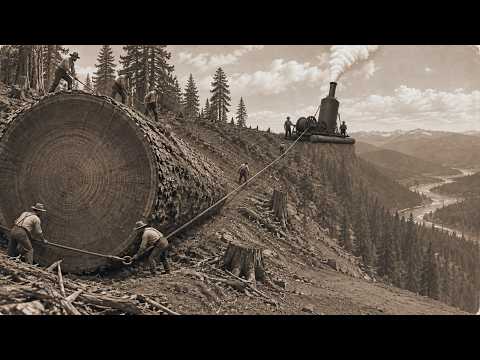
That machine had to beat six things to do its job. A hill it had to climb by itself. Logs that dug into the ground like plows. A signal that had to cross a mile of brush faster than a man could run. The machine’s own habit of blowing apart. Canyons nobody could build a road across. And last, a mountain far too steep for any ordinary train.
I’ve been reading company catalogs from 1913, a logger’s own handbook, and the old photographs and records from Washington, Oregon, and California. Two people carry this story. The first is a boy of about 16 standing in the brush with a thin wire in his hand, whose one job was to tell a steam engine he couldn’t see when to pull and when to stop. A logger from Eddyville, Oregon named D.D. Strite wrote about boys like him in 1924. The second is Louis Far, a carpenter on that Yosemite mountain, who built a little sled 6 feet long so the men could ride that railroad down the mountain on a grade steeper than any staircase. He gave it a brake that worked by pressing cleats against the rail. It wasn’t enough.
The first problem was waiting the moment anyone tried to put one of these engines on a hill. A steam donkey, which is what the loggers called it, weighed tons. It had no wheels and no tracks. It had no driver’s seat because it was never meant to go anywhere on its own. And yet in the Northwest woods, the logs were always somewhere else. They were at the bottom of a gully or halfway up the next ridge or across a creek with no bridge. A machine that sat in one place could only reach so far.
So the machine had to move. And it had to move uphill through stumps and brush on ground no wagon could cross. There’s an old photograph in the Humboldt State collection in Northern California that shows exactly what the loggers did about it. The caption says it plainly: “A large donkey engine pulling itself up a steep incline.” Pulling itself. That’s the part that sounds impossible.
Here is how it worked. The whole machine sat on that sled—two big logs laid side by side like the runners on a child’s sled. The crew took the end of the donkey’s main cable and carried it up the hill to the biggest, deepest-rooted stump they could find. They wrapped the cable around the stump and made it fast. Then they went back down. The engineer opened the steam and the drum started winding in the cable. The cable couldn’t move because the stump wasn’t going anywhere. So the only thing left that could move was the machine.
The donkey wheeled itself up the hill toward the stump, dragging its own sled, its own boiler, and its own drums behind it, inch by inch. Think of sitting on a sled at the bottom of a snowy hill with a rope tied to a tree at the top. You can’t walk up, but you can pull yourself up hand over hand, and the sled comes with you. The donkey did the same thing with a steam engine for arms and a stump for the tree. When it reached the stump, the crew carried the cable farther up to the next one and did it again.
That was how a machine with no wheels crossed a mountain. And that was the first lesson the woods taught about this machine. It was only as strong as whatever it was tied to. A rotten stump or one with shallow roots could tear loose with tons of iron hanging below it on a slope.
Getting up the hill was only half of it. The machine also had to eat. A steam donkey ran on fire and water. Most of the ones working in the Northwest woods from the 1890s into the 1920s burned wood, and the woods had plenty of that. On the back of the sled sat a water tank, and on some machines a tank of fuel oil. Over the engine, the crew usually built a little shed with a roof called the donkey house to keep the rain off the man running it.
How much did it take to keep one going? In Reedsport on the Oregon coast, there’s a big machine on display that tells you it’s a Smith and Watson Yarder put to work in 1915 by the Winchester Bay Logging Company. The marker beside it says it took about 25 men to keep that one machine working. Some of them did nothing but cut wood for its firebox—about three cords a day. A cord is a stack 4 feet high, 4 feet deep, and 8 feet long. So picture three of those stacks every single day. Other men ran pumps and a pipeline to bring it about 3,000 gallons of water a day. And the firemen had to keep a steady heat, so the boiler held its steam pressure all day long.
People ask how the animals in these old logging camps were fed and watered. The machine that replaced a lot of those animals had an appetite of its own. Every one of those cords was cut and split by hand. Every one of those gallons had to be pumped and piped to the machine. If the firewood ran short or the water stopped, the whole operation stopped with it. That’s why the marker counts the wood cutters and the pumpmen as part of the machine’s crew. Without them, the engine couldn’t turn a drum.
So now the machine could climb a hill on its own, and it could keep itself fed while it worked. The loggers had gotten their engine up the mountain. And the moment they started dragging logs with it, they found out the mountain had a much worse problem waiting. The problem was the log itself.
A log dragged across the ground digs in. Picture a Douglas fir log longer than a house, so thick a man standing beside it can’t see over the top, lying in the brush on a Washington hillside. The donkey sits up on the slope above it. The crew wraps a short loop of cable around the fat end of the log, hooks that loop to the end of the donkey’s main cable, and the engineer opens the steam. The cable comes tight. The log starts to move. And the front end of that log—the end being pulled—drives straight into the dirt like the blade of a plow.
It catches on a stump. It wedges against a rock. It rolls sideways into a hole. Every few yards the whole thing stops dead, and the cable sits there humming with the full pull of the engine on it until something gives. The loggers had a name for this way of working. They called it ground lead, because the pole ran along the ground. And from the 1880s until about 1910, ground lead was the way nearly every steam crew in the Northwest woods worked.
To make it work, they built roads for the logs. A skid road was a track of small logs laid crosswise in the dirt a few feet apart, like the ties under a railroad. The big logs were dragged along on top of those cross pieces instead of through the mud. A skid road could run as long as a mile. A University of Washington history of logging on the Olympic Peninsula says that before the logging railroads came, all this dragging kept logging to within about a mile of water deep enough to float the logs away.
That’s a strange thing to think about in a forest that big. A mile. The finest timber in the country stood a few miles back from the water. And for years, a lot of it might as well have been on the moon.
And there was a second problem, a smaller one that turned out to be deadly. The first donkeys had a single drum. The drum wound in the main cable, and the main cable dragged in the log. Then the end of that cable was sitting at the donkey, and the next log was a quarter mile away in the brush. How do you get a heavy steel cable back out to the next log? At first, they used a horse. A horse walked out into the woods, dragging the end of the main line behind it. The crew hooked on the next log, and the engine pulled it in. Then the horse walked back out again. All day. One horse walking a quarter mile of brush and back for every single log.
The fix came quickly and it changed everything about the job. The builders added a second drum to the donkey. On that second drum went a lighter cable called the haulback. The haulback ran from the donkey out through the woods, through a pulley tied to a stump at the far end of the logging ground, and back to the end of the main cable. Now, when a log reached the landing, the engineer threw the second drum in gear, and the haulback dragged the main cable back out into the brush by itself.
Think about what that made. A loop of steel cable, hundreds or thousands of feet long, running from the machine out through the woods, around a stump, and back again. Two drums, one pulling in and one paying out, so the loop could run either way. No horse needed. It was much faster—and every man working in the brush was now standing somewhere inside a moving loop of steel.
Here’s what that loop did to the men inside it. When the haulback lay slack on the ground, it looked like nothing. A dead line in the ferns. When the engineer threw the drum in, that slack line jumped off the ground and snapped straight between the stump and the machine, and anything standing in its path went with it.
Strite, the logger from Eddyville, described that moment in his handbook for new loggers in 1924. He wrote that the steel line lying at your feet will become a living thing. He wrote that it zips past your ear and knocks off your hat. He meant it as a joke. Read it again knowing what that line weighed.
Near Eatonville, Washington, in the shadow of Mount Rainier, a local history record of the year 1923 lists the men from that town who died in the woods that year. In September, two of them died together—Paul Wuk from the little town of Ashford and Harry Howell. The record says they were believed to have been cutting a tree and got in line with the haulback line. In line with it. Standing in the one place the cable wanted to be when it came tight. The same list counts at least nine men from that one small Washington town who died in the woods that single year.
So by the time the steam donkey had climbed its hill, the logging crews had two problems they couldn’t fix with a bigger engine. The logs dug into the ground and hung up on everything. And the line that pulled them could kill a man who was standing a few feet the wrong way. And then there was the worst ground of all.
Picture a log lying at the bottom of a steep ravine with the donkey sitting up on the ridge above it. Every foot of that pole goes uphill into the face of the slope. A log dragged up a hillside doesn’t plow. It buries its nose in the mountain and stays there. For years, the answer to the logs at the bottom of the ravine was simple. You left them there.
The answer that finally reached them was standing right there in the woods. It was a tree.
Around 1910, crews in the Douglas fir country of Washington and Oregon stopped pulling along the ground and started pulling from the sky. They called it high lead. The main cable came down at the log from above, and the first thing it did when it came tight was lift the front end of the log up off the dirt. A log with its nose in the air doesn’t plow. It rides over the stumps.
The pulley needed something tall and strong to hang from, so they used the woods. A high climber went up a chosen tree with spikes on his boots, cut off every branch, and topped it 150 feet up. They called it the spar tree. They didn’t build it—they grew it. Guidelines ran from its top to stumps all around, holding it like a tent pole.
With lines running a mile into the timber, the man at the log and the man at the engine couldn’t see or hear each other. So a boy of sixteen stood in the brush with a thin wire tied to the whistle. One short blast meant stop. The simplest signal, placed where a scared kid could never get it wrong.
The engine never did it alone. It borrowed the mountain—the stump, the tree, the slope—and tied itself there. So here’s my question for you: if you stood on that ridge in 1912 with a wire in your hand, would you have pulled it?
Report this article
Select a reason for reporting:






