The Galapagos Islands: a name that conjures images of giant tortoises, pristine beaches, and the quietude of nature. But in the early 1930s, on the southernmost island of Floreana, a bizarre and deadly drama unfolded—one that would leave behind a legacy of suspicion, jealousy, and unsolved disappearances.
It began with a German doctor, Friedrich Ritter, and his mistress, Dora Straub, who arrived in 1929 seeking paradise. They built a life from scratch, but their relationship soured, and the island’s harsh realities set the stage for a series of strange events.
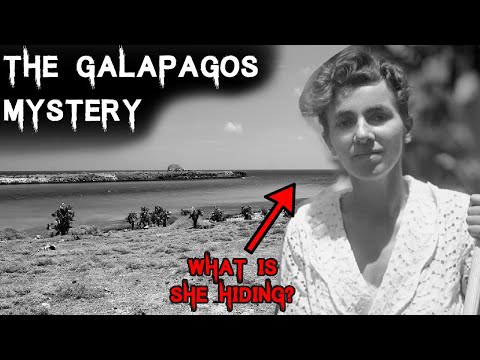
As word of their unconventional lifestyle spread, others followed. The Wittmer family arrived in 1932, seeking the famous doctor’s help for a pregnancy. Their relationship with Ritter and Straub was tense but manageable. Then, in 1933, a flamboyant Austrian woman calling herself the Baroness von Wagner arrived with two lovers and a servant, intent on building a grand hotel. She waved pistols, intercepted mail, and sowed discord.
On March 27, 1934, the Baroness and her favorite lover, Robert Philippson, vanished without a trace. No ship was seen, their belongings remained, and a shriek was heard. Dora claimed no vessel passed, while Margaret Wittmer believed they left on a ship to Tahiti—but no record exists.
The mystery deepened. The Baroness’s servant fled, and the spurned lover, Alfred Lorenz, left on a fishing boat, only to be found dead of dehydration on a beach months later. Then, in November 1934, Friedrich Ritter died of apparent food poisoning, but suspicions arose when Dora remained unaffected. She left the island soon after, and her memoirs painted a different picture than Margaret’s.
What really happened on Floreana? Was it murder, madness, or merely a series of tragic coincidences? The island’s close-knit community harbored motives and secrets, and the truth remains buried in the Pacific.
As the years passed, the Wittmers stayed and prospered, but the shadows of the past lingered. The Baroness’s fate, Ritter’s death, and Lorenz’s end—all unsolved, all whispering of a darker side to paradise.
But the story does not end with those graves and departures. Floreana kept its secrets, yet the island was not quite done with the people who had disturbed its silence. In the decades that followed, a trickle of visitors—sailors, scientists, and the merely curious—began to call at Post Office Bay, and each one carried away a fragment of the legend.
Some of those fragments did not fit. In 1935, a Norwegian whaling crew reported anchoring off Floreana for water and finding the door of Hacienda Paradise standing open, its interior untouched as though the Baroness might return at any moment. A single boot lay in the doorway, and on the table a tin of biscuits, swollen and rusted with the years.
Yet the strangest detail was the pistol. It rested on the shelf exactly where the Baroness had always kept it, and by every account it had not been fired.
If she and Philippson had met violence, someone had taken great care to leave no sign of it. If they had simply walked into the sea or boarded a phantom ship, the pistol’s presence made no sense at all. The crew took the biscuits and left the rest, and the story hardened into the shape it holds today.
Back on the mainland, the rumors found fresh fuel. A German newspaper printed a letter supposedly written by the Baroness weeks after her disappearance, addressed to no one, in which she complained of being watched. The paper claimed the letter had been found in a mail sack at Post Office Bay, but no one could say how it got there or who had carried it.
Dora Straub, by then back in Germany and increasingly frail, was asked about it by a correspondent and gave a reply that has never been fully explained. “She was not the only one on that island who knew how to wear a mask,” she said, and would say nothing more.
Margaret Wittmer, for her part, refused to discuss the Baroness at all in her later years. When a journalist pressed her in the 1960s, she offered only a thin smile and remarked that the island had a way of settling its own accounts.
Her son Rolf, who had grown up among these shadows, was more forthcoming—but only barely. He recalled that as a boy he had once been sent to fetch water from the spring and had found a woman’s shoe on the path, half-buried in the volcanic soil. He had told no one. He was not sure, he said, whether it had truly been there or whether he had dreamed it.
The spring itself became a source of quiet dread among the settlers. It was the only reliable water on that part of the island, and after the disappearances the Wittmers took to fetching from it in pairs, never alone, never after dark.
Whether that caution was born of superstition or of something they had seen, no one ever established. The Wittmers kept their counsel, and the island kept its dead.
It was not until the 1950s, when the first tourist boats began to nose into Floreana’s black-sand bays, that outsiders noticed something odd about the Wittmer family’s account. Margaret had always insisted the Baroness and Philippson must have boarded a ship to Tahiti. Yet no such vessel was ever logged, and the harbor records at San Cristóbal—kept with bureaucratic care by the Ecuadorian authorities—showed nothing. Not a single ship had passed Floreana in that final week of March 1934.
Rolf Wittmer, by then a young man running his yachting company, was asked about this discrepancy more than once. His answer never varied: the sea was empty, the sky was clear, and his mother had believed what she wanted to believe. He did not say it unkindly. He simply said it, and changed the subject.
The spring, though, was another matter. In 1957 a visiting geologist from Quito spent three days mapping the island’s water sources and came away unsettled. He noted in his report that the main spring had been walled up—crudely, with lava rock and mortar—at some point in the previous two decades. The Wittmers told him it was to keep the hogs out. He did not argue. But he observed that the wall had been built from the inside.
That detail sat quietly in an archive for years. When it surfaced again, it was in the hands of a German journalist named Klaus Behrend, who had become obsessed with the Floreana affair after reading Dora Straub’s memoir in the 1970s. Dora’s account, he noticed, contained a single sentence that no one had ever bothered to chase down. She wrote that on the night of the disappearance she had heard not one shriek but two—the second much fainter, and coming from the direction of the spring.
Behrend traveled to the Galapagos in 1978 and interviewed Rolf on the veranda of the family’s small hotel. Rolf was polite, tanned, and utterly unshakable. When Behrend quoted the passage from Dora’s memoir, Rolf went quiet for a long moment. Then he said something that Behrend never forgot.
“My mother told me once that some doors are better left closed. I think she meant that literally.”
He would not elaborate. He poured more coffee, looked out at the water, and asked whether the journalist had seen the flamingos at Cormorant Point.
Behrend did not leave it there. He spent two more days on the island, walking the old paths with a local guide. Near the spring, in a hollow beneath an overhang of lava, he found a rusted tin box—the kind that once held German cigarettes. Inside were three buttons, a woman’s tortoiseshell comb, and a scrap of paper on which someone had written, in a fine, slanting hand, a single word: Enough.
The handwriting was never conclusively identified. Dora’s letters had a different slope; Margaret’s were rounder. But the comb matched a description of one the Baroness had worn in her hair on the day she arrived at Hacienda Paradise, waving her pistol at the sky.
Behrend published his findings in a small German magazine, and for a few weeks the old story stirred again. Then it faded, as such stories do. The tin box was handed to the Galapagos National Park office, where it was catalogued and, eventually, misplaced.
Rolf Wittmer died in 2010, having spent nearly his whole life on the island of his birth. In his final years he was asked once more about the Baroness, and this time he gave an answer that was longer than usual.
“People want a monster,” he said. “But there was no monster. There was only a small island, and too many people who had run away from something, and not enough water. When you put those things together, someone always pays.”
He did not say who had paid, or how. He only smiled the way his mother had smiled, thin and closed, and let the silence do the rest.
Today, visitors to Floreana can still walk to Post Office Bay and drop a letter in the old barrel, and they can still buy a beer at the Wittmer hotel, where a faded photograph of the Baroness hangs near the bar—unlabeled, half-forgotten, watching the door.
The bartender will tell you, if you ask, that the photograph was found in the attic during a renovation in the 1990s. No one knows who put it there. Some say the frame was wrapped in a woman’s silk scarf, and that the scarf still smelled faintly of perfume.
Klaus Behrend returned once more to Floreana in 1989, older and quieter. He walked the path to the spring alone, against the advice of the park rangers, and later wrote that he stood a long time at the walled-up spring and listened. “The water was still running underneath,” he wrote. “You could hear it. It never stopped.”
He never published another word about the case. When asked why, he said only that some stories refuse to be finished, and that he had decided to let this one refuse in peace.
Dora Straub’s grave in Germany is unmarked. Margaret Wittmer’s is on Floreana, under a small tree, and visitors sometimes leave flowers there. The Baroness has no grave at all—only a photograph, a comb, and a tin box that may or may not still exist in a park office somewhere on Santa Cruz.
And the spring still runs, walled up and dark, feeding the green things that grow around it. The hogs are gone now. The wall remains.
So what do you think happened on Floreana? Did the Baroness and Philippson walk into the sea, or did the island swallow them? Did Dora poison the doctor who failed her, or did a dead chicken do the work? And what was written on that scrap of paper—Enough—and by whose hand? Tell us your theory in the comments below.
Report this article
Select a reason for reporting:






