On July 17, 1944, fifty-seven thousand German prisoners marched through the streets of Moscow. At their head walked nineteen captured generals, men who had once commanded armies bent on destroying the city. Behind the last column, tank trucks sprayed the asphalt clean—a piece of Soviet propaganda choreographed to symbolize the washing away of the Third Reich. The images circled the globe. And then, the prisoners simply disappeared.
For years, the Soviet Union kept the secret of what happened behind the barbed wire of its camps. While millions of German families waited for any sign of life from fathers, sons, and brothers, the fate of these men rested in the hands of Lavrentiy Beria and the NKVD. Some surfaced unexpectedly—like Field Marshal Friedrich Paulus, who testified against his former comrades at Nuremberg in 1946. But the vast majority were sent thousands of kilometers from Germany to toil in mines, factories, forests, and giant Soviet reconstruction projects.
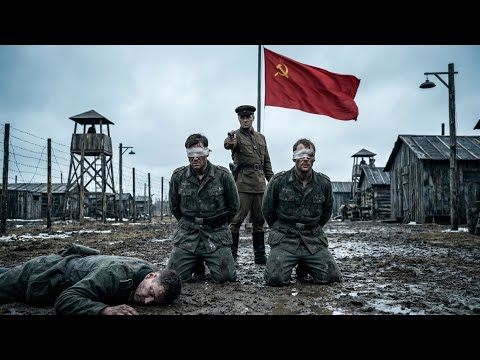
Soviet archives recorded over 3 million German prisoners. About two million returned. Hundreds of thousands never did. Of the 91,000 men captured at Stalingrad, barely 6,000 survived the ordeal. What really happened to the hundreds of thousands of German prisoners who found themselves in the Soviet Union? This is their story.
The collapse of the Third Reich began long before the first prisoner column snaked eastward. In the early hours of June 22, 1944—exactly three years after the Wehrmacht crossed into the Soviet Union—more than two million Red Army soldiers launched an offensive against German positions in Belarus. The operation bore the name of a Georgian general who had fought Napoleon: Bagration. Against them stood Army Group Center, the formation that had reached the gates of Moscow in 1941 but was now a shadow of its former self.
In just twelve days, the German front disintegrated. Vitebsk, Orsha, Mogilev, and Bobruisk fell one after another, and entire armies were trapped in pockets from which very few escaped. When Soviet tanks entered Minsk on July 3, the scale of the catastrophe exceeded any previous German defeat, including Stalingrad. Nearly 30 divisions were destroyed or reduced to useless remnants, and German losses approached half a million men killed, wounded, and missing. For tens of thousands of those missing, the war ended that summer—but their ordeal had only just begun.
On July 17, 1944, Moscow witnessed a carefully staged spectacle. Some 57,000 German prisoners, led by their captured generals, marched in columns through the streets of the Soviet capital before a silent crowd. Behind the last rank, water trucks washed the asphalt—a propaganda gesture meant to symbolize the cleansing of Russian soil. The images flew around the world, but what happened next never appeared in the newsreels. These men were loaded onto trains bound for labor camps scattered across the Soviet geography. They were the vanguard of a human mass that would number in the millions in less than a year.
The collapse in Belarus dragged the entire Eastern Front with it. During the autumn of 1944, the Red Army reached the borders of East Prussia, the historic heart of Prussian militarism. In October, its lead units set foot on Reich territory for the first time. In the Baltic region, Army Group North remained isolated in the Courland Peninsula in Latvia. About 200,000 German soldiers held out there, besieged and supplied by sea, until the very day of surrender. Hitler repeatedly refused to evacuate them, convinced that this bridgehead would one day serve a counterattack that never came. That decision doomed nearly all these men to Soviet captivity when they laid down their arms on May 8, 1945, without having been defeated on the battlefield.
In January 1945, the Vistula-Oder Offensive repeated the pattern on a larger scale. Zhukov’s and Konev’s fronts advanced more than 400 kilometers in three weeks, from Warsaw to the Oder River, only 70 kilometers from Berlin. Meanwhile, Rokossovsky isolated East Prussia from the rest of Germany, trapping hundreds of thousands of soldiers and civilians between the Baltic Sea and the Soviet advance. Königsberg, declared a fortress by Hitler, resisted until April 9, when its commander, General Otto Lasch, surrendered. Some 30,000 survivors of the garrison marched into captivity, and an enraged Hitler sentenced Lasch to death in absentia and ordered his family arrested.
The army trying to contain this collapse was no longer the Wehrmacht of 1941. Tanks sat motionless for lack of fuel after the fall of the Romanian oil fields at Ploiești in August 1944 and Allied bombing destroyed synthetic fuel plants. Divisions that on paper numbered 15,000 men barely mustered 2,000 or 3,000. Gaps were filled by improvised units—air force ground crews with barely any infantry training, sailors turned into riflemen, convalescing soldiers pulled from hospitals, battalions for men with stomach ulcers, battalions for the hard of hearing. And behind them all stood the regime’s last refuge: the Volkssturm, the people’s militia created on September 25, 1944, to mobilize all males between 16 and 60 who had not yet joined the ranks. Hitler Youth and teenagers, veterans of the First World War, were handed armbands, old rifles, or Panzerfausts and sent to stop the most powerful army of the time. For the Red Army, this proved decisive for their fate. These armed civilians were combatants like any other, and they would be treated as such upon capture.
The final battle began on April 16, 1945, on the Seelow Heights above the Oder. On April 25, the lead units of Zhukov’s and Konev’s armies met west of Berlin, closing the ring around the capital. Inside the pocket remained the remnants of General Helmuth Weidling’s LVI Panzer Corps, Waffen-SS units, police, firefighters, Volkssturm, and Hitler Youth—perhaps 80,000 defenders in fighting condition, facing a million and a half attackers. In the bunker beneath the Chancellery, Hitler ordered counterattacks by armies that existed only on maps. On April 30, with Soviet soldiers a few hundred meters away, he committed suicide alongside Eva Braun. Among those remaining in the bunker was his personal telephone operator, SS Sergeant Rochus Misch—a man whose name would reappear in this history, because his path from that bunker would lead him directly to the Lubyanka cellar and nine years of Soviet captivity.
On May 2, Weidling surrendered, and about 130,000 defenders of Berlin began their march east. Many of them would not return until late in the following decade. Many others never returned at all. But Hitler’s death did not stop the war, and what happened in those final eight days explains much of what was to come.
Behind him, Grand Admiral Karl Dönitz, who had settled in Flensburg near the Danish border, shaped his entire policy around a single idea: to prolong resistance in the East long enough for as many soldiers and civilians as possible to reach the Anglo-American lines. It was not a military strategy but a race against Soviet captivity. The fear had concrete roots. Three years of a war of annihilation in the East, Goebbels’s propaganda, and the real news that came from Nemmersdorf in October 1944 and from the occupied eastern provinces had bred in every soldier the conviction that falling into Soviet hands meant Siberia or death. Moreover, the Germans knew what their country had done to Soviet prisoners of war, more than 3 million of whom had died in German custody, and many feared similar retribution.
So in May 1945, Germany did not surrender once, but several times. On May 2, the forces in Italy surrendered. On May 4, Admiral von Friedeburg signed the surrender of the forces in northwest Germany, Denmark, and the Netherlands before Montgomery at Lüneburg Heath. On May 5, Army Group G surrendered in Bavaria. Every partial surrender to the Western Allies was in fact a maneuver to continue fighting in the East. General Walther Wenck’s Twelfth Army, theoretically sent to relieve Berlin, devoted its last forces to keeping open a corridor to the Elbe, through which tens of thousands of soldiers of the Ninth Army and a flood of refugees crossed the ruined bridge at Tangermünde to surrender to the Americans. In the Baltic, the navy carried out the largest maritime evacuation in history—Operation Hannibal—which since January had transported more than two million soldiers and civilians to the West, paying a heavy price in disasters such as the sinking of the Wilhelm Gustloff. And in Bohemia, Field Marshal Ferdinand Schörner, Hitler’s most brutal commander, notorious for hanging his own soldiers for defeatism, kept Army Group Center in fighting condition, some 900,000 men, hoping to lead them toward the West. When the general surrender took effect, Schörner abandoned his troops and fled in a light aircraft wearing civilian clothes. His soldiers, who continued to fight and march west after May 8, were reached by the Soviets in the following days. The Americans, adhering to the agreed demarcation lines, refused to receive most of those who arrived late. Hundreds of thousands of men who believed they had survived were handed over or captured and took the opposite road east.
The final surrender was signed twice—on May 7 at Reims before Eisenhower by General Alfred Jodl, and again at Stalin’s request on the night of May 8–9 in Berlin’s Karlshorst district, where Field Marshal Wilhelm Keitel surrendered to Zhukov. Both signatories ended up on the Nuremberg gallows a year and a half later. But for millions of German soldiers, those signatures were not the end of anything—they were the beginning of everything.
Who were the men who fell into Soviet hands during those weeks? NKVD documents eventually recorded some 3,100,000 German prisoners of war taken throughout the conflict, the vast majority in its final months. Between January and May 1945 alone, more Germans were captured than in the previous three and a half years combined. And that human mass was far more diverse than the word “soldier” suggests.
There were Wehrmacht veterans from 1939 and recruits with only weeks of training. Waffen-SS men expecting harsher treatment and longer sentences. Luftwaffe ground crews and sailors taken in Baltic ports. Boys and old men of the Volkssturm who wore nothing but an armband as a uniform. Todt Organization laborers, railway workers, police, customs officials, military administrators, civilians who had never fired a shot. Added to them, in a different legal category but often an identical fate, were tens of thousands of male civilians arrested in the occupied territories as hostile elements or simply as labor, detained or deported by direct order of the Soviet State Defense Committee.
When the guns finally fell silent in Europe on May 8, 1945, the columns were already crawling. From Courland and Königsberg, from Berlin and Bohemia, from temporary camps in meadows and sports fields, millions of men marched east under Soviet guard, not knowing where they were going or how long their absence would last. Germany had ceased to exist as a power for its soldiers. A second war had begun—silent, without fronts, fought against hunger, cold, and time in the camps of the Soviet Union.
For the German soldier, the end of the war did not come with signatures on documents but with a more intimate and more terrifying moment: the raising of hands. Survivors described it decades later with astonishing precision, because no one forgets the moment when their life stops belonging to them. First, the order to lay down arms. Then, the search. The victors stripped the prisoners of watches, wedding rings, pens, good boots, photographs of their families. “Uri, uri.” This Russian mangling of the German word Uhr—watch—was the first word hundreds of thousands of Germans learned from their captors. In veterans’ memoirs, it became the symbol of that first hour of defeat.
Rank insignia and medals were torn from officers’ uniforms. Documents were lost or confiscated, and with them the prisoner’s administrative identity vanished. For his family, that man passed from that moment into the most dreaded category in postwar German vocabulary: Vermisst—missing. Because a prisoner in Soviet hands remained outside any system of international protection. The Soviet Union had not ratified the 1929 Geneva Convention, did not allow Red Cross inspections, and did not share prisoner lists. Germany had exploited that same legal void to let more than 3 million Soviet prisoners die. Now its soldiers discovered what it meant to be on the other side of that void.
A soldier captured in Berlin or Courland simply evaporated. It might take his mother or wife two, three, or five years to receive the first censored postcard of twenty-five words—if it arrived at all. Then began the journey, and for many the journey was worse than the battle.
The 130,000 defenders of Berlin who surrendered on May 2 left the city in endless columns, passing between the ruins and the bodies of the battle they had just lost, under the silent gaze of Berlin women searching the ranks for a familiar face. The 200,000 men of the Courland pocket, who surrendered without having been defeated, marched toward ports and stations convinced they would soon be released, as they had been led to believe. It would take years to realize the deception. Schörner’s soldiers, captured in Bohemia after May 8, marched on foot in the opposite direction along the same roads they had tried to flee westward. Those marches covered hundreds of kilometers on meager or nonexistent rations. Prisoners drank from ponds, tore up grass, nettles, and raw potatoes from the fields, and dysentery spread from column to column within the first week. Anyone who collapsed and could not keep up was left behind, and testimonies agree that stragglers were often shot by guards—in violation of Soviet regulations themselves—amid the brutal chaos of those weeks. Veterans called those treks “the hunger marches to the East.”
The marches were followed by trains: closed freight cars holding forty, fifty, or sixty men, a hole in the floor as a latrine, a bucket of water, and journeys lasting two, three, or four weeks toward the Urals, Kazakhstan, or Siberia. At every stop, the dead were unloaded. Soldier Helmuth Weltz, captured at Stalingrad two years earlier, had already described in his diary those transport calculations in which every dawn counted those who no longer woke. Those captured in 1945 lived the same experience on a far larger scale. Tens of thousands of men died before they ever reached a camp to be registered—a detail that sounds bureaucratic and, as we will see, poisoned the counting of the dead for half a century.
The fate awaiting them at the end of the journey was, for the vast majority, not the Gulag camps reserved for Soviet convicts—though from behind the barbed wire, the difference was often invisible. Prisoners of war were held in a parallel network of camps run by the Soviet Ministry of the Interior through a special directorate called GUPVI, with hundreds of main camps and thousands of labor detachments spread across the country. It is enough to grasp the essence of that machine to understand what it meant for the Germans. The prisoner was not serving a sentence and was theoretically supposed to return one day, yet at the same time he was a unit of labor whose food depended on his output. Only a few knew other degrees of that system: the special Moscow prisons like Lubyanka or Butyrka, reserved for generals, Hitler’s staff, and war crimes suspects, where they faced endless interrogations; and the actual Gulag camps, where those convicted by military tribunals to twenty-five years always ended up. That distinction, which no prisoner chose, would later decide who returned home in 1948 and who grew old behind barbed wire until 1955.
Stalin had demanded at Yalta that prisoners work as war reparations in a country that had lost 27 million people, and that decision defined every day of the German prisoners’ lives. Germans descended into the coal mines of the Donbas and Vorkuta above the Arctic Circle. They felled forests in the Urals and Siberia with hand saws in temperatures of forty below zero. They laid railway lines, built dams, worked in brick factories, and rebuilt with their own hands the cities their army had destroyed: Stalingrad, Kiev, Minsk, Sevastopol. There was a historical irony in the fact that survivors of the Sixth Army cleared the ruins of Stalingrad itself, where they had been trapped. In Moscow and other cities, housing blocks built by prisoners kept the popular nickname “the German houses” for decades.
The system ran on daily production quotas, and food rations were tied to the percentage achieved. This mechanism created a deadly spiral: the exhausted man who failed to meet the quota received less bread and grew weaker still. Prisoners soon learned the unwritten rules of survival, seeking indoor work in kitchens, workshops, and infirmaries to become indispensable as specialists; engineers, mechanics, and doctors had better chances and formed small groups of two or three comrades who shared everything and watched for signs of psychological surrender in one another. For it was known in the camps that the man who stops washing and stops talking is a man dying.
They died above all of hunger. The first two winters of the postwar period coincided with a general famine in the Soviet Union that killed hundreds of thousands of its own citizens. In a country where the victor went hungry, the defeated occupied the last place in line: the prisoner’s theoretical ration was about 600 grams of wet black bread and a soup of cabbage or watery millet. Rarely did a little salted fish reach the bowl intact—it was plundered at every link in the distribution chain. Men worked outdoors in the uniforms in which they had been captured in May, which they kept patching for years. Camp hospitals, staffed mainly by German prisoner-doctors improvising treatment without resources, filled with diagnoses the Germans learned in Russian: chronic hunger followed by tuberculosis, dysentery, lice-borne typhus, and scurvy treated with pine-needle infusions.
Mortality peaked massively between 1943 and 1947. The extreme case was that of the men of Stalingrad: some 91,000 marched into captivity in February 1943, already exhausted, frozen, and sick before they surrendered. The vast majority died within a few months, and only about 6,000 ever returned to Germany. That figure—6,000 out of 91,000—was carved into the German conscience and stained the image of Soviet captivity with horror, even though those captured in 1945, in far better physical condition, enjoyed much higher survival rates.
How many died in total? No question haunted postwar Germany more, because behind these statistics stood millions of families in a state of waiting. The Soviet archives opened to historians since the 1990s recorded about 2,400,000 German prisoners in the camps, with roughly 356,000 deaths—a rate of 15 percent. The great German research led by historian Erich Maschke’s committee between 1957 and 1974, working without access to Russian archives by cross-referencing Wehrmacht lists and surveys of more than a million returnees, estimated the dead and missing at more than one million. The discrepancy stems not from bad faith but from what each figure measures. The Soviet number counts only those who arrived alive to be registered in a camp, excluding those who died at collection points, on marches, and in trains, as well as tens of thousands of detained civilians never classified as prisoners of war. The German numbers for captivity deaths include many who had already fallen in the final battles without anyone recording their deaths, because under the general collapse of 1945 the German army no longer buried its dead or notified their families. Modern research places the truth between these two poles, with the certainty that the Soviet figure represents a minimum, not a maximum.
For German families, this academic debate had a concrete face: the face of a father or son who might be on the list of the dead or among those who might still return. Until the late 1950s, German radio broadcast search programs for the missing in which names were read aloud, and the German Red Cross tracing service collected millions of files. Returnees were shown photographs of missing persons in case they had seen them in a camp. Men just back from hell spent their first nights at home answering letters from unknown mothers asking about their sons.
Captivity attacked not only the prisoner’s body but his convictions, and here the German experience acquired a unique dimension. From 1943, the camps featured a political re-education apparatus without parallel in Western captivity. Anti-fascist activists were recruited from among the prisoners themselves, along with wall newspapers, compulsory lectures, and—most promisingly—central schools like Krasnogorsk near Moscow, where German communist exiles such as Walter Ulbricht trained cadres for a different future Germany. For the ordinary prisoner, anti-fascism in the camps was often a survival strategy more than an ideological conversion. Activists received better food, more tolerable jobs, and the promise of early repatriation, and survivors remembered bitterly that some of the most zealously re-educated had shortly before been the most convinced Nazis in the barracks.
But there were also profound transformations, none more dramatic than at the top. Artillery General Walther von Seydlitz-Kurzbach, a decorated hero of Stalingrad who had broken out of the pocket despite Hitler’s orders, came in captivity to the conviction that saving Germany required overthrowing the regime from outside. From September 1943 he headed the League of German Officers, linked to the National Committee for a Free Germany, drafted appeals to the German army, and even proposed forming German units against Hitler—which Stalin never authorized. The Reich condemned him to death for treason and arrested his family under the principle of family responsibility. And when he ceased to be useful, his own hosts tried him as a war criminal and sentenced him to twenty-five years. Seydlitz, whom some considered a traitor and others a puppet, did not return to Germany until 1955 and spent his last years defending his honor in a country that never knew how to deal with him.
Other Stalingrad officers walked the path of collaboration to the end. General Vincenz Müller, who surrendered with his forces in the Belarus catastrophe, and General Otto Korfes, the military historian, returned early to help found the communist German army. Yet Moscow’s most valuable case was the most resistant. Field Marshal Friedrich Paulus, the man of Stalingrad, refused all forms of cooperation for a year and a half and signed his first appeal against Hitler only in August 1944, after the July 20 assassination attempt and the execution of officers he respected. In February 1946 he appeared unexpectedly in Nuremberg as a witness for the Soviet prosecution, to the astonishment of Göring and Keitel, who covered him with contempt from the dock. He later lived in a guarded villa near Moscow in gilded captivity but remained a prisoner until 1953, when he was allowed to settle in Dresden in East Germany, where he died in 1957—a troubling ghost to both Germanys, never having seen his wife, who died in the West in 1949 while he was still held.
Repatriations began as early as 1945 with the disabled and accelerated between 1946 and 1948 as the victors returned men no longer able to work, then the others. In 1949, Moscow announced it had released the last prisoners of war. It was a half-truth hiding a tragedy. Tens of thousands of men remained in detention after being convicted in summary trials as war criminals. The truly guilty, men responsible for atrocious crimes, were deliberately mixed in the same category with those convicted on general charges, all sentenced to twenty-five years and distributed between Vorkuta and Siberia.
Among them was Rochus Misch, the SS sergeant who had been Hitler’s communications officer in the bunker. Arrested on May 2, 1945, while trying to escape Berlin, he was taken to Lubyanka, where interrogators obsessed with Hitler’s death and the possibility of his escape tortured him to extract every detail of the final days in the bunker. He then spent years in labor camps, one of the last detainees. His release, and that of about 10,000 like him, came only when Chancellor Konrad Adenauer traveled to Moscow in September 1955 and agreed to establish diplomatic relations in exchange for the return of the last prisoners.
That autumn, Germany witnessed one of the founding scenes of the postwar era. Trains arrived at the Friedland transit camp in Lower Saxony amid crowds holding placards bearing photographs of the missing. Old men in padded Soviet coats stepped down into a divided country that had changed for centuries in their absence. Wives who did not recognize their husbands. Eleven-year-old children seeing their fathers for the first time. The Germans called them Heimkehrer—the homecomers. Their return, ten and a half years after the war’s end, finally closed the chapter of captivity.
But for millions of other Germans—those who had never worn a military uniform—the postwar period had written its own story of loss, and here we must turn our gaze now: the Germans who were not soldiers, the expulsions, the deportations, and the ethnic cleansing. While the soldiers crawled east, another entire Germany set out in the opposite direction, carrying its life in a suitcase. They were not combatants. They were Silesian peasants, Bohemian craftsmen, Danube winemakers, schoolteachers from East Prussia, old people, women, and children whose families had lived for centuries in Eastern Europe—many of them outside the borders of any Germany that had ever existed.
Between 1944 and 1950, between 12 and 14 million ethnic Germans were uprooted in the largest forced migration in European history. Their fate was decided largely at a conference table to which no German was invited. At Cecilienhof Palace in Potsdam, between July 17 and August 2, 1945, the victors agreed that Germany would lose nearly a quarter of its 1937 territory. Silesia, eastern Pomerania, and most of East Prussia would go to Poland; Königsberg to the Soviet Union. Article XIII of the agreement added the human consequence in a phrase of technical appearance and devastating scope: the German populations in Poland, Czechoslovakia, and Hungary would be transferred to Germany in an orderly and humane manner. For the millions affected, that formula set in motion what was already happening in a manner far from orderly and humane, and drew a line that historiography has respected ever since—the line between the brutal expulsions of spring and summer 1945, carried out by militias and local authorities before Potsdam, and the organized transports by train from 1946 onward: harsh, but incomparably less deadly.
Nowhere did Germans live that sequence with greater violence than in Czechoslovakia. The Sudeten Germans—more than 3 million people settled in Bohemia and Moravia since the Middle Ages—had mostly welcomed annexation to the Reich in 1938 with enthusiasm, and that collective responsibility, real for some and attributed to all, descended upon them in May 1945 without distinction between persons. President Edvard Beneš’s decrees collectively stripped them of citizenship and property, with exceptions only for certified anti-fascists. But before any procedure came the revenge in Prague after the May uprising, where German civilians were executed without trial, burned alive, hanged from lampposts. In late May, some 27,000 Germans were expelled from Brno—most of them women, children, and the elderly, since the men were either dead, prisoners, or missing—from their homes in a single night and forced to march on foot to the Austrian border. In the Brno death march and the internment that followed, hundreds and perhaps thousands died, many of dysentery. On July 31, after an explosion that the Czech authorities blamed without evidence on German saboteurs, crowds threw German civilians into the Elbe from a bridge, including mothers with their children. A joint commission of Czech and German historians decades later estimated that between 15,000 and 30,000 Germans died from violence, suicide, and internment in Czechoslovakia, correcting older inflated estimates without diminishing the horror of what happened. Survivors waited for expulsion wearing white armbands, subjected to reduced food rations and forced labor until the organized transports began in January 1946 to the American and Soviet occupation zones. By late 1947, an 800-year German presence in Bohemia had ended. In the emptied villages remained cemeteries with German gravestones, and in many homes whose owners had been expelled, a house key remained that no one would ever return for, kept for generations.
For the Germans of the Reich’s own eastern provinces, the catastrophe had begun even before the war’s end, and we have already seen its beginning: the flight across the ice of the winter of 1945, carts crossing the frozen Vistula, the wrecks of ships in the Baltic. Those who could not flee faced the advancing front, expropriations, the deportation of men and women into the Soviet Union as labor, and mass rape documented by all sources, leaving scars on a generation of German women condemned to silence for decades. In Königsberg, about 100,000 German civilians survived the April 1945 siege and remained in what became known in 1946 as Kaliningrad. Without legal status or priority in supplies, they lived on begging and work for the new occupiers until starvation wiped them out in 1946 and 1947. The last 25,000 were deported to occupied Germany between 1947 and 1948, and with them German East Prussia faded forever.
In Silesia and Pomerania, transferred to Poland, Germans first experienced the brutal expulsions of 1945, when the new authorities emptied entire regions to create facts on the ground before the Potsdam conference, then a long wait for organized transport that became a life without rights. They were stripped of homes and farms that were given to Polish settlers who arrived in a tragic exchange of fates from lands Poland itself had lost in the East. Thousands of Germans considered suspect or simply useful labor passed through internment camps like Lamsdorf or Zgoda in Świętochłowice, where typhus, hunger, and mistreatment produced extremely high mortality rates. Between 1946 and 1949, trains of the so-called Operation Swallow carried millions of Silesians and Pomeranians westward with forty kilograms of luggage per person. A woman expelled from Breslau recalled that the last thing she saw in her city was the new name—Wrocław—freshly painted over the station sign.
To the south, the German community that paid the relatively highest price was that of Yugoslavia: half a million Danube Swabians, descendants of colonists brought to Banat and Bačka in the eighteenth century. Some of them had collaborated with the occupation, including the SS Prince Eugen Division, which committed atrocious crimes against the Serbian people, and everyone paid the price. In November 1944, Tito’s new authorities collectively stripped the German minority of its rights and property. Thousands of men were shot in the weeks of liberation. Tens of thousands of young people of both sexes were deported to the Soviet Union, while the rest—mostly the elderly, women, and children—were confined in their villages, turned into fenced camps like Rudolfssgnad or Gakovo or Molidorf, where hunger and typhus claimed tens of thousands of lives between 1945 and 1948. Estimates suggest that about a quarter of the Germans who remained in Yugoslavia at the end of the war did not survive. The rest emigrated in the following years until the community practically vanished.
In Romania and Hungary, Germans faced another pattern of the shared fate: direct deportation for forced labor to the Soviet Union, under an order of the Soviet State Defense Committee in December 1944 that targeted all Germans of working age in the countries occupied by the Red Army. In January 1945, tens of thousands of Transylvanian Saxons and Banat Swabians, and a similar number of Germans from Hungary, were arrested from their homes. Men aged 17 to 45 and women aged 18 to 30 were transported on trains to the mines of the Donbas and the Urals under the label of “reconstruction work.” From Romania alone, about 70,000 people were deported. Many of them were girls who had no connection to politics, and they spent up to five years in the camps. About 15 percent never returned. One of those stories—that of the deportees from the village of Herta Müller’s mother in Transylvania—ended up decades later, through the pen of the Nobel laureate, becoming the literary memory of an almost forgotten tragedy. Hungary, explicitly covered by the Potsdam agreement, transferred about 200,000 of its Germans to occupied Germany between 1946 and 1948. Ironically, Romania did not expel its minority, which remained stripped of property and subjected to discrimination, only to fade gradually through emigration in the following decades.
Adding all the flows together—flight, arbitrary expulsions, Potsdam transfers, and deportations for forced labor—between 12 and 14 million Germans lost their homes. How many lost their lives? For decades this question remained the subject of a painful war of numbers. Official German statistics in the 1950s spoke of more than two million dead and missing, based on demographic balances full of uncertainty. Modern research, based on documented deaths, places the number of victims directly linked to flight, expulsion, and internment at between 500,000 and 600,000, without closing the debate, since the fate of hundreds of thousands of individuals remains unknown—shadows in the files of search services alongside the files of missing soldiers.
What no number captures is the scale of what was erased. Communities with histories spanning 600 and 800 years, with their dialects, churches, schools, and cemeteries, were wiped from Eastern Europe within five years. Then came the arrival: millions of these uprooted people poured into a shrinking, destroyed, occupied, and hungry Germany, which had to absorb them at a time when it had nothing to offer. It must be emphasized that many of them had never lived inside Germany at all. Transylvanian Saxons or Danube Swabians were German in language and culture but had historically been subjects of Hungary, Austria, or Yugoslavia, and they arrived in a supposed homeland they did not know, where their dialect seemed strange. In villages of Bavaria and Schleswig-Holstein, the expellees were forcibly housed with local farmers who received them as intruders and competitors for bread and shelter. They were mockingly called “bag carriers,” and marriages between natives and expellees were rare for years. In 1950, one in six residents of the Federal Republic of Germany was an expellee from the East. That this mass of the dispossessed did not turn into fuel for a new revanchism is one of the most remarkable facts of postwar Europe. The Equalization of Burdens Law of 1952 redistributed part of the wealth in their favor. The economic miracle gave them work, and their own organizations declared in the 1950 Stuttgart Charter the renunciation of revenge and retaliation. Integration was slow, incomplete, and shrouded in silence. But it happened, and so by the mid-1950s the great wounds opened in 1945 had roughly closed.
At Friedland, the last prisoners returned by Moscow stepped down from the trains. And in the new neighborhoods of the Federal Republic, the expelled from Silesia and Bohemia hung on their walls a picture of a house that now belonged to others. Germany paid the price of the Third Reich’s collapse not only with its destroyed cities and its dead soldiers, but with a decade of absent men, with millions of families torn apart by waiting, and with the disappearance of an entire German world east of the Oder, of which today only cemeteries, archives, and memory remain.
On August 13, 1945, barely three months after the surrender, the Soviet Council of People’s Commissars approved the first order for a collective release of German prisoners. Some 708,000 men were to be freed because they were incapable of work. It was not a humanitarian gesture, and the internal documents do not hide it. Medical commissions in the camps classified each prisoner into four categories of fitness for labor, and those who fell into the fourth category—the incurably emaciated—ceased to be assets and became a food burden. Their return to Germany, in the system’s calculations, was a cleansing operation.
The result for Germany was that the first returnees from the East to set foot on its soil were not a representative sample of captivity but its most damaged and destroyed elements. Men of twenty-five weighing forty kilograms, tuberculosis patients in their final stages, the mutilated, the blinded by vitamin deficiency. Many of them died in transit camps before reaching their homes or in the weeks that followed. That first image—statistically biased but emotionally decisive—fixed in German public opinion for the next ten years the equation between Soviet captivity and death, and explains why the families of the missing lived its weight with a dread that no later official figures succeeded in dispelling.
The transit camps through which they passed were German institutions of the first order, and it is fitting to name them, because almost the whole of history passed through them. The Friedland camp in the British zone near Göttingen, opened in September 1945 on the grounds of an agricultural college, became the main gateway until 1950. More than a million and a half people passed through it—returnees, expellees, and refugees. In the Soviet zone, the corresponding transit point was Gronenfelde near Frankfurt an der Oder, through which nearly 1,200,000 returnees entered.
At Friedland, arrivals underwent medical examination and received a hot meal deliberately rationed by doctors because rapid feeding was killing the emaciated, along with civilian clothes, twenty marks, and a discharge certificate. They were also interrogated. Western intelligence services—especially the Gehlen Organization, the nucleus of the future Federal Intelligence Service—realized very early that every returnee was a source of information about Soviet industrial and military geography, and they set up a system for interrogating returnees in what was called Operation Hermes. Thousands of former prisoners described from memory the locations of factories, mines, airports, and industrial complexes they had built with their own hands. None of them imagined that their forced labor was ending up transformed into the geography of the Cold War.
Between 1946 and 1947, repatriations reached their peak pace. By late 1947, about a million prisoners had returned from the East, and the Soviet Union announced that the process would end by late 1948. But German calculations did not match Soviet calculations, and that discrepancy became the great political dilemma of the decade. The German Red Cross tracing service in Munich and the Wehrmacht Information Office for War Losses and POWs had already collected millions of index cards, and their review showed that hundreds of thousands of men whose capture had been recorded were still missing.
In 1947 and 1948, the German Red Cross published the Search Books—massive indexes containing photographs of the missing arranged by unit—and organized traveling exhibitions of panels showing pictures of missing children and absent soldiers that toured German cities. For years those books and panels remained the only real procedure for obtaining information. Returnees walked among them, pointing to faces they believed they had seen in this camp or that column, and every family was notified of any positive identification of a relative’s identity. This system, in its primitive and desperate manner, recorded tens of thousands of successes—and also countless false hopes.
The legal nature of the detainees’ fate changed in 1949, and this change was the most harmful political decision for German prisoners throughout the postwar period. Under growing international pressure and its commitment to end deportations, the Soviet Union chose to convert tens of thousands of prisoners of war into convicted criminals. Between late 1947 and 1950, Soviet military courts tried and convicted about 26,000 Germans in trials that rarely lasted more than twenty minutes, with token lawyers and pre-written verdicts applying Article 58 of the Criminal Code of the Russian Soviet Federative Socialist Republic—the same article used against Soviet citizens for counter-revolutionary crimes. The standard sentence was twenty-five years of hard labor, a substitute for the death penalty after its formal abolition in 1947.
In that mass of convicts, two incomparable groups were deliberately mixed. On one hand were perpetrators of proven atrocious crimes, unit commanders responsible for reprisals, executors of scorched-earth policy, and members of police units involved in mass killings. On the other were men convicted on general phrases without individual basis—such as belonging to a unit that fought on Soviet territory or driving a supply truck. Then Moscow’s announcement on May 4, 1950, that the deportation of prisoners of war had ended and that only convicted war criminals remained closed the humanitarian path with a single blow. As for criminals tried by sovereign courts, negotiating over them was out of the question. For German families, this announcement meant that their husband or son had ceased to be a prisoner to be claimed and had become a criminal to be ashamed of. Many of them discovered then that they could not even know whether their loved ones were among the convicted, because the lists were incomplete and arrived in dribs and drabs through returnees.
The fighter pilot Erich Hartmann embodies with documentary precision what that machine meant. A fighter ace with 352 confirmed aerial victories, the highest number in aviation history, he surrendered on May 8, 1945, to American forces in Czechoslovakia with his unit’s pilots, ground staff, and German civilians who had taken refuge with them. The Americans handed them over to the Soviets a few days later. In 1949, Hartmann was charged with war crimes on the grounds that he had destroyed Soviet aircraft and Soviet state property, and sentenced to twenty-five years. His captivity was a continuous struggle. He refused to cooperate with political officers, rejected offers to work in Soviet aviation or the future air force of East Germany, and participated in the prisoners’ strike and revolt at the Shakhty camp in 1955, after which he spent long periods in solitary confinement. His mother and his wife Ursula, with whom he had lived only a few months before the war, led campaigns in Germany to write letters to the federal government for his release—a phenomenon multiplied in those years by family committees.
Hartmann returned in 1955 after ten and a half years of captivity. His son, born after his capture, had died at the age of three without his father ever being able to know him. He joined the new German army, commanded the Federal Republic’s first jet fighter squadron, and until his death in 1993 he publicly insisted on two ideas uncomfortable for their time: that his conviction had been a farce, and that he had learned to distinguish between the system that imprisoned him and the Russian guards and civilians who sometimes shared with him the little they had. In 1997, four years after his death, the Prosecutor General’s Office of the Russian Federation formally rehabilitated him, declaring his conviction unlawful.
The case of Rochus Misch allows us to follow the same process from the base of the pyramid and from the symbolic heart of the system. A non-commissioned officer in the SS, a communications operator, and Hitler’s personal bodyguard, he survived the Chancellery bunker and was captured on May 2, 1945, while trying to escape through the subway tunnels. His value to the Soviets was not military but intelligence. Stalin did not trust the account of Hitler’s suicide, and Misch was one of the most interrogated eyewitnesses of the entire war. He passed through the prisons of Lubyanka and Butyrka and described in later interviews night interrogations, sleep deprivation, and mistreatment aimed at forcing him to confess that Hitler had escaped. He too was sentenced to twenty-five years. He later worked in the camps of the Vorkutlag system and in reconstruction, and did not return until 1953 among those released after Stalin’s death.
In Berlin, he found a situation that illustrates the social cost of absence. His wife Gerda had been declared a widow. His daughter Brigitte was nine years old and did not recognize him, and his wife’s family had given up hope of his return. Misch opened a small painting and decorating business in Berlin and remained silent for decades. Only from the 1990s, already an old man, did he begin giving interviews and publish his memoirs in 2008. His testimony is of historical value and at the same time problematic, and historians treat it on that basis. He provided verifiable details about the final days in the bunker, yet he maintained to the end his personal loyalty to Hitler. He never fully questioned, and discovered only in old age, as he stated, that his wife was of Jewish origin and that her family had been deported. He died in Berlin in 2013 at the age of ninety-six, the last living witness to the events of the bunker.
In complete contrast to the military scale, Field Marshal Friedrich Paulus lived a captivity that was at once a privilege and a condemnation. After his appearance as a witness for the Soviet prosecution at Nuremberg in February 1946, where he testified for two days about the planning of aggression against the Soviet Union before the open hostility of Göring and Keitel, Paulus was placed in a guarded dacha at Ilinskoye near Moscow, with household service and medical care but no freedom of movement or ordinary correspondence. His wife Elena Constance, of Romanian origin, died in Baden-Baden in 1949 without seeing him again. His son Friedrich had fallen at Anzio in 1944. His other son, Ernst Alexander, had been arrested by the Gestapo after the July 20 assassination attempt under the principle of family responsibility. Paulus repeatedly demanded his return and obtained it only in October 1953 after Stalin’s death.
He settled in Dresden in the German Democratic Republic in a villa with an official car and an assistant who also monitored his movements, and worked as a civilian inspector at the Institute for Military Historical Research. He devoted his last years to defending his conduct at Stalingrad through writings and lectures, insisting that he had obeyed orders to the utmost, and even declaring publicly that he had fought for Germany and was prepared to serve the socialist cause. He died in Dresden on February 1, 1957, of amyotrophic lateral sclerosis. His remains were transferred to Baden-Baden to be buried beside his wife. His personality was trapped between two rejections: in the Federal Republic he was considered the marshal who betrayed his men by collaborating with the enemy, while in the German Democratic Republic he was tolerated without ever being fully accepted.
Walther von Seydlitz-Kurzbach was the most contradictory and harshest case of all. As head of the League of German Officers from September 1943, he drafted appeals to the Wehrmacht, spoke through loudspeakers at the front, and proposed to Moscow the formation of German units against Hitler—a proposal that was rejected. The Nazi regime sentenced him to death in absentia for high treason in April 1944, confiscated his property, and applied the principle of blood responsibility to his family. When the war ended and his propaganda value dried up, his hosts treated him like anyone else. He was arrested and held in isolation in Butyrka for long periods, and sentenced in July 1950 to twenty-five years as a war criminal on charges relating to operations of his army corps. He was released in October 1955 among the final batches.
His return to the Federal Republic was bitter. A large part of society and his former comrades considered him a traitor. He did not receive a general’s pension for years and had to litigate to obtain rehabilitation. The Nazi death sentence was formally annulled by a German court in 1956, but his full rehabilitation came only much later. The Russian Prosecutor General’s Office annulled his Soviet conviction in 1996, by which time he was already dead. He died in Bremen in 1976. His memoirs and correspondence reveal a man convinced he had acted for Germany, and punished in succession by both sides that claimed to represent it.
The path of those who returned early and collaborated to the end was entirely different. General Vincenz Müller, who surrendered in the Belarus catastrophe in July 1944 and ordered in writing the remnants of his army to lay down their arms, returned to Germany in 1948 and integrated into the Soviet zone. He was a deputy involved in creating the Barracked People’s Police and became chief of staff of the National People’s Army of the GDR with the rank of lieutenant general. His career ended in 1958 and he died on May 12, 1961, after falling from the balcony of his home in Berlin under circumstances officially described as suicide and never fully clarified. General Otto Korfes, commander of the 295th Infantry Division, was captured at Stalingrad on January 31, 1943. A military historian by training and an archivist by profession before the war, he was among the first generals to join the National Committee for a Free Germany. He returned in 1948, directed the state archive in the GDR for a period, and participated in building the new army, though he ended up marginalized and investigated by the Stasi, and died in Potsdam in 1964. Both cases illustrate a rule of captivity: collaboration may shorten the sentence, but it guarantees neither the trust of the new master nor the respect of fellow citizens.
The outbreak of the Cold War turned the prisoners into a diplomatic instrument. The Federal Republic of Germany, founded in 1949, made their release a matter of state despite having no relations with Moscow. Konrad Adenauer raised the issue before the Western powers at every possible occasion. The Bundestag passed unanimous resolutions. The Catholic and Protestant churches organized days of prayer for the prisoners. In 1950, the Association of Returnees, Prisoners of War, and Relatives of the Missing was founded, its membership exceeding half a million, and it became a decisive pressure group with its permanent slogan that no missing person should be forgotten. The United Nations intervened: in 1950, the General Assembly established a special committee on prisoners of war, which the Soviet Union refused to recognize. In the GDR, by contrast, the issue was systematically silenced. The official narrative maintained that the Soviet Union had treated prisoners humanely and that those still detained were fascist criminals justly convicted. Returnees arriving at Gronenfelde were received with political events and classified as untrustworthy. Many were monitored, and from 1950 the Stasi considered late returnees a dangerous group likely to be recruited by Soviet intelligence or to spread hostile propaganda once they described what they had lived through.
Stalin’s death on March 5, 1953, opened the first real crack. Amid de-Stalinization and the fall of barriers implemented in December of that year, the new Soviet leadership began releasing groups through successive amnesties. In 1953 and 1954, several thousand convicts returned, including Rochus Misch, and first steps were taken toward prominent figures like Paulus. But the final disengagement required a high-level political agreement, and that came in 1955 in a very specific context.
The Federal Republic had regained its sovereignty in May of that year and joined NATO. Moscow, interested in stabilizing the status quo in Europe and opening relations with Bonn, sent a formal invitation to the Chancellor on June 7, 1955. Adenauer’s visit to Moscow from September 8 to 14, 1955, was one of the most tense diplomatic episodes of postwar Germany. The Chancellor, then seventy-nine, traveled with a delegation of more than a hundred people, including Foreign Minister Heinrich von Brentano and experts like Wilhelm Grewe and Herbert Blankenhorn, under a clear domestic mandate: without the prisoners, there would be no relations.
The Soviets, led by Bulganin and Khrushchev with Molotov as foreign minister, proposed the opposite equation: relations first, and only then, as a sovereign decision, could a possible gesture be made regarding the convicts. The talks came close to collapse several times. Khrushchev accused the Germans of killing millions of Soviet citizens. Adenauer retorted by reminding him that the Wehrmacht had also been attacked, and the discussion drifted into a historical argument about the 1939 German-Soviet treaty that left the negotiating table paralyzed. At a critical moment, he ordered the German delegation to prepare the return train. The breakthrough came through informal channels, off-protocol conversations, the mediation of intermediaries, and—according to participants’ accounts—a personal decision by Khrushchev.
The final agreement was unusual in legal terms. No document concerning the prisoners was signed. Adenauer agreed to establish diplomatic relations in exchange for a verbal promise reinforced by a unilateral German declaration preserving the legal position on the borders and the sole representation of the German people. The Chancellor returned to Bonn aware of the criticism that would pour upon him. He had recognized de facto a state that occupied German territory and kept the country divided, and he had done so relying on a word of honor. His justification was always the same, and he repeated it in the Bundestag: he could not place a legal principle above the lives of 10,000 men.
The Soviets complied quickly. On September 28, 1955, the Presidium of the Supreme Soviet issued a decree releasing the German convicts. Between October 1955 and January 1956, nearly 9,626 people returned. The prisoners and about 20,000 detained German civilians, including those arrested from the eastern provinces, came home. The transports reached Herleshausen on the inner border, and from there to Friedland. The Friedland bell, installed in 1957 and cast from donations, and the Friedland cross erected on the hill, became the material symbols of that moment. The new arrivals were registered by the search service and, with their consent, subjected to systematic questioning about the missing. Each was invited to review the lists and photographs. From that work emerged tens of thousands of fate clarifications that German committees later entered into their archives. They also brought data unknown to Germany: the location of camps, the existence of prisoner graves, confirmation of deaths years earlier.
Reintegrating the returnees was a social problem of the first order, and it is documented far better than is usually believed because the federal state studied it meticulously. The legislation was substantial: the Returnees Assistance Law of 1950, the Federal Law for the Assistance of Victims of 1950, and above all the Returnees Compensation Law of 1954, which established graduated economic compensation according to months of captivity, with a special annex for those held after 1946. German medicine defined a distinctive clinical picture—the so-called returnee sickness, or late dystrophy—described in studies such as those of Professor Kurt Gauger and in later work of the Heidelberg school of psychosomatic medicine. Former prisoners suffered abnormally high rates of stomach ulcers, cardiovascular disorders, premature aging, chronic insomnia, depression, and what is classified today as post-traumatic stress disorder. Follow-up studies conducted in the 1960s and 1970s showed that late returnees had a much higher mortality rate than their peers and a disproportionate rate of incapacity for work.
Socially, the consequences were equally harsh. German courts allowed the missing to be declared dead, and thousands of wives remarried in good faith. Postwar divorce statistics recorded a peak partly attributed to men returning to marriages that no longer existed. Children born before their departure or during final leaves faced unknown fathers trying to exercise an authority none of them recognized. German literature and cinema recorded the phenomenon immediately. Wolfgang Borchert’s radio drama about the soldier Beckmann, first broadcast in February 1947, one day after its author’s death, became the model text of the returnee who knocks on doors and finds none open.
There were also returns that German society received without any sentiment. Field Marshal Ferdinand Schörner, the last commander-in-chief of the army and the man who abandoned 900,000 soldiers in Bohemia, fleeing in a small plane in civilian clothes, returned from Soviet captivity in 1955 after being sentenced to twenty-five years and serving ten of them. In Germany he was not treated as a victim. Former soldiers despised him for his brutal field courts-martial. In 1957, a Munich court sentenced him to four and a half years for negligent homicide in a case involving field executions of his subordinates. He was the only one of Hitler’s marshals imprisoned by German justice. He died in Munich in 1973, effectively isolated from everyone. His case shows that memories of captivity did not function as automatic immunity from prosecution. German society distinguished, at least in some cases, between suffering endured and responsibility committed.
While the transports stopped in January 1956, the most painful file remained open: the file of the missing. The Federal Information Office for War Losses and the Red Cross tracing service kept more than a million unresolved cases from the Eastern Front. These men had not necessarily died in captivity. Most had fallen in the collapse battles of 1944 and 1945, when the German army could no longer record losses or bury its dead with their identities. But for decades there was no way to separate them from the others. The dead of captivity lay in cemeteries attached to the camps in the Donbas, the Urals, Kazakhstan, and the Moscow region, in numbered graves whose records were kept in closed archives. Families continued to demand to know the fate of their relatives for decades. The Association of Returnees kept the issue alive until the 1970s, and indeed there was a written answer. Every prisoner registered in a camp had a personal record card containing the date and cause of death and the place of burial, kept in the archives of the Soviet Ministry of the Interior. Those documents remained inaccessible as long as the Soviet Union stood.
The story of what happened when those records were finally opened, and how Germany and Russia decided to remember all of this, forms the final part of the story: memory, controversy, and legacy.
In 1957, the West German federal government commissioned a scientific committee led by historian Erich Maschke to conduct a comprehensive investigation of German captivity in all the victorious states. The project, funded by the Ministry for Expellees, worked for seventeen years, interviewing and surveying tens of thousands of returnees, and produced twenty-two volumes, fifteen of them devoted to Soviet captivity, concluding in 1974. It was the largest investigation ever conducted on the subject, and its fate embodies precisely the German dilemma with memory. The federal government, amid the policy of détente with the East under Willy Brandt, decided not to publish the volumes openly; they were distributed in restricted form to libraries and institutions and did not reach commercial bookstores until a 1980s edition. A work documenting the suffering of millions of Germans was shelved—not because it was inaccurate, but because it was diplomatically inconvenient at the time. Moreover, Maschke himself carried a past that tainted his work’s reception: he had been an active historian during the National Socialist period, a detail later historiography used to examine the committee’s assumptions critically, without invalidating the enormous documentary value of the testimonies collected.
That tension between documenting one’s own suffering and confronting one’s own guilt defines the first great controversy of this chapter and deserves to be stated precisely. The question is not whether German prisoners suffered. They suffered enormously and in a documented manner. The question is how that suffering relates to the fact that the war in the East had been designed by Germany as a war of annihilation. Comparative data are essential to answer. Of the nearly 5,700,000 Soviet prisoners of war taken by Germany, about 3,300,000 died—more than half, and not mainly due to circumstances but due to a deliberate policy of starvation and neglect applied from the autumn of 1941 in the camps of Ukraine and Belarus. By contrast, the death rate of German prisoners in the Soviet Union, depending on the measure used, ranges between 15 and 35 percent, concentrated in periods of general scarcity that also affected the Soviet population.
Acknowledging this asymmetry does not erase the death of an eighteen-year-old German soldier in Vorkuta; it places both experiences in their correct causal and moral relationship. German historiography has reached a consensus that public discourse today maintains: German suffering in 1945 is a historical fact to be investigated and remembered, and at the same time it is the result of a war that Germany began and waged criminally. Neither cancels the other, and using the first to diminish the second is precisely the operation that defines revisionism.
That debate was not theoretical; it erupted publicly on several occasions. The most important was the Wehrmacht Crimes exhibition organized by the Hamburg Institute for Social Research, which toured Germany and Austria between 1995 and 1999 and was seen by nearly a million people. The exhibition demolished the myth of the “clean Wehrmacht”—the idea, supported for decades by generals’ memoirs and postwar reconciliation policy, that the regular army fought honorably while the SS committed the crimes. It provoked massive demonstrations for and against, a bomb attack in Saarbrücken in 1999, and a crisis when errors were discovered in the attribution of some photographs, forcing it to be revised and reopened in 2001 in a corrected version in which its central theses were confirmed. The impact on our history was direct. Many former prisoners still alive and their families saw the identity they had lived with for half a century—that of the soldier who did his duty and paid an unjust price—called into question.
In later years, however, German public debate showed remarkable maturity by reintegrating its own suffering without excuses. Günter Grass’s 2002 novella about the sinking of the Wilhelm Gustloff, W. G. Sebald’s work on the bombing, the great reports on flight and expulsion, and public television’s documentary series opened a space where speaking of German suffering no longer meant denying German responsibility.
The organized memory of former prisoners was a considerable social force for decades. The Association of Returnees, with more than half a million members at its peak, published the magazine Das Heimkehrer for years, maintained legal advisory offices to handle compensation and pensions, and encouraged the erection of memorials in hundreds of locations. The Friedland cross, dedicated in 1967 on the hill overlooking the transit camp, and the bell that rang with every arrival, became the national symbols of return. The National Day of Mourning in November steadily integrated the dead and missing in the East into German civic rituals. Over the decades, the association lost members for biological reasons, and its history reflects the full trajectory of the subject: from a pressure group with direct access to the Chancellor in the 1950s to a marginal organization in the 1990s.
At the same time, the production of memoirs was enormous, though of uneven quality. Alongside testimonies of great documentary value were published accounts that exaggerated numbers or ignored personal participation in the war. Historical criticism has learned to read these texts cautiously and compare them with the camp records now available.
In the GDR, the process was exactly the opposite, and its effects were felt even after reunification. Captivity was not remembered; it was reinterpreted. Returnees in the GDR had no association of their own, received no compensation for captivity, and their experience could be published only through the lens of anti-fascist re-education—a kind of memory that tells how a soldier deceived by the Nazis discovered the truth in a Soviet camp. Those who told a different story exposed themselves to consequences. Stasi reports document open investigations against former prisoners for spreading—in official terminology—anti-Soviet propaganda. The result was the complete privatization of memory. For forty years, millions of families in East Germany kept their memories behind closed doors. And when the Wall fell, that repressed memory exploded at once. German search services have recorded since 1990 a massive increase in requests from the new federal states, often submitted by retired children who could for the first time officially ask about a father missing since 1945 without the question having a political price. That little-known phenomenon is one of the most measurable social effects of German reunification.
The opening of the Soviet archives between 1990 and 1992 transformed historical knowledge definitively. The files of the Prisoners and Detainees Administration of the Ministry of the Interior, preserved in the State Archive of the Russian Federation and the Military Archive in Podolsk, contained camp records, quarterly mortality reports, medical commission minutes, and above all the personal cards of registered prisoners, including name, unit, date of capture, camps passed through, and in the case of death, the date and place of burial and its cause.
The first result was methodological. Historians could finally interpret the old contradiction between the Soviet figures of about 2,400,000 registered German prisoners and 356,000 deaths, and the German Maschke committee figures estimating deaths at more than a million. The explanation lay in accounting criteria. The Soviet record began when a prisoner arrived alive at a permanent camp, excluding deaths at frontline collection points, on marches, and in rail transports—which were especially high in 1945. It also excluded detained civilians, those handed over to other states, and those classified under other nationalities. German estimates, by contrast, included within captivity deaths an unspecified number of soldiers who had already fallen in combat without being recorded. Current historiography, after two decades of joint German-Russian research, agrees that the true death rate lies above the Soviet figure and below the traditional German one, with no final number possible given the existence of unresolved cases.
The second result was humanitarian and perhaps more important. A German-Russian agreement in 1992 on the care of war graves allowed the German War Graves Commission to locate, mark, and maintain prisoner graves in the former Soviet territories, and to establish collective cemeteries such as Rossoshka near Volgograd and Dukhovshchina, where remains from countless scattered graves were gathered. At Rossoshka, opened in 1999 on the site of the former Stalingrad pocket, tens of thousands of German soldiers lie, and opposite them stands a Soviet cemetery. The layout was designed specifically so that both sides could share the same space of mourning. At the same time, the exchange of data between Russian archives, the German Federal Information Office, and the Russian Memorial society clarified the fate of hundreds of thousands of cases. Families who had spent fifty years in complete ignorance finally received a notification containing a date, a cause, and coordinates. Elderly Germans traveled in the 1990s and the first decade of the twenty-first century to Vorkuta or Karaganda or Stalingrad to visit the grave of a father they had never known. This process is still ongoing. The digitization of files and the publication of databases continue to resolve cases to this day.
Yet Russian political development moved in the opposite direction from the openness of the 1990s. Memorial, the organization that had been the hero of this work, was dissolved by court order in December 2021, and access to certain collections was restricted again—a reminder that archives open and close to the rhythm of politics.
With all of the above on the table, it became finally possible to answer precisely the question that structured this documentary: what actually happened to those three million Germans?
Of the nearly 3,100,000 German military personnel captured by the Red Army between 1941 and 1945, about two million survived and returned to Germany. The vast majority returned between 1945 and 1950 after years of forced labor in mines, forests, construction sites, and ruined cities. Between 400,000 and a little over a million died in captivity, depending on whether one relies on Soviet records or German accounts that include unrecorded stages. Expressed in proportions, between one in seven and one in three prisoners did not return, with the extreme case of Stalingrad, where only about 6,000 of the 91,000 men captured in February 1943 came back. Deaths were heavily concentrated between 1943 and 1947, caused by hunger, dystrophy, tuberculosis, dysentery, typhus, and cold, exacerbated by forced labor and the Soviet famine of 1946 and 1947. Military courts convicted about 26,000 of them, and some 10,000 remained in captivity until the winter of 1955–1956, when the verbal promise Adenauer obtained in Moscow brought them home after ten and a half years.
To that military balance must be added the civilian toll: tens of thousands of ethnic Germans deported from Romania, Hungary, Yugoslavia, and the eastern provinces for forced labor in the Soviet Union, with a death rate of about 15 percent, alongside 12 to 14 million displaced persons who lost their homeland forever.
And so the story closes where it began—with a column of men marching through a city that was not theirs, and behind them a truck washing the asphalt clean. The Soviet cameras recorded the march and then turned away, because the story they wanted to tell ended there. But the story itself did not end. It continued in the mines of Vorkuta, in the bread lines of the camps, in the letters that never arrived, in the bells of Friedland, in the house keys kept for generations in emptied villages, and in the old men who traveled east at the end of their lives to kneel at a grave they had waited fifty years to find. History does not wash away. It waits to be asked. And now that you have followed these millions of men and women to the end—through the marches, the camps, the expulsions, and the long silence—what do you think: was this justice, tragedy, or something that needs a word we have not yet invented?
Report this article
Select a reason for reporting:






