Rain lashed against the windows of Children’s Hospital as curator Olivia Reeves peeled back the acid-free tissue from a forgotten box of photographs. The hospital’s 150th anniversary had unearthed decades of archives, but one sepia portrait stopped her cold. A young nurse, perfectly composed, cradled an infant swaddled in an embroidered christening gown. The inscription read: “Margaret Howard, head nurse, with Baby Elizabeth Stone, April 18th, 1904.” Something was wrong. The baby’s face was too still, the skin waxy, the tiny hands too symmetrical. Olivia’s magnifying glass confirmed the unthinkable: this was a postmortem photograph. But why was the nurse holding the dead child, not the family?
Dr. Bennett, the hospital’s historian, nodded soberly. “Postmortem photography was common, but a nurse posing with a deceased patient? That’s highly unusual.” Olivia’s heart raced. Who was Baby Elizabeth? And what bond could compel a nurse to cradle a dead infant for the camera?
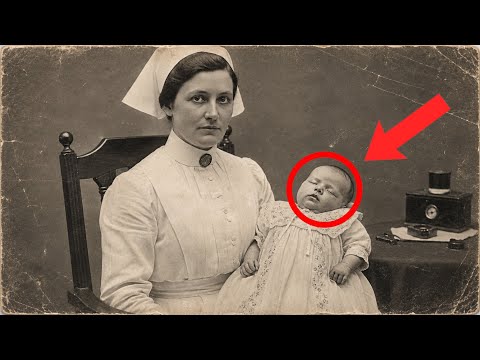
Her search led to the hospital’s basement archives, where Margaret Howard’s journals—eight leather-bound volumes—had been preserved for nearly a century. The entries from 1904 were meticulous, and on March 12th, Olivia found the first mention of Elizabeth: “Baby girl brought in today, abandoned at church steps. Severely malnourished, respiratory distress. Perhaps six months old. No identification except a small silver cross and the name Elizabeth embroidered on her blanket.” Margaret had named her Stone after the baptismal font where she was found.
Over the following weeks, Margaret’s entries revealed a growing attachment. “Her tiny hand grasped my finger today and would not let go for nearly an hour,” she wrote on March 20th. By March 27th, Elizabeth’s breathing had worsened, and Margaret spent nights in a chair beside her crib. “I cannot bear the thought of her struggling alone in the darkness.”
Then came April 17th. “We lost our Elizabeth today at 3:17 this morning. I was holding her when she took her final breath. So gently, it was like watching a candle flame flicker out.” No family had come forward. Hospital protocol required a photograph for medical records before burial, but Margaret requested to hold Elizabeth for the portrait. Dr. Prentiss agreed, understanding that in six weeks, Margaret had become the only mother Elizabeth ever knew.
Olivia sat back, tears blurring the journal’s ink. The photograph was no longer clinical documentation—it was an act of love, ensuring that in death, the abandoned infant was held in caring arms. But the story was far from over. The silver cross, the christening gown, and a nurse’s lifelong mission were waiting to be uncovered.
Olivia’s next call was to Dr. Eleanor Fisher, a medical historian who specialized in early pediatric care. They met in the hospital library, the 1904 photograph resting between them on the polished oak table. Fisher examined it through archival gloves, her brow furrowed with quiet reverence.
“Postmortem photography was standard practice well into the early twentieth century,” Fisher explained. “But this example is extraordinary because it represents an institutional memorial rather than a family one. And the gown—that’s not hospital issue. Margaret likely purchased or sewed it herself.” She pointed to the small silver cross at Elizabeth’s throat. “That detail alone tells us the birth mother wanted her child recognized as beloved, even in abandonment.”
The admission ledger confirmed the bare facts: Infant female, approximately six months, admitted March 12th, 1904. Diagnosis, severe malnutrition, respiratory infection, suspected tuberculosis. Primary nurse, Margaret Howard. The death certificate, retrieved from the city archives, listed the cause as consumption and failure to thrive. No parents named—simply unknown in faded ink. The informant was Margaret Howard.
But the most illuminating document came from Dr. Prentiss’s monthly report to the hospital board. “Head Nurse Howard provided extraordinary care, remaining with the infant during off-duty hours and ensuring dignified treatment through final disposition,” he wrote. “While I have cautioned staff against forming personal attachments, I cannot fault the quality of care this dedication produced.”
A notation in the hospital’s financial ledger revealed something even more telling: April 19th, 1904, disbursement to M. Howard for reimbursement of burial expenses for indigent patient E. Stone, $4.75. A considerable sum for a nurse’s salary—enough to suggest Margaret had personally funded a burial far beyond the simple interment the city provided for unclaimed infants.
Olivia tracked down the hospital’s contracted photographer, James Sullivan, through the Boston Historical Photography Society. His appointment book for April 18th, 1904, contained a brief entry: Children’s Hospital, 10:00 a.m. Memorial portrait, deceased infant with Nurse Howard. Special considerations noted.
Sullivan’s technical notes proved more revealing still. “Nurse Howard requested natural light only, no visible support apparatus, and the child to be photographed in her arms rather than in the standard repose position,” he had written. “She provided special white christening clothes and insisted on washing and preparing the infant herself. She also requested copies of the photograph for hospital records and for herself personally—unusual for an institutional subject, but granted given the circumstances.”
Most striking was Sullivan’s own emotional postscript. “Of the many postmortem photographs I have been called to take, this stands among the most affecting. The nurse held this child not with the formal pose of professional duty, but with the same tender attention I observed when my own wife held our sleeping daughter. Some bonds transcend the expected relationships, reminding us that family is sometimes found rather than born.”
Olivia set down the photographer’s notes, her hands trembling slightly. The portrait was no longer a mystery—it was a testament. But Margaret’s journal had mentioned the silver cross found with Elizabeth at abandonment. If that artifact still existed, it would complete the story.
Her search led to the hospital’s small museum, where curator Dr. Sarah Chen greeted her with understandable skepticism. “Small personal items from indigent patients rarely survived,” Chen explained, leading Olivia past glass cases of antique surgical kits and yellowed diplomas. “However, we do have a collection donated by Margaret Howard’s family after her death. Let me check the inventory.”
To both women’s surprise, the Howard collection included a small velvet box containing a tarnished silver cross on a faded ribbon. The accompanying note card, in Margaret’s precise hand, read simply: Elizabeth Stone’s cross, found with her at abandonment, March 1904, kept in her memory.
The cross was delicately crafted, engraved with a floral pattern along its edges. It was not an expensive piece of jewelry, but neither was it a cheap trinket. When Dr. Chen carefully turned it over, they discovered a tiny engraving on the back: “With love, always.”
“Someone cared enough to leave this with her when they felt forced to give her up,” Olivia observed. Chen nodded. “The early 1900s offered few options for single mothers. Leaving a child with a valuable item often indicated desperate circumstances rather than lack of love.”
Margaret’s journal entries following Elizabeth’s death revealed how the cross had become a tangible connection to the infant she had lost. April 30th, 1904. I wear Elizabeth’s silver cross inside my uniform while on duty. It feels important to carry this small piece of her with me as I care for other children.
By mid-May, the entries grew more resolute. Visited Elizabeth’s grave today. The small marker shows only her name and dates, but I know who she was, how she fought to breathe, how she gripped my finger. I placed wildflowers on the grave and promised to return. The journal revealed that Margaret had continued visiting monthly for years—and had established a small fund to provide proper burial clothes for other abandoned infants who died in the hospital’s care.
“She transformed her grief into a mission,” Dr. Chen observed as they carefully returned the cross to its protective box. “This wasn’t just about one child. Elizabeth’s death changed how Margaret approached her entire nursing career.”
Armed with the death certificate’s burial location, Olivia visited the old city cemetery. Section 8, the children’s section, lay in a quiet corner beneath ancient oak trees. The attendant, an older man named Joseph who had worked there for decades, became interested in her research. “Most abandoned children received only numbered markers, if anything,” he explained. “But there was a nurse from Children’s Hospital who changed that for many of them.”
He led Olivia through rows of small markers until they reached a modest stone: Elizabeth Stone, unknown in life, beloved in death, 1903–1904. Unlike the surrounding graves, this one showed signs of care—the stone relatively well preserved, the small plot free of weeds. “The records show this plot was purchased privately,” Joseph said. “And there’s a perpetual care notation with a small endowment established in 1952.”
“1952? That’s the year Margaret Howard died,” Olivia realized. Joseph nodded. “The original notation says Margaret Howard, nurse, as the purchaser. And the records show she did the same for several other children’s graves in this section between 1904 and 1927.”
Examining the surrounding plots, Olivia noticed several with similar markers—simple but dignified stones for children identified only by first names and approximate dates. Cemetery records confirmed Margaret had purchased individual markers for over twenty children during her career, all patients who had died without family to claim them.
Most moving was a discovery Joseph made while reviewing the oldest ledgers. “When Nurse Howard died in 1952, her will specified that she wished to be buried in the children’s section near Elizabeth Stone, rather than in her family plot.” He pointed to a modest grave about ten feet away, marked: Margaret Howard, 1879–1952, faithful nurse and guardian.
“She chose to be buried near the children she cared for rather than with her own family,” Olivia said softly. “It happens more than you might think,” Joseph replied. “People form bonds that go beyond conventional relationships. Death sometimes reveals the true architecture of human connections—who really mattered to whom.”
Before leaving, Olivia placed flowers on both graves and photographed the two stones together—the nurse and the infant she had refused to let be forgotten. Their final resting place was a permanent testament to a bond that had begun in a hospital ward and continued long after death had separated them.
Back at the hospital, Olivia faced her final hurdle: the anniversary exhibition committee. Dr. Paul Winters, the chairman, shifted uncomfortably. “Most visitors have never seen postmortem photography. They might find it morbid.”
Olivia met his gaze. “That’s precisely why it belongs. This isn’t about death—it’s about care that continued beyond death.” Dr. Bennett backed her. “If we sanitize medical history, we do the public a disservice.”
A compromise emerged: the photograph would hang with full context, clear advance notices, and a focus not on loss but on Margaret’s devotion. The ethics consultant, Dr. Maya Singh, approved. “Dignity, education, and context—this honors them both.”
On opening night, Olivia watched visitors linger. Current NICU nurses studied Margaret’s handwritten care protocols, murmuring that her philosophy foreshadowed modern palliative practice by decades.
Then an elderly woman approached—Patricia Howard Collins, Margaret’s great-niece. She had brought a hand-embroidered handkerchief, initialed E. “Aunt Margaret said Elizabeth taught her what it means to be a nurse. This photograph hung in her bedroom until she died.”
As the lights dimmed, Olivia studied the serene nurse and the still infant one last time. What had once seemed unsettling now read as a quiet manifesto: technical care without compassion fulfills only half of healing’s promise.
What do you think—should hospitals display such intimate historical images, or do they belong behind closed archive doors? Tell us in the comments.
Report this article
Select a reason for reporting:






