Ten days before Jacqueline Bouvier married Senator John F. Kennedy, a ruptured water pipe flooded a New York workroom. Fifty yards of ivory silk taffeta—the wedding dress—was ruined. Rust stains bled into the fabric. The bride’s gown and most of the bridesmaids’ dresses were destroyed. The woman who made them bought new fabric, hired extra hands, and remade everything. She told no one in the family. The job that was supposed to earn her $700 cost her $2,200. On the wedding day, according to surviving accounts, she was directed to use the service entrance.
Her name was Ann Lowe. How did the woman who dressed America’s wealthiest families end up nearly broke, her name omitted from the creations that defined an era? This is the story of a hidden life behind American wealth—the money, the secrets, and the people who paid the price.
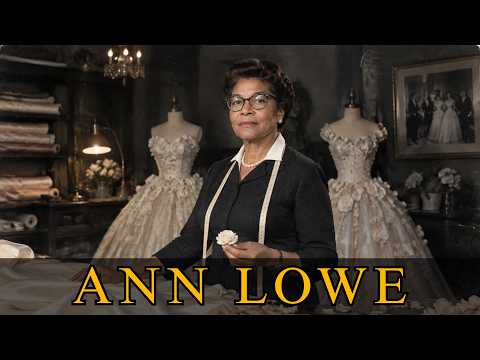
In a small Alabama workroom at the turn of the century, a young girl gathered fabric scraps from the floor and twisted them into flowers. She was about six years old. The flowers were copies of those in the garden—tiny buds made from remnants. She made them because the scraps were there, and because the women around her spent their days turning cloth into something worth looking at.
Those flowers would follow her for the rest of her career. She would scatter them on ball gowns and wedding dresses for sixty years, and they would become her signature. But at six, she was just scraps on her mother’s floor.
The two women who owned that workroom were her mother and grandmother. Their names were Jennie Cole Lowe and Georgia Thompkins. Both had once been enslaved. In the 1850s, mother and daughter were held in bondage in Alabama as domestic workers. In 1860, Georgia’s husband bought their freedom. His name was General Cole, and he was a free carpenter. He paid for two women—his wife and their daughter.
These two women went on to build a business. The business was sewing. In Montgomery, the state capital, Georgia and Jennie sewed for the city’s wealthy white families, working through Reconstruction and into the long Jim Crow years. They established a workroom trusted by the finest families. Jennie was known for her mastery of embroidery. By 1910, their clients included the wife of Alabama’s governor.
For a Black woman in that world, the needle was one of the very few paths to independence. Dressmaking was among the best-paid and most respected trades available to any woman in the nineteenth century, Black or white. And for a Black woman, it offered something rarer still—the chance to own a business.
Curator Elizabeth Way, who studied the family’s story for nearly a decade, noted how few other doors were open. There was a famous precedent. A generation earlier, a formerly enslaved seamstress named Elizabeth Keckley had sewn clothes for Mary Todd Lincoln. Skill could take a woman far. It could take her into the most private rooms of the nation’s most powerful families. But it could not make those families treat her as an equal.
Ann was born into that legacy in a rural area near Clayton, Alabama. Her parents were Jane and Jack Lowe. She had an older sister, Sally, who would also become a skilled seamstress and, one day, Ann’s caretaker. Ann’s birth year is uncertain. Most accounts point to 1898, with one specifying December 14. Others suggest 1889 instead. Textile historian Margaret Powell, who spent ten years studying her life, suggested the earlier date may have been recorded to conceal Ann’s young age at her first marriage.
She grew up in Montgomery, close to the family business. The work began early. By age five, she was proficient at sewing. By six, she was making her own flowers. By eight, according to one account, she had sewn a complete dress. By ten, she was designing her own patterns. Elizabeth Way put it simply when looking at what remains of her work: “We know she was designing her own clothes and sewing at a very high level from the age of eight or ten.”
Some modern profiles add another layer to her origins, describing her as the granddaughter of an enslaved woman and a plantation owner. That claim is considered family tradition rather than documented record.
Her mother’s clients had their own world, and that world had a book. In 1887, a former gossip-column publisher named Louis Keller printed the first Social Register—a directory of families of consequence. The register contained 3,600 names and cost $1.75. Its rules of admission were never published. Members were nominated by other members and approved by a committee, and they were almost entirely white, Christian, and influential. Over time, the book would cover thirteen American cities, and the women in it would need dresses for every appearance, every ball, every wedding their position demanded.
The girl in Montgomery didn’t know it, but she was being trained for that book.
Her schooling, by her own account, ended around age fourteen when she left school to marry. The census tells a slightly different story, as it often does in her life. In 1910, the census places her in Dothan, Alabama, with a husband—a man named Lee Cone. If the census is correct, she was very young indeed; one reading of the records puts her age at twelve. Later accounts suggest the husband’s name was Lee Cohen, and one magazine profile written during her lifetime described him as ten years her senior and dated the marriage after her mother’s death—which the census contradicts.
What the sources agree on is the general shape. She married as a child. About a year later, she gave birth to a son, Arthur Lee Cone. Her husband did not want her to continue sewing. At his insistence, she set the work aside. Giving it up was a heavy thing. She had been sewing since she was five. Her mother and grandmother had built their entire lives around the needle. Now the girl who could design a sewing pattern at ten was a young wife in Dothan with a child, forbidden to work.
The fabric scraps were still on the workroom floor in Montgomery. Her mother was still at the table, working on orders for the governor’s wife and the wealthiest women in the capital. Then, in 1914, Jennie Cole Lowe died suddenly, leaving four unfinished evening gowns.
The orders were for a New Year’s Eve ball, and one of the four gowns on the table belonged to Alabama’s first lady. Her name was Elizabeth Kirkman O’Neal, known as Lizzie, and she was the wife of Governor Emmet O’Neal, who held office from 1911 to 1915. He was a lawyer from Florence, a former president of the state bar association, a former United States attorney, and a delegate to the state’s 1901 constitutional convention. He had married Lizzie Kirkman in Tuscaloosa in 1881. She was exactly the kind of client the Montgomery workroom had spent decades cultivating—and her gown was unfinished.
Years later, after leaving office, Emmet O’Neal would be appointed a federal judge in bankruptcy cases in Birmingham. The seamstress’s daughter who finished his wife’s gown would one day declare bankruptcy herself.
The other three belonged to women of the same circle, a small set of wealthy clients who had a ball to attend. All four gowns were in Jennie’s hands. Now all four were without the woman who had planned them. Her death was sudden; the sources do not record the cause. They say only that it was unexpected, and that it came in the middle of the season’s most important order.
Sewing does not stop for grief. The ball had a date. Someone had to finish the work, or the family name in Montgomery would go into the grave with the woman who had carried it.
That someone was her daughter, who was about sixteen years old. Ann finished all four gowns. She later described it as the first big test of her life. And in a city where reputation passed from one wealthy woman to another, the girl who completed the dead seamstress’s orders for the governor’s wife now had a name of her own. Several accounts say that job cemented her local standing and that she took over the family business.
The New Year’s gowns changed something inside her, too. The Metropolitan Museum’s account says the order revived her passion for design—the very work her husband had told her to abandon.
There is a pattern here that would repeat for the rest of her life. A crisis arrives at her table. No one else can solve it. She solves it, quietly and expertly. And the people whose problem she solved go to their party without thinking much about what it cost.
At sixteen, the cost was the chance to mourn her mother in peace. Later, the cost would be counted in dollars.
The next turn came in a department store. The sources differ on which store. The Metropolitan Museum says it was a store in Alabama. The curator of the Henry B. Plant Museum in Tampa described a Tampa family visiting Dothan around 1915. The Smithsonian’s account says only that it was a department store.
What they agree on is the scene. A wealthy woman from Florida saw a young Black woman wearing a dress so impeccably made that she asked about it—and learned the young woman had designed it herself. The shopper was Josephine Edwards Lee, wife of a Florida citrus grower and a prominent figure in Tampa society. She had daughters—twins according to the Smithsonian, four daughters according to others. The twins were approaching their wedding day. They needed wedding dresses. They needed a trousseau. The complete wardrobes a bride of that class carried into her married life. Josephine Lee wanted a seamstress who could make all of it, and she wanted her to live in the house.
Ann told her husband about the offer. Years later, she described that conversation to the Saturday Evening Post. “When I told my husband, he said, stay home. But I took my child and got on that train to Tampa.”
The sentence has two halves, and the essence of her character lies in the gap between them. The first half is a man telling her what to do. The second half is what she did. There are no recorded arguments, no tears, no justifications. There is only a child, a train, and a city in Florida. It is the most decisive moment she ever described about herself, without any embellishment at all.
In 1916, at about eighteen, she left her marriage with her small son, departed Alabama, and moved to the Lee family’s estate by a lake outside Tampa. She described the opportunity in words that sound almost joyful compared to the simplicity of the train ride. She said: “It was a chance to make all those beautiful dresses I had always dreamed of.”
And for a time, that was exactly the reality. The Lees gave her what the Montgomery workroom could not—a single wealthy family with daughters, money, and a calendar full of occasions. She made tailored suits for Josephine Lee and her daughters. She made afternoon dresses. She made wedding gowns. She made trousseaux, piece by piece, for young women about to become wives of consequence in Florida. Over time, her client base widened beyond that family, especially in wedding dresses.
Beneath that opportunity lay a harsher truth. Ann was a live-in seamstress. She lived on the estate in a house that was not hers, sewing for the family that housed her. The arrangement gave her freedom from her husband and provided work she loved. But it did not give her a name of her own.
The child she carried onto that train was Arthur. He grew up alongside her work, and many years later, he would take over her ledgers and manage her supplies. At the time, he was just a small boy on a Florida farm, and his mother was making the dresses the Lee daughters would marry in.
She seems to have realized she needed more than talent. Within a year, she left the Lee farm to train in New York. In 1917, she enrolled in a fashion school in Manhattan. The school had accepted her admission. But it did not yet know what she looked like.
The S.T. Taylor School of Design discovered its new student was Black only when she walked through the door. The director questioned her ability to afford tuition. Her classmates refused to share a room with her. The school’s solution was to isolate Ann in a private room, where she worked alone.
She worked so hard that the arrangement flipped upside down. Her work in that solitary room surpassed anything in the main classroom. Soon, the school used her designs as models for the students who had refused to sit beside her. She finished the course in half the expected time, and the school told her they had taught her all they could.
Back in Tampa, she started her own business. By the 1920s, she employed eighteen seamstresses and designed costumes for the Gasparilla court. If you didn’t have a Gasparilla gown by Ann, you might as well stay home, one woman recalled. She saved twenty thousand dollars and then closed her shop. She wanted the Social Register families of New York.
She arrived in 1928, just before the crash. Her first New York store failed within a year. She stayed, working anonymously for other fashion houses—Hattie Carnegie, Sonia Gowns—her designs sold under their labels. In 1947, Olivia de Havilland accepted her Oscar in a gown Ann designed. The label inside read Sonia Rosenberg. No one mentioned Ann Lowe.
She eventually opened her own salon on Madison Avenue, the first Black woman to do so. She dressed the Rockefellers, the du Ponts, the Lodges. And then Jacqueline Bouvier. The wedding dress took two months. The flood destroyed it. She remade it in days, at her own expense, and told no one. On the wedding day, she was told to use the service entrance. She refused. “If you want the dresses, this is the door I’ll come through,” she said, and walked in the front.
She never received proper credit. When Jackie Kennedy later called her a “colored seamstress,” not a couturier, Ann wrote a quiet letter asking to be called a designer. The reply, if any, is unrecorded. She won Designer of the Year in 1961, the same year. She declared bankruptcy in 1962, lost an eye to glaucoma, and her son Arthur died in a car crash in 1958. She retired in 1972, nearly blind and penniless.
She died in 1981. Her name was forgotten—until museums began collecting her work. In 2023, the Winterthur Museum opened the largest exhibition of her designs, finally calling her what she always was: an American couturier. The flowers she made as a child lived longer than every silence. Was Ann Lowe forgotten, or was she hidden—by the same families who valued her genius, her discretion, and her low prices? What do you think?
Report this article
Select a reason for reporting:






