The camera shutter clicked, capturing a moment frozen in time—but the subjects in the frame were not all alive. In the Victorian era, death was not a quiet passing but a violent, unpredictable force that struck without warning. They didn’t pose the dead to shock anyone. They posed them to survive the moment. The photograph was not a mere keepsake; it was a desperate attempt to control the uncontrollable.
Grief-stricken families, grappling with sudden loss, turned to the new art of photography for solace. Death, in their eyes, looked frightening, uncontrolled, wrong. So they tried to correct it. Bodies were dressed carefully, positioned upright, placed beside the living. Not to pretend nothing happened, but to make the scene bearable. A seated body felt familiar. A standing posture felt normal. A calm face felt safe.
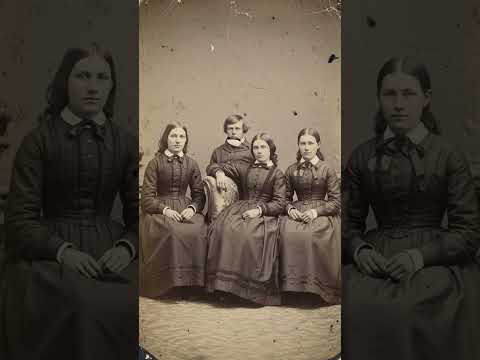
These photographs weren’t lies. They were compromises. Ways to turn chaos into something the mind could accept. The dead were posed like the living because reality was too much to face. In an age of high mortality, where children were lost before their fifth birthday and mothers perished in childbirth, the photograph offered a fleeting illusion of peace.
Consider the case of the Brown family, who lost their youngest daughter to scarlet fever in 1863. The photographer arrived the next day, his camera a bulky wooden box that required the subjects to remain perfectly still for minutes. The girl was propped in a chair, her favorite doll in her lap, her eyes carefully closed. Her mother stood beside her, hand resting on her shoulder, as if she might wake at any moment. The resulting image, tinted with rosy cheeks, was not a deception but a balm—a way to remember the child as she was, not as she had become.
But the practice was not without controversy. Some saw it as morbid, a violation of the natural order. Others whispered of spiritualism, of capturing the soul. Yet for the families, it was a necessary ritual, a final act of love in a world where death was always near.
As the century waned and medical advances slowly pushed back the tide of disease, the need for such compromises faded. But the photographs remain—haunting, beautiful, and deeply human. They remind us that even in the face of the ultimate unknown, we seek to impose order, to find comfort in the familiar.
The story of post-mortem photography is not just about death, but about life—about the lengths we go to hold on to what we love, even when it has already slipped away.
It was not only the wealthy who commissioned these images. In the cramped tenements of London’s East End, families pooled pennies to hire a traveling photographer, often a man with a secondhand camera and a steady hand. The cost of a single daguerreotype could equal a week’s wages, yet parents went hungry to afford one last portrait of a child taken by cholera or a husband felled by a factory accident.
The photographers themselves carried a strange burden. They worked quickly, quietly, with a practiced gentleness. Some kept props in their satchels—a favorite toy, a small Bible, a sprig of rosemary for remembrance. They learned to position a body without leaving a mark, to tilt a chin just so, to paint open eyes onto closed lids with a fine brush. It was a craft of mercy, though few outside the trade understood it.
Not every attempt succeeded. In 1871, a photographer named Elias Ward was summoned to a farmhouse outside Norwich, where a young man had drowned in the river. The body had been recovered too late, the features already stiff and darkened. Ward tried for hours to arrange the limbs, but rigor mortis had locked the arms at an awkward angle. The family wept in the doorway. In the end, Ward posed the young man with his face turned toward the window, a shadow falling across his bruised cheek, and told the parents it was the best light in the house. They accepted the plate without a word.
Some photographers refused the work altogether. Others drank. A few, like the celebrated Antoine Claudet, argued publicly that the dead should be left in peace, that the camera was an instrument of vanity, not grief. But the families kept coming. They came because the alternative was worse—a memory that frayed a little more each year, until the face of a lost child blurred into nothing.
The living often appeared in these frames too, though never smiling. A mother might be photographed holding her dead infant, her expression carefully blank, her hands arranged to suggest sleep rather than stillness. The image would hang in the parlor for a year, then be moved to a drawer, then finally to an attic—not out of shame, but because grief, like film, eventually fades.
By the 1890s, the practice had begun to slip into shadow. The Kodak camera arrived in 1888, cheap and simple, and suddenly everyone could take their own pictures. Death was pushed out of the frame, replaced by birthday parties and seaside holidays and dogs on lawns. The posed corpse became a relic of a darker age, something to be whispered about, then mocked, then forgotten.
But the negatives survived. They surface now and then, in estate sales and museum archives, and when they do, someone always asks the same question: why would anyone want such a thing? And the answer, if there is one, lies in the eyes of the mother standing beside her daughter’s chair—steady, unblinking, refusing to let go.
It was that refusal—the quiet, stubborn insistence on remembering—that carried the practice across the Atlantic and into the American frontier, where death was even more present and even less forgiving. In the scattered towns of the Midwest, a family might wait weeks for a photographer to pass through, and by then the body could no longer be posed. Some families buried the dead twice: once in the ground, and once in a photograph taken days later, of an empty room arranged as if the departed had just stepped out.
These “empty room” portraits were a strange offshoot of the tradition, and they unsettled even the photographers who made them. A chair pulled slightly from the table. A pipe resting in an ashtray. A child’s shoes placed neatly by the door. The absence was the subject, and the absence was the point. Grieving parents found these images easier to live with than a stiffened corpse—they could pretend, for a few minutes each day, that the room was merely waiting.
But the most troubling development came from the Spiritualists. By the 1870s, a movement had spread through parlors and lecture halls, claiming that the camera could capture not only the dead but the soul itself. Photographers like William Mumler produced images in which ghostly figures hovered behind their living subjects—a translucent grandmother, a child in a white gown. Mumler was eventually tried for fraud, but the public appetite for his work only grew. Grief, it turned out, was willing to pay for almost any proof.
The line between comfort and exploitation blurred. Some operators preyed openly on the bereaved, charging double for a “spirit” they had painted onto the negative themselves. Others, like the Boston photographer Eliza Hartwell, refused to traffic in ghosts but still found herself drawn into the trade. She kept a ledger of every family she photographed, noting not their names but their losses—”three children,” “husband, typhoid,” “mother, childbirth.” She never showed the ledger to anyone.
Hartwell’s most famous image, taken in 1874, shows a young woman seated in a high-backed chair, her hands folded in her lap, her head tilted slightly to one side. The woman is dead, but you would not know it at first glance. Her cheeks are pink, her lips parted as if about to speak, and in her arms she holds a sleeping infant who had died three days before her. The two were buried together the following morning.
When the photograph was exhibited decades later, a critic called it “the most dishonest picture ever made.” But a woman in the audience stood up and said quietly, “No. It is the only honest one.” She was the dead woman’s sister.
The exchange was reported in a local paper and then forgotten. But it captures something the histories often miss: the photographs were not meant for us. They were meant for the people in the room, the ones who had to keep living.
The sister’s words lingered in the lecture hall long after the audience dispersed, a quiet verdict that no critic could overturn. She had not come to defend the image; she had come to claim it. For her, the photograph was not a deception but a document of love—proof that her sister and nephew had existed, had been held, had mattered.
In the decades that followed, the practice faded, but the impulse behind it never truly died. We still pose our dead in memory, if not in photographs—arranging their stories, smoothing their rough edges, placing them in frames where they can look back at us calmly. The Victorian parlor has become the digital archive, the family album a scrolling feed, but the need is the same: to make the unbearable bearable, to turn chaos into something the mind can accept.
And so the negatives remain, tucked in museum drawers and attic boxes, waiting for someone to ask the old question. When they do, the answer is not about death at all. It is about the stubborn, tender refusal to let go—the same refusal that makes us keep a child’s shoe, a father’s watch, a mother’s handwriting on an old recipe card.
The dead were posed like the living because the living could not bear to pose without them. That is not morbid. That is human. And if you doubt it, look again at the mother standing beside her daughter’s chair, her hand resting on a shoulder that will never shrug her off. She is not pretending the child is alive. She is insisting the child was here.
What would you keep, if the camera were your only way to hold on?
Report this article
Select a reason for reporting:






