March 15th, 1962. 3:28 p.m. Charlie’s Barber Shop, 125th Street, Harlem. The scissors kept their rhythmic clicking, the dominoes clacked in the back, and the air hung thick with talcum powder and cigarette smoke. Twenty men occupied the space—three in chairs, four at the domino table, two hunched over a chessboard—all oblivious to the storm about to break. Then the door opened, and Bumpy Johnson stepped inside.
His eyes swept the room, landing on Marcus Williams, half-covered in shaving cream, Charlie’s straight razor pressed against his throat. Bumpy spoke four words: “I know it is you.” The scissors stopped. The dominoes went quiet. Charlie’s hand froze, the razor a hair’s breadth from the carotid artery. In the mirror, Marcus’s eyes went wide, his mouth opening but no sound coming out.
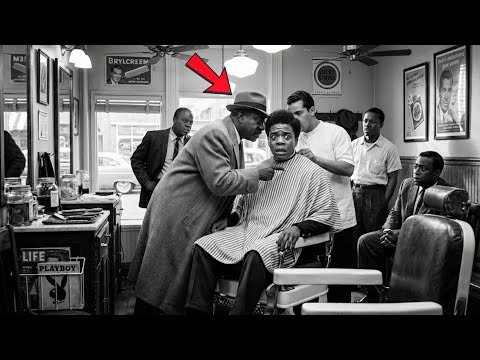
“You want to tell these men I’m wrong?” Bumpy asked, his voice eerily conversational. “That you haven’t been on your knees for federal agents for $500 a month?” Marcus tried to shake his head, but Charlie pressed the razor harder, drawing a thin red line on the skin—not deep enough to open, but close. Illinois Gordon moved from the door, a mountain of a man blocking any escape.
Bumpy pulled a photograph from his jacket and held it up to the mirror. “February 14th. You met Torres in a parking lot on Amsterdam. You gave him information about a heroin shipment at Pier 47. The FBI raided it two days later. You know what they found? Nothing. Because I made it up. I told only you, Squeaky. Just you. And I waited to see what would happen.”
He leaned close to Marcus’s ear. “You know the difference between you and a real man? A real man breaks his own mother’s heart before he breaks his word. You broke both.” Marcus’s voice came out strangled, pleading that they’d threatened his mother, shown him photographs. Bumpy straightened. “You believed white men in suits who make their living putting black men in cages. You believed them over me, over this neighborhood, over everyone who ever trusted you with their lives.”
Charlie spoke for the first time, his voice flat. “What do you want me to do, Bumpy?” “Not yet,” Bumpy said. “First, I want everyone in this room to hear what 20 pieces of silver buys these days.” He unfolded a paper. “Agent Michael Torres promised you $500 a month. Promised you a new identity. Promised you’d be relocated to California—fresh start, nobody would ever find you. You believed that, too, didn’t you? You believed they’d actually let a negro informant live long enough to spend their money.”
He looked around the room at the twenty faces watching. “You know what happens to rats when the government is done with them? They get dropped back on the street with a target painted on their backs. The agents go home to their families, get promotions, get awards for bringing down criminals. And the rat? The rat gets found in an alley with his throat cut. And nobody writes a report about that.”
He turned back to Marcus. “But you thought you were special. Smart enough to play both sides. Smart enough to take my money and the FBI’s money and walk away clean.” “I didn’t have a choice,” Marcus whispered. “Everyone has a choice,” Bumpy said. “You could have come to me. You could have trusted that I would protect you the same way I’ve protected everyone in this neighborhood who ever asked for help. But you didn’t. You chose to believe that white men cared about your mother more than I did.”
He straightened up, looked at Charlie. “How long have you been cutting hair in Harlem, Charlie?” “38 years.” “38 years. How many men have sat in that chair? How many secrets have you heard?” “Too many to count.” “And in 38 years, how many times have you repeated those secrets?” “Never. Not once.” “That is the difference,” Bumpy said, looking at Marcus in the mirror. “That is what you never understood. This neighborhood survives because we keep our mouths shut. We don’t talk to the police. We don’t sell each other out for promises that will never be kept. We survive because we are loyal to each other, even when being loyal costs us everything.”
Special Agent Robert Sullivan slammed the phone down hard enough to crack the plastic. Across the desk, Michael Torres looked like he had swallowed poison. “Tell me again how this happened,” Sullivan said. “Tell me how we burned six months of work because you couldn’t figure out that Johnson was feeding your rat false information.” Torres wiped sweat from his forehead. “The shipment at Pier 47 was a setup. Johnson gave Williams fake intelligence to test if it would leak. When we raided the pier, we found nothing. No heroin, no money, just empty containers and our own stupidity.”
“How many times did Williams feed us information that turned out to be worthless?” “Three times in the last month. The meeting on March 3rd—nobody there. The warehouse on March 7th—empty. The pier on the 16th—same thing. Each time we moved on his intelligence, we came up empty.” Sullivan stood, walked to the window. “And it never occurred to you that maybe Johnson had figured out we had someone inside? Maybe he was testing his own people to find the leak.”
“I thought we were being careful,” Torres said. “Careful,” Sullivan repeated. “You thought you were being careful with a man who has been running Harlem for 40 years. A man who survived the Italian mob trying to kill him, survived the police trying to arrest him, survived every two-bit gangster who thought they could take his territory. And you thought you could outsmart him with a wire and some lies about his informant’s mother.” He turned from the window. “Where is Williams now?” “We don’t know. He missed his check-in this morning. I called his apartment—his wife said he left for work at the usual time. I called the collection routes—nobody’s seen him.” “Because Johnson has him,” Sullivan said. “Johnson has him, and by now Williams has told him everything. Every meeting, every payment, every promise we made. And Johnson is deciding what to do about it.”
Torres stood up. “We need to send people into Harlem. Extract Williams before Johnson kills him.” Sullivan laughed—a sound without humor. “Send people into Harlem? You mean send white federal agents into a neighborhood where every person on every corner knows our faces and reports back to Johnson within five minutes? You mean start a war in the middle of the day over an informant who was stupid enough to get caught?” “We can’t just abandon him.” “We already did,” Sullivan said. “The moment you recruited him with lies about his mother being arrested, the moment you promised him protection you knew we could never provide—we abandoned him. He was useful when he was feeding us information. Now he’s a liability, and liabilities get cut loose.”
He sat back down. “Johnson is smart. He won’t kill Williams in a way that brings heat down on Harlem. He’ll make him disappear. Quiet. Make it look like Williams ran away or overdosed or got killed by someone who had nothing to do with Bumpy Johnson. And by the time we figure out what happened, it’ll be too late to do anything except file a report and move on to the next operation.” “So we do nothing,” Torres said. “We do exactly nothing,” Sullivan confirmed. “We shut down Operation Clean Sweep. We tell our superiors that our intelligence was insufficient for prosecution. We bury the files and we forget Marcus Williams ever existed. Because if we don’t—if we try to make this into something it’s not—Johnson will make sure everyone knows that the FBI got a man killed by lying to him about his mother being in danger.”
Torres’s hands were shaking. “They’re going to kill him. You know that, right? They’re going to take him somewhere and cut him apart piece by piece until he tells them everything. And then they’re going to dump what’s left in the river.” “Probably,” Sullivan said. “But that’s what happens when you make deals with the devil and think you can cheat him. Williams knew the risks. He took the money anyway. And now he gets to pay the bill that comes with that money.”
He opened a drawer, pulled out a folder. “You want to know what really makes me angry, Torres? It’s not that we lost the operation. It’s not even that Williams got caught. It’s that Johnson is better at this than we are. He built a network based on loyalty and trust, and we tried to break it with threats and lies—and he won. He always wins. That’s why he’s still the king of Harlem. And we’re sitting here in an office explaining to our bosses why we have nothing to show for six months of work.”
Torres walked to the door, stopped. “What happened to Williams’s mother? She really is sick. She really does need that money for her medicine.” Sullivan looked up. “That’s not our problem anymore. Williams should have thought about his mother before he decided to become a rat. Maybe she can find another son to take care of her. One who isn’t stupid enough to trust federal agents who promised things they could never deliver.”
The door of Charlie’s Barber Shop swung shut behind Marcus Williams, and the bell above it gave a thin, cheerful jingle that seemed to mock the moment. He walked east on 125th Street with his coat pulled tight, past the record shop and the soul food counter, past men who nodded at him without meeting his eyes. He was still breathing. He still had his hands. But he had nothing else.
Inside, Charlie wiped the razor clean and set it down. Nobody asked what had been said in those seven minutes. Nobody needed to. “Next,” Charlie said, and a man climbed into the chair as if the seat had never been warm.
Marcus’s wife Rachel filed her missing-person report on the 18th. The investigation produced no leads, no witnesses, no evidence of foul play. The file went inactive in April and closed for good in 1965. She moved back to North Carolina, remarried a history teacher who never asked too many questions, and the girls grew up believing their father had simply run off.
In Georgia, Clara Williams received a letter in late March from a friend of her son’s. Marcus had found work in California, it said. He was doing well. He would send for her soon. She believed it, because mothers want to believe. She died in 1970, still waiting for a phone call that never came.
Bumpy Johnson ran Harlem until 1968, when he slumped over a winning hand at Wells Restaurant and was gone before the ambulance arrived. Thousands lined the procession. The neighborhood mourned him like a king—because that was what he had been. A king who understood that power came from loyalty freely given, not fear forcibly imposed.
Charlie’s shop stayed open until 1987. The chair where Marcus sat was never replaced, never reupholstered, never thrown away. It stayed in the corner like a monument, a reminder that some furniture is too heavy with history to be treated like an ordinary object.
Real power is not what you can destroy. It is what you choose to build—and what twenty men choose to carry in silence for fifty years. So tell us: was Bumpy’s justice a king protecting his people, or a tyrant teaching a neighborhood to fear him? Drop your answer below.
Report this article
Select a reason for reporting:






