The sun had barely cleared the ridge when William Hodson halted the bullock cart. Behind him, a hundred horsemen. In front, three princes of the Mughal house, their hands bound, their eyes fixed on the road back to Delhi. It was September 22, 1857, and the city they had ruled for three centuries was now a conquered ruin. The crowd pressing in behind the cart had swelled to two or three thousand, a living tide of shock and fury. Hodson ordered the princes to strip. Then, in his own words, he shot them one after another.
“I am not cruel,” he would write two days later, “but I confess I did rejoice at the opportunity of ridding the earth of these wretches.”
The dead men were Mirza Mughal, a son of Emperor Bahadur Shah Zafar and the nominal commander of the rebel forces; Mirza Khizr Sultan, another son in his early twenties; and Mirza Abu Bakr, a grandson of about twenty. Hodson took their signet rings and a turquoise amulet. Their bodies were thrown into the cart and dumped in front of the city’s police station, in what one officer called the most public street in Delhi. They lay there, naked in the sun, for days—a warning to every watching eye.
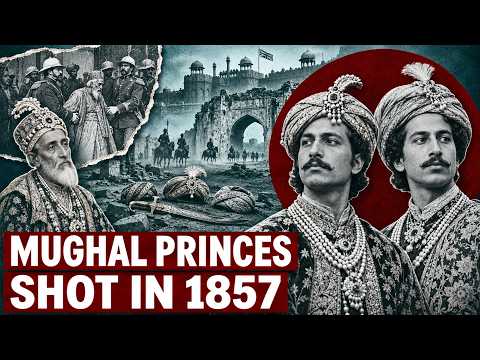
That single afternoon did not end the dynasty. It started a slow, deliberate dismantling. The gunfire at the Khooni Darwaza—the Bloody Gate—echoed far longer than anyone on that road could have imagined. It echoed through the gallows of Delhi, where no fewer than twenty-nine of the emperor’s sons and grandsons were hanged. It echoed through a guarded compound in Rangoon, where the old emperor was buried in an unmarked grave, his name erased from the land. It echoed through the lanes of the old city, where princes begged with bags around their necks, and through a slum near Calcutta, where in 2025 a widow of that line asked India’s Supreme Court to give her the Red Fort.
The Mughal dynasty had ruled for more than three centuries. What followed that gunfire was not justice—it was a calculated effort to make sure no Mughal would ever again be someone Indians could rally around. And many of the people who paid for it were royal women and children who had never fought at all.
To understand how it came to this, we have to go back to May 1857, when the princes first stepped onto a stage they had never been trained for. On the 11th of May, three hundred mutinous sepoys rode into Delhi from Meerut. The emperor they came looking for was Bahadur Shah Zafar, then in his early eighties—a poet and calligrapher whose real power had long since passed to the East India Company. The British even claimed the right to decide which of his sons would succeed him. In 1856 they had named a prince called Mirza Jawan Bakht as crown prince, passing over the son his favorite wife, Zeenat Mahal, wanted on the throne. Now, suddenly, armed men were asking him to lead a war.
His sons saw a chance. Mirza Mughal, born in 1817, petitioned with his half-brothers for military command. His father refused at first, then gave in, naming him commander-in-chief. By most accounts, he had no training or experience for the job. When a seasoned rebel general, Bakht Khan, arrived later, he took over the top command, and Mirza Mughal became the officer in charge of supplies. A few weeks after that, he was given the job of running the city’s administration.
Five days after the sepoys arrived, something happened inside the Red Fort that would hang over the whole family. A group of European prisoners—mostly women and children—had been taken into the palace. On the 16th of May, they were brought out to a water tank in front of the palace drum house and killed. Who was responsible is still argued over. The court diary has the emperor saying the army may do as they please. Zahir Dehlvi, a young court official who later wrote a memoir of these months, remembered it differently. He has Zafar ordering his officers to reason with the soldiers and save the prisoners. As for the princes, the evidence is thinner still. A summary of Dalrymple’s research says the princes seem to have been involved. That hedge matters, because the surviving records do not go any further.
By September, the siege lines on the ridge outside had held. The assault began on the 14th. In one neighborhood alone, Kuchā Chelān, an officer named Edward Vibart wrote that the order went out to shoot every soul. And by Dalrymple’s account, some 1,400 people were killed there. As the city fell, Zafar slipped out of the fort with his household and took refuge at the tomb of his ancestor Humāyūn outside the walls. Zahir Dehlvi remembered the old man’s fear in those days. “After they leave,” he has the emperor saying, “the British are going to cut my head off along with that of my children.”
Hodson was the man sent after him. He was a company officer who had raised an irregular cavalry regiment of around 2,000 men, known as Hodson’s Horse, and he also headed British intelligence in the camp. His orders, as his brother later published them, were to promise the king his life and freedom from personal indignity, and to make what other terms he could. Zafar agreed to come out on one condition: that Hodson repeat the government’s promise of safety with his own lips. He did, and the old man was escorted back into the city.
The next morning, Hodson returned to the tomb for the princes. There was no promise this time. In his diary, he put the crowd around the tomb at six or seven thousand. The princes surrendered their weapons, climbed into the cart, and the procession set off for Delhi. The question that has been argued over for nearly 170 years is what happened in Hodson’s mind on that road. His own letters give us a surprising amount of it. Writing two days later, Hodson said he had meant to have the princes hanged, but that with the mob pressing in, it had come down to a choice between “they or us.” He told the crowd that these were the butchers who had murdered and brutally used helpless women and children. Then came the line that has followed him ever since: “I am not cruel, but I confess I did rejoice at the opportunity of ridding the earth of these wretches.”
The gateway is now known as the Khooni Darwaza, the Bloody Gate. And the story of what happened after the shots were fired—to the bodies in the street, to the emperor in his cell, to the women and children who had never fought—is a story of calculated erasure that would stretch across three continents and more than a century and a half.
The bodies were laid out on the raised platform in front of the Kotwali, the police station in Chandni Chowk. Accounts say they were left there, naked in the sun, for days. Hodson’s fellow officer wrote approvingly that the bodies lay in the most public street where all might see them. Nobody was trying to bury them quietly. They were meant to be seen, and the notice was aimed at the rest of the family.
Hodson boasted in a letter to his sister that within twenty-four hours he had disposed of the principal members of the house of Timur the Tartar. When the news reached Zafar, one account says he was so shocked and depressed that he could not react at all. The hunt did not stop with three. Dalrymple writes that most of Zafar’s sons were tried and hanged, and a summary of his research puts the total at no fewer than twenty-nine of the emperor’s sons and grandsons executed.
Even counting the sons is difficult. Dalrymple refers to sixteen, while other genealogies list more than twenty—a reminder of how large and tangled the household inside the fort had become. Some princes escaped. A review of Dalrymple’s book notes that two of the emperor’s sons escaped and lived out their lives in obscurity. And later in this story, we will meet a prince who walked out of the wreckage and kept walking for decades.
The household itself was enormous. A review of one modern translation of survivors’ accounts puts the number of royals living inside the Red Fort at around three thousand—a whole town of cousins, wives, servants, and grandchildren who all depended on the emperor’s name. Overnight, that name had become a danger.
The city around them was emptying. The British suspected Delhi’s Muslims in particular, and many were expelled. The poet Ghalib, who stayed and tried hard to win British favor, still wrote that the victors were so angry one would think they would leave not even a dog or a cat alive. When Muslims were eventually allowed back, he noted with bitter humor that whether a man could return depended on how much of the fee he could pay.
Zahir Dehlvi, the young court official, had already fled the city when the British battalion stormed it. Both men’s later lives show what survival looked like for the court servants. Ghalib wrote his diary of the uprising, the Dastanbui, partly in the hope that it would earn him, in his words, a title, a robe of honor, and a pension from the new rulers. He got the pension back. The post of poet laureate he wanted never came.
Zahir, who had been twenty-two when the sepoys arrived, came back to Delhi months later, once pardons were being granted, and scraped a living as a horse trader. Then he drifted from one princely court to another for the rest of his life. About four years in Alwar, around eighteen in Jaipur, where his wife died, roughly fifteen in Tonk, and finally Hyderabad. The Mughal court had trained a whole class of poets and officials, and after 1857 they scattered across India looking for any patron who would still pay for Urdu and Persian verse.
The palace itself was gutted. The British demolished the harem apartments where the royal women had lived and built army barracks in their place—a decision the architectural historian James Fergusson later called deliberate vandalism. The Mughals had lost their emperor, their princes, and their home within a few weeks. What they had not lost yet was a legal existence, and that was what the trial set out to take.
On the 27th of January 1858, Bahadur Shah Zafar was brought into the Diwan-i-Khas, the hall of private audience in his own palace, to stand trial before a British military commission. He was eighty-two, and one account says he had to be helped to walk into the room. He faced four charges: aiding the mutiny of the troops, encouraging war against the British government, assuming the sovereignty of Hindustan, and causing and being an accessory to the murder of Christians.
Dalrymple points out a detail that says a lot about how the proceedings felt from the defendant’s chair. The five officers judging him did not speak Hindustani, the language his defense was conducted in. The prosecutor was Major Harriott. A key piece of evidence was the palace’s own court diary, along with testimony from Hakim Ahsanullah Khan, Zafar’s own physician and closest advisor, who gave evidence against him in return for a pardon.
Zafar denied the charges and insisted he had tried to stop the killing of the prisoners. Zahir Dehlvi’s memoir backs him up on that point, though Zahir was writing decades later. On the 9th of March, the commission found him guilty of all and every part of the charges preferred against him. A death sentence was ruled out because Hodson had promised him his life at Humayun’s tomb, and the commission treated that promise as binding. Instead, he was sentenced to transportation for life.
Hodson took criticism from both directions. In a letter dated February 1858, he complained, “I am blamed for it now,” meaning his promise to spare the king, and noted that some of the people loudest against him for sparing the father were also attacking him for killing the sons. He did not have to listen to the argument for long. Two days after the verdict, on the 11th of March 1858, Hodson was shot while his regiment stormed the Begum Kothi, a palace in Lucknow. He died soon after, aged thirty-six, and was buried the next evening in the garden of La Martinière, a school in Lucknow, where his grave still stands.
His last words are reported to have been, “I hope I have done my duty.” Though that line comes to us through a British magazine writing in 1911, so it’s best treated as tradition rather than transcript. Records from this period rarely agree—three different counts of the May prisoners, two different years for Zeenat Mahal’s death still ahead.
At 4:00 in the morning on the 7th of October 1858, Zafar left Delhi in a bullock cart, escorted by British cavalry of the 9th Lancers. With him went his wife Zeenat Mahal, his two remaining sons, Mirza Jawan Bakht and Mirza Shah Abbas, and Jawan Bakht’s wife, Shah Zamani Begum. The journey by road, river, and sea took about two months. At the end of it was Rangoon in British-ruled Burma.
There, the family came under the supervision of Captain H. Nelson Davies. They lived in a small house near the Shwedagon Pagoda—one account describes four rooms, each sixteen feet square. One for the old man, one for Jawan Bakht and his wife, and the rest shared by Zeenat Mahal and the younger son. Two sentries guarded them by day and three by night. The family’s food allowance was eleven rupees a day, with an extra rupee on Sundays.
When Davies suggested that the two young princes might be sent to England for an education, the Viceroy’s office turned the idea down and told him to stop referring to his charges as ex-king or ex-royals. They were to be called Delhi state prisoners.
Zafar’s health failed in the autumn of 1862. By early November, he could barely swallow broth. On the 6th, Davies wrote that he was evidently sinking from pure desuetude and paralysis in the region of his throat. He died at 5:00 in the morning on Friday, the 7th of November at about eighty-seven. He was buried at 4:00 that afternoon at the back of his enclosure in an unmarked brick grave. Dalrymple writes that his two sons attended with an elderly mullah in one telling and a servant in another. Zeenat Mahal did not.
Davies was frank about what he wanted. “No vestige will remain,” he wrote, “to distinguish where the last of the great Mughals rests.” A British report on the death contained a line that’s hard to read without a wince: “None of the family appear much affected by the death of the bedridden old man.” Fearing that news of the death might stir unrest, the authorities kept it quiet. According to one account, Davies only reported it to London a week later, and word reached Delhi about a fortnight after the burial.
The British plan for that grave worked for a remarkably long time. In 1905, when a monument was proposed, officials in Calcutta rejected it on the grounds that it might become a place of pilgrimage. Rangoon’s Muslims protested, and in 1907, a stone slab went up saying the emperor was buried near this spot, but nobody knew exactly where. Then, in February 1991, laborers digging a drain struck a brick-lined grave a few feet underground, some distance from the marked site, and it was identified as Zafar’s. A shrine was built over it and opened in December 1994. The British had wanted the place forgotten, and it became exactly what they’d feared—a site where Indian and Pakistani leaders, from Manmohan Singh to Pervez Musharraf, have come to pay their respects.
For the family who stayed behind in Rangoon, though, the story didn’t end in 1862. By 1867, the survivors were allowed to leave the prison enclosure and live elsewhere in the cantonment. Shah Zamani Begum fell seriously ill, and by 1872, she was completely blind. Zeenat Mahal, the wife who had once pushed to make her son emperor, lived on. Accounts drawing on Dalrymple’s research put her death in 1882, though one Indian history gives 1886. She was buried near the tree where people believed her husband lay.
Her son, Mirza Jawan Bakht, the boy for whom she’d planned a lavish ten-day wedding when he was eleven to strengthen his claim to the throne, died in Rangoon in 1884 in his early forties. His younger brother in exile, Mirza Shah Abbas, married the daughter of a local Muslim merchant, lived until about 1910, and according to that Indian account, his descendants still live in what is now Yangon.
Jawan Bakht’s son, Jamshed Bakht, was born in Rangoon in 1860 and died there in 1921. His biography says he went to the Diocesan School and Rangoon College, spoke English well, and drew a princely pension of 450 rupees a month, which was suspended after his death. The same accounts say he lived in deep poverty by the end. A grandson of the Mughal emperor, educated in a British colonial school in Burma. It’s through his line that the family’s claim would eventually travel back across the Bay of Bengal a century later to a courtroom in New Delhi.
Before we get there, though, there’s another branch of this story, and it played out in the streets the princes had once ridden through. In 1922, a Sufi writer from Delhi named Khwaja Hasan Nizami published a book called Begumat ke Aansu, which means Tears of the Begums. He’d gone looking for the survivors of the royal household, the people who’d fled the Red Fort in September 1857, and he wrote down their stories. Rana Safvi’s English translation has twenty-nine of them—literary retellings polished by Nizami’s pen. So the dialogue shouldn’t be read as courtroom testimony, but the basic facts in them—a pension, a shrine, a street corner—are the kind of detail that’s hard to invent.
The first fact that keeps coming up is money, or the lack of it. According to these accounts, the British fixed a pension of five rupees a month for the surviving princes and princesses. In one story, the family of a princess named Kulsum Zamani Begum received ten. She’s quoted as saying simply, “I laughed at this pension.”
Kulsum’s own escape reads like an adventure story. She left the Red Fort at dawn with three other women on a bullock cart. Villagers robbed them at a place called Kurali. A local man named Basti took them in his cart to a place called Ijarah, where a nobleman they’d counted on refused them shelter. With Basti’s help, they eventually reached Hyderabad. Her husband, Mirza Ziauddin, ended up earning a living through calligraphy and teaching the Quran. The family eventually made the pilgrimage to Mecca, and Basti was sent home with a reward.
Another story follows a prince who left the fort for the shrine of Nizamuddin carrying his prayer mat, some perfume, and two eggs from a breed of hen called Sabzwar, while he left his wealth in the care of his servants. The servants ran off with the valuables. His wife and daughter were left with nothing at all.
There’s Sultan Banu, the daughter of Mirza Kavish, that crown prince the British had picked in 1856. She was sixteen when Delhi fell and sixty-six when she told her story to Nizami. Her brother, she said, was killed by a Sikh soldier. Her father rode off into the countryside and she never found out what became of him. She and her sister took shelter at the shrine of Hazrat Nizamuddin, where crowds of refugees had gathered, and her sister died in an epidemic that swept through afterwards. Decades later, she told Nizami the five-rupee pension still reached her. Her account also says a prince named Mirza Abu Bakr was shot at Humayun’s tomb, which doesn’t match Hodson’s own description of where the killing took place. An old woman’s memory of a day sixty years earlier and an officer’s letter written in the same week don’t have to agree. And here they don’t.
There’s Mirza Nasir ul-Mulk, a grandson of the emperor, who first worked for a merchant in the old city with his sister. When the five-rupee pension came through, he stopped working, fell into debt, and in later years, paralyzed in his legs, begged near Chitli Qabar with a bag hung round his neck. There’s Mirza Kamar Sultan, a son of Zafar’s daughter, once addressed as Sahib-e-Alam, lord of the world, who went out begging only at night because he couldn’t bear to be recognized.
And there’s the most extraordinary of them all. In May 1917, a cart driver named Zafar Sultan was hauled before a Delhi magistrate after a brawl while he was carting bricks at Raisina, where the British were building New Delhi. Asked whether he’d struck the two men who had complained about him, he answered, “Yes, I have hit them.” He told the court he was descended from the royal house. After 1857, he said, he’d fled with his blind mother, who died in the jungle. He’d been beaten so badly he lost the hearing in one ear. He wandered as a mendicant, lived ten years in Mecca and five in Medina, traveled through Syria, Jerusalem, and Baghdad, and came back to work on railway construction. He saved three hundred rupees, bought a share in an oxcart, and eventually bought out his partner. He’d turned down the five-rupee pension. “I get three to four rupees daily from carting bricks,” he said, “and there was no humiliation in driving a cart.” The magistrate discharged him honorably and fined the two men who had brought the complaint.
The British journalist William Howard Russell, who saw the captive emperor in 1858, summed up what remained in a single phrase: “a palace full of penniless princesses.” Nizami’s book is what happened to them when they walked out of it.
Now, there’s another way to read everything we’ve just covered, and it deserves to be heard in full, because in 1857 it was the majority British view, and it still has defenders. Hodson’s brother, the Reverend George Hodson, published his letters in 1859 partly as a defense. The case goes like this: In May, European prisoners, many of them women and children, had been killed inside the emperor’s palace while in his custody. Mirza Mughal had been the rebels’ commander. Hodson was escorting three senior figures of the rising through a city that had just been taken street by street, followed by a crowd his fellow officer estimated in the thousands. If the princes had been rescued, the argument ran, they could have become the figureheads of a renewed war. Hodson’s defenders saw the killing of the princes as swift justice for the 16th of May.
Hodson himself wrote in the days after the shooting that his conscience was clear and that he expected to make more enemies than friends. His defenders could also point to his record. Hodson had been in trouble before. In 1855, the Governor-General, Lord Dalhousie, removed him from civil duties after he’d imprisoned a Pathan chief, Kader Khan, who was later acquitted, and a court of inquiry questioned his handling of regimental funds. But a later investigation by Major Reynell Taylor went through two years of his accounts and called them “an honest and correct record from beginning to end, if irregularly kept.”
The critics started almost immediately, and many of them were British. In a Commons speech in February 1858, Thomas Perronet Thompson, the Member of Parliament for Bradford, condemned the killings as dishonorable. Frederick Roberts, who’d later become a Field Marshal, called them “a blot on the record of an otherwise brilliant officer.” Another writer, William Ireland, questioned whether they’d been necessary at all.
Then there’s the question of loot. Hodson’s letters mention taking the turquoise armlet, the signet rings, and some historic swords, and his brother insisted the inventory of his possessions contained no loot. Hodson’s widow later presented a sword that had belonged to the Emperor Jahangir to Queen Victoria, and it’s in the Royal Collection today. On the other side, the officer Henry Norman claimed Hodson had sent several thousand pounds to Calcutta that could only have come from plunder. When Hodson’s own effects were sold after his death, they reportedly fetched only £170. Nothing was ever proved either way.
So where does that leave a fair verdict? It helps to apply a single test to both sides. The killed on the 16th of May were unarmed and in custody when they died. So were the three princes on the 22nd of September. If killing captives without trial was a crime when sepoys did it at the water tank—and it was—it’s hard to call it anything else when a British officer did it at the gate. The British themselves held a trial for the emperor with charges, witnesses, and a verdict. The princes got a roadside and a bullet.
What remains genuinely open is how guilty the three dead men actually were. Mirza Mughal was the rebels’ commander when the prisoners were killed in May. Whether he or his kinsmen ordered or encouraged the massacre was never tested in any court, because the only man who could have put them in front of one chose not to. That uncertainty, more than anything else, is why the Khooni Darwaza still has its name.
And everyone who paid deserves to be named. The European women and children killed in the palace, the 1,400 or so residents of Kuchā Chelān, the nobles shot or hanged without trial after the city fell, the Delhi families expelled from their homes, British and Indian soldiers on both sides of the siege lines—and then the royal women and children who had spent their lives behind palace walls and were suddenly on the road with nothing. Very few of them ever chose a side.
That brings us to the modern end of the line, and to a family name that turned up again in the files of independent India. In 1960, India’s central government recognized a man in Calcutta, Mirza Mohammad Bedar Bakht, as a descendant and heir of Bahadur Shah Zafar, and the Home Ministry began paying him a pension. He was described as the emperor’s great-grandson. In 1965, he married a girl of fourteen named Sultana. He was thirty-two years older than her, and he earned a little money as a fortune teller, but by her account he could never really support the family. He died on the 22nd of May 1980. From the 1st of August that year, the pension passed to his widow.
By 2021, Sultana Begum was sixty-eight and living in a cramped two-room hut in a slum on the outskirts of Calcutta, sharing a kitchen with neighbors and washing at a communal tap. Her income was a pension of 6,000 rupees a month, about eighty dollars. For some years, she’d run a small tea stall near her home until it was demolished to widen a road. “Can you imagine?” she told a reporter. “The descendant of the emperors who built the Taj Mahal now lives in desperate poverty.”
She’d spent about a decade petitioning the authorities, and then she went to court with a claim that sounded outrageous to almost everyone who heard it. The Red Fort, she argued, had been taken from her husband’s family illegally in 1857. So it should either be handed back to her or she should be compensated for its use from 1857 to the present day.
In December 2021, the Delhi High Court threw the petition out, calling it a gross waste of time. It didn’t rule on whether her ancestry was genuine. It dismissed the case because of delay, noting that her lawyers hadn’t explained why none of Zafar’s descendants had brought a similar claim in the century and a half since his exile. Her appeal was rejected too, and her lawyer’s explanation that she was illiterate and unwell wasn’t accepted as a reason for the lateness.
In May 2025, the claim reached the Supreme Court. Chief Justice Sanjiv Khanna called it misconceived and asked the question that summed up the court’s view: “Why only Red Fort? Why not Fatehpur Sikri and Taj Mahal?” The petition was dismissed.
Claims to descent from the last emperor are often disputed, and no court has ever ruled one way or the other on hers. Even so, India’s government did officially recognize her husband as an heir in 1960, and it has paid his widow a pension on that basis since 1980.
So, to answer the question in the title: the three princes Hodson shot lay in the sun in Chandni Chowk as a warning to everyone watching. Most of their brothers and cousins followed them, many on the gallows. Their father was tried in his own audience hall, taken to Rangoon as a state prisoner, and buried in a grave meant to vanish. His widow, his sons, and their wives grew old and sick in a garrison town in Burma. The princes and princesses who stayed behind lived on five rupees a month, or begged, or drove carts. And 164 years after the shooting, a widow from that line asked for the fort back and was told, more or less, that she’d come far too late.
Hodson wrote that he’d rid the earth of these wretches. He didn’t. The family wasn’t wiped out. It was made ordinary, scattered into slums and shrines and lanes. And the British officer in charge hoped no trace of the emperor’s grave would ever remain. Then a drain crew found it anyway.
If the princes had been brought to trial like their father, with charges and witnesses, do you think history would judge that afternoon at the Bloody Gate any differently—or was the outcome always going to be the same? Tell us in the comments.
Report this article
Select a reason for reporting:






