April 27, 1942. The Firth of Clyde, Scotland. Commander David Fletcher gripped the railing of the harbor patrol boat as the searchlight beam swept across the roiling black water. The steel cable from the retrieval winch dripped seawater onto the deck, straining against something massive thirty feet below. Fletcher had seen fouled nets before—fishing trawlers, debris, even a wayward British submarine. But the tension on that cable told a different story. The winch motor screamed. Whatever was down there was fighting to get free.
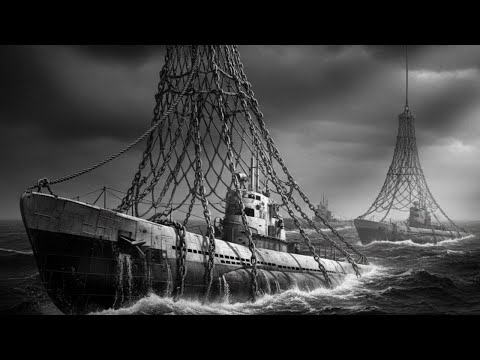
“Pressure hull breach detected, sir,” the hydrophone operator’s voice cracked. “She’s blowing ballast tanks.” Then Fletcher’s blood ran cold. Through the murky water, a gray shape emerged—the distinctive bow planes of a German Type VIIC U-boat, wrapped in 300 feet of revolutionary wire mesh that looked nothing like the heavy submarine nets protecting every other British naval installation.
Fletcher’s modified indicator net—the design naval architects in Portsmouth had called laughably inadequate, the mesh pattern senior officers dismissed as “no stronger than herring nets”—had just strangled a 750-ton U-boat hunter. The submarine wallowed helplessly, her diving planes tangled, her propeller shaft fouled with wire. Fifty-two German submariners would surrender within the hour.
What the skeptics at the Admiralty didn’t know was that this was the second U-boat Fletcher’s “ridiculous” net had captured in three days. And seventy-two hours later, his revolutionary design would bag one more, forcing a complete rethinking of how the Royal Navy defended its most vital harbors for the rest of the war.
For thirty-three months, German U-boats had been bleeding Britain white. Since September 1939, Admiral Karl Dönitz’s undersea fleet had sent over 1,200 Allied merchant ships to the bottom of the Atlantic—11 million tons of desperately needed food, fuel, weapons, and raw materials that would never reach British shores. The statistics were devastating. In March 1942 alone, U-boats sank 273,000 tons of shipping. At that rate of loss, Churchill’s military planners calculated Britain had perhaps eight months before starvation forced a negotiated peace with Hitler.
The submarine menace wasn’t confined to the open Atlantic. German commanders had discovered a tactical gold mine: attacking ships at the very thresholds of British harbors. Convoy escorts, exhausted after crossing the Atlantic under constant threat, typically broke formation within sight of port. Merchant captains, believing the worst was behind them, relaxed their vigilance. U-boat commanders exploited this weakness ruthlessly. Between January and April 1942, German submarines sank 47 merchant vessels and two Royal Navy destroyers within ten miles of British coastal installations. The approaches to Liverpool, Glasgow, and the Clyde estuary—the primary entry points for American war materials—had become killing grounds.
The Royal Navy’s standard defense against submarine penetration had been developed during the First World War: massive anti-submarine nets constructed from five- or eight-inch flexible steel wire rope woven into twelve-foot square mesh, suspended from enormous timber buoys weighing several tons each. These barriers hung from the surface to depths of 120 feet, anchored with rendering winches designed to absorb the impact of a ramming submarine. The system had theoretical merit—during World War I, no British capital ship protected by such nets had been torpedoed at anchor. But these nets suffered from crippling weaknesses that peacetime theorists had overlooked and wartime experience brutally exposed.
First, the nets were extraordinarily expensive. A single 400-foot section required eight miles of heavy wire rope and cost £12,000 to manufacture—the equivalent of two Spitfire fighters. Second, they were agonizingly slow to install. The net defenses at Scapa Flow, the Home Fleet’s primary anchorage, took fourteen months to complete. Third, and most critically, they required constant maintenance. Saltwater corrosion attacked the wire relentlessly. The strong currents of Scottish sea lochs twisted the nets into useless tangles. Ice damage in winter and storm damage year-round meant sections had to be replaced every four to six months.
Commander Ian Campbell, who supervised net defenses for the Rosyth Naval Base, documented the problem in a January 1942 report to the Admiralty: “Standard submarine nets are failing at an unacceptable rate. Of 18 net sections installed September through November 1941, 11 have required complete replacement due to storm damage, corrosion, or structural failure. At current replacement rates, we cannot maintain barrier integrity.”
The nets had another fatal weakness that wouldn’t be discovered until after the war. When captured German naval archives revealed the truth: on October 28, 1918, the German submarine UB-116 had penetrated the supposedly impregnable Scapa Flow defenses by simply cutting through with bow-mounted shears. The boat was eventually destroyed by mines, but the net barrier itself had offered virtually no resistance. British naval intelligence never learned of this incident during the interwar period.
By early 1942, the Admiralty faced an impossible equation. Britain had 53 major ports and naval installations requiring submarine net protection. Standard nets were too expensive, too slow to install, too difficult to maintain—and quite possibly too easy to defeat. Yet without effective harbor defenses, U-boats would continue hunting merchant shipping at the very gates of British ports. The men responsible for solving this problem were not the celebrated destroyer captains or aircraft carrier admirals whose names filled the newspapers. They were engineers—men like Commander David Fletcher, a 38-year-old former merchant marine officer who had studied naval architecture before the war and now commanded a harbor defense unit most senior officers considered a backwater posting. What Fletcher was about to prove was that sometimes the most important innovations come not from adding strength, but from rethinking the entire problem.
The conference room at the Admiralty building in Portsmouth was lined with charts showing the locations of submarine net defenses around the British Isles. Commander Fletcher stood before a skeptical audience of senior naval architects and staff officers, presenting his proposal for a revolutionary new net design. “The problem with current nets,” Fletcher explained, “is that we’re trying to stop a submarine with brute strength. A 750-ton U-boat moving at six knots submerged has tremendous momentum. Our nets must be strong enough to halt that momentum, which means heavy wire, heavy floats, heavy everything. The result is a defense that costs a fortune, takes months to install, and fails regularly.”
Captain Edmund Hathaway, the Admiralty’s chief of harbor defenses, leaned back in his chair with undisguised contempt. “So, your solution is to make the nets lighter. Commander, do you understand basic physics?” Fletcher pressed on. “Our nets fail because submarines can cut through wire, sir. German U-boats are equipped with bow shears specifically designed to sever cables up to three-quarters of an inch thick. But what they can’t cut easily is mesh—specifically, three-eighths-inch flexible steel wire woven into a much finer pattern, six-foot squares instead of twelve.”
“Herring nets,” Hathaway interrupted. “You want to defend His Majesty’s harbors with glorified fishing nets.” “The finer mesh tangles the submarine’s dive planes and propeller shaft,” Fletcher continued, his voice tight. “Instead of presenting a single cable to cut, the submarine encounters hundreds of crossing wires—each individually too light to stop the boat, but collectively forming a web that fouls every moving surface.”
The senior officers exchanged glances. Commander Phillips from the materials research division shook his head. “Commander Fletcher, we’ve tested lighter nets. They fail under stress. A submarine pushes through them like they’re not even there.” “That’s because you tested them hung statically from heavy buoys,” Fletcher countered. “My design uses a yielding system—rendering winches with hydraulic governors that feed out cable under strain. The net gives way, absorbing momentum instead of resisting it, while the fine mesh progressively tangles the submarine’s control surfaces and propulsion.”
Hathaway stood up, signaling the meeting’s end. “Gentlemen, I’ve heard enough. Commander Fletcher’s theoretical net might work in laboratory conditions, but in the real world, submarines don’t politely swim into nets and wait to be caught. They ram them at full power. They use explosive charges. They have cutters precisely designed to defeat this sort of obstacle. Approving this ridiculous design would be negligent.”
The Admiralty rejected Fletcher’s proposal in February 1942. Standard heavy nets would continue to be installed at all major facilities. But Fletcher had one advantage his critics didn’t know about. As commander of harbor defenses for the Clyde Anchorage, he controlled a discretionary budget for experimental improvements to defense installations. It wasn’t enough to purchase nets through official channels. However, there were eight fishing trawler companies operating out of Glasgow whose businesses had been ruined by the war. They had fabrication equipment, wire rope, and men who knew how to work with marine nets. Fletcher quietly began purchasing materials.
Before we continue, I’d love to know where you’re watching from and what you know about the Battle of the Atlantic. Drop a comment below and let me know if you’d heard about submarine net defenses before. And if you’re enjoying these deep dives into World War II naval engineering and tactics, hit that subscribe button. These stories take serious research to get the technical details right. And knowing you’re out there makes it all worthwhile.
March 1942. The Firth of Clyde stretched dark and cold under overcast skies as Fletcher watched his crew lower the first section of his modified net into position. Three months of clandestine work had produced 2,400 feet of experimental netting—enough to create a layered defense across the narrowest approach to the Clyde anchorage. The mesh was three-eighths-inch flexible wire rope woven into six-foot squares. At 45 tons for the complete installation, Fletcher’s system weighed less than a single section of conventional netting.
His crew—merchant seamen and fishermen rather than Royal Navy ratings—worked with practiced efficiency. Old hands who’d hauled herring nets in North Sea gales for twenty years knew how water moved, how wire rope behaved under strain, how to read the subtle signals that meant equipment was about to fail. “Governor pressure set at eighty pounds per square inch on both winches,” reported Chief Petty Officer McLeod, a former Aberdeen trawler captain. “She’ll start feeding at sixty percent of failure load, just like you specified.”
The rendering winches were the key. When a submarine hit the net, the winches would gradually release cable under hydraulic control, letting the net envelope the submarine rather than creating a rigid barrier the U-boat could cut or ram through. Fletcher’s calculations suggested that a submarine traveling at six knots would generate roughly 8,000 pounds of force against the net. The hydraulic governors would start yielding at 5,000 pounds, progressively releasing cable while the fine mesh wrapped around the submarine’s dive planes, rudder, and propeller shaft.
The installation was completed on March 22nd. Fletcher filed the appropriate paperwork describing it as “experimental modifications to existing defensive positions approved under local command authority.” Technically true, if misleading. For four weeks, nothing happened. Then on the night of April 25th, 1942, everything changed.
U-438, a Type VIIC submarine under Kapitänleutnant Heinrich Heinsohn, had been stalking Convoy ON-92 for three days. At 2253 hours, lookouts aboard the patrol trawler HMT Sycamore detected diesel engine noise bearing 270 degrees. Before they could issue a challenge, the submarine dove. Heinsohn ordered standard crash dive procedure, taking U-438 under the known net positions at eighty feet. She never made it.
At 2254 hours, U-438’s bow struck Fletcher’s net at fifty-five feet depth. The rendering winches immediately began feeding cable, their hydraulic governors hissing as they released tension. But the net wasn’t parting—it was wrapping. Three-eighths-inch wire mesh, far too fine to cut with standard bow shears, snagged on the submarine’s dive planes. Within thirty seconds, wire rope had fouled the starboard diving plane, wrapping around its mounting bracket. The plane jammed in the fifteen-degree down position.
“Both planes to rise! Emergency surface!” Heinsohn’s command came too late. The port dive plane was now tangled as well, locked in the dive position. U-438’s automatic systems responded by blowing ballast tanks, but with both planes forcing the nose down and 200 feet of net now wrapped around the hull, the submarine couldn’t surface. She began to sink. The propeller churned in reverse, but the net was already fouling the propeller shaft. Wire rope wrapped around the spinning shaft, creating a high-pitched scream of tortured metal as the blade tips shredded the wire. Within seconds, the shaft seized.
Aboard HMT Sycamore, Fletcher’s hydrophone operator tracked every sound. “Target is fouled, sir. Propeller is stopped. She’s settling on the bottom.” Fletcher grabbed the radio handset. “All patrol craft—converge on grid reference Clyde 77. Submarine trapped in net barrier. Prepare for possible surface blow.”
At 2312 hours, unable to surface and with air quality deteriorating rapidly, Heinsohn made the only decision available. He ordered emergency ballast blow and surfaced directly into the middle of Fletcher’s patrol screen. Four patrol trawlers and two motor torpedo boats surrounded U-438 within minutes. Searchlights blazed across the water, illuminating a submarine hopelessly entangled in wire mesh. Unable to dive, unable to maneuver, her deck guns unmanned, Heinsohn surrendered his boat and fifty-two crew members without firing a shot.
It took salvage crews eighteen hours to cut U-438 free. But Fletcher barely had time to process the capture before the next submarine arrived. U-454 entered the Firth of Clyde forty-eight hours later, unaware that U-438 had been taken. Her commander, Kapitänleutnant Burkhard Hackländer, used identical tactics—surface approach in darkness, crash dive when challenged, pass beneath the known net positions at seventy-five to eighty feet. At 0340 hours on April 27th, U-454 struck Fletcher’s net under circumstances nearly identical to U-438’s capture. Her dive planes fouled, her propeller shaft wrapped with wire mesh. Within six minutes, she was trapped on the bottom in sixty feet of water.
This time, Fletcher’s patrol boats detected the submarine before she surfaced. When Hackländer attempted his own emergency ballast blow at 0421 hours, he surfaced into a coordinated pattern of depth charges that forced an immediate surrender. The second capture in three days electrified British naval intelligence.
When Fletcher’s after-action report reached Portsmouth, Captain Hathaway—the same officer who had dismissed his proposal two months earlier—immediately dispatched a technical assessment team to Scotland. Commander Phillips, the materials research officer who had testified against Fletcher’s design, led the investigation. His report, filed April 30th, 1942, reversed nearly every objection he had previously raised.
“Field examination of U-438 and U-454 reveals that both submarines were immobilized by Commander Fletcher’s modified net design through a mechanism entirely different from standard anti-submarine netting. The three-eighths-inch wire rope, previously considered too light for submarine defense, proves nearly impossible to cut with standard German bow shears. Most significantly, the yielding characteristic of the rendering winches prevents the submarine from generating sufficient force to break free.”
Phillips’s report included a startling calculation. Fletcher’s net installation had cost £18,840—less than one-seventeenth the cost of equivalent standard netting. Installation time was fourteen days versus six months. Maintenance requirements were minimal because the lighter weight generated far less strain on moorings and connections.
On May 2nd, 1942, the Admiralty issued Emergency Directive 43B. “All Harbor Defense commanders are authorized to implement modified flexible net systems based on Commander Fletcher’s Clyde installation. Materials allocation for flexible net production receives priority two classification, equivalent to destroyer construction.” The directive reached fleet units on May 3rd. On May 4th, U-569—approaching the Clyde using the same tactics that had worked for German submarines for months—became the third U-boat captured by Fletcher’s nets in eight days.
The impact cascaded through both the Royal Navy and the Kriegsmarine with remarkable speed. By August 1942, modified flexible net systems had been installed at forty-three British ports and naval installations. German U-boat commanders, receiving reports of multiple submarines trapped in previously reliable hunting grounds, began avoiding coastal approaches entirely. The number of merchant vessels sunk within ten miles of British harbors dropped from forty-seven in the first four months of 1942 to three in the last eight months.
Commander David Fletcher received promotion to captain in June 1942 and was awarded the Distinguished Service Order for “innovative defensive systems that materially contributed to harbor security.” He spent the remainder of the war commanding the naval research section at Portsmouth, developing improved net designs and training harbor defense specialists. The three captured U-boats—U-438, U-454, and U-569—were recommissioned into Royal Navy service after thorough technical examination. U-438, redesignated HMS Graph, conducted war patrols against German shipping until 1944.
Postwar analysis by both British and German naval historians confirmed that flexible net defenses prevented an estimated sixty to seventy submarine attacks on ships at harbor approaches between May 1942 and May 1945. Given that German submarines typically achieved a forty percent hit rate in such attacks, Fletcher’s system likely saved twenty-five to thirty merchant vessels—roughly 200,000 tons of shipping—from destruction.
Captain Hathaway, the Admiralty officer who initially rejected Fletcher’s proposal, wrote in his 1947 memoir: “I was comprehensively wrong. The Royal Navy was fortunate that Commander Fletcher possessed both the technical insight and the moral courage to proceed despite official rejection. Innovation in warfare rarely comes from making existing systems stronger. It comes from seeing the problem differently.”
The established wisdom held that stopping a 750-ton submarine required brute strength—heavier cables, more rigid structures, greater resistance. Fletcher understood something those men didn’t: that strength and rigidity could become weaknesses. A rigid barrier presents a fixed target for cutting equipment, for ramming, for explosive charges. But a flexible system that yields under attack, that uses the enemy’s momentum against him, that progressively entangles rather than rigidly blocks—that system exploits the fundamental physics of the situation rather than fighting them.
The three U-boats caught in Fletcher’s nets represented more than tactical victories. They demonstrated that sometimes the solution to an impossible problem isn’t more force, but different thinking. Not because it was stronger, but because it was smarter. The submarine commanders who surrendered their boats weren’t defeated by superior technology. They were defeated by a harbor defense officer who refused to accept that the only way to stop a submarine was the way it had always been done before.
Sometimes the most heroic thing an engineer can do is trust the calculations when everyone else demands conventional solutions. And sometimes the quietest innovations—the ones dismissed as “herring nets” by the men who thought they knew better—prove to be the ones that change the course of a war.
What other overlooked wartime innovations do you think deserve to be remembered? Let me know in the comments below.
Report this article
Select a reason for reporting:






