By early 1945, the Third Reich was bleeding from every front. The Normandy breakout had shattered the Western line, and on the Eastern Front, the Soviets had annihilated Army Group North and Center. All alarms inside Germany went off at once. The Allies were just miles from the original border, and men and material were needed everywhere—but there were none left to give.
It was in this climate of absolute desperation that the Waffen-SS, an organization famed for its elite panzer divisions, began scraping the bottom of the barrel. The result was a series of divisions that were not just weak—they were precarious to the point of being tragic.
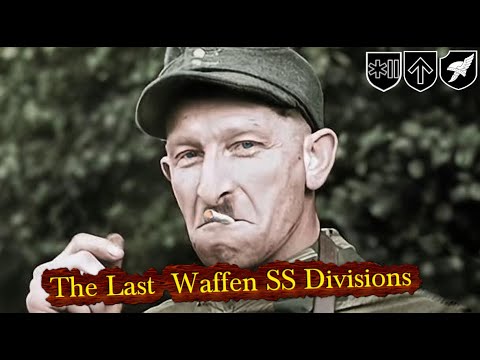
German civilians lost every privilege they had clung to. Recruitment standards collapsed. Men who had been deemed unfit for combat—the injured, the sick, the too old, the too young—were suddenly pressed into service. By late 1944, they were declared combat-ready. Then, in January 1945, the Soviets launched their Vistula-Oder offensive and tore the German army to shreds. Project Lutheran was activated: recruits still in training were rushed to the front, sometimes forming new divisions on paper overnight.
One of the first of these was the 32nd SS Volunteer Grenadier Division “30 January.” Formed between January 26 and 30, 1945, its name marked the anniversary of Hitler’s ascension to chancellor. Its ranks were filled with wounded Waffen-SS veterans pulled from hospitals, along with police and administrative personnel. Morale was abysmal. They had no tanks, almost no artillery. One soldier remarked that it was “not a division, but a pile of scraps sewn together on the run.”
By early February, the division mustered about 12,000 men of all kinds and was sent to the Oder as a reserve for General Busse’s Ninth Army. When the Soviets attacked in mid-April, the division was torn to pieces in days. Continually surrounded, it could only retreat. The remnants crossed the Spree River and surrendered to the Americans. No member of this unit is known to have received a significant decoration.
Next came the 35th SS Police Grenadier Division, created on February 10, 1945, from remnants of other units and, mainly, German police officers. Understrength in both men and materiel, it was rushed to the Eastern Front. When the Soviets attacked on April 16, the division was overwhelmed, isolated, and split into small groups on the outskirts of Lebus. Some withdrew to Berlin to perish with the capital; others fled west to surrender to the Americans.
The last division formed during the conflict was the 38th SS Grenadier Division “Nibelungen,” created on March 27, 1945—barely a month before the war ended. It was cobbled together from the shattered remnants of the 6th, 7th, and 30th SS divisions, plus SS customs officials and Hitler Youth. Its 6,000 troops were sent to the Western Front to defend a 35-kilometer strip near Kelheim, north of Munich. They were too weak to hold the line and were easily overwhelmed by the Americans.
Yet in early May 1945, the division reorganized and launched a counterattack near Oberwassen that pushed the Americans back—one of the last tactical successes of the Waffen-SS. A day later, on May 5, they received the ceasefire order from Admiral Dönitz. Again, there was no time for any Knight’s Cross.
But these three divisions were not alone. Around the same time, many more were formed with volunteers from occupied or threatened countries—Italians, Hungarians, Slovaks, Dutch, French, and Estonians. With almost no equipment and tiny numbers, they were thrown into the final defense of the Reich. The regular army, too, created hurried divisions from all kinds of recruits, each more unique—and more doomed—than the last.
Most performed poorly, crippled by inadequate training, experience, and materiel. And yet, their story is rarely told. These were the units that no one mentions—the scraps of an empire in collapse, sent to fight a war that was already lost.
But to truly understand how far the Waffen-SS had fallen, we must look beyond the German recruits and into the ranks of the foreign volunteers. Among the most curious of these late formations was the 33rd Waffen Grenadier Division of the SS “Charlemagne,” though its origins stretched back earlier than the desperate winter of 1945. Formed from French volunteers who had embraced collaboration, its first incarnation had been mauled on the Eastern Front in 1944. What remained was reconstituted in early 1945 as a grenadier brigade, barely 7,000 strong and chronically short of everything.
In February 1945, the Charlemagne division was rushed to Pomerania to stem the Soviet tide. It was a hopeless assignment. Thrown into the line against overwhelming armor, the Frenchmen fought with a ferocity that surprised even their German commanders—but ferocity could not substitute for anti-tank guns. Within days, the division was shattered. Survivors were split into ad hoc battle groups, and a few hundred, led by men who refused to accept the end, would eventually find their way to Berlin.
There, in the final days of April 1945, a handful of Charlemagne veterans fought in the ruins of the capital itself, reportedly destroying a number of Soviet tanks in close-quarter ambushes near the government district. Their stand was brief and futile, but it illustrated a grim truth: the last defenders of the Reich were often not Germans at all, but foreigners with nowhere left to go.
Equally tragic was the fate of the 34th SS Volunteer Grenadier Division “Landstorm Nederland.” Raised from Dutch collaborationist militia in February 1945, it was never a division in any meaningful sense—more a collection of battalions with a grandiose title. Sent to defend positions along the Lower Rhine and later the Betuwe region, its men were poorly armed and barely trained. When the Allies pushed forward, the unit simply dissolved into the countryside, many of its members shedding their uniforms and vanishing into the civilian population.
Then there was the 37th SS Volunteer Cavalry Division “Lützow,” formed in March 1945 from the remnants of the 8th SS Cavalry Division “Florian Geyer” and the 22nd SS Volunteer Cavalry Division “Maria Theresia”—both of which had been annihilated in the Budapest pocket. What was left was a mounted force in name only, with horses giving way to bicycles and trucks that rarely had fuel. It was committed to the fighting in Austria and Hungary, where it was ground down in the path of the advancing Red Army.
These foreign formations shared a common thread: they were raised too late, equipped too poorly, and asked to do the impossible. Their commanders knew it. In several cases, officers privately admitted that their units were little more than “speed bumps”—delaying actions designed to buy hours, not victory. The men themselves, however, often fought with a desperation born of having burned every bridge behind them.
And still, the list of forgotten divisions continues. There were the Italian volunteers of the 29th SS Division “Italia,” the Hungarian units absorbed wholesale into SS ranks, and the Estonian remnants who had already given everything at Narva and now found themselves defending a doomed Reich. Each of them carried the same burden: the prestige of the Waffen-SS, stripped of the means to live up to it.
What emerges from this catalogue of collapse is a portrait not of elite soldiers, but of an organization that had become a machine for consuming its own. The divisions we have examined were not aberrations—they were the logical endpoint of a system that refused to admit defeat. And as the spring of 1945 wore on, more of them would be thrown into the fire, their names barely recorded before they vanished from the map.
To grasp just how far the rot had spread, consider the 36th SS Grenadier Division, which never even received a proper honor title. Formed in February 1945 from a grab-bag of SS construction brigades, prison guards, and men combed out of rear-area offices, it was intended for the Oder front but was so poorly equipped that its artillery consisted of a handful of captured guns with almost no ammunition. Its commander reportedly joked bitterly that his division was “fully motorized—if you counted the bicycles.” Committed near Cottbus, it disintegrated within a week under the Soviet onslaught, its survivors folded into whatever units would take them.
Equally telling was the fate of the 30th SS Grenadier Division, a unit whose short life was marked by chaos even before it reached the front. Raised in early 1945 from White Russian and Ukrainian volunteers, along with a scattering of German cadre, it was sent to the Rhine and then almost immediately redirected east. Its men spoke a dozen languages and shared no common training. When it finally met the Red Army in April, it broke apart in a single afternoon, and its commander was captured—a fate that spared him from having to explain the disaster to Berlin.
What these divisions reveal is something the propaganda machine could never admit: that the Waffen-SS, by 1945, had become two entirely different organizations wearing the same uniform. On one side stood the celebrated panzer divisions—Leibstandarte, Das Reich, Totenkopf—still capable of savage resistance. On the other stood a shadow army of the wounded, the elderly, the foreign, and the barely trained, sent to die in units that existed mostly on paper.
The men themselves were often painfully aware of the gap between reputation and reality. Veterans transferred into these formations from the elite divisions were appalled by what they found. One recalled being told he was joining a “grenadier division” only to discover a few hundred exhausted boys and a single anti-tank gun without sights. The prestige of the black uniform, he said, had become a cruel joke.
Yet the tragedy cuts deeper than mere military inefficiency. These units were the final expression of a regime that had long since stopped counting its people as anything but fuel. The Hitler Youth boys of the Nibelungen division, the Dutch militia of Landstorm Nederland, the French volunteers of Charlemagne—all were consumed in the same furnace, their names recorded in the same terse after-action reports that noted, almost casually, “unit destroyed” or “no longer combat effective.”
And as April turned to May, the pace only quickened. New divisions were still being ordered into existence even as Soviet shells fell on the outskirts of Berlin—formations that would never fully assemble, never receive their equipment, never fire a shot. The paperwork of their creation outlasted the men themselves.
It is here, in the final weeks, that the story of the Waffen-SS’s worst divisions becomes something more than a catalogue of military failure. It becomes a portrait of an entire system eating itself alive—issuing orders to phantom units, promoting officers to command divisions that existed only in filing cabinets, and demanding heroism from men who had been given nothing but a rifle and a date with oblivion. The elite divisions would be remembered; these would be forgotten. But their fate, perhaps more than any victory, tells us what the Reich had truly become.
The final weeks reduced even the paperwork to absurdity. Divisions were “activated” on paper that never saw a single soldier muster. Officers received commands over units that existed only in filing cabinets, their maps marked with positions held by men who had already deserted or died.
In one rear headquarters, a staff officer reportedly signed orders for three divisions in a single afternoon—none of which possessed more than a few hundred rifles between them. “We are commanding ghosts,” he wrote in his diary. The ghosts, however, bled just the same.
When the end came, it came not with a final stand but with a whimper of dissolving formations. Men shed uniforms, burned papers, and walked west. The elite divisions surrendered with ceremony; these units simply evaporated.
Their story is not one of glory or shame, but of a system that refused to stop consuming until there was nothing left to consume. The black uniform, once a mark of prestige, had become a death sentence for the desperate.
What do you think—were these men victims, fanatics, or simply the last fuel for a dying machine? Let us know in the comments.
Report this article
Select a reason for reporting:






