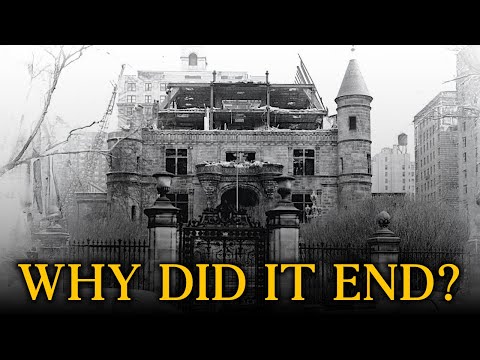
They were palaces built to last centuries—then torn down in a single generation. Between 1870 and 1900, America’s richest families erected monuments of marble, gold, and ambition. Cornelius Vanderbilt II’s 137-room Fifth Avenue mansion covered an entire city block. The Breakers in Newport boasted 70 rooms and a 50-ton marble fireplace. These weren’t homes; they were declarations of immortality.
But within forty years, most of these architectural treasures would be rubble. Over 2,000 Gilded Age mansions were systematically demolished, replaced by parking lots, gas stations, and glass towers. Who was to blame? And why did America destroy its own gilded past?
The Gilded Age was a time of unimaginable wealth. Steel magnates, railroad barons, and banking dynasties accumulated fortunes worth hundreds of billions in today’s currency. They built castles in the sky—Gothic revival estates, Italian Renaissance villas, French chateaux—each one announcing that its owner had transcended ordinary limits.
William Kissam Vanderbilt spent $3 million on a Fifth Avenue chateau in 1883—roughly $90 million today. The housewarming party cost $250,000 for a single evening. 1,200 guests arrived in costume, and one wore a taxidermy cat as part of her ensemble. Newport, Rhode Island became the summer capital of this new aristocracy. The Breakers required 22 furnaces and consumed coal by the boxcar. The Biltmore estate needed 80 full-time employees just to operate.
These mansions represented a belief that great families could shape civilization through ambition and architecture. The owners genuinely believed their legacy would endure. The stones would outlast them. The names would echo through generations. They were wrong.
Within forty years, most of these mansions would be demolished. The families would scatter. The fortunes would dissolve. And America would systematically erase nearly every trace of the architectural legacy that defined an entire era.
What happened? The first crack came in 1913, when the 16th Amendment authorized a federal income tax. By 1918, the top marginal rate reached 77%. Estate taxes emerged in 1916, climbing to 77% by 1935. Passing wealth between generations became a financial crisis. The mansions built as dynastic seats became tax liabilities instead of family treasures.
Then came the Great Depression. Fortunes evaporated. The Vanderbilt mansion at 5th Avenue and 57th Street stood empty by 1926. Nobody wanted to buy it—the land underneath had become more valuable than the structure on top. The family donated it to developers, and it was demolished.
But economics alone did not kill these mansions. A cultural shift accompanied the financial pressure. Wealth that seemed admirable in 1880 appeared vulgar by 1930. Newspapers that once celebrated mansion openings now criticized them as monuments to greed. Families stopped hosting grand balls. They closed entire floors. The very visibility that made these homes statements of achievement now made them targets of resentment.
Zoning laws tightened. Servants became impossible to find. Technology changed domestic life, but older mansions required expensive retrofitting. The first generation built these mansions. The second inherited them. The third sold them. And the fourth watched them demolished.
But the destruction was not random. Forces beyond family choice and economic pressure were quietly coordinating. Behind the scenes, developers and politicians were making decisions that would erase an entire architectural legacy. Robert Moses, New York’s master builder, understood the future belonged to automobiles, not aristocrats. Between 1935 and 1960, he demolished over 250 mansions in New York alone. Similar figures emerged in every major city.
The battle for land and legacy had begun—and the preservationists were losing.
The fight for the William Wetmore estate in 1948 revealed the futility of resistance. Wetmore, a 19th-century financier, had built a Gothic revival mansion in the Bronx covering 12 acres—80 rooms, multiple conservatories, and formal gardens designed by Frederick Law Olmsted. The family maintained the property for three generations.
Then New York City announced plans to build a highway through the estate. The Wetmore heirs hired lawyers. They challenged the city’s eminent domain authority. They presented architectural surveys proving the mansion’s historical significance. The city ignored every argument. Robert Moses declared the highway alignment non-negotiable.
The legal battle lasted three years. In 1951, bulldozers arrived. The mansion was demolished in four days. The land became an interchange between two expressways. Today, cars pass over the spot where the Wetmore family once lived, completely unaware of what existed beneath the pavement.
This pattern repeated constantly. The battle for the Cornelius Vanderbilt II mansion at 5th Avenue and 57th Street demonstrated how even the most significant buildings could not be saved. When the family decided to demolish in 1926, protests erupted. Architects petitioned the city. Historical societies offered to purchase the property. The French government even expressed interest in relocating the building to Paris. None of these efforts succeeded.
The mansion was demolished in 1927. Bergdorf Goodman purchased the land and built a department store. The only remnants preserved were the main gates, relocated to the Conservatory Garden in Central Park. Everything else became rubble.
The financial calculations were brutal. The mansion occupied land valued at $7 million. Maintaining the building cost $200,000 per year in property taxes alone, plus $300,000 for staff and operations. No use could generate sufficient income to cover these costs. Residential use had become economically impossible.
The Henry Clay Frick mansion on Fifth Avenue survived only through extraordinary measures. Frick died in 1919 and left the building to become a public museum with a $20 million endowment. Even with this massive financial cushion, the museum struggled. Few families could match Frick’s foresight or resources.
Most estates entered probate after the owner’s death. Heirs faced estate tax bills exceeding 40% of the property’s value. To pay the taxes, they sold the mansion. The buyers were always developers. The outcome was always demolition.
The battle became particularly intense in Chicago. Potter Palmer, a real estate magnate, built a castle on Lakeshore Drive in 1882—90 rooms, $1 million, equivalent to $35 million today. When Palmer died in 1902, his widow maintained the property. When she died in 1918, the children inherited. By 1930, they could not afford the upkeep.
They sold to developers in 1940. The family negotiated preservation of certain rooms in the Art Institute of Chicago. Everything else was demolished. An apartment building replaced the mansion in 1950.
In San Francisco, the James Flood mansion on Nob Hill survived the 1906 earthquake when nearly every other mansion burned. Constructed from Connecticut brownstone, the building proved fireproof. After the earthquake, Flood’s widow could not afford to maintain the property. She sold it to the Pacific Union Club, a private men’s club, in 1907.
The club renovated the interior and expanded the building. They had the financial resources to maintain the property because hundreds of wealthy members shared the cost. This model—converting mansions into private clubs—saved several dozen buildings nationwide. But it worked only for properties in desirable locations that could attract sufficient membership.
The battle lines were clear. On one side stood preservationists, historians, and families who viewed these mansions as cultural assets worth saving. On the other side stood developers, city planners, and politicians who viewed them as obstacles to progress. The preservationists lost nearly every battle. They lacked money, legal authority, and political power. The developers had all three.
But the preservationists learned. Each lost battle taught lessons. They began lobbying for historic preservation laws. They pressured politicians to create landmark protections. They organized public campaigns to raise awareness. And slowly, painfully, they began to change the legal framework governing demolition.
The National Historic Preservation Act of 1966 created the National Register of Historic Places. Buildings listed on the register received protection from federally funded demolition. But the act contained a fatal weakness—it only applied to federal projects. Private owners could still demolish registered landmarks without consequence.
New York City passed its landmarks preservation law in 1965, after Pennsylvania Station’s demolition sparked outrage. The law allowed the city to designate buildings as landmarks and prohibit demolition without approval. But the law came too late. By 1965, most of the great Gilded Age mansions were already gone.
The battle for land and legacy continued through the 1970s and 80s. Some mansions survived through conversion to museums, schools, or institutional use. Others were saved when preservation organizations purchased them. But most were demolished. By 1980, fewer than 200 of the original 2,000 Gilded Age mansions remained.
The battle was over. The developers had won. What remained were fragments—architectural elements salvaged from demolished buildings, photographs documenting what existed, historical societies collecting documentation. But the buildings themselves, the physical manifestations of an entire era, were gone.
The question that haunted every preservationist was simple. Could anything have stopped this destruction? Or was it inevitable that progress would erase beauty, that economics would overwhelm sentiment, that the future would devour the past?
The hidden forces behind the demolition boom went far beyond visible economics. The real estate lobby shaped policy with surgical precision. Between 1930 and 1960, developer associations poured millions into political campaigns and drafted legislation that state governments passed with minimal modification. Rather than directly attacking historic buildings, they promoted policies that made preservation financially impossible. Accelerated depreciation schedules favored new construction. Tax abatements rewarded demolition. Zoning changes prohibited residential use in commercial districts.
The Federal Housing Administration played an unexpected role. Created in 1934, the FHA refused to insure mortgages in neighborhoods it deemed high-risk—zones frequently outlined in red ink that included older mansions. Without FHA insurance, banks would not lend. Without lending, buyers could not purchase. Redlining became a self-fulfilling prophecy. Neighborhoods denied investment deteriorated, and deterioration justified the original designation.
Political corruption accelerated destruction. City officials approved demolition permits in exchange for campaign contributions. Building inspectors condemned structurally sound buildings because developers paid them to. In some cases, developers burned buildings they wanted to demolish. Arson eliminated the structure and made the insurance payout exceed the acquisition cost.
Even labor unions inadvertently assisted. Through the 1950s and 60s, construction unions negotiated higher wages. Renovation costs soared because restoration required skilled craftsmen who commanded premium pay. New construction performed by less skilled workers cost less. Developers chose demolition over renovation.
The federal highway program, launched in 1956, demolished more mansions than any other single policy. Planners chose routes through older neighborhoods where land acquisition costs were lowest. In Detroit, the Lodge Freeway demolished dozens of mansions along Woodward Avenue. In Los Angeles, the Harbor Freeway cut through West Adams. In Boston, the Central Artery destroyed the West End neighborhood entirely.
By 1960, the Hidden Forces had created an industrial demolition complex. Developers identified targets. Banks financed acquisitions. City governments approved permits. Construction crews demolished buildings. And new structures rose on the sites. Nobody planned this outcome. No single policy created it. Instead, dozens of policies and thousands of individual actions combined to produce a systematic erasure of architectural history.
The machine operated efficiently. It destroyed beauty and replaced it with functionality. It erased memory and created progress. And once it started, nobody could stop it.
When the numbers stopped making sense, financial logic—once a bulwark for preservation—turned against these grand homes. In 1890, the Vanderbilt family spent $11 million constructing their Fifth Avenue mansion. By 1920, property taxes exceeded $200,000 annually, maintenance employed 40 full-time staff, and utilities added another $100,000. Total annual operating cost: $7 million in modern currency. The family earned no income from the property.
The math became impossible when estate taxes were factored in. By 1940, federal estate taxes peaked at 77%. If the mansion and land were valued at $20 million, the estate tax bill would exceed $15 million. To pay that bill, heirs had to liquidate assets. The only buyers were developers who valued land, not buildings.
This created an absurd situation. The most expensive house in America, which cost the equivalent of $420 million to construct, reduced property value by $45 million by continuing to exist. The building itself had negative value. Cities assessed property based on its highest and best use. For land in commercial districts, that meant commercial development. Even though the property housed a mansion, taxes were calculated as though an office building stood there.
Insurance presented another impossible equation. By 1950, insuring a large mansion cost 5 to 10% of its value annually. A $20 million mansion required $1 to $2 million in annual premiums—purely an operating cost with no return. Banks recognized the math and stopped lending. Without financing, the market for mansions collapsed.
The tax code made renovation economically irrational. If a building needed $2 million in repairs, the owner could deduct depreciation on the building’s existing value but gained no tax benefit from the renovation. The improved building was assessed at higher value, increasing property taxes. The math punished preservation and rewarded abandonment. Demolition costs were tax-deductible. Selling the vacant land generated capital gains taxed at preferential rates.
By 1950, the financial logic was inescapable. Maintaining a Gilded Age mansion cost millions annually. The property generated no income. Taxes consumed capital. Insurance drained resources. Renovation increased costs. And the building itself reduced land value. The only economically rational decision was demolition.
But the numbers alone do not explain why families made these decisions. Many could afford the losses. The Vanderbilts, despite diminished fortunes, retained substantial wealth through 1950. They could have maintained the Fifth Avenue mansion at a loss. They chose not to. Why? The answer reveals something deeper than economics.
The families no longer believed the mansions were worth saving. They no longer identified with the buildings. They no longer saw them as family seats, but as burdens. The emotional attachment that once made financial sacrifice acceptable had dissolved. When the first generation built these mansions, they were creating dynasty. The buildings represented immortality through architecture. The third generation viewed the mansions as monuments to ancestors they never knew. The buildings felt like museums of someone else’s life.
So when the numbers stopped making sense, when accountants showed that keeping the mansion destroyed wealth, when lawyers advised that demolition was prudent, the families agreed. They signed the papers, they accepted the offers, and they watched bulldozers reduce their family history to rubble without looking back. The financial logic of demolition was real, but the emotional logic of abandonment was what ultimately sealed the fate of these buildings.
When families stopped caring, no amount of money could save the mansions. And America lost not just buildings, but an entire way of life.
In the end, America must live with the consequences of choices made between 1920 and 1960. The demolished buildings are gone forever. The architectural legacy they represented is largely lost. The cultural continuity they might have provided was severed. Whether this was necessary price for progress or tragic waste of cultural heritage remains debated.
What is certain is that America made a choice. The country chose modernization over preservation, efficiency over beauty, future over past. And in making that choice, America became what it is today—a forward-looking nation, uncomfortable with its own history, constantly reinventing itself, permanently restless, unable to settle into the contentment that comes from historical continuity.
The demolished mansions are monuments to this restlessness. They were built with ambition, destroyed with indifference, and mourned with nostalgia. They are gone, but not forgotten, and their absence shapes American identity as profoundly as their presence once did. The dream of permanence died with the buildings. Nothing remains but memory, photographs, and questions that can never be fully answered.
This is the inheritance the demolition boom left to future generations—loss, regret, and the perpetual question of what might have been.
If America could turn back time, would it choose differently—or was the destruction of its gilded past always inevitable? Share your thoughts in the comments below.
Report this article
Select a reason for reporting:






