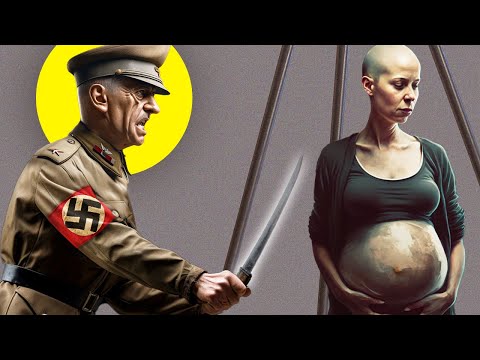
The train screeched to a halt, and the doors slid open to reveal a scene from hell. Guards shouted, dogs barked, and the air was thick with fear. You clutched your belly, hoping to hide the life growing inside you. But in Auschwitz, pregnancy was a crime punishable by death.
You had heard the whispers in the ghetto: pregnant women were sent to the gas chambers immediately. Now, standing on the platform, you knew the truth. Any sign of your condition would seal your fate. You had to survive, for the child within you.
Before the war, the Nazis had already waged war on reproductive rights. The Nuremberg Laws of 1933 and 1935 made it illegal for Jews to marry or have relations with Germans. Surgical sterilization was permitted for those deemed “lesser,” a legal pathway to genocide. While German women were encouraged to reproduce for the Aryan nation, Jewish women were condemned for bringing “undesirable” children into the world.
In the camps, pregnant women faced unimaginable horrors. Hard labor, starvation, and medical experiments were just the beginning. They were vulnerable on two fronts: as women, they faced assault and forced will; as pregnant women, they bore the health of two. Nazi doctors studied the effects of malnutrition on pregnancy, often costing both mother and child their lives.
Most pregnancies ended in miscarriage or stillbirth. If a baby survived, it was often taken from the mother and drowned. The few who gave birth were forced to watch their newborns die. But amidst this darkness, one woman dared to defy the odds.
Stanisława Leszczyńska, a Polish midwife, was deported to Auschwitz in 1943. When she arrived, she informed the camp doctor she was a midwife. She was assigned to the maternity ward—a grim barracks where pregnant women were sent to die. She refused to participate in the murders. Instead, she delivered babies, cared for mothers, and defied the SS at every turn.
With only a single brick stove, no running water, and little food, she delivered over 3,000 babies in two years. She stood up to Joseph Mengele himself, refusing to kill newborns. Around 500 of those babies survived, thanks to her bravery. Her story is a beacon of hope in a landscape of living hell.
But the horrors of Auschwitz were far from over. The pregnant women who fell into the hands of the SS faced unspeakable cruelty. Forced abortions, public whippings, and executions were common. And for those who resisted, the consequences were deadly. The story of pregnancy in Auschwitz is one of unimaginable suffering—and extraordinary courage.
You saw her on your third day—a thin figure in a stained apron, moving between bunks with quiet purpose. Stanisława Leszczyńska did not look like a hero. She looked exhausted, hollowed out by grief and hunger. Yet the women whispered her name like a prayer. If a pregnant woman could reach her, there was a chance—a small, fragile chance—of surviving.
You learned the rules quickly. Report a pregnancy, and the SS would force an abortion. Hide it too long, and the bump would betray you at roll call. Every morning, you wrapped your belly in rags and stood straight as the guards counted. Every night, you prayed the baby would stay quiet, stay small, stay hidden.
The maternity ward was a brick barracks with a single stove and no running water. You had heard the stories: babies born there were often drowned in a bucket while the mother watched. Sister Clara and Sister Fanny, the SS-appointed nurses, were known for their cruelty. They followed orders without hesitation. But Leszczyńska refused. She delivered babies with bare hands and a broken heart, knowing most would not live.
One night, a girl from your block went into labor. You helped carry her to the ward, your own belly heavy and tight. Leszczyńska met you at the door. She looked at your stomach, then at your eyes, and said nothing. She simply nodded and led the girl inside. You waited outside, shivering, until a thin cry pierced the dark. The baby lived. For now.
But survival in Auschwitz was never guaranteed. The SS watched the ward closely. Pregnancy was a death sentence, and Leszczyńska knew it. She moved the mothers, hid the newborns, lied to the guards about stillbirths. Every day she risked her life—and every day she saved another.
You returned to your bunk with a new resolve. If Leszczyńska could defy the SS with nothing but courage, so could you. You would hide your child until liberation—or die trying. The weeks ahead would test every ounce of your strength, but you had seen the impossible made possible. And in Auschwitz, that was everything.
The winter came hard that year. Frost clung to the barrack walls, and the food rations shrank to almost nothing. You felt the baby kick less and less, a sign that worried you more than the guards’ eyes. Leszczyńska noticed too. She pulled you aside one morning, her voice low.
“You must eat more,” she said, pressing a small crust of bread into your hand. “The child needs it.” You wanted to refuse—others were hungrier—but she would not let you. She had seen too many mothers waste away, too many babies born silent. She would not let it happen again.
That night, you dreamed of your child growing strong, of a world beyond the wire. It was a foolish dream, but it kept you alive. And in Auschwitz, that was enough to keep going.
But the SS had eyes everywhere, and the maternity ward was no exception. One morning, a young guard with a face too soft for his uniform appeared at the barracks door. He carried a clipboard and a cold, practiced smile. “All pregnant women are to report to the infirmary for examination,” he announced. The room went silent. Every woman knew what that meant—the forced abortions had begun again.
Leszczyńska stepped forward, her voice steady despite the fear in her eyes. “There are no pregnant women here,” she said. “Only the sick and the dying.” The guard laughed and pushed past her, his boots echoing on the wooden floor. He began pulling blankets back, examining bellies with clinical indifference.
You pressed yourself against the wall, wrapping your arms around your stomach. The baby kicked—hard, as if sensing the danger. You held your breath. The guard moved closer, his clipboard ticking off names. One more step, and he would see you.
Then Leszczyńska did something extraordinary. She stepped between you and the guard, her thin frame blocking his view. “This one has typhus,” she said, pointing at you. “Highly contagious. You should not be near her.” The guard recoiled, his face twisting in disgust. He scribbled something on his clipboard and hurried out of the barracks.
You exhaled, your legs nearly giving way. Leszczyńska turned to you, her expression unreadable. “That will not work twice,” she whispered. “You must be ready to move at any moment. When the time comes, you will not have time to think.” You nodded, tears stinging your eyes. She had saved you—and your child—but the clock was ticking.
Days turned into weeks, and the winter deepened. The camp was a frozen graveyard, and the roll calls grew longer as more women failed to stand. You learned to sleep sitting up, your back against the barrack wall, so the guards could not see the swell of your belly beneath the thin blanket. You learned to steal extra bread, to drink snow when the water ran out, to count the baby’s kicks like a lifeline.
One night, a woman in the bunk above you began to scream. She was in labor—too early, far too early. Leszczyńska was summoned, but by the time she arrived, the woman was bleeding heavily. There was nothing anyone could do. The baby was born blue and silent, and the mother died before dawn.
You helped carry the body to the pile outside the barracks. The snow covered her quickly, a white shroud that erased her from memory. You touched your own belly and made a silent promise: you would not let this place take your child. You would fight, even if it killed you.
The next morning, the SS announced a selection. All women were to line up in the yard, naked, for inspection. Those deemed unfit for work would be sent to the gas chambers. You knew what that meant for a pregnant woman. You wrapped your belly as tightly as you could, the rags digging into your skin. It was agony, but it was survival.
Leszczyńska found you before the lineup. She pressed something into your hand—a small, sharp piece of glass. “If they see you,” she said, her voice barely audible, “use it on yourself before they take you. It will be faster.” You stared at her, horrified. But you understood. In Auschwitz, death was sometimes the only mercy left.
The selection began. Women shuffled forward, shivering in the cold, their bodies reduced to skin and bone. The SS doctor pointed left or right with a flick of his gloved finger. Left meant life. Right meant death. When your turn came, you stepped forward, your heart pounding. The doctor’s eyes swept over you—and paused.
His gaze lingered on your middle, and the world stopped. You thought of the glass in your palm, the rags biting into your skin, the child who had kicked only hours before. Then Leszczyńska was beside you, murmuring something in German about a tumor, a growth, a woman unfit for anything but the infirmary. The doctor waved his hand—left. Life.
You stumbled back to the barracks and wept into your sleeve, the glass still clutched in your fist. The weeks that followed were a blur of hunger and fear, but the baby held on. So did you. When the Soviet guns finally thundered in the distance that January, the SS fled, and the wire that had caged you fell silent.
You gave birth on a straw pallet in the liberated camp, with Leszczyńska’s steady hands guiding you through the pain. The cry that filled the barracks was not thin or weak—it was furious, alive, a declaration of war against every force that had tried to erase it. She placed your daughter on your chest and smiled for the first time. “She is strong,” she said. “Like her mother.”
Stanisława Leszczyńska returned to Poland and lived quietly, never seeking praise for the three thousand lives she caught in her hands. But the women she saved never forgot. In a place built to destroy mothers and children, she had built something else entirely: a quiet, stubborn defiance that no gas chamber could extinguish.
You held your daughter close as the first free dawn broke over Auschwitz, and you thought of all the mothers who never got to hold theirs. What would you have done, in the face of such cruelty—hidden, fought, or refused to look away? Tell us in the comments below.
Report this article
Select a reason for reporting:






