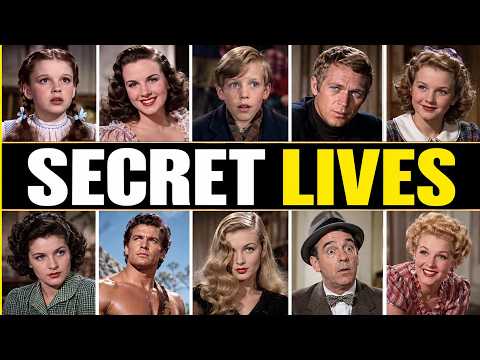
What if the most famous face in America was standing right next to you—and you had no idea? For these twelve classic TV actors, that wasn’t just a hypothetical. It was their daily reality. They traded the spotlight for ordinary lives, slipping into jobs and towns where no one knew their names. Some grew mustaches to hide in plain sight. Others answered phones, wrote traffic tickets, or bagged groceries. And when their pasts finally caught up with them, the world was stunned.
Take Ken Osmond, the mischievous Eddie Haskell from Leave It to Beaver. After the show ended, typecasting nearly killed his career. So he joined the LAPD, grew a mustache, and spent 18 years as a motorcycle cop. Drivers he pulled over had no clue they were meeting a TV legend. “He was very much typecast,” he later said, “and for an actor, that was a death sentence.” But the real shock came in 1980 when he was shot three times in the line of duty—and survived.
Then there’s Gordon Lee, known to millions as Porky from The Little Rascals. He walked away from Hollywood at age 12, changed his name, and became a schoolteacher. For decades, his students had no idea their mild-mannered teacher was a childhood star. “He played his past down so completely,” one friend recalled, “that an impostor even claimed to be him.” It wasn’t until 1980 that fans tracked him down, and he finally embraced his legacy.
And who could forget Betty Hutton, the explosive star of Annie Get Your Gun? By 1967, bankrupt and broken, she found refuge as a cook and housekeeper for a priest in a small Rhode Island town. The woman who once earned thousands a week now washed dishes in obscurity. When the press discovered her in 1974, headlines screamed tragedy. But Hutton didn’t see it that way. “She made it clear that she did not want anybody’s pity,” a reporter noted. She sent back money from fans as a matter of pride.
These are just a few of the twelve. From Tarzan to Zuzu, from Steve McQueen to Deanna Durbin, each story is a reminder that fame is fleeting—and that sometimes the quietest lives are the most extraordinary. Stay tuned as we uncover the rest, one hidden star at a time.
George Winslow, the gravel-voiced boy from Gentlemen Prefer Blondes, vanished even more completely. After retiring from acting at just 12, he served in the Navy, then spent decades as a postal worker in a tiny Northern California town called Camp Meeker. He lived alone with about 25 cats, and his neighbors knew him only as George Wlaf—the retired mailman who volunteered at a military museum. When he failed to show up for a shift in June 2015, a friend found he had died of a heart attack. Only then did the town learn that the quiet man down the lane had once traded barbs with Marilyn Monroe.
Veronica Lake’s story was different—she didn’t hide so much as she was forgotten. The blonde bombshell of the 1940s, whose peekaboo hairstyle was copied by millions, ended up working as a cocktail waitress at a Manhattan hotel for women. She used the name Connie de Toth, and the customers she served had no idea she’d once filled the pages of Life magazine. “She made it clear that she did not want anybody’s pity,” a reporter wrote after tracking her down in 1962. She even mailed back money from sympathetic fans.
Then there’s Gordon Scott, the 11th actor to play Tarzan. After swinging through jungles on screen, he spent his final years as a house guest of a Baltimore couple who had admired him since childhood. “He came,” Betty Thomas said simply, “and he never left.” For roughly eight years, the man who’d been a Saturday matinee hero lived in an ordinary row house on an ordinary city street, far from Hollywood and nearly forgotten.
Perhaps the most poignant case is Billy Thomas—Buckwheat from The Little Rascals. He turned down all offers to return to acting after his Army service, choosing instead to work as a film lab technician. He processed negatives for other people’s movies, including Jaws. “After the army,” he said shortly before his death, “I was not really interested in the hassle of performing.” When the Sons of the Desert fan society invited him to a convention in 1980, the crowd gave him a standing ovation and he wept. Ten weeks later, he was dead of a heart attack at 49.
And then there’s Gloria Jean, the golden-voiced girl who sang with Bing Crosby. After her film career faded, she spent 28 years as a receptionist at a hair care company in the San Fernando Valley. Anyone who called or walked in was greeted by a pleasant woman named Gloria—the same voice that had once sung opposite Bing Crosby. Most had no idea. She retired in 1993 and lived quietly until her death in 2018 at 92.
But the most surprising hidden life of all belongs to the King of Cool himself. In the late 1970s, Steve McQueen—the highest-paid movie star in the world—grew a heavy beard, let his hair go long, and moved to a small farming town called Santa Paula. He wanted to learn to fly an old biplane, so he called a local pilot named Sammy Mason. Mason later said that from the way the caller talked, he took him for the attendant at the service station or perhaps the butcher. McQueen took flying lessons under an assumed identity, made his first solo flight in May 1979, and counted it among the proudest days of his life. The town simply let him be—which was exactly what he had come for.
Peter Ostrum’s story might be the quietest of them all. He was Charlie Bucket in Willy Wonka and the Chocolate Factory, and then he simply went home. The producers offered him a three-picture contract when he was thirteen. He said no. “He was a child who acted, not a child actor,” his dialogue coach observed—and that was exactly how Peter saw it himself.
Back in Ohio, he finished school, went to Cornell, and became a veterinarian. For nearly forty years he drove from farm to farm in northern New York, treating horses and cows in every kind of weather. To the dairy farmers who called him out at night, he was simply Dr. Ostrum. Most of them had no idea he had ever stood in front of a camera.
He even lied about it sometimes, telling people it was his brother who’d been in the film. He didn’t tell the woman he was going to marry until just before she met his mother. He wanted to work with animals—and that was that.
Then there’s Deanna Durbin, who didn’t just walk away from fame—she built a wall around herself and never looked back. In the 1930s and 40s, she was one of the most popular stars in the world. Winston Churchill was an admirer. Anne Frank pinned her picture to the wall of the secret annex. By the 1940s, she was the second highest-paid woman in America.
And she hated it. She called herself “the highest paid star with the poorest material” and was tired of playing a little Miss Fixit who bursts into song. So in 1949, at twenty-seven, she retired and moved to France. She married the director Charles David on one condition: that she could have what she called “the life of nobody.”
They settled in a village west of Paris, where she kept house, cooked, and raised her children. She was Madame David—a married woman living under her husband’s name—and no studio publicist ever came to say otherwise. She turned down every offer to return, including the role of Eliza Doolittle in the original Broadway production of My Fair Lady. She said she had her ticket for Paris in her pocket.
She refused all interviews with a single exception in 1983, when she spoke about the Deanna of the movies in the third person, as if she were someone else entirely. Her fans never forgot her, and a society devoted to her films kept meeting for decades without any hope of ever seeing her in person. When she died in April 2013 at ninety-one, the news came quietly—a short notice from her son, passed on days later through the newsletter of her fan club.
And finally, Carolyn Grimes—Zuzu Bailey, the little girl who hands her father the petals and tells him that every time a bell rings, an angel gets his wings. She was six when Frank Capra cast her in It’s a Wonderful Life in 1946. She made sixteen films in all. Then her childhood fell apart. Her mother died of an early form of Alzheimer’s when Carolyn was fourteen. A year later, her father was killed in a car accident. At fifteen, she was an orphan.
A court sent her to live with an aunt in a small Missouri town—an aunt she later described as cruel and unstable. Hollywood was over. She married young, had two daughters, divorced, and became a medical technologist. She worked in labs for twenty-five years. She remarried, to a man with three children, and they had two more. It was a busy household near Kansas City, and the films were hardly ever mentioned.
Her own children knew she’d been in the movies, she said, but it wasn’t important to them—because it wasn’t important to her. She had never even sat down to watch It’s a Wonderful Life. The film had been a disappointment in 1946, and she had no idea that in the 1970s its copyright had lapsed and television stations all over the country had begun showing it every Christmas.
Then, in 1980, a reporter knocked on her door in Kansas and asked if she was the little girl from the movie. More reporters followed. So did letters from fans. James Stewart’s secretary tracked her down too, and the two stayed in touch until his death in 1997. Her later years brought terrible losses—her youngest son died at eighteen, and her husband died of cancer a few years afterward. But the film, and the people who loved it, gave her a purpose again. Now in her eighties, she still travels each winter to talk about Zuzu.
What these twelve stories share isn’t tragedy—it’s something stranger. Each of them chose, or was forced, to become ordinary. And in doing so, they proved something the spotlight never could: that a life doesn’t have to be famous to be full.
So here’s the question: if you passed one of these legends on the street tomorrow—bagging your groceries, writing your ticket, or flying a biplane—would you even recognize them? And more importantly, would they want you to?
Report this article
Select a reason for reporting:






