On October 2, 1919, a group of soldiers crossed the war-shattered fields near Thiepval, France, searching for the dead. Over the following months, they uncovered more than 1,000 fallen men—one for every yard of ground. But this was no ordinary battlefield. This was Square 25, a single grid on a trench map that would become a microcosm of the entire First World War.
What made this patch of earth so bloody? Why did four years of relentless fighting converge here? And what secrets does it still hold today?
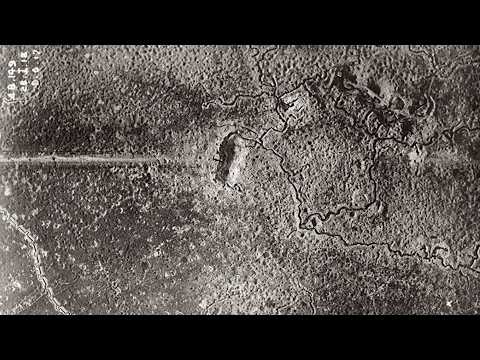
To understand, we must go back to 1914. Before the war, Thiepval was a peaceful village of 300 people, with a church, a café, a baker, a butcher, and a magnificent 13th-century chateau. Its fields and woods were farmed by families who had lived there for generations. But when war came, Thiepval’s location overlooking the River Ancre made it a strategic prize. The Germans arrived first, turning the village into a fortress. Trenches snaked through back gardens, houses became billets, and the chateau was fortified.
By 1915, the Somme was considered a quiet sector—but that was about to change. The British, taking over from the French, began planning a massive offensive. On July 1, 1916, the Battle of the Somme erupted. For months, Square 25 was at the heart of the storm.
“We took over this trench somewhere near Thiepval, and it was full of dead Germans… They were all bloated, different colors, pallid gray, green, black.” One veteran’s account captures the horror. The village was obliterated, reduced to a smudge on the landscape. By September, the British finally captured the ruins, but the cost was staggering.
Then, in March 1918, the Germans launched their Spring Offensive, recapturing Thiepval in days. But the tide turned. By August, the Allies, with tanks and American troops, pushed forward. On August 24, 1918, Welshmen of the 38th Division passed through the rubble of Thiepval. The war in Square 25 was over—but the reckoning had just begun.
After the armistice, Graves Registration Units scoured the field. Body density maps from 1919 reveal a chilling statistic: an average of 1.2 bodies recovered per square yard. And they are still being found today—the iron harvest brings up shells, bullets, and bones each spring.
One report from 1938 details the recovery of Private Charles Martin, identified by his identity disc, found precisely at grid reference 57 D R 25 B 1575—a spot we can pinpoint on the map. He was one of the lucky ones. Most remain unknown.
Today, the Thiepval Memorial bears the names of 72,000 British missing. Square 25 is just a field again, but beneath its soil lies the story of four years of war—a story of courage, horror, and remembrance.
But the story of Square 25 does not end with the armistice, nor with the burials of the missing. The land itself remembers, and it has never quite let go. Walk across that field today and the earth is strangely uneven—gentle dips and rises that betray the ghosts of trenches. In spring, when the plough turns the soil, the iron harvest begins again. Farmers still pile up shells by the roadside, and pieces of shrapnel, buttons, and bones work their way to the surface like the land is exhaling.
“Every year we find something,” one local farmer has said. “You never get used to it. You just learn to put it aside and keep going.” It is a strange inheritance—a field that feeds them and a field that still kills.
And yet, the most remarkable discovery came not from the plough but from the air. LiDAR scans of Thiepval Wood revealed the trenches still carved into the earth beneath the trees—White Church Street, the old British front line, and the faint scars of shell holes a century old. The war is still written there, in the ground and in the undergrowth.
What does it mean to stand in Square 25 now? The village is gone. The chateau is a mound of rubble beneath the memorial. But the grid square remains—a quiet field, a patch of wood, a place where history is not buried but layered, one year upon another.
Perhaps that is the true legacy of Thiepval. Not the grand strategies or the casualty figures, but the simple fact that the ground itself refuses to forget. And as long as the plough turns and the shells rise, Square 25 will keep telling its story—one yard, one body, one memory at a time.
But to truly grasp what Square 25 became, we have to follow the men who fought there through the years between the great battles—the quiet months that were never really quiet. In early 1916, before the storm, British soldiers in Thiepval Wood settled into a grim routine. They rotated between the front line, the support line, and the reserve, always under the watchful eye of German observers on the higher ground. Snipers ruled the daylight hours. A carelessly raised helmet, a moment’s pause at a parapet—these could mean a bullet through the skull.
And beneath the trenches, another war was being fought. Miners on both sides drove tunnels under no-man’s land, packing them with explosives. The craters they left behind still pockmark the fields today, silent monuments to a subterranean battlefield few ever saw. In Square 25, the chalk geology made tunneling possible—and deadly. Listening posts pressed stethoscopes to the earth, straining to hear the scrape of enemy picks.
When July 1, 1916, finally came, the men of the 36th Ulster Division charged from the edge of Thiepval Wood with remarkable success. They crossed the 85 yards of no-man’s land in the northern part of the square and stormed the Schwaben Redoubt, a fortress of German trenches and deep dugouts. For a few hours, it seemed like a breakthrough.
But it was not to last. German artillery, pre-registered on the captured positions, began to fall. Counterattack after counterattack slammed into the Ulstermen, and with no reinforcements and ammunition running low, they were forced back. By nightfall, they had returned to their starting trenches, leaving thousands of their comrades dead or wounded in the churned earth of Square 25.
The fighting dragged on through the summer and into autumn. Every yard of ground was contested. Every trench line changed hands, sometimes more than once in a single day. The Germans, fighting from deep shelters, emerged after each bombardment to man their machine guns. The British, attacking across open ground, were cut down in waves.
By September, the battlefield had been transformed. Aerial photographs show a moonscape of overlapping shell craters, the chalk subsoil exposed like bleached bone. Where once there had been hedgerows and gardens, there was now only mud—a sucking, drowning mud that swallowed men whole. Tanks, used for the first time on the Somme that September, bogged down in the craters. Infantry who fell wounded into no-man’s land often drowned before they could be rescued.
It was during this period that the 18th Division finally took the ruins of Thiepval. The village had ceased to exist as anything but a name on a map. Soldiers who entered it found only shattered masonry, splintered beams, and the stench of death. One officer described it as ‘a heap of rubble not worth the name of a village.’ Yet it had cost thousands of lives to capture.
With Thiepval in British hands, the front line moved down the slope toward the River Ancre. Square 25 became a support position, a place where troops massed before attacks and where the wounded were carried back. The 13th of November saw another push—the Battle of the Ancre—which finally broke the German hold on the sector. But by then, the Somme campaign had exhausted both sides.
Winter set in. The trenches filled with water. Frostbite and trench foot claimed as many men as bullets. And then, in February 1917, came the surprise: the Germans withdrew. Under Operation Alberich, they pulled back to the Hindenburg Line, nineteen miles to the east. Square 25 was suddenly behind the lines—a place of silence and ghosts.
For the first time in nearly three years, the guns fell silent over Square 25. But the silence was not peace—it was a reckoning. The first villagers who crept back found nothing but a wasteland. Where their homes had stood, only a light-colored smudge on the landscape remained. The chateau, the church, the café, the butcher’s shop—all gone. They stood on the edge of their own fields and wept.
But the war was not finished with this ground. In March 1918, the German Spring Offensive smashed through the British lines. Storm troopers, aircraft, and massed artillery drove the Allies back. By March 26, Thiepval had fallen again. The Germans were back in the ruins they had lost two years earlier. For a few months, Square 25 was German ground once more.
Yet this time, the advance faltered. The old battlefield—still a chaos of shell holes and broken trenches—slowed the German supply lines to a crawl. Troops exhausted, casualties mounting, the offensive ran out of steam. By August, the Allies counterattacked. On August 24, 1918, Welshmen of the 38th Division entered the rubble of Thiepval. They passed through without stopping—there was nothing left to capture.
The war in Square 25 ended on November 11, 1918. But the reckoning had only begun. Graves Registration Units scoured the field for years. Body density maps from 1919 told a horrifying story: in four quadrants of Square 25 alone, they recorded 150, 513, 125, and 463 bodies. An average of 1.2 men per square yard—and that was only the marked graves.
They are still finding them. In 1938, a work party recovered Private Charles Martin of the Hertfordshire Regiment, identified by his identity disc, at grid reference 57 D R 25 B 1575—a spot we can pinpoint on the map today. He was one of the lucky ones. Most remain unknown.
Today, the Thiepval Memorial bears the names of 72,000 British missing. Square 25 is just a field again—a quiet patch of farmland and wood. But walk across it and the earth is strangely uneven. LiDAR scans reveal the old trenches still carved beneath the trees. Each spring, the plough turns up shells, shrapnel, and bones. The land itself refuses to forget.
Perhaps that is the true legacy of this single grid square. Not the grand strategies or the casualty figures, but the simple fact that history here is not buried—it is layered, one year upon another. The war in Square 25 is over. But its story keeps rising to the surface, one yard at a time.
What do you think—should these fields be left to heal, or should every last secret be dug up and remembered? Let us know in the comments below.
Report this article
Select a reason for reporting:






