When the Third Reich launched Operation Barbarossa in June 1941, the Soviet Union faced a crisis that would test the limits of human endurance. As German forces swept across the Eastern Front, they seized the most vital agricultural regions, stripping the Red Army of its primary food sources. Millions of soldiers found themselves not only fighting a ruthless enemy but also battling the relentless grip of hunger. In the chaos of war, a single meal could mean the difference between life and death.
From the frozen trenches of Stalingrad to the muddy fields of Kursk, Soviet troops endured some of the harshest conditions imaginable. Yet, even in the face of starvation, they held the line. This is the story of what they ate—and how it fueled their fight against impossible odds.
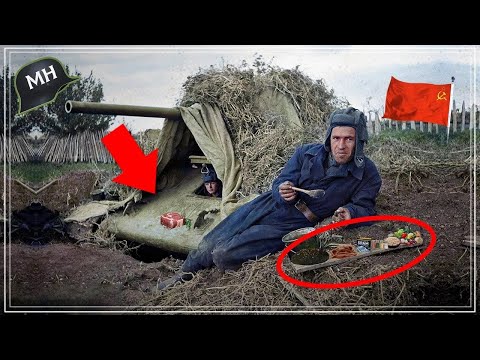
The early years of the war were brutal. Cut off from supply lines and with German troops advancing rapidly, Soviet soldiers often resorted to scavenging. They looted local homes and ate whatever they could find—leftover vegetables, scraps of bread, even animal feed. The daily ration was a far cry from the propaganda images of abundance; it was a meager loaf of black bread, a few spoonfuls of spread, and whatever vegetables remained from previous meals.
During the Battle of Stalingrad, between August 1942 and February 1943, the situation became desperate. The Red Army had to supply itself locally, often taking food from their own compatriots. “We ate whatever we could find,” recalled one veteran. “Sometimes it was just a piece of bread and a cup of tea.” The Germans, too, suffered from supply problems, but that offered little comfort to the starving Soviet troops.
Relief came in 1943 when the Allied nations began sending aid through loans and resources. The typical ration improved to include black bread, wheat flour, macaroni, meat, fish, and oatmeal, supplemented with sugar, tea, salt, and vegetables like carrots, potatoes, beets, and cabbage. Tobacco was regulated at 20 grams per day, and three boxes of matches per month. For women on the battlefield, the ration included butter, biscuits, and chocolate. Pilots received extra items such as fresh milk, cottage cheese, eggs, and nuts. Submarine personnel got sauerkraut, salted cucumbers, raw onions, and red wine to prevent scurvy and compensate for the lack of oxygen.
But not everything was ideal. The infantrymen’s rations did not include water, forcing them to fetch it themselves. Many turned to alcoholic beverages like vodka. Jewish and Muslim soldiers complained about the inclusion of pork, but the high command did nothing to change it—they had to eat or starve.
A significant portion of Soviet supplies came from England, which bought canned goods from Brazil and Argentina. These included meats, soups, concentrated broths, and pork jerky. Curiously, the Red Army officers forgot to relabel the products, so most soldiers couldn’t read the English labels, causing logistical confusion. The error was quickly corrected with small paper labels in Russian.
One of the most popular foods on the Eastern Front was Spam, a canned North American product made from chopped pork, ham, salt, water, potatoes, and sodium nitrate. The United States sent large quantities to prevent famine. Nikita Khrushchev later wrote in his memoirs, “Without Spam, we would have been unable to feed our men when everything else was scarce.” The troops received it three times a day, seven days a week. Stalin, displeased that his forces were consuming a meal made in the capitalist United States, ordered it renamed “tanka” to sound Russian.
To supply troops in combat, the Soviets developed a dynamic system of field kitchens. These were typical of 19th-century Russia, placed on trucks or wheel trailers, each with up to four cauldrons, a food storage compartment, and utensils. They ran on wood, so strict orders required cooking before sunrise or after sunset to avoid smoke detection by the enemy. The cooks were generally women, and a simple one-course meal took an hour and a half. Soups were a specialty—easy to make and cheap. The most common were kasha (millet and lard), borscht (beetroot), and shchi (cabbage soup).
Once the dish was ready, the odyssey of delivering it to the soldiers began. One man had to carry the heavy cauldron from the field kitchen to the trench over uneven terrain, with bullets whizzing and shells exploding nearby. If he survived, he would deliver dinner to his unit mates, who would congratulate him and enjoy a warm meal together.
The experience of Soviet troops was at times a nightmare, and only thanks to willpower did they stay on their feet despite severe food restrictions. Their resilience in the face of hunger is a testament to the human spirit. But how did they manage to cook under fire? And what other secrets lay behind the Soviet supply system?
The answer lay in a remarkable network of logistics that few outside the Red Army ever understood. Behind every frontline unit stood an invisible army of bakers, butchers, and supply clerks working around the clock. Mobile bread bakeries—known as field bakeries—followed the troops just a few kilometers behind the front, producing thousands of loaves of black bread each day. These loaves were dense, heavy, and often sour, but they provided the calories soldiers desperately needed.
The black bread itself became a symbol of survival. Made from rye flour, sometimes mixed with sawdust or tree bark when flour ran short, it was baked in massive brick ovens that could be dismantled and rebuilt within hours. “A soldier without bread is not a soldier,” went a common saying in the trenches. Each man was entitled to roughly 800 grams per day, though in practice the amount fluctuated wildly depending on the supply situation.
Meat was another matter entirely. Fresh meat was a luxury reserved for rear units and special occasions. At the front, soldiers relied on canned meats, dried fish, and the ubiquitous Spam. Sausages, known as kolbasa, were sometimes air-dropped to encircled units as a morale booster. When a supply plane managed to reach a surrounded pocket, the sight of sausage tins falling from the sky could spark cheers louder than any artillery barrage.
But the true genius of the Soviet supply system emerged during the great offensives of 1944 and 1945. As the Red Army pushed westward through Poland and into Germany, supply lines stretched to the breaking point. The solution was a system of forward supply depots, established just behind the advancing armies, stocked with food, ammunition, and fuel. These depots moved constantly, sometimes relocating three or four times a week.
Railways played a crucial role. The Soviets converted captured German rail lines to the wider Russian gauge, allowing supply trains to roll directly to the front. Each train carried enough food to feed an entire division for several days. When tracks were destroyed—often by retreating German forces—supply columns switched to trucks and horse-drawn carts.
The winter months brought additional challenges. Food froze solid in the brutal cold, and soldiers had to thaw their rations against their bodies or over small fires. Frozen bread was so hard that soldiers joked it could stop a bullet. Yet even in these conditions, the field kitchens kept working, boiling water for tea and heating soups that warmed frozen hands and lifted sagging spirits.
By the time Soviet troops reached Berlin in April 1945, the supply system had become a well-oiled machine. Soldiers advancing into the heart of the enemy capital received hot meals from field kitchens set up in the ruins of German streets. The irony was not lost on them—they were eating in the very heart of the empire that had tried to starve them into submission.
What sustained these men and women through four years of unimaginable hardship was not just food, but the knowledge that every meal was a small victory. Each loaf of bread, each tin of Spam, each bowl of borscht was proof that the Soviet Union would not be broken. The field kitchens, the bakeries, the supply trains—all of it represented a collective determination to endure.
And yet, the story of Soviet military food was not only one of survival—it was also one of surprising ingenuity. Scientists at the Institute of Nutrition in Moscow were tasked with creating concentrated food blocks that could sustain a soldier for days. These compressed bricks of nutrients, weighing barely a few hundred grams, could be dissolved in water to produce a thick, if unappetizing, porridge.
The most famous of these was the so-called “food concentrate,” a hardened mixture of grains, fats, and dried meat. Soldiers nicknamed it “the brick,” and many swore it tasted better than it looked—though that was not saying much. A single block could provide up to three thousand calories, a lifesaver for reconnaissance units operating deep behind enemy lines.
Another innovation was the development of portable stoves that burned solidified alcohol. These small devices allowed small teams to heat water and prepare tea without the telltale smoke of a wood fire. In the frozen forests of the north, a cup of hot tea could mean the difference between life and frostbite.
But perhaps the most remarkable aspect of Soviet wartime food was its role in morale. On holidays and after major victories, special rations were distributed—chocolate, canned fruit, and even small amounts of alcohol. These treats were rare, but their psychological impact was enormous. A soldier who received a chocolate bar on New Year’s Eve might forget, for a moment, the horror of the trenches.
Vodka, of course, played its own complicated role. The famous “100 grams” ration—a small cup of vodka issued before combat—became a fixture of Soviet military life. Commanders debated its value for years. Some argued it steadied nerves before an attack; others insisted it dulled reflexes and led to unnecessary casualties.
In the end, the decision was left to individual unit commanders, and the practice varied widely. Some soldiers credited the vodka ration with giving them courage; others blamed it for the deaths of friends who charged too recklessly. Like so much in war, it was a double-edged sword.
As the Red Army marched westward, its soldiers encountered foods they had never seen before. In Poland and Germany, they discovered canned goods, cheeses, and sweets that had been unimaginable in the starving years of 1941 and 1942. Some sent packages home to their families; others devoured everything on the spot.
For the men and women who had survived on black bread and watery soup, the abundance of the West was almost overwhelming. One veteran recalled staring at a jar of pickles for ten minutes, unable to believe such a thing existed. The war had changed them in ways they were only beginning to understand.
When the war ended, the field kitchens fell silent, but their legacy endured. The experience of feeding millions under fire reshaped Soviet military logistics for decades. The black bread, the Spam, the vodka ration—all became part of a shared memory.
Veterans returned home with stories of hunger and camaraderie. “We ate what we had, and we shared what we could,” one survivor recalled. The war taught them that food was more than fuel—it was hope.
Today, the field kitchens and ration tins are museum pieces. But the lessons of survival and solidarity remain. They remind us that even in the darkest times, a warm meal can be a victory.
So, would you have traded your dinner for a soldier’s ration? Share your thoughts in the comments below.
Report this article
Select a reason for reporting:






