Private Tommy Wilson peeked over the trench wall for just two seconds. A single crack echoed across the valley. He fell backward into the mud, a bullet hole between his eyes. He was the 147th Australian soldier to die this way since the landing three weeks ago. Three more would die before sunset. None of them would ever see who fired the shot.
This was the nightmare of Anzac Cove. The Ottomans held the high ground, and every ridge, every hill, every rocky outcrop hid enemy shooters. The Allied forces could not move forward, could not retreat, could barely survive. “Sniping is not proper warfare,” Colonel James insisted in the command tent. “It is murder, not combat.” But the men dying in the trenches did not care about honor. They cared about staying alive.
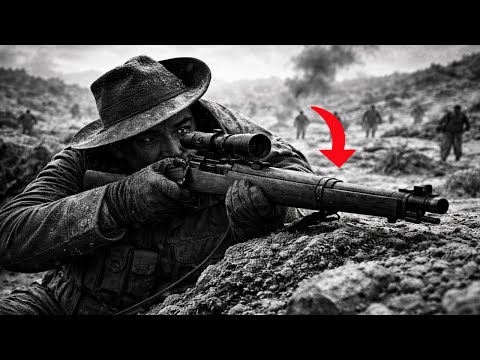
Among them sat a quiet 23-year-old private named Billy Singh. He did not look like a soldier who would change everything. Short and lean, with dark hair and sharp eyes, he had grown up on a farm in Queensland, hunting kangaroos in the outback. He knew how to stay perfectly still for fifteen hours under the burning sun, how to read the land, how to use every rock and bush for cover. He knew that the best hunter was the one you never saw coming.
Billy watched the other soldiers fire blindly at the hills. He watched artillery shells explode and accomplish nothing. And he thought about the kangaroos. In Queensland, if you fired randomly into the bush, you would never hit anything. The animals would hear you coming from a mile away. The only way to hunt successfully was patience. You had to become part of the landscape. You had to wait until the target came to you.
He looked up at the rocky hills where the Ottoman snipers hid. The terrain reminded him of home. He realized something the British colonels had not: this was not a job for artillery or bayonet charges. This was a job for a hunter. And Billy Singh had been hunting since he was old enough to hold a rifle.
Billy did not ask permission. On the morning of May 3rd, he took his standard Lee Enfield rifle and inspected every part of it. He chose the one with the smoothest trigger pull and the cleanest barrel. Then he gathered rocks. For two days, he built his hunting position—350 yards from the Ottoman trenches. He stacked flat stones into a low wall that looked like natural rubble, wove scrub brush between the rocks, and created a tiny opening just wide enough for his rifle barrel. From the outside, it looked like another pile of rocks on a hillside covered with rocks.
Inside his hide, Billy could lie flat on his stomach for hours without moving. He practiced his breathing—slow and steady. He learned the rhythm of the enemy trenches. Ottoman soldiers appeared at the same times each day: morning water delivery at 6:00, shift change at noon, evening meal at 7:00. They followed patterns. Billy studied those patterns the way he used to study kangaroo trails back home.
On May 5th, Billy took his first shot. An Ottoman soldier stood up to pass a water bucket. The distance was 362 yards. Billy had already calculated the wind and adjusted for the slight uphill angle. He squeezed the trigger slowly—just like his father had taught him when he was eight years old. The rifle cracked once. The soldier fell and did not get up.
Billy did not celebrate. He did not move. He stayed perfectly still for three more hours while the enemy fired randomly at the hillside, their bullets hitting rocks fifty yards away. He waited until they stopped searching, then crawled out in the darkness and returned to the Allied trenches.
The next morning, he was back before sunrise. He shot two more soldiers that day—one at 340 yards, one at 395. Both died instantly. Both times the enemy could not find the shooter. On the third day, he killed three more. The Ottoman soldiers in that section became afraid to show themselves. They stopped standing up. They stopped passing supplies openly. They started moving only at night.
After twelve days, Billy had confirmed kills on twelve Ottoman soldiers. The British officers in his sector noticed something remarkable: their casualty rate had dropped. Men were not dying from sniper fire anymore—at least not in the area where Billy was hunting. That section saw only two deaths in those twelve days, while other sections were still losing fifteen to twenty men in the same period.
Major General Bridges heard about the quiet private who was getting results. He called Billy to his tent. Billy stood at attention, covered in dust, looking nothing like a typical soldier. Bridges asked him how he was doing it. Billy explained in simple words: “Find good ground. Stay invisible. Be patient. Shoot straight.” Bridges listened carefully. This was not the gentleman’s warfare Colonel James had talked about, but it was working.
Still, many officers resisted. Colonel James argued loudly: “We are not assassins. We are soldiers. If we start hiding and shooting from shadows, we are no better than common murderers.” But Bridges looked at the numbers. Billy’s sector had 60% fewer deaths than other areas. That meant sixty soldiers who went home to their families instead of dying on this beach. Bridges did not care about old rules. He cared about keeping his men alive.
On May 28th, Bridges assigned a spotter named Tom Sheehan to work full-time with Billy. Tom was a tall soldier from New South Wales with excellent eyesight. His job was to watch through a salvaged periscope while Billy aimed. Tom would spot targets, calculate distances, and help Billy adjust. Together, they became a two-man hunting team.
The Singh-Sheehan system was devastatingly effective. Tom would spot an Ottoman soldier through the periscope and whisper the distance and position. Billy would make tiny adjustments, take one breath, one trigger squeeze, one shot—and the target would fall. Then both men would stay frozen for hours to avoid detection. They never fired twice from the same position. They never established a pattern the enemy could predict.
Within the first month, Billy and Tom had forty confirmed kills. Every single shot was between 300 and 400 yards. Every single target died without ever seeing who shot them. And most importantly, not once did the Ottoman forces locate Billy’s position. He was a ghost—invisible, untouchable.
The results were undeniable. In Billy’s protected sector, Allied casualties from sniper fire dropped from an average of twenty men per week to just eight. Other sections of the line were still losing soldiers every day, but where Billy hunted, the Australians could eat their meals safely. They could sleep without constant fear. They could move around their trenches without expecting instant death.
Billy achieved all of this with a standard-issue rifle, homemade camouflage made from rocks and bushes, and a periscope salvaged from damaged equipment. He had no special training, no expensive gear, no fancy technology—just the skills he learned hunting kangaroos in Queensland and the patience to use them properly.
By the end of June, Billy Singh was killing eight to ten Ottoman soldiers every single day. And the enemy still had no idea who was firing.
By July 1915, the numbers told a story that even the skeptical officers could not ignore. In the sections of trench where Billy hunted, Allied deaths from enemy sniper fire had dropped by 75%. Before Billy started his work, those sections lost an average of twenty-two men per week to invisible shooters. Now they lost only five. In other parts of the line, soldiers were still dying at the old terrible rate—twenty men one week, eighteen the next, twenty-four the week after that.
The difference was so dramatic that soldiers started requesting transfers to Billy’s sector. They felt safer there. They could look over the trench wall without expecting instant death. Word spread through the camps: there was a silent protector watching over certain areas. A ghost who hunted the hunters. The men did not know his name yet, but they knew someone was keeping them alive.
Major General Bridges saw the success and made another crucial decision. In early August, he ordered Billy to train other soldiers in his methods. Fifteen men were selected from different units. Billy taught them everything—how to build a hide that looked natural, how to judge distance by eye, how to control breathing, how to wait without moving for eight or ten or twelve hours. How to think like the animal you were hunting. The kangaroo farmer from Queensland had become a teacher.
By the middle of August, Billy’s fifteen students were positioned across the entire ANZAC line. Each one used his techniques. Each one built invisible hides. Each one practiced patience. The methods that had worked for Billy now protected thousands of Allied soldiers, and the sniper casualty rate across the whole beachhead began to drop.
The Ottoman command noticed. They were losing men to an enemy they could not see or fight. Their own snipers were the best in the region—they knew this terrain, they had trained for years—yet somehow Allied shooters were killing them from positions nobody could locate. The situation was unacceptable.
In late August, the Ottomans brought in their own legend. His name was Abdul Aziz, though the Allied soldiers called him Abdul the Terrible. He was the most feared sniper in the Ottoman army, with over ninety confirmed kills against Russian forces in previous battles. He had never failed to find and eliminate an enemy shooter. His commanders gave him one specific mission: find the ghost, kill the invisible Australian, stop the bleeding.
Abdul studied the patterns of Allied deaths in the Ottoman trenches. He noticed that one sector suffered far worse than others—that was where the primary hunter operated. He set up his own hide 420 yards away from where he calculated the shooter must be. Then he waited. For three days, Abdul watched the hillside through his scope. He saw nothing unusual—just rocks and scrub brush, no movement, no glints of metal, no disturbed earth. This opponent was skilled, very skilled. Abdul respected that, but he was confident. He had found and killed thirty-seven enemy snipers in his career. This Australian would be number thirty-eight.
On the fourth day, Billy killed an Ottoman soldier at 370 yards. Abdul saw the muzzle flash—just a tiny puff of smoke that lasted less than a second, but it was enough. He marked the location in his mind. Now he knew where to look.
The next morning, Abdul aimed at the spot where he had seen the flash and waited for Billy to fire again. Hours passed. The August sun blazed down on the rocks, and heat made the air shimmer and dance. Flies swarmed over bodies that had been lying in no man’s land for days. The silence was total except for the distant sounds of artillery from other parts of the peninsula.
Then Billy fired. Abdul saw the tiny flash again and squeezed his trigger immediately after. His bullet struck a rock exactly where Billy’s rifle barrel had been—but Billy had already moved. The instant after firing, he had rolled three feet to the left inside his hide. Abdul’s bullet hit nothing but stone.
Billy knew someone was hunting him now. He recognized the quick response shot. He had been found—not completely, but close enough. For the first time since landing at Gallipoli, Billy felt the cold fear his targets must have felt. Somewhere out there, an expert was watching for him, waiting for him to make a mistake.
The duel between Billy Singh and Abdul the Terrible lasted eleven days. Abdul fired seventeen shots at Billy’s suspected positions. Every single one missed. Billy fired only when he was certain of his background cover. He changed positions after every shot. He never established a pattern.
On the eighth day of their private war, Billy saw a flicker of movement 430 yards away—Abdul adjusting his position slightly. Billy aimed carefully, held his breath, and squeezed the trigger with gentle pressure. The bullet flew across 430 yards of hot, dusty air. It struck Abdul directly in the forehead. The legendary Ottoman sniper was dead before he hit the ground.
The Ottomans had sent their best hunter to stop Billy Singh. Now their best hunter was gone, and Billy was still invisible.
The Allied war diaries from that period contain remarkable entries. One British officer wrote: “The assassin struck again today. Enemy activity in section 4 has ceased entirely. The Turks will not show themselves.” By late September, the Ottomans pulled their frontline trenches back 200 yards in the sectors where Billy operated—giving up hard-won ground just to escape the invisible shooter.
By October 1915, Billy Singh had 150 confirmed kills in official documents. His spotter Tom estimated the real number was closer to 200. 150 Ottoman soldiers had died without ever knowing who fired. And the farm boy who pulled the trigger remained completely invisible.
The campaign ended in December 1915. Billy was transferred to France, where he continued his work, trained more soldiers, and earned the Distinguished Conduct Medal. “Just doing my job,” he shrugged when officers congratulated him. In 1918, shrapnel tore through his shoulder and chest. His war was over.
Back in Queensland, Billy worked whatever jobs he could find and rarely spoke of the war. He died in 1943, aged 57, buried in a simple grave with few mourners. Yet his methods—patience, concealment, reading the land—became standard doctrine for snipers around the world.
The quiet farmer who became a ghost saved thousands of lives by taking them, then disappeared into ordinary life, content to let his work speak louder than his name ever could.
What do you think—does true heroism need recognition, or is the quiet sacrifice enough? Share your thoughts below.
Report this article
Select a reason for reporting:






