March 1942. A Polish military attaché walks into a War Department office in Washington with a proposal so audacious it sounds like madness: arm a million ordinary people across Nazi-occupied Europe with pistols so cheap they cost less than a movie ticket, so crude they’d be discarded after a single shot, and so simple a farmer who’d never held a weapon could use one to kill a German soldier.
The American Assistant Chief of Staff for Intelligence listens. Then he picks up the phone. Within two weeks, the Joint Psychological Warfare Committee delivers its verdict: Do it. Build it. Make a million of them, and make them now.
By May 1942, a contract lands on the desk of George Hyde at General Motors’ Inland Manufacturing Division in Dayton, Ohio. His assignment: design a handgun that costs almost nothing, requires no training, and can be dropped behind enemy lines by the thousands.
Hyde studies the specifications. Single-shot. .45 caliber. Dirt cheap. Deadly at close range. He gets to work.
What Hyde creates is unlike any weapon ever made by the U.S. military. Twenty-three parts. No rifling in the barrel. No serial numbers. No inspector’s marks. Just stamped sheet metal welded together with a zinc die-cast cocking knob. The barrel is a simple four-inch steel tube. The trigger is sheet metal. The grip holds ten rounds of ammunition, but doesn’t feed them into the chamber. You load one round at a time manually by twisting open the breech block at the back of the weapon.
It takes longer to reload than it did to manufacture. And that’s exactly the point.
The gun is deliberately designed to be used once, maybe twice, then discarded or hidden. It’s not meant to win firefights. It’s meant to start them.
The concept is brutally simple. A resistance fighter recovers the weapon from an airdrop, approaches a lone German sentry from behind, fires a .45 caliber round at point-blank range, and takes the soldier’s rifle, ammunition, and equipment. Now that resistance fighter is armed with a real weapon.
Do this a thousand times across occupied France, and suddenly the Germans have a problem they can’t solve with tanks or bombers. An invisible enemy, everywhere, armed.
To hide the project from Nazi spies, the military gives it a misleading designation: Flare Projector Caliber .45, FP45. On official documents, the barrel is labeled “tube.” The trigger is called a “yoke.” The firing pin becomes a “control rod.”
Workers at Guide Lamp Division, a General Motors factory in Anderson, Indiana, that normally manufactures headlights and turn signals for cars, are told they’re building flare projectors for the military. Three hundred workers are assigned to the program. They’re sworn to secrecy.
Production begins in the second week of June 1942. They work 24 hours a day, seven days a week. The factory floor never stops. Stamping presses hammer out sheet metal parts. Welding stations fuse them together. Assembly lines move at breakneck speed.
By August 21, 1942—just over ten weeks later—the workers have completed one million pistols. One every 6.6 seconds. It’s calculated that the FP45 is the only firearm in history manufactured in less time than it takes to load.
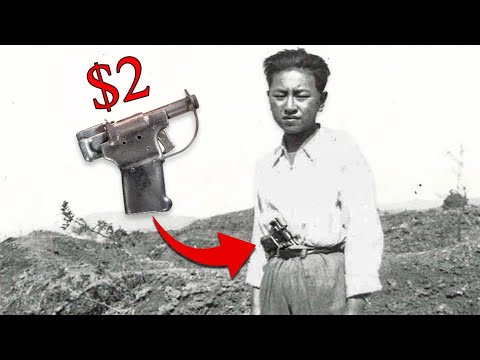
Each pistol costs $2.10. Boxed and ready for delivery with ten rounds of Frankford Arsenal .45 ACP ammunition. That’s about $40 in today’s money.
For comparison, a single Thompson submachine gun costs over $200. The military can arm 5,000 resistance fighters for the price of a single Sherman tank.
The hollow grip of each Liberator stores ten rounds. A wooden dowel is included to punch out spent cartridge cases because extraction is unreliable. Instructions are printed in comic-strip form with no words, so anyone, regardless of language, can understand how to use it. Load one round. Twist the breech closed. Pull the trigger. Repeat if you survive.
Testing reveals the weapon’s limitations immediately. The welded seams begin splitting after just ten to fifteen rounds. None survive fifty rounds of testing. In humid environments like the Pacific Islands, the unfinished metal rusts within weeks. The smoothbore barrel makes the pistol wildly inaccurate beyond twenty-five feet. The sheet metal trigger flexes and bends. The zinc cocking piece cracks under repeated use.
It’s fragile, crude, and barely functional by military standards. But it doesn’t need to be a military weapon. It needs to be a weapon for farmers, shopkeepers, teachers, and factory workers who’ve never fired a shot in their lives. For that purpose—at point-blank range, aimed at the back of a soldier’s head in a dark alley—it’s perfectly adequate.
Each pistol is test-fired at least once during production to satisfy inspection requirements. Random samples are fired as many as fifty times for extensive testing. By the time manufacturing is complete, workers have expended over 1.5 million rounds of .45 ACP ammunition.
It doesn’t take long for the 300 workers to realize they’re not building flare projectors. One foreman is fatally injured when he accidentally discharges a Liberator into his abdomen. Though the official story claims he was hurt by malfunctioning equipment, word spreads through the factory floor. Secrecy becomes harder to maintain, but the workers keep building. The war needs these weapons.
By August 1942, one million Liberators sit in crates, packed in waxed cardboard boxes, ready to be loaded onto aircraft and dropped over occupied Europe. The plan is simple. Bomb raids already fly over France, Belgium, Holland, and Poland every night. Add crates of Liberators to the payload. Drop them by parachute alongside supply containers. Let the resistance find them. Let chaos follow.
The Joint Psychological Warfare Committee believes the psychological impact alone will shatter German morale. Every soldier patrolling the streets of Paris or Brussels would know that any civilian might be carrying a weapon. Every checkpoint, every patrol, every moment of occupation becomes a potential ambush. The Germans would have to divert thousands of troops from the front lines just to maintain control of cities they’d already conquered.
But when the plan reaches the desks of the generals actually running the war, resistance begins. General Dwight Eisenhower, Supreme Commander of Allied forces in Europe, looks at the proposal and shakes his head. 500,000 Liberators are shipped to Great Britain, waiting for his approval to be dropped over France. Eisenhower refuses.
His reasoning is blunt and practical. Every bomber that drops pistols is a bomber that’s not dropping bombs. Every flight hour spent distributing weapons to untrained civilians is a flight hour that could be spent destroying German factories, railways, and military installations. Aircraft are precious. Pilots are precious. Fuel is precious.
He authorizes distribution of fewer than 25,000 pistols to the French resistance through covert OSS operations. The rest sit in British warehouses unused.
In the Pacific theater, General Douglas MacArthur is slightly more receptive. He approves the distribution of 50,000 Liberators to resistance forces in the Philippines. General Joseph Stilwell, commanding American forces in the China-Burma-India theater, is equally skeptical but allows shipments to proceed. 100,000 pistols are sent to China in August 1943, destined for guerrilla fighters and bandits willing to strike against the Japanese occupation. Another 200,000 are delivered to Kolkata, India, in July 1944. 40,000 go to Saigon. 44,000 to Burma.
But exact distribution numbers remain unknown. Records are incomplete. Resistance fighters don’t file paperwork. They survive, they fight, and they die, often without leaving any trace.
The Office of Strategic Services, the OSS—predecessor to the CIA—takes over the Liberator Project from the Army. The OSS operates behind enemy lines, coordinating espionage and supporting resistance movements. They prefer to supply guerrilla fighters with more effective weapons whenever possible. Sten guns. Thompson submachine guns. Captured German MP40s.
But when those aren’t available, when supply lines are cut and airdrops are impossible, the Liberator becomes the last resort. A few thousand are airdropped to Greek resistance forces in 1944. Some make it into the hands of French partisans, though documentation remains scarce.
How many Liberators were actually used in combat? No one knows.
Resistance fighters rarely kept detailed records. If they were captured with documents listing weapons, ambush sites, or names of collaborators, the consequences were immediate and brutal. The Nazis executed entire families for acts of sabotage. After the assassination of Reinhard Heydrich, a high-ranking SS officer, by Czech resistance fighters in May 1942, the Germans destroyed the villages of Lidice and Ležáky, murdering over 300 civilians in retaliation.
Allied commanders became cautious. Random acts of violence by armed civilians could provoke reprisals that killed more people than the original attacks. The calculus of resistance became horrifyingly complex.
One documented account comes from Niklaus Langanger, a German military policeman who claimed that thousands of Liberators were in circulation in occupied France. He described an incident where an FP45 was used in a close-range assassination, but specific details are scarce. Resistance fighters who survived the war often had fragmented memories or chose not to speak about operations that remained classified.
The only confirmed photograph of a Liberator in theater during World War II shows the pistol tucked into the waistband of an unidentified man in Kunming, China. That single image is the only visual evidence that the weapon reached its intended users.
Were German or Japanese soldiers neutralized with Liberators? Almost certainly. Were there hundreds of successful ambushes using these crude pistols? Possibly. Were there documented, verified reports filed and archived? No. The nature of clandestine warfare means success is measured by what doesn’t get written down.
A German patrol that disappears in the French countryside. A Japanese sentry found with a single gunshot wound in occupied Manila. A resistance fighter who suddenly has a rifle that wasn’t issued by any Allied force. These are the ghosts of the Liberator’s war.
The weapon’s true impact wasn’t measured in confirmed eliminations. It was measured in fear. German soldiers in occupied territories knew that cheap, untraceable pistols might be hidden in every farmhouse, every cellar, every shed across Europe. Japanese troops in the Philippines understood that even unarmed civilians could become threats with a single airdrop.
Occupation forces had to increase patrols, implement stricter curfews, conduct more searches, and divert more personnel to internal security. Every soldier assigned to guard a checkpoint in Lyon or search homes in Manila was a soldier who wasn’t fighting at the front. That was the Liberator’s victory. Not in the shots fired, but in the paranoia it created.
When the war ended in 1945, the military had no use for hundreds of thousands of leftover Liberators. Over 600,000 pistols were dumped into the ocean off the coast of England. The remaining inventory was melted down for scrap.
The project was considered a failure by many military analysts. Too few distributed, too little documentation of success, too much skepticism from commanders in the field. But the Liberator proved something else. That American industrial might could produce a million weapons in eleven weeks. That unconventional thinking could turn automobile factories into arms manufacturers overnight. That psychological warfare could be as effective as bombs and bullets.
In 1964, the CIA resurrected the concept. During the early stages of the Vietnam conflict, they developed the Deer Gun, a similar single-shot pistol chambered in 9mm. A thousand were manufactured before the conflict escalated into a full-scale war, and the project was quietly terminated. After President Kennedy’s assassination, Congress passed legislation requiring the destruction of all clandestine weapons devices. Most Deer Guns were eliminated. Between ten and twenty-five are believed to exist today.
Today, original FP45 Liberators are among the rarest American martial handguns from the war. Specimens in poor condition start at $1,500. Pristine examples in their original waxed cardboard boxes—with instructions, ammunition, and wooden dowels—can sell for over $7,000 at auction.
Collectors prize them not because they were effective combat weapons, but because they represent one of the most audacious experiments in psychological warfare ever attempted. The idea that you could arm a million people for the cost of a battleship. That fear could be manufactured and airdropped like bombs. That resistance could be sparked with nothing more than stamped metal, .45 caliber ammunition, and desperation.
The FP45 Liberator was never going to win the war. It was never designed to. It was designed to make the enemy believe they’d already lost. That every occupied street, every checkpoint, every quiet night could explode into violence without warning. That the people they’d conquered weren’t defeated—just waiting.
And all it took was $2.10 and eleven weeks of American manufacturing genius to make that nightmare real. History doesn’t repeat itself, but it echoes. And sometimes those echoes are louder than we imagine.
What would you have done if a crate of Liberators landed in your backyard during the occupation—fight, hide them, or hand them over?
Report this article
Select a reason for reporting:






