The photograph arrived in a water-stained cardboard box, just another estate donation from a crumbling Garden District mansion. Archivist Clare Duchamp had seen hundreds like it—silk gloves, yellowed letters, tarnished silver. But at the bottom, wrapped in crumbling tissue paper, lay a single large photograph in an ornate brass frame. The embossed mark read: “Lavo & Sun Portrait Studio, Royal Street, 1904.”
Clare had cataloged countless wedding portraits from that era. They radiated celebration, status, joy. This one radiated something else entirely. It radiated fear.
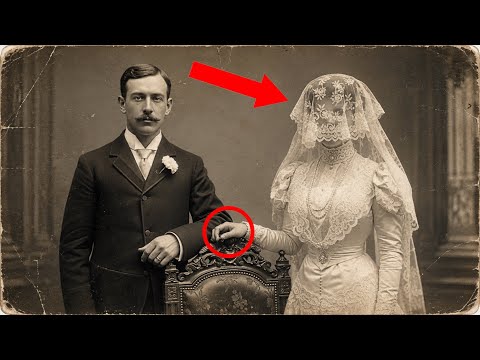
The bride sat rigid beside her groom, her white dress a masterpiece of Edwardian fashion—layers of silk, intricate lace, a high collar adorned with pearls. But her veil was unusually dense, heavy lace that cast deep shadows across her face. Most bridal portraits pulled the veil back to reveal the bride’s features clearly. This one hung forward, obscuring much of her face, creating an almost ghostly effect.
Clare positioned her magnifying lamp over the image. The quality was remarkable for its age. She could see individual pearls on the dress, the texture of the groom’s mustache, the grain of the wooden chair. But the bride’s face remained shadowed, mysterious. Something about the pose felt wrong. The bride’s hands clutched together in her lap with a tension that suggested anxiety rather than joy.
Two days later, Clare sat beside Marcus Reed in the digital imaging laboratory. Marcus had worked with historical photographs for twelve years, specializing in restoration and enhancement. He approached each photograph as a puzzle, teasing out information hidden by time, deterioration, or inadequate original exposure.
“This one’s in excellent condition structurally,” Marcus observed as the high-resolution scan appeared on his monitor. “But that veil is going to be challenging. It’s creating significant shadow across the subject’s face.”
Clare pulled her chair closer. “Can you work around it? I want to see her expression, her eyes. Something about this portrait feels off.”
Marcus’s fingers moved across his keyboard, applying initial adjustments. The image sharpened, contrast increased slightly. He zoomed into the bride’s face, filling the screen with the veiled features. The heavy lace created a complex pattern of light and shadow, but modern software could analyze and compensate for such obstacles.
“Let me try increasing shadow detail without overexposing the highlights,” Marcus said, adjusting multiple parameters simultaneously. “This will take a few minutes to process properly.”
The software worked its calculations, and gradually the bride’s face became clearer. The shape of her nose emerged, the line of her lips, the contours of her cheeks beneath the veil. Marcus continued refining the enhancement, bringing up midtones, clarifying details.
Then Clare saw it. “Marcus, stop right there.”
On the screen, now unmistakably visible, were streaks running down the bride’s cheeks. Not shadows from the veil, but actual moisture—tears captured in the moment the photograph was taken. The bride had been crying during her wedding portrait.
“That’s unusual,” Marcus said quietly. “Emotional brides weren’t uncommon, but photographers typically waited for composure before exposing the plate. These studios charged significant fees. Clients expected perfect images.”
“Can you enhance it further?” Clare’s voice was tense. “I want to see everything.”
Marcus applied additional filters, sharpening the focus even more. He adjusted the tonal curve, bringing out every possible detail in the shadowed areas beneath the veil. The bride’s face filled the screen, and now they could see not just tears, but her expression—eyes wide, jaw tight, every muscle in her face conveying distress.
And then Marcus saw something else. He zoomed in further, focusing on the area around the bride’s left eye, where the veil’s shadow was deepest. He increased the exposure, compensating for the darkness. The discoloration became visible gradually, but once they saw it, there was no mistaking what it was.
A bruise. Dark and substantial, spreading from the bride’s eye socket toward her temple.
The heavy veil hadn’t been a fashion choice or a stylistic decision. It had been a deliberate attempt to hide evidence of violence.
Clare and Marcus sat in silence, staring at the screen. The crying bride, the concealing veil, the hidden bruise. This was not a wedding portrait. It was documentation of something far darker.
“We need to identify these people,” Clare said finally. “I need to know who she was and what happened to her.”
The Lavo & Sun Portrait Studio had been one of New Orleans’ most prestigious photography establishments in the early 1900s, catering to wealthy Creole and American families in the French Quarter and Garden District. The business had closed in 1932, but its records had been preserved by the Louisiana Photography Archive, housed in a climate-controlled facility near Tulane University.
Clare contacted the archives director, Dr. Simone Bertrand, explaining what she had found. Simone had dedicated her career to preserving New Orleans’ photographic heritage and immediately understood the significance of Clare’s discovery.
“The Lavo sitting books are quite complete for that period,” Simone said when Clare arrived at the archive the next afternoon. “They were meticulous record-keepers. Every client, every session, payment details—even notes about special requests or difficulties during sittings.”
They located the ledger for 1904 and began searching through entries from the spring and summer months. Wedding portraits were marked with a small decorative symbol in the margin, a tradition the Lavo studio had maintained to distinguish these important commissions from ordinary sittings.
On June 18th, 1904, they found it. Wedding portrait, Miss Emily Devou and Mr. Robert Thornton. Four plates exposed, special sitting arrangement. $15 paid in advance by Devou family.
The price was substantial—more than double the usual rate for wedding portraits—and the notation special sitting arrangement was unusual. Clare had seen hundreds of entries in the ledger, and very few included such remarks.
“Emily Devou,” Clare repeated the name. “The Devou family was prominent in New Orleans society. I’ve seen the name in other collections. They owned sugar plantations upriver and had significant real estate holdings in the city.”
Simone was already pulling additional records. The Lavo studio kept a separate journal—more personal observations than the business ledger. The owner, Jean-Baptiste Lavo, was known for recording his thoughts about particularly memorable or difficult sessions.
“Let me see if there’s an entry for this date.”
The journal was smaller, leather-bound, filled with Jean-Baptiste’s flowing handwriting. Simone turned to June 1904 and found several entries. On June 19th—the day after the Devou-Thornton sitting—Jean-Baptiste had written extensively.
“Yesterday’s wedding portrait troubles my conscience still. The Devou family arrived with the bride at precisely ten o’clock as scheduled. Miss Emily was accompanied by her mother, Madame Celeste Devou, and the groom, Mr. Robert Thornton. Also present were Mr. Henri Devou, the bride’s father, and Mr. Thornton’s associate, whose name I did not catch, but whose presence seemed to make everyone uncomfortable.”
“The bride herself appeared unwell—pale, with reddened eyes suggesting recent tears. When I inquired whether we should postpone the sitting to allow her to compose herself, Madame Devou intervened sharply, insisting we proceed immediately. The bride said nothing, simply stared at the floor.”
“Most disturbing was the veil. Madame Devou had brought it herself—an unusually heavy piece, far denser than customary bridal veils. She insisted it be positioned forward, covering much of her daughter’s face. When I suggested this would obscure the bride’s features, the very purpose of a wedding portrait, Madame Devou became agitated, stating the veil was essential and must remain as positioned.”
Clare felt her chest tighten as she read on.
“I positioned the couple as requested. Mr. Thornton standing, the bride seated, the heavy veil arranged to cast maximum shadow. Through my lens, I could see the bride trembling—not the nervous excitement of a young woman on her wedding day, but fear. Unmistakable, profound fear. Mr. Thornton kept his hand on her shoulder throughout the sitting, firmly, possessively. When I asked the bride to turn her head slightly to improve the composition, his grip visibly tightened, and she flinched. He smiled at me—a cold, practiced smile—and said his bride was simply overwhelmed by the momentousness of the occasion.”
“I exposed four plates, though I knew even one would have sufficed. I wanted the family gone. The atmosphere in my studio felt poisonous. Wrong. As they prepared to leave, the bride looked at me directly for the first time. Even through that cursed veil, I could see her eyes, and what I saw there haunts me. She was pleading—silently, desperately pleading for help. But what could I do? The marriage contract was legal. The family is in agreement. A photographer does not interfere in the private affairs of wealthy clients. And yet I find I cannot shake the feeling that I have participated in something terrible.”
“When Madame Devou returned three days later to collect the finished portraits, she examined them carefully, nodded with satisfaction, and paid the remainder due. She mentioned that her daughter and new son-in-law had already departed for an extended honeymoon abroad. She did not say where. I pray I am wrong. I pray that young woman finds happiness in her marriage, but I fear she will not.”
Clare and Simone sat in silence after finishing the entry. Jean-Baptiste Lavo had witnessed something deeply wrong, had documented it through his camera, and had been haunted by his inability to intervene.
“We need to find out what happened to Emily Devou after this photograph,” Clare said. “Marriage records, society announcements—anything that tells us where she went and whether she survived.”
Simone was already making notes. The Devou family would have been prominent in social circles. The Times-Picayune and the Daily States both covered high society events extensively. If there were announcements about the wedding or the couple’s subsequent activities, they would have been reported.
But Clare was thinking about Jean-Baptiste’s final observation. The couple had departed for an extended honeymoon abroad, destination unknown. In 1904, abroad could mean anywhere. Europe, South America, even Asia. Tracking someone who had left the country with no specified destination would be nearly impossible—unless something had happened to bring them back into public record. A death, a scandal, a legal matter that required documentation.
Clare needed to search not just for happy announcements of a successful marriage, but for any trace of Emily Devou Thornton in the years following that terrible wedding photograph.
“I’ll start with the newspapers,” Clare said. “Marriage announcements first, then any subsequent mentions of either the Devou or Thornton families. There has to be something. People this wealthy don’t just disappear.”
But even as she said it, Clare felt a chill. In 1904, a married woman effectively became her husband’s property. If Robert Thornton wanted his wife to disappear—if he wanted to take her far from family and witnesses—the law would have been entirely on his side. And that heavy veil hiding tears and bruises suggested that was exactly what he had intended.
The Times-Picayune archives yielded a brief announcement: Emily Devou, daughter of Mr. and Mrs. Henri Devou, married Robert Harrison Thornton of Boston on June 17, 1904. The couple would reside abroad. No further mention of Emily appeared in New Orleans society pages.
Clare widened her search. A ship manifest from July 1904 listed Mr. and Mrs. R.H. Thornton bound for Liverpool. Then, in a Paris society column from October 1904, a fleeting note: the Thorntons at a reception hosted by a French banking family. After that, silence.
Months later, a London genealogist responded to Clare’s forum query with a death certificate from Nice, dated January 1906. Emily Thornton, age 22, died from an accidental fall from a villa balcony. The informant was her husband.
Clare’s hands trembled. She contacted the New Orleans police cold-case unit, and Detective James Rousso uncovered the pattern: Thornton married four wealthy women between 1904 and 1916. All died in apparent accidents. He died in the 1918 influenza pandemic, never prosecuted.
Clare curated an exhibition, Hidden in Plain Sight, displaying Emily’s portrait beside a photograph of her at fourteen, smiling. Descendants of all four victims attended, sharing stories long silenced.
As Clare stood before the wedding portrait, she whispered, “You left evidence. We finally saw it.”
What other stories remain hidden in the shadows of old photographs, waiting for someone to look closer?
Report this article
Select a reason for reporting:






