Evan didn’t plan on stopping at the shelter that afternoon. The weather had turned gray and tired, the kind of rainy shift that makes everything outside look as worn out as you feel. He was driving home from work, radio low, mind somewhere else entirely, when he passed the wooden sign near the road: Adoption Event Today. Normally, he kept driving. That day, he didn’t.
Maybe it was the house. Too quiet lately. After twelve years with Riley, his shepherd, silence didn’t feel peaceful anymore—it felt wrong. Six months gone, and every morning Evan still caught himself checking the kitchen floor before walking, so he wouldn’t step on a dog that wasn’t there.
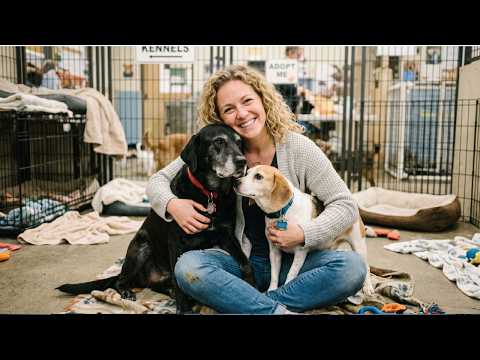
The shelter was small, older building, faded paint, volunteers rushing to keep dogs calm while families wandered kennel to kennel saying the same things. “He’s cute.” “She’s too big.” “How old is this one?” The puppies got all the attention up front. The older ones sat farther back, barely glanced at. Same pattern everywhere: energy gets adopted first. Quiet gets forgotten.
Evan was halfway to the exit when he heard it—a bark. Loud, not aggressive, desperate. The sound stopped him cold because it didn’t sound like a dog trying to scare people away. It sounded like a dog trying very hard not to disappear.
A volunteer noticed him turn. “You can go back there if you want,” she said gently. “Those are our longer stays.” Longer stays. That phrase always means the same thing: the dogs nobody picked.
He nodded and followed the hallway toward the older kennels, where the building got quieter—not calmer, just quieter in a heavy kind of way. That’s where he saw Walter.
Walter was enormous, old Saint Bernard mix maybe. Thick fur gone uneven around his hips, gray spreading through his face. One ear bent halfway down permanently, like it had healed wrong years ago. But it was his posture that hit Evan first. The dog wasn’t barking anymore. He sat completely still at the front of the kennel, like he’d already used up all his energy trying to matter to people earlier in the day.
A small card hung beside the gate: Walter, 11 years old, owner surrender, good with people, needs joint medicine. Evan crouched slightly. Walter stood immediately—slowly, but immediately. The dog’s tail gave one careful wag against the concrete wall. Not excited. Hopeful. Like he’d learned not to expect too much.
“That’s Walter,” the volunteer said quietly behind him. “He’s been here almost four months.” Four months for an older, large dog—that might as well be forever.
“What happened?” Evan asked. The volunteer hesitated the way shelter workers do when they’ve repeated the same story too many times. “Owner passed away. Family couldn’t keep him.”
Walter kept staring directly at Evan while she talked, not moving around, not pacing—just watching him with exhausted concentration. And then something happened that made Evan’s chest tighten unexpectedly. Walter leaned his entire body against the kennel door—not scratching, not jumping, just leaning—like he was tired of holding himself up alone.
Evan looked away for a second. That was usually the moment people left, the emotional part. Most visitors can handle seeing sad dogs right up until the dog starts feeling real.
“You can meet him if you want,” the volunteer offered. Evan nodded before thinking too hard about it.
A few minutes later, they brought Walter into a small visiting room with an old couch and faded blankets stacked in one corner. The second the leash came off, Walter walked directly to Evan and pressed his giant head into his chest. No hesitation, no circling first—just immediate trust. Evan laughed softly under his breath, even though something in him already felt dangerous about this.
“You barely know me,” he muttered. Walter sighed. Actually sighed. The volunteer smiled a little. “He does that when he settles down beside somebody.”
And for about two minutes, the situation felt simple. Older dog, lonely man, sad but manageable story.
Then Daisy ruined that completely.
She appeared in the doorway before Evan even noticed her—a smaller dog, brown and white, maybe some cattle dog mix. Thin in the way anxious dogs often are, because they burn through energy faster than they eat. One of the staff had accidentally left the hallway gate unlatched, and Daisy slipped into the room before anyone could stop her.
At first Evan thought she was just wandering. Then she walked straight to Walter—not to him, to Walter. The older dog immediately shifted toward her, not playful, protective. The change happened so fast it was almost strange. Walter positioned himself beside her while Daisy tucked herself partly underneath his chest, like she’d done it a hundred times before.
The volunteer froze. “Oh no,” she whispered under her breath.
“What?” Evan asked.
She rubbed her forehead tiredly. “They came in together.”
Evan looked between the dogs. “They’re bonded?”
“Not officially, but close enough.”
Daisy still hadn’t acknowledged Evan. She kept checking Walter constantly. Every movement he made, she reacted to it. If he shifted, she shifted. If he looked up, she looked up. Meanwhile, Walter kept gently nudging her back toward him anytime she drifted too far away. It didn’t feel trained. It felt necessary.
The volunteer crouched beside Daisy carefully. “She panics when he’s out of sight.”
“How long have they been together?”
“Since intake. Apparently animal control found them wandering near an abandoned property outside town after Walter’s owner died. Nobody knew where Daisy came from originally. She wasn’t chipped. No missing reports. Nothing. But once the shelter separated them, things got bad fast. Walter stopped eating. Daisy started shaking constantly.”
“They calm each other down,” the volunteer explained. “We tried adopting Walter out once already.”
Evan looked up. “What happened?”
The silence answered before she did. “He stopped functioning without her.”
That landed harder than Evan expected, because suddenly this wasn’t one sad dog anymore. It was two creatures holding each other together the best they could. Daisy finally glanced toward Evan for the first time then. Her eyes looked completely different from Walter’s. Walter looked tired. Daisy looked afraid. Like she expected every room to become temporary eventually.
Evan sat back slowly against the couch. “This is complicated,” he murmured. The volunteer gave a small exhausted laugh. “That’s pretty much their entire file.”
Outside, another family passed the hallway laughing about puppies. Inside the little room, Walter lowered himself carefully onto the floor beside Daisy with a groan from his hips. The smaller dog immediately curled against him so tightly it almost looked rehearsed. And Evan felt something shift in the room right then. Not excitement. Not certainty. Responsibility. Which is usually the real beginning of adoption stories people don’t talk about honestly enough. Because loving an animal in a shelter is easy. Taking home grief is different.
The volunteer sat down across from him. “You don’t have to decide anything today.” But that wasn’t entirely true anymore, because once you’ve seen something vulnerable depending on something else vulnerable, walking away starts feeling heavier than it did before.
Evan stayed another hour, then another, mostly talking with staff, learning routines, medication schedules, behavioral problems. Daisy had severe separation anxiety. Walter needed expensive joint treatment. Neither dog adjusted well to loud environments. Objectively, they were difficult. That’s the word shelters use when they’re trying not to say unlikely.
At one point, the volunteer asked gently, “Do you have other pets?”
“No.”
“Kids?”
“No.”
“That actually helps.”
Evan nodded absently while Walter slept beside his feet. Daisy wasn’t sleeping. She kept lifting her head every few minutes just to make sure Walter was still there. That part stayed with him—the checking. Like safety had become a job she couldn’t clock out from.
By evening, the shelter had emptied out almost completely. The puppies were gone. Three younger dogs had been adopted. Walter and Daisy were still there. Of course they were.
Evan stood near the front desk with his jacket half on while rain tapped against the windows outside. “You can think about it,” Linda told him. “No pressure.” But then Walter barked once from the hallway. Not loud, just enough. And Daisy started whining immediately after hearing him. Evan closed his eyes briefly. That was the exact moment he knew he was in trouble.
He signed the paperwork the following Tuesday, after three sleepless nights spent staring at his ceiling and telling himself he was being reckless. The woman at the front desk, Linda, kept looking up at him like she couldn’t decide whether to congratulate him or warn him.
“You know they’re a package deal,” she said for the third time, sliding the forms across the counter. “No take-backs on one and not the other.”
“I know.”
“And Walter’s medication is twice a day. Daisy will need patience. Real patience.”
“I know,” Evan said again, and something in his voice must have convinced her, because she finally stopped talking and just handed him the pen.
The first week was awful. Nobody says that part enough either. People like happy endings more than adjustment periods, but the truth was the dogs barely slept at first. Walter paced the house slowly at night because unfamiliar floors made his joints ache worse. Daisy followed him everywhere so closely she nearly tripped him twice going down the hallway.
Evan slept maybe three hours at a time. The house felt tense instead of comforting. Every sound startled somebody, and the dogs startled each other. Daisy panicked anytime Evan grabbed his keys. Walter refused to eat unless Daisy ate first. Daisy refused to go outside unless Walter went too. It was like bringing home two survivors still waiting for something bad to happen.
Around day four, Evan sat on the kitchen floor at two in the morning while Daisy shook beside the table after a thunderstorm rolled through. Walter stood beside her trying to lick her ears calmly despite barely being able to stay awake himself. And for the first time, Evan wondered if he’d made a mistake. Not because he didn’t care about them—because he did. Too quickly. That was the problem. He’d walked into the shelter wanting to help something lonely. He hadn’t realized loneliness comes home with you for a while.
The next morning, he almost called the shelter. Not to return them. Just to ask if struggling this much was normal. Before he could, something small happened. Tiny, really.
Walter finished breakfast before Daisy did. And instead of waiting anxiously afterward like usual, he walked slowly into the living room and laid down near the couch. Trusting. For the first time since arriving, he wasn’t monitoring everything. Evan noticed immediately. Recovery in older rescue dogs rarely looks dramatic. Usually it’s microscopic. A slightly deeper sleep. A quieter reaction. Eating without checking the room every five seconds. Tiny things. But tiny things matter.
A few days later, Daisy climbed onto the couch beside Evan for exactly eleven seconds before hopping back down nervously. Progress. Another night, Walter fell asleep hard enough to snore. Progress.
The house started changing after that. Not quickly. Gradually. Like everyone inside it was learning each other’s shapes at the same time. Daisy stopped following Walter into every room eventually—not because she stopped loving him, but because she started believing he’d still be there when she came back. That difference matters more than people realize.
Walter improved too, though slower. Old dogs carry sadness differently. It settles deeper. Sometimes Evan would catch him standing silently in the hallway staring at nothing. Those moments always felt like Walter had wandered briefly into an old memory and forgotten where he was for a second. But then Daisy would trot over and bump his leg lightly, and Walter would come back.
One afternoon about a month after the adoption, Evan found both dogs asleep together near the back door with sunlight across the floorboards. Daisy was sprawled halfway over Walter’s front paws. Walter’s chin rested gently on her back. For some reason that scene hit harder than any emotional moment before it, because the room finally looked peaceful instead of temporary. That’s different. Temporary homes feel tense. Safe homes feel boring—and boring, honestly, is what healing usually looks like after enough time passes.
The real breakthrough happened by accident. Evan had to leave for two hours one Saturday, and normally departures triggered chaos for Daisy—crying, pacing, scratching doors. When he returned, the house was too quiet. His stomach dropped. He opened the door expecting destruction.
Instead, Walter was asleep by the couch while Daisy lay beside him calmly chewing a toy. Neither panicked. They just looked up, relieved, not terrified. They believed he was coming back now. Trust always sounds beautiful in stories. In real life, it usually arrives very quietly.
Weeks turned into months. Walter’s hips still hurt, Daisy still startled easily, but the house softened around all three of them. Near Christmas, Linda called to check in. “How are my problem children?” Evan smiled. “They’re weird.” She laughed. “That means they’re doing better.”
Walter lived two more good, slow years. When his body finally gave out, it happened gently at home, Daisy and Evan beside him the whole last afternoon. Afterward, Daisy searched for him less each day, until one night she simply slept closer to Evan instead.
He’d gone there thinking he was rescuing abandoned dogs. Really, three grieving creatures had taught each other how to stay. What’s the quietest act of trust you’ve ever witnessed?
Report this article
Select a reason for reporting:






