In the heart of World War II, as tanks rolled across Europe and cities burned under Nazi bombs, one country stood untouched—Sweden. But this wasn’t just luck. It was a high-stakes gamble with survival at its core. How did a small nation avoid the wrath of Adolf Hitler while surrounded by enemies? The answer is a tale of secrets, sacrifices, and one man’s promise that changed history.
As the German war machine devoured Denmark and Norway in a matter of hours, Sweden braced for the inevitable. Citizens received letters ordering them to arm themselves. Within days, over 300,000 soldiers stood ready. Yet, the invasion never came. Why? The truth is stranger than fiction.
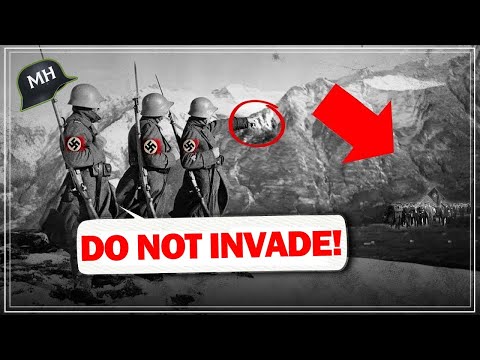
Sweden’s history is steeped in blood—from Viking raids to centuries of wars with neighbors. But by the 20th century, the nation had embraced neutrality. When Hitler rose to power, Sweden’s socialist government clung to that policy, terrified of provoking the Führer. They poured money into defense, but deep down, they knew they couldn’t withstand a German assault.
“We had no illusions. If Hitler wanted to invade, he would.” A Swedish officer later recalled. The government walked a tightrope, trading iron ore for survival and allowing German troops to transit through their land. It was a deal with the devil, but it kept the wolves at bay.
Then came the Winter War. When Stalin attacked Finland, Sweden abandoned neutrality to help their neighbors. 87,000 volunteers joined the fight, and Swedish weapons flowed east. But this act of defiance caught Hitler’s eye. The Nazi war machine turned its gaze north.
In 1940, Germany demanded access to Sweden’s telephone and telegraph networks. The Swedes agreed—but secretly tapped the lines, spying on their own allies. They passed intelligence to the Polish resistance, who smuggled it to Britain. It was a dangerous game, and Churchill wasn’t impressed. He blockaded Swedish ports, nearly strangling their economy.
Surrounded by enemies, Sweden had to choose: starve or collaborate. They chose the latter. In 1941, they allowed German soldiers to use their railways to invade the Soviet Union. The public was outraged, but the government insisted it was survival. “We did what we had to do,” a minister later said.
Yet, in the shadows, Sweden saved thousands. 50,000 Norwegians found refuge, and nearly all of Denmark’s Jews escaped the Holocaust through Swedish territory. It was a contradiction—collaboration and compassion, side by side.
So why didn’t Hitler invade? The answer lies with one man: Hermann Göring. The Luftwaffe commander had married a Swedish noblewoman and promised to protect her homeland. When Hitler planned an invasion, Göring threatened to resign. The Führer, unwilling to lose his right-hand man, relented. “Sweden’s neutrality was secured by a single promise,” a historian noted.
But was it that simple? Iron ore, strategic distractions, and Göring’s influence all played a part. The full story is more complex—and more shocking—than you might imagine.
To understand why Hitler truly backed down, you have to look beyond Göring’s romantic promise. The German war machine needed Swedish iron ore like a body needs blood. Every tank, every rifle, every bomb dropped on London was forged from ore mined in the north. “Without Sweden’s iron, the Reich would have bled out in months,” an economic advisor to Hitler later admitted.
And so a strange bargain was struck. Sweden would keep its independence, but it would feed the beast. Iron ore flowed south, German troops crossed Swedish rails, and the government in Stockholm looked the other way. Yet in the same breath, they opened their arms to refugees and fed intelligence to the Allies.
But the war was far from over, and Sweden’s tightrope would soon fray. By 1943, the tide had turned. Germany was losing on every front, and the Allies were closing in. Suddenly, the Swedes had a choice to make—keep playing both sides, or finally pick one.
It began with a whisper. British intelligence had intercepted German cables revealing that Sweden was still shipping ball bearings to the Reich—tiny metal spheres that kept Nazi aircraft and tanks running. Churchill was furious. He demanded Sweden cut the trade at once, or face consequences.
The Swedish government hesitated. Cutting off Germany meant risking invasion, but refusing the Allies meant economic ruin. “We are trapped between the hammer and the anvil,” the foreign minister wrote in his diary. The pressure was unbearable.
Then, in August 1943, the unthinkable happened. A Swedish diplomat in Berlin received a tip: Hitler had revived the invasion plans. The Swedish government panicked. They had weeks, maybe days, to act.
But instead of mobilizing, they reached for their most powerful weapon—diplomacy. They sent a secret envoy to Berlin with a single message: Sweden would cut iron shipments if Germany attacked. It was a bluff, and both sides knew it. But Hitler, already losing at Stalingrad, couldn’t afford another enemy.
The invasion was shelved. Again. But this time, Sweden knew the game was almost up. The war was shifting, and they had to shift with it.
In a desperate move, the government secretly approached the Allies. They offered to stop all trade with Germany, share their spy network, and even allow Allied planes to land on Swedish soil. It was a complete reversal—a last-ditch attempt to save their reputation.
But the Allies wanted more. They demanded Sweden close its borders to German troops and end the railway transit. The Swedes agreed. By 1944, the trains had stopped, the iron had slowed to a trickle, and the refugees kept coming.
Yet the damage was done. When the war ended in 1945, Churchill’s condemnation echoed across Europe. Sweden had survived, but at a cost. “Neutrality is a beautiful word,” a Swedish historian later wrote, “but it was paid for with silence.”
Today, the debate still rages. Was Sweden a coward, or a pragmatist? Did they save more lives by bending than by breaking? The answer, like the country itself, remains carefully, deliberately neutral.
The questions lingered long after the guns fell silent. In the decades that followed, declassified documents painted an even more tangled picture. Swedish intelligence hadn’t just tapped German phone lines—they had built an entire shadow network of informants across occupied Norway and Denmark. “We were neutral on paper,” one retired officer confessed in a 1962 interview, “but our ears were everywhere.”
Those ears caught something chilling in early 1942. German engineers were surveying rail lines near the Norwegian border, measuring bridges and testing load capacities. The Swedes knew exactly what that meant—a southern invasion route was being mapped. The government quietly reinforced the border with two divisions, never announcing why.
But the most damning revelations came from trade records. Sweden hadn’t merely sold iron ore to Germany; they had sold it on credit, allowing the Reich to defer payment until after the war. “It was a loan to a killer,” a British diplomat fumed in a 1946 memo. “And they expected to collect.”
Yet the same archives revealed something the Allies never publicized. In the winter of 1944, as German troops retreated from Finland, Swedish border guards quietly allowed thousands of Finnish civilians to cross into safety—not just refugees, but wounded soldiers and children. The operation was never officially authorized. Local commanders simply looked the other way.
One of those children, a girl named Aino, later became a nurse in Stockholm. In a 1989 oral history, she described the moment a Swedish guard handed her a cup of warm milk. “He said nothing. He just nodded and pointed south. That nod saved my life.”
The war ended, but Sweden’s reckoning was only beginning. In 1946, the government published a white paper defending its neutrality. It was a masterful piece of legal argument—and a masterful evasion. Not a single word mentioned the iron ore contracts or the railway transit. The public, eager to move on, accepted it.
But the Allies hadn’t forgotten. When Sweden applied to join the United Nations in 1946, the Soviet Union threatened a veto, citing Swedish collaboration. Behind closed doors, a deal was struck: Sweden would receive no punishment, but it would also receive no praise. “You survived,” a British delegate reportedly told his Swedish counterpart. “Don’t expect us to applaud.”
And so Sweden entered the Cold War as a nation with two faces—a champion of human rights abroad, and a keeper of uncomfortable silences at home. The debate over whether that was wisdom or cowardice would outlive everyone who had lived through it.
By the 1990s, the last of the wartime generation had grown old, and with them went the instinct to keep quiet. In 1997, a Swedish historian named Maria-Pia Boëthius published a book that tore the white paper to shreds. “We were not neutral,” she wrote. “We were complicit, and we called it survival.” The country erupted.
Newspapers ran dueling editorials. Schoolteachers rewrote their lessons. Ordinary Swedes, many of whom had never known the details, confronted a version of their grandparents they had never imagined. Some wept. Some denied. Some simply nodded, as if they had always suspected.
The government responded with a formal inquiry. Its 2002 report confirmed what the archives had hinted: the iron ore trade had been more extensive than admitted, and the railway transit had continued longer than the white paper claimed. “The line between neutrality and collaboration was never as clear as we told ourselves,” the report concluded.
Yet something else emerged from the reckoning—stories the old records had buried. A Swedish railway worker who had slowed trains carrying German troops by “forgetting” to switch tracks. A customs clerk who had quietly diverted iron shipments to Norway’s resistance. A diplomat who had stamped false visas for Jews long before the government officially allowed it.
None of them had been heroes in any public sense. They had simply done what they could, when they could, in a country that asked them not to. “We were not brave,” one of them said in a 1998 interview, weeks before his death. “We were just ashamed of doing nothing.”
Sweden never formally apologized for its wartime trade. But in 2000, the prime minister stood in parliament and said something that no predecessor had dared. “Our neutrality was not without cost, and not without guilt. We must remember both.” It was not an apology. It was something rarer—an admission.
Today, the iron mines still operate in the north. The ore still ships south, though now it goes to build bridges and hospitals, not tanks. And the debate still flickers, quieter now, whenever the world asks what a small nation owes its neighbors when the wolves are at the door.
So here is the question that remains, for you to answer: If you had been in Stockholm in 1941, would you have kept the trains running—or would you have risked everything to stop them? Let us know in the comments below.
Report this article
Select a reason for reporting:






