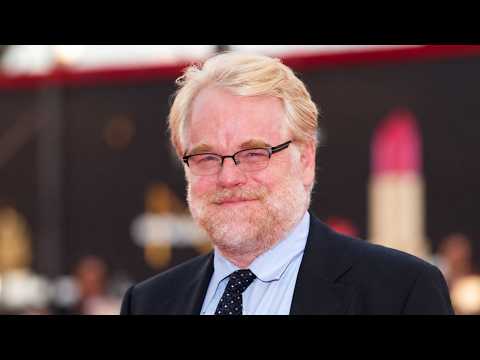
On the morning of February 2nd, 2014, Philip Seymour Hoffman was supposed to see his three children. He never showed up. His calls went unanswered. Friends were sent to check on him. Inside his Manhattan apartment, they found him dead in the bathroom—a needle still in his arm, heroin and prescription pills nearby. He was 46 years old.
The man lying there was not a forgotten star. He was an Oscar winner, a Broadway legend, a father of three, and a recovering addict who had stayed clean for 23 years. What made his death even more haunting was that Hoffman had stayed away from drugs for more than two decades. He had fought the battle and won—until he didn’t.
Philip Seymour Hoffman was born on July 23rd, 1967, in Fairport, New York, a suburb near Rochester. His father worked for Xerox. His mother, Marilyn, was the steady force in his early life—raising four children while continuing her own education, eventually becoming a lawyer and then a family court judge. When Philip was nine, his parents divorced, and the rhythm of family life changed. His father was no longer a daily presence. Marilyn took on most of the responsibility.
It was Marilyn who opened a door Philip could never have predicted would define his future: the theater. At around 12, he saw Arthur Miller’s All My Sons. The experience left a deep impression. But at that age, he was still a boy who loved baseball and wrestling. The stage might have remained a side interest—until a neck injury in his teens interrupted his path in sports. Unable to continue wrestling the same way, Philip turned to drama. What started as a substitute quickly became an obsession.
By the end of his teenage years, acting was no longer an alternative to sports. It was a calling. He was accepted into the Tisch School of the Arts at NYU, where he studied drama formally. New York placed him in a completely different environment—more competitive, more demanding. Hoffman did not have the appearance that immediately made people think of a leading man. Nor did he build himself around charm. What he developed instead was an approach based on observation, detail, and a willingness to enter uncomfortable emotions.
But his years in New York also brought a very different problem. Hoffman began drinking heavily and using drugs. He later acknowledged he had tried many different substances. While his acting ability was becoming increasingly refined, another struggle was quietly taking shape alongside it.
In 1989, Hoffman graduated from NYU. He was in his early 20s, with no name recognition, no stable income. But only about a year later, at 22, he realized his use of alcohol and drugs had gone too far. Hoffman checked himself into rehab and began the process of getting sober. That decision came before he had achieved anything major in Hollywood—before the Oscar, before Broadway, before the roles that would make audiences remember his face.
When he left treatment, Hoffman did not walk straight into success. He returned to New York and to a life that was still highly uncertain. Auditions, small roles, side jobs. But this time he entered the profession with a different level of focus. And before long, a small television role followed by a multi-round audition for an Al Pacino film would give him his first real opportunity.
That opportunity came in 1991 when Hoffman began appearing on screen with a role in Law & Order. Around the same time, he appeared in the independent film Triple Bogey on a Par Five Hole. Even his name had to be adjusted. Philip Hoffman began using his middle name, Seymour, professionally to avoid being confused with another actor of the same name. At the time, no one had any reason to think that the three words Philip Seymour Hoffman would eventually become one of the most respected names in American cinema.
Only a year later, an audition process that stretched across multiple rounds created the first real crack in that door. In 1992, Hoffman was called in to audition for Martin Brest’s Scent of a Woman. He had to return several times—reportedly around five auditions—before winning the role of George Willis Jr., a wealthy and arrogant student who appears alongside Al Pacino’s Frank Slade. Hoffman was not the center of the film, nor did he have scenes designed to turn him into a star, but he did something that would later become a familiar hallmark of his work. He appeared only briefly, yet made the character feel as though he had existed for a long time before the camera ever found him.
George required little explanation. His smugness, cowardice, and sense of privilege emerged almost immediately through the way Hoffman spoke, looked at others, and reacted. Scent of a Woman later became a major commercial success, grossing about $134 million worldwide, while Al Pacino won the Academy Award for Best Actor. For Hoffman, however, the more important reward lay elsewhere. He later reflected that without the film, the course of his career might have been completely different. After the role, he quit his day job and accepted a frightening decision for any young actor: to support himself entirely through acting.
That decision did not immediately lead to major roles. Over the next several years, Hoffman moved through a series of characters whose names most audiences at the time could easily forget after the credits rolled. Joey Breaker, My Boyfriend’s Back, Money for Nothing, The Getaway, When a Man Loves a Woman. In 1994, Nobody’s Fool placed him beside Paul Newman. But even sharing the screen with a legend did not yet make Hoffman a face capable of selling tickets. What was forming was much quieter. Casting directors began to recognize that he was especially useful for imperfect characters—men who made others uncomfortable, awkward people, figures carrying a kind of anxiety that did not need to be spoken aloud. Hollywood often wants young actors to discover their image as quickly as possible. Hoffman moved in the opposite direction. The more he worked, the harder it became to define what kind of actor Philip Seymour Hoffman actually was.
In 1996, two films opened two completely different doors. In Hard Eight, Hoffman appeared only very briefly as a loud gambler in a casino. The role was so small that for many actors it might have amounted to no more than a line on a resume. But behind the camera was Paul Thomas Anderson, a young director also at the beginning of his career. The meeting did not create immediate attention, but it laid the foundation for one of the most important collaborations of Hoffman’s life. That same year, he appeared in Twister as Dusty Davis, the loose, funny, high-energy member of the storm-chasing team. The film became one of the biggest blockbusters of the year, earning about $499 million worldwide. For the first time, millions of people around the world saw Hoffman on the big screen, but they still did not really know who they had just seen. Dusty was so playful that he was almost the opposite of the people Hoffman would bring to the screen only a short time later.
Paul Thomas Anderson called him back for Boogie Nights in 1997. And this time it was no longer just a few minutes at a casino table. Hoffman played Scotty J., a sound technician in the adult film industry—a man painfully lonely because of his feelings for Mark Wahlberg’s Dirk Diggler. Scotty could easily have become a comic figure. His awkward clothes, misplaced manner, and repeated attempts to impress, followed by failure, all gave an actor plenty of material to keep a distance and wink at the audience, as if to say he knew exactly how pathetic this man was. Hoffman did not do that. He walked directly into Scotty’s humiliation and made no attempt to protect himself from it. When the character is rejected and then sits in his car cursing himself, there is no layer of comedy left to shield the viewer. The discomfort of the scene is precisely what gives it its power. Hoffman accepted looking weak, foolish, and completely helpless—something an actor trying to build a star image would usually avoid. It was from this point that Hollywood began to look at him differently.
A year later, Hoffman proved that Scotty was no accident. In the Coen brothers’ The Big Lebowski, he turned Brandt, Jeffrey Lebowski’s stiff and excessively polite assistant, into one of the film’s most memorable supporting characters with only a handful of short scenes. The way Brandt laughs, stands, chooses his words, and struggles to preserve formality in absurd situations creates a kind of humor entirely different from Scotty’s. But that same year, Hoffman entered Todd Solondz’s Happiness and moved to the opposite extreme. Allen is a lonely, obsessive man whose behavior unsettles the audience. The film was already controversial for the way it examined sexuality, deviance, and unacceptable desires. Hoffman refused to make his character more pleasant in order to ask for sympathy. He did not stand outside Allen and judge him, nor did he try to defend him. That coldness of observation makes the performance difficult to watch, but difficult to forget.
Around the same time, Hoffman also appeared opposite Robin Williams in Patch Adams, a film heavily criticized by many reviewers but a major commercial success. In only a short period, he had moved from the Coen brothers to Todd Solondz and then to a mainstream studio comedy-drama without carrying the same Philip Seymour Hoffman from one film into the next. By 1999, that range had become even clearer. Paul Thomas Anderson brought him back for Magnolia. But this time, there was no trace of Scotty J. Hoffman played Phil Parma, a nurse caring for a dying man. In a film filled with anger, regret, and people breaking apart under the weight of their pasts, Phil is a rare, gentle presence. Hoffman needed no major transformation. Patience in his eyes and the way his character listens were enough to make Phil one of the emotional centers of the story. An actor who had once made audiences uncomfortable with desperation in Boogie Nights could now make them believe in kindness without giving a speech.
Then came The Talented Mr. Ripley. Hoffman had only a relatively limited amount of screen time as Freddy Miles, but Freddy entered the film as if his entire world had already existed beyond the frame. Wealthy, confident, contemptuous, and immediately suspicious of Matt Damon’s Tom Ripley, Freddy creates a threat that the other characters have not yet recognized. Hoffman does not explain the character or ask the audience to like him. Simply by the way Freddy looks around a room, speaks to Tom, or occupies space, he changes the temperature of a scene. The role brought Hoffman further critical attention and helped strengthen his reputation as an actor capable of turning a supporting character into a genuine force within a story.
That same year, Flawless placed him opposite Robert De Niro as Rusty, a drag performer. It was another kind of challenge because the character could easily have been pushed into caricature if built only around voice, clothing, or gesture. Joel Schumacher later noted how Hoffman continuously found new variations while filming, sometimes leaving even the director unsure what he would bring to the next take. That was an important part of Hoffman’s working method. He did not treat preparation as a process that ended before he arrived on set. The character continued to be explored even after the camera was rolling. The rhythm of a line could change. A gesture could be removed and an emotion that seemed already discovered could still be tested again from another direction.
By the end of the 1990s, audiences had seen him in too many forms for Hoffman to be easily placed under a single label. But the paradox remained. Serious directors had begun to know exactly who he was. Critics were paying increasing attention while the wider public often still recognized the face without remembering the name. And it was at that moment, as his career was moving toward another level, that Hoffman entered a relationship that began not on a red carpet or at a Hollywood party, but in the place that had always remained closer to him than fame itself—the New York stage.
It was on the New York stage that Hoffman met Mimi O’Donnell in 1999. She worked in costume design, and what began as an artistic connection gradually became a family. They never legally married, but they had three children—Cooper, Tallulah, and Willa—and remained together until his death. He told Mimi directly that he was a recovering addict and that his sobriety still had to be protected every day.
Then came Capote. Hoffman spent more than four months preparing, listening to recordings, adjusting his voice, posture, and breathing. He did not want audiences to see the effort. He wanted them to forget Philip Seymour Hoffman was there at all. On March 5th, 2006, he won the Academy Award for Best Actor. But instead of choosing safer roles, Hoffman immediately turned toward a major action franchise, playing the cold villain Owen Davian in Mission: Impossible III.
By 2012, he had reached two peaks at once—Death of a Salesman on Broadway and The Master on screen. But it was during this period of success that pressures began to accumulate. Around 2012, Hoffman asked Mimi what she would think if he started drinking again. To her, that was an alarming sign. At first, it was only a few drinks. Then prescription medication appeared. Then heroin.
He entered rehab in early 2013, but the problem did not resolve. Mimi eventually asked him to move out to protect the children. She remained by his side, but fear had become part of every day. Each time Hoffman walked out the door, she did not know whether he would come back.
On the evening of February 1st, 2014, Hoffman had dinner with friends in Greenwich Village. The next morning, he was supposed to see his children. He never showed up. The medical examiner ruled the death an accident—acute mixed drug intoxication involving heroin, cocaine, amphetamines, and benzodiazepines.
Broadway dimmed its marquee lights in his memory. Ethan Hawk offered perhaps the fairest perspective: If people remembered only that Hoffman died because of addiction, they would overlook the more than two decades during which he maintained sobriety and continued working, loving, raising children, acting, and living.
Philip Seymour Hoffman’s legacy does not lie in how completely he could transform himself for a role, but in the way he made even the most difficult people feel worth looking at for a little longer. Talent can make a person admired, but compassion is what allows us to see them more completely.
What do you think—should we remember Hoffman for the 23 years he fought and won, or for the one day he lost?
Report this article
Select a reason for reporting:






