In 1973, a low-budget film opened in neighborhood theaters on Chicago’s South Side—the same blocks where its story was set. It had no stars, no major studio backing, and no place in the downtown multiplexes. But audiences lined up. Word spread. And within weeks, the FBI made sure it vanished.
The film was The Spook Who Sat by the Door. It told the story of a Black man who infiltrates the CIA, absorbs everything the agency teaches—espionage, surveillance, guerrilla warfare, psychological manipulation—and then quits. He returns to Chicago, finds a street gang, and turns them into a revolutionary army.
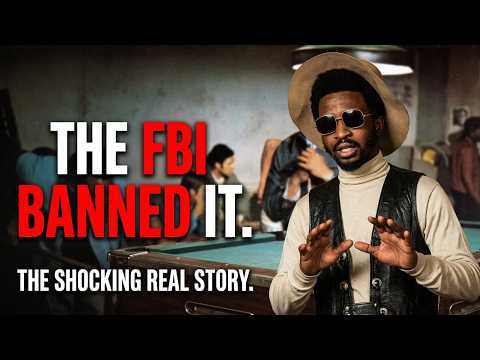
The FBI pressured United Artists to pull the film from circulation. The prints were recalled. For thirty years, it became a ghost—a movie people remembered seeing but could never find again.
But here is the detail that should stop you cold: at the very same time the FBI was erasing the film from public view, the FBI Academy at Quantico, Virginia, was using the novel it was based on as required reading for its trainees.
The same government that banned the movie was teaching the book to its own agents—not as fiction, but as a threat assessment. A blueprint for what a real Black operative might do if he turned against the government that trained him.
Start with the man who wrote it. Sam Greenlee was born in 1930 on Chicago’s South Side—the same streets the story would return to, in fiction and in reality. He was not a gangster or a hustler. He was educated, a graduate of the University of Wisconsin–Madison. And in 1957, he took a job with the United States Information Agency, handling American propaganda and public diplomacy overseas.
For eight years, Greenlee worked for the U.S. government. He was posted to Iraq, Pakistan, Indonesia, Greece. He represented America abroad. And the entire time, he watched how the government operated behind the curtain—the intelligence gathering, the manipulation of foreign governments, the training of political groups to serve American interests and then abandoning them when they were no longer useful.
And he was Black. Working inside a system that sent him overseas to represent American values while denying those same values to people who looked like him back home. The contradiction ate at him for eight years.
When he returned to Chicago, he carried a question that would become a novel: What if a Black man used everything the government taught him against the government that taught him?
In 1969, the novel was published. The Spook Who Sat by the Door. The title had a double meaning. Spook as a racial slur. Spook as slang for spy. And the man who sits by the door is the token Black agent placed near the entrance so visitors can see the agency has integrated—while the real work happens in rooms he is never invited into.
The character, Dan Freeman, plays the game. He sits by the door for five years. He absorbs everything. Then he walks out, goes home to Chicago, finds a street gang called the Cobras, and turns them into something the United States government has never faced: a Black guerrilla army trained with CIA methods, operating in American cities.
The novel was dynamite. Critics called it part thriller, part satire, part social commentary. Dozens of American publishers rejected it before a British house picked it up. When it finally reached America, it sold. The neighborhoods devoured it. And the FBI immediately understood what it had on its hands.
In 1973, the film version arrived—directed by Ivan Dixon, co-written and co-produced by Greenlee himself, shot on a small budget on the actual Chicago streets the story describes. The FBI’s reaction was swift and documented. The film was pulled from theaters. United Artists removed it under pressure. The prints vanished.
For three decades, The Spook Who Sat by the Door existed as a rumor, a cult legend, a film people insisted they saw but could not find a copy of anywhere.
And at the FBI Academy in Quantico, the novel sat on a reading list. Aubrey Lewis, one of the first Black FBI agents recruited in 1962, told Greenlee directly that his book was required reading for FBI trainees. The same government banning the movie with one hand, studying the book with the other—because the FBI understood something most Americans did not. The novel was not just a story. It was a manual.
And the street gang in the book, the Cobras, was not fictional. The Cobras were the Blackstone Rangers. And the Blackstone Rangers were very, very real.
The South Side of Chicago, early 1960s. A teenager named Jeff Fort is growing up in the Woodlawn neighborhood. He is small, not physically imposing, and did not finish grade school. By every measure the system uses to assess a young Black man’s potential, Jeff Fort is invisible.
But Fort has something no test can measure. He can organize. He can lead. He can walk into a room full of angry, directionless young men and give them structure, purpose, and a name.
In the early ’60s, Fort co-founds a street organization called the Blackstone Rangers, named after Blackstone Avenue on the South Side. What starts as a neighborhood crew grows into something Chicago has never seen. By the late 1960s, the Blackstone Rangers have an estimated 50,000 members.
50,000. That is not a gang. That is a small army. Spread across the South Side, organized into smaller units, each with its own leadership, all answering to Jeff Fort.
And here is where the story first crosses the line between street crime and something the government has to take seriously. In the late ’60s, the federal government is pouring money into anti-poverty programs—Lyndon Johnson’s Great Society, the War on Poverty. And someone in Washington makes a decision that will become one of the most controversial grants in the history of American social programs.
They give Jeff Fort’s Blackstone Rangers $1 million in federal anti-poverty funds from the Office of Economic Opportunity to run job training programs on the South Side of Chicago. A street gang receiving government money to train young men for employment.
The money does not go to job training. Senator John McClellan’s congressional investigation later reveals that the funds are used to strengthen the gang’s infrastructure. The jobs program is a front. The government has handed a million dollars to a street organization and received nothing in return except a stronger, better-funded street organization.
Fort is convicted of misusing the federal funds. He goes to prison. He comes out. But before the conviction, before the prison, one detail tells you exactly how far Jeff Fort’s reach has extended.
In 1969, Jeff Fort is invited to the presidential inauguration of Richard Nixon. The inauguration of the President of the United States. A street gang leader from the South Side of Chicago standing in Washington, D.C., watching the most powerful man in the world take the oath of office.
A million dollars in government money. An invitation to the inauguration. And the man receiving both is the leader of a 50,000-member street gang. That is 1969—the same year Sam Greenlee publishes The Spook Who Sat by the Door, a novel about a man who takes a Chicago street gang and gives it a political framework.
In the real world, the leader of the biggest Chicago street gang is already receiving government money and attending presidential events. The novel is not predicting the future. It is describing the present.
And then comes the transformation. In the late ’70s and early ’80s, Jeff Fort does something that tracks almost exactly with what Dan Freeman does in the novel. He converts to Islam. He changes his name. He becomes Prince Malik. And he renames the Blackstone Rangers.
They become the El Rukn Moorish Science Temple—the El Rukns—a street gang reborn as a religious organization with a new name, a new identity, a new framework that is no longer just criminal. It is political. It is spiritual. It is organized around a belief system that gives its members a sense of purpose beyond the corner.
The El Rukns take over a former movie theater on Drexel Boulevard on the South Side. They call it The Fort. It becomes their headquarters, their mosque, their command center. The theater marquee that once advertised films now displays the name of an organization the FBI considers one of the most dangerous in America.
And from inside The Fort, Jeff Fort runs the South Side. But Fort is not satisfied with Chicago. Jeff Fort has an ambition that goes beyond anything the FBI has ever seen from a domestic street organization. He wants international allies.
And he finds one.
Muammar Gaddafi, the leader of Libya, had positioned himself as the champion of anti-American movements worldwide—funding revolutionary groups across Africa, the Middle East, and Europe. By the mid-1980s, he was one of the most wanted figures in American foreign policy.
And Jeff Fort, from inside a federal prison cell—already serving time on earlier charges—reached out to Libya.
The negotiation, when the FBI finally uncovered it, was staggering in its ambition: two and a half million dollars from the Libyan government in exchange for the El Rukns carrying out operations against United States interests on American soil. A domestic street gang negotiating with a foreign government to carry out operations against their own country.
The FBI intercepted the plot. El Rukn members had actually traveled to Libya to meet with government officials. The organization had attempted to acquire military-grade equipment. The scope of the conspiracy was unlike anything the Bureau had ever encountered from a domestic organization.
In 1987, Jeff Fort and several El Rukn members were convicted—conspiracy to commit acts against the government in exchange for payment from a foreign power. Fort, already serving 75 years, received an additional 80. 155 years. The kind of sentence designed to ensure a man never sees daylight again.
Jeff Fort has been in federal custody since approximately 1972. Over 50 years. He is currently held at ADX Florence in Colorado, the most secure federal prison in the United States—the same facility that holds the most dangerous men in the federal system. He will never come out.
And the film that predicted what he would do was banned 11 years before he did it.
So sit with that chain for a moment. 1969: Sam Greenlee publishes a novel about a Black man who takes a Chicago street gang and turns it into a revolutionary force against the American government. 1973: The novel becomes a film. The FBI pulls it from theaters—while simultaneously making the novel required reading at Quantico.
1970s and 1980s: Jeff Fort, leader of the largest street gang in Chicago, converts to Islam, renames his organization, gives it a political and religious framework, and attempts to negotiate with a foreign government to carry out acts on American soil.
The novel describes a man turning a Chicago gang into a revolutionary army. Jeff Fort turns a Chicago gang into a revolutionary army. The novel’s gang is called the Cobras. Fort’s gang is the Blackstone Rangers—from the same South Side streets Greenlee wrote about. The novel’s character uses training and discipline to transform directionless young men into a coordinated force. Fort uses religion and structure to transform 50,000 gang members into an organization that negotiates with foreign heads of state.
The FBI banned the movie because they were afraid someone would copy it. Someone copied it. And banning the movie did not stop it—because the conditions that created the story were not fictional. They were real. They existed on the South Side of Chicago in 1969 when Greenlee published the novel, and they still existed in 1986 when Fort picked up the phone and called Libya.
Sam Greenlee did not invent a fantasy. He described what was already happening. He just put it on paper before it reached its conclusion. The FBI understood that. That is why they banned the film and studied the book. They knew the story was not fiction. It was a forecast. And Jeff Fort proved them right.
So what do you take from this story? Take the chain. A Black man who worked for the American government wrote a novel about using the government’s own tools against it. The FBI banned the movie and required the book. And a real man on the South Side of Chicago—who had already taken government money and attended a presidential inauguration—did exactly what the novel described.
The film was called The Spook Who Sat by the Door. It was pulled from theaters in 1973 and disappeared for 30 years. The man who made it real was called Jeff Fort. He has been in a cell for over 50 years and he will never leave.
And the question the novel asked in 1969—the question the FBI was afraid of, the question Jeff Fort answered in the worst possible way—is the same question that hangs over this story like smoke: What happens when the people you train decide to use what you taught them?
The FBI knew the answer. They banned the movie to keep it from spreading. It spread anyway.
But here is what still haunts me: the film was eventually re-released in 2004, restored and screened at Lincoln Center. Audiences lined up again—this time in the light. The FBI’s ban failed. The book survived. The story spread. So what does that tell us about the difference between erasing a film and erasing an idea? Have you ever seen a story that was supposed to stay hidden—and found it anyway?
Report this article
Select a reason for reporting:






