She was the fourth child in a family of nine, raised on a relentless diet of winning. But Kathleen “Kick” Kennedy was different. While her siblings dutifully followed the paths carved by their ambitious parents, Kick kept asking one question that no one in the Kennedy clan dared to: “Why?”
Born on February 20, 1920, in Brookline, Massachusetts, Kick grew up in the shadow of her brothers Joe Jr. and Jack—the golden trio her father believed would write the next chapter of American history. But Kick had a spark that couldn’t be tamed. She was the rebel, the one who laughed at rules, charmed everyone she met, and refused to let her life be scripted by anyone but herself.
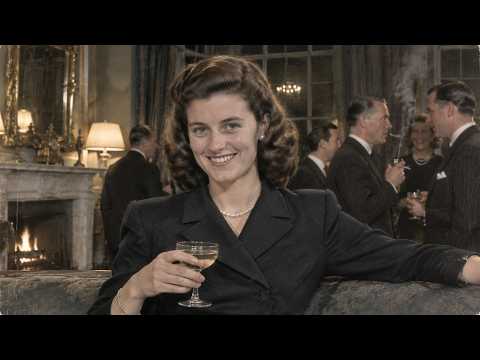
Her mother, Rose, ran the household like a military operation, keeping index cards on each child’s illnesses and religious milestones. But Kick slipped through the cracks. She was sent to convent schools, where her habit of questioning the nuns earned her the nickname “Mademoiselle Pourquoi”—Miss Why. She was beautiful, yes, but it was her spirit that captivated. As one friend recalled, “She enjoyed everything.”
When her father was appointed U.S. Ambassador to the Court of St. James’s in 1938, the family moved to London, and Kick was thrust into a world of debutante balls and aristocratic intrigue. She was eighteen, a Catholic girl from Boston among the dukes and earls of England. And she was an instant sensation.
It was at a weekend party at Cliveden, the opulent estate of the Astors, that she first locked eyes with Billy Hartington—the heir to the Duke of Devonshire, a shy, thoughtful Protestant from one of England’s most powerful families. He was everything her mother would forbid: not just non-Catholic, but a symbol of the very establishment that had oppressed her Irish ancestors.
But Kick didn’t care. She was drawn to his quiet strength, his gentle humor, and the way he listened to her as if she were the only person in the room. Their romance blossomed amid the glittering London season, against the backdrop of a world sliding toward war.
Rose Kennedy was horrified. She bombarded Kick with frantic telegrams, sent envoys to dissuade her, and even enlisted archbishops to convince her daughter to abandon the match. But Kick was resolute. “I’ve made my decision,” she told them. “I’m going to marry Billy.”
On May 6, 1944, in a bare register office in Chelsea, with only her brother Joe by her side, Kick became Lady Hartington. The ceremony lasted seven minutes. Her mother was in a hospital bed in Boston, too “ill” to discuss it. Her father sent a telegram: “You are first in my heart, and will always be.”
But the fairy tale was short-lived. Within weeks, Billy was sent to the front lines in France. And then came the news that would shatter her world: Billy was dead, killed by a sniper’s bullet in Belgium. Kick was a widow at twenty-four.
She retreated to her faith, but the wounds never fully healed. And yet, she refused to let grief define her. She stayed in England, threw herself into charity work, and became a fixture of post-war London society. But her heart was restless.
Then, in the summer of 1946, she met Peter Fitzwilliam—a married Protestant earl with a reputation as a womanizer and a gambler. He was everything her family would despise. But Kick saw something in him: a kindred spirit, a chance at happiness. Once again, she chose love over dynasty.
Her mother threatened to disown her. Her father, more pragmatic, considered seeking a papal dispensation. But Kick was determined. She and Peter planned to fly to Paris to seek her father’s blessing, then continue to the Riviera.
On May 13, 1948, they boarded a small plane in Croydon. The weather was stormy, but the pilot assured them it was safe. They took off anyway. Somewhere over the Rhône Valley, the plane encountered a violent squall. It broke apart in mid-air and crashed into a mountainside near the village of Saint-Bauzile. All four aboard were killed instantly.
Kick was twenty-eight years old.
Her father, waiting in Paris for their lunch, learned of the crash from a reporter. He sat down and wrote: “No one who knew her could feel that life was not better for the moment.”
She was buried in Edensor, on the edge of the Chatsworth estate, among the Cavendish dead. Her mother did not attend. Her brother Jack could not bring himself to come. Only her father stood by the grave.
The stone that marks her resting place bears a simple inscription: “Joy she gave, joy she has found.”
But the story of Kick Kennedy is not just one of tragedy. It is a story of a woman who dared to defy the expectations of her family, her faith, and her time—and paid the ultimate price. She was the rebel who chose love over dynasty, and her legacy remains a testament to the courage it takes to follow one’s heart.
Yet the silence that followed her death was not the end of the story. It was merely the beginning of a long, slow reckoning that would stretch across decades, shaping the lives of those who loved her and those who had tried to control her.
Rose Kennedy, the mother who had been too ill to attend her daughter’s wedding and too grief-stricken to attend her funeral, retreated into a stoic silence that would last for years. She never spoke of Kick publicly again. In her memoirs, she wrote only of her children’s triumphs, never of the one who had defied her. But those who knew her best said that the loss of Kick was a wound that never healed—a quiet, festering grief that she carried to her grave.
Jack Kennedy, the brother who had been too ill to stand beside her at her wedding and too heartbroken to stand beside her grave, carried his own guilt. He had been her confidant, her ally, the one who understood her rebellious spirit. In the years that followed, as he rose to the presidency, he kept a small photograph of Kick on his desk. He never spoke of her in public, but those close to him said that her death had changed him—made him more determined to live fully, to love deeply, to never let fear dictate his choices.
And then there was Peter Fitzwilliam’s wife, Olive, the woman he had been preparing to divorce. She had been the forgotten figure in the tragedy, the wronged wife who had watched her husband fall in love with another woman. After the crash, she retreated from society, raising their daughter alone. But she never spoke ill of Kick. In a rare interview years later, she said only: “He loved her. I cannot fault him for that.”
The press, which had hounded Kick in life, canonized her in death. Newspapers on both sides of the Atlantic ran glowing tributes, calling her a “martyr to love” and a “brave American girl.” But the truth was more complicated. Kick was not a martyr. She was a woman who had made choices—difficult, painful, sometimes reckless choices—and had lived with the consequences. She had loved two men, both of whom were forbidden to her, and she had lost them both. She had defied her family, her faith, and her country, and in the end, she had paid the ultimate price.
But her story did not end with her death. It lived on in the lives of those she had touched. Her father, Joseph Kennedy, never fully recovered from the loss. He had already lost his eldest son, Joe Jr., in the war, and now he had lost his beloved daughter. In the years that followed, he became more withdrawn, more bitter, more determined to see his remaining sons succeed. He poured his ambitions into Jack and Bobby, pushing them toward the White House with a ferocity that some said was fueled by grief.
Her sister Eunice, who had been shopping with Kick when the news of Billy’s death arrived, named her daughter Kathleen in her honor. Her brother Bobby named his eldest daughter Kathleen as well. The name became a quiet tribute, a way of keeping her memory alive in a family that rarely spoke of its losses.
And then, in 1963, Jack Kennedy made a pilgrimage to her grave. He was president now, the most powerful man in the world, but as he stood before the simple stone in Edensor, he was just a brother mourning a sister. He placed a wreath of flowers he had brought from Ireland and stood in silence for a long moment. Those who were with him said he wept.
Five months later, he too was dead, cut down by an assassin’s bullet in Dallas. The Kennedy family had lost another child, another sibling, another piece of its soul. And once again, the world watched as they mourned in public while suffering in private.
Rose Kennedy lived to be 104 years old. She outlived four of her nine children—Joe Jr., Kick, Jack, and Bobby. She never spoke publicly about Kick’s death, but in her final years, she reportedly kept a photograph of her rebellious daughter on her bedside table. Some say she prayed for her every night, asking for forgiveness for the silence that had stood between them.
The story of Kick Kennedy is not just a story of tragedy. It is a story of courage—the courage to defy expectations, to follow one’s heart, and to accept the consequences. She was a woman who refused to be defined by her family’s ambitions or her church’s rules. She chose her own path, even when it led her away from everything she had known.
And in the end, perhaps that is her greatest legacy: the reminder that love, however forbidden, however fleeting, is always worth the risk. That joy, however brief, is always worth the sorrow that follows. That a life lived on one’s own terms, however short, is always better than a life lived in someone else’s shadow.
Kick Kennedy was many things—a daughter, a sister, a wife, a widow, a rebel, a romantic. But above all, she was a woman who dared to ask “why” and then dared to answer it for herself. And for that, she will always be remembered.
For decades, the silence held. The Kennedy family archives kept their secrets, the Devonshires kept theirs, and the world knew only fragments of the truth. But history has a way of surfacing, like stones washing up on a shore long after the storm has passed.
In 1987, the full story of Rosemary—the sister Kick had tried to protect—finally became public, and with it came a new understanding of the family Kick had both loved and defied. The Kennedys were not just a dynasty of ambition; they were a family of secrets, of wounds carefully hidden beneath public smiles.
And Kick, the rebel, the one who asked “why” when no one else dared, became a symbol of something the family could never quite contain: the right to choose one’s own life, even when it costs everything.
Her grave in Edensor remains a quiet pilgrimage site. Visitors leave flowers, letters, and sometimes just a moment of silence. They come not because they knew her, but because they recognize something in her story—the universal struggle between duty and desire, between family and self.
“Joy she gave, joy she has found.” The words are simple, but they carry the weight of an entire life—a life that was brief, brilliant, and fiercely her own.
So what do you think? Was Kick Kennedy a rebel who paid the price for her freedom—or a daughter who never stopped hoping her family would finally bless her choices? Share your thoughts in the comments below, and subscribe to follow more hidden lives.
Report this article
Select a reason for reporting:






