On April 16, 1918, 300 feet beneath the main street of Hibbing, Minnesota, a timberman named Simon Martino raised his steel bar to test the roof of a freshly blasted tunnel. The roof pushed back. The bar struck something warm. In that instant, every lamp flame in the tunnel bent toward the rock, as if the entire mine had drawn a breath. For half a minute, the air held still, then rushed back over the men’s faces—warm and smelling of nothing at all. Something inside the iron ore had just taken a breath.
When the crew cleared away the broken rock, their lamps found a man. A man made of copper, forty feet long, lying curled on its side in a hollow in the ore, the way a man sleeps on a cold night. Its body was built of overlapping copper plates as large as doors, fastened with rivets the size of fists. Its eyes were two closed lids of plate. It had no mouth. It was as warm as a living body, and once every hour to the minute, its chest rose.
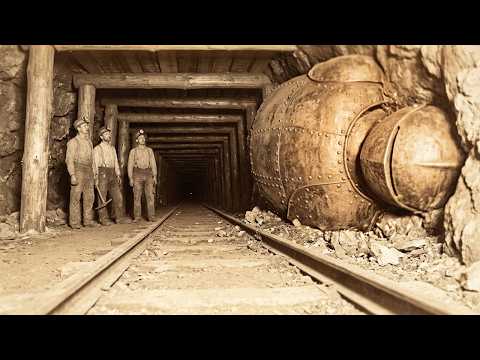
The miners called it the Sleeper. Within weeks, three things became plain to the men who worked beside it. Every time they blasted near it, it stirred. Every time it stirred, the ore around it came up richer than anything on the range. And every time it stirred, the streets of Hibbing, 300 feet above, sank a little lower. One young engineer measured that sinking for thirty-eight years, a thousandth of a foot at a time. His ledger shows a whole town going down whenever the Sleeper moved—and holding perfectly still for ten months in a year when nobody went near it.
The Ojibwe had a name for this ground long before any of it. Misabi Waju—big man lying down. The record begins with a map. The 1917 plat of the village of Hibbing shows a grid of about forty blocks on a low rise of land between the open pits. By 1918, about 15,000 people lived on that grid—Finns, Slovenes, Croatians, Italians, Swedes, Cornishmen, Greeks. The village called itself the richest in the world, and nearly every school and street lamp in it was paid for by taxes on the mines that surrounded it.
The map does not show who was there first. The Ojibwe had lived in the lake country of northern Minnesota for generations before the first survey party came through. In 1918, most Ojibwe families of the region lived on reservations at Fond du Lac, Net Lake, Vermillion Lake, and Leech Lake, and many of the men worked in the lumber camps and the mines. The long ridge that crosses the range from northeast to southwest had a name before the companies did. The name is printed on every map. Few of the men who worked under it knew what it meant.
More than half the iron ore mined in the United States came out of this one range, and the country had gone to war the year before. Every rifle barrel, shell casing, and ship plate began as ore. Washington asked for more steel, and then for more again. Most of the ore around Hibbing came out of open pits by then. Some still came out of the old underground mines, and the oldest of those was the Bert. It had shipped its first ore in the summer of 1895, and by 1918 it belonged to the Oliver Iron Mining Company, the arm of United States Steel that ran most of the range. Its shaft stood at the north edge of the village.
Misabi ore is soft. It lies in great flat beds of red and blue earth, and an underground mine on the Misabi did not so much cut through it as eat it from below—taking a slice, letting the ground above settle onto the timbers, then taking another slice beneath. The engineers called the method caving. Everyone knew what it did to the surface. Fields over the old mines sagged into long shallow bowls, and now and then a hole opened in a pasture overnight.
In the spring of 1918, the 300 level of the Bert was pushing a new tunnel south. Miners call a tunnel like that a drift. The company’s drill holes showed a tongue of rich ore running in under the village—under Pine Street—and the mine captain had promised Duluth he would find its edge by summer. At the end of each night shift, the crew charged the face with dynamite and fired it, and at seven the day shift came down to see what the round had broken. The south drift gained about seven feet a day.
The first man into the drift each morning was Simon Martino. He was fifty-eight, a timberman, the oldest man on the level. He was Ojibwe from the Fond du Lac reservation near Cloquet. A timberman sets the heavy posts and caps that keep a tunnel open, and the good ones can hear in a timber how much weight it is carrying. Simon tested everything with a long steel bar. His grandmother had raised him on the St. Louis River, and he still went home to Fond du Lac twice a year.
On the morning of April 16, 1918, the round had been fired at a quarter to six. The day shift rode the cage down at seven and walked south through air that stayed near fifty degrees in every season, past rock that sweated red water. When the smoke thinned, Simon went in with his bar and struck the new roof. He described it afterward to the engineer who wrote it down. Sound rock gives back a sharp, clean note. Loose rock answers with a dead thud. This was neither.
The bar sank a little into something that yielded and was warm like the flank of a horse in a cold barn. Then it was pressed back into his hands slowly—about the width of three fingers. In the same moment the air of the drift began to move. It came from behind the men and flowed past them toward the face, and every lamp flame on the level bent the same way and stayed bent half a minute perhaps. Then the pressure let go of the bar. The current turned and came back over them, warm and without any smell, and the drift went still.
For a while, nobody moved. Then the machine man, a Finn named Aino Salo, who had drilled the round the night before, scrambled up the muck pile to the ragged hole where the blast had punched through into open dark. He pushed his arm in to the shoulder. His hand met something smooth, and he kept it there, as if he were feeling for a heartbeat.
The others crowded up behind him with their lamps. Beyond the hole was a cavity in the ore body as big as a church nave, and most of it was taken up by one rounded mass of copper—red-gold sheets of plate lapped edge over edge and studded with rivets. It was the round of a shoulder, and it stood as big as a freight wagon.
A nipper was sent running for the cage. A nipper is the boy who carries tools and messages through a mine, and the nipper on the 300 level was Simon’s nephew, Thomas Martino—called Tommy—sixteen years old.
By noon the captain of the Bert had come down. Gideon Thea was fifty-four. He had started at thirteen pushing ore cars in Ishpeming. He wrote his orders in pencil on yellow forms and signed them with his initials, and he had eleven hundred men under him and a tonnage figure from Duluth that came in the end from Washington. His daughter Ruth, twenty-three, was an army nurse with a base hospital in France.
He wrote an order that no powder of any kind was to be fired in the hollow, and sent a telegram to Duluth for the company geologist. By evening there was an engineer underground with a steel tape, and nearly everything that is known about the next thirty-eight years comes from his field books.
Martin Aho was twenty-five, a junior engineer in the Hibbing office of the Oliver Company. He was born in Calumet, Michigan, the son of a Finnish copper miner, and had grown up in a town where copper was as ordinary as snow. He finished the school of mines at the University of Minnesota in 1916. He never erased anything. A wrong figure got one straight line through it and his initials beside it, and every day’s page ended with a double rule and the hour. His rodman, a fifteen-year-old named Arvid Lind, initialed every page, too.
For six days, with picks and bars and no powder, the crew cleared the broken ore out of the hollow. Then Martin measured what was in it three times over in sections. It was the figure of a man lying on its right side, knees drawn up, head bowed onto its chest. Straightened out, it would have been about forty feet long. The top of the shoulder stood more than eight feet above the floor.
It was sheathed in copper plates as big as doors. They overlapped from the crown of the head down toward the feet, the way slates are hung on a church roof, so that water would run off it. Their rivets marched in lines a draftsman could not have drawn straighter, each head a dome as big as a clenched fist. Martin started counting the rivets on one plate, reached sixty-four, and wrote that number down and no other.
The color troubled the older men first. It was the color of a new penny. In the Bert, every piece of metal rusted—a shovel left there over a Sunday came back orange, and copper wire went green. The figure carried no stain of any kind. It looked new. Martin, who had grown up with copper, wrote one short line and underlined it. Has not been exposed to air.
There was something else in that line, and he did not write it down until years later. If the ore had formed around the figure—and the hollow fitted it so closely that it seemed to have—then the figure was older than the ore. And Misabi ore is ancient. The geologists of the day measured its age in ages.
There was no nose and no mouth. Where eyes would be, two long lids lay shut, each beaten from one curved plate. The hands ended in broad flat paddles crossed by a single seam like a child’s mittens. Martin looked for any seam that opened, any fastening, any letter or numeral or maker’s mark, and found none. The right arm lay along the flank; the left was bent at the elbow and reached out and down over a bed of dark blue ore, the way a man asleep lets one arm hang off the side of the bed.
Martin wrapped the bulb of a mercury thermometer in his handkerchief and held it to a plate. The hollow itself was fifty-four degrees. The copper was ninety-eight—close to the warmth of a living man. He checked it at the end of the shift, and again the next day, and it had not changed. And it breathed once in each hour. The great chest swelled, perhaps six inches, for about thirty seconds, and the air of the entire 300 level streamed into the hollow to fill it. Then the chest sank, and the air streamed back out.
Martin’s watch put the gap between breaths at no less than fifty-nine minutes and no more than sixty-one. Tommy Martino did not need a watch. He had always known to the minute how long ago the last round had gone off. Now he could say when the next breath was coming, and he was not wrong by more than a minute.
They tested it the way miners test anything. Simon’s bar, swung with his whole weight, landed as dead as if it had hit a grain sack. A pick skated off a plate edge and left it bright and unmarked. A cold chisel under a four-pound hammer mushroomed and turned its edge. A hacksaw blade was stripped of its teeth before it had scored the surface.
Simon watched and said nothing. Then he walked once around the figure, tapping the rock of the hollow as he went, and stopped where the outstretched arm lay over the ore. A trammer saw him take a pinch of tobacco from his shirt pocket and set it on the rock beside the copper hand. For many Ojibwe people, tobacco is how something that matters is begun. It is set down as an offering before a prayer, a request, a journey, or the taking of anything from the land. The trammer thought the old man had dropped it.
Riding the cage up that evening, Martin asked Simon what he made of it. Simon said the name of the range, Misabi. Martin wrote the word in the margin three ways, with a question mark after each. Then Simon said one more thing, and Martin wrote that down as well. He is not sleeping. He is carrying.
Under the outstretched arm, at the very back, where the copper hand met the rock, there were the butts of old timbers—gray, hewn, and not sawn, flattened and split along the grain. Simon crouched and drew his thumb along one. “Tamarack,” he said, and went back to work.
No one examined those timbers that spring. No one would for eight years. That week the ore from under the arm went to the assay office. Ordinary Bert ore ran about fifty-two percent iron. This ran fifty-eight. Thea read the slip and wrote a second order on a yellow form. No man would strike the obstruction with steel again, but two new drifts would be driven, one along each side of the hollow at sixty feet, to get past it into the ore beyond. Nobody on the level thought it unreasonable. Ore was ore, and the war wanted all of it.
The East Side Drift fired its first round on the twenty-fifth of April as the day shift came off. Martin and Tommy had stayed in the hollow to close a survey, on the shift boss’s word that sixty feet of rock would swallow the shock. It did not.
The floor kicked under them, and a sheet of red dust slid off the roof. The figure had breathed only forty minutes before. Now it breathed again—a hard, short pull that sucked the flame off Tommy’s lamp. Then it shifted. The copper shoulder heaved and rolled away from them by the breadth of a hand, the way a sleeper turns his back on a light, and the plates rasped over one another with a long dry sound like a sled runner on crusted snow. Its next breath came early, nineteen minutes later. After that, it went back to its hour.
In the morning, the assay office sent down the figures for the ore beside the arm. Sixty-three percent iron. And when the miners opened that ground with picks, they found something nobody had ever seen on the Misabi—fine threads of pure red copper branching through the blue ore like frost ferns on a window. Misabi ore does not carry copper. The men who had come from the Michigan copper country turned the pieces in their lamplight and all said the same thing. This does not belong here.
Martin caught one more thing that week, and only because of a job nobody else had wanted. The summer before, the village had borrowed an engineer from the company to fix the exact height of its streets for new sewer lines, and Martin had set eighteen brass benchmarks. They were small brass plugs, each one sunk level into stone or concrete, each one stamped with a number, and recorded in his book to the thousandth of a foot above the sea. Number four was in the bottom step of the Arcade Hotel on Pine Street. Number eleven was in a bare ledge of dark greenstone at the far south end of the village, where nothing had been built.
That Saturday, running his weekly line of levels for the sewer work, he found benchmarks three, four, and five lower than the Saturday before. Eleven-thousandths of a foot—the thickness of a fingernail. He read each one three times, and Arvid Lind initialed the page. In the ten months since the discs were set, Pine Street had not moved a thousandth. From then on, he read the line every morning before work.
The geologist the telegram had summoned was Raymond Fairburn, forty-four, from the Oliver offices in Duluth. He held a theory that the rich Misabi ores had been made by water carrying the rock away and leaving the iron behind. He wanted—and would say so after a whiskey—one discovery with his name on it. In the middle of May, he asked for a sample. The company ought to know, he argued, whether this was native copper grown in place or copper shaped by hands.
Thea allowed one hole in the forearm with an air drill and a fresh bit. The drill was given to Aino Salo. He was thirty-four, from Ostrobothnia in Finland, and in 1916 he had walked out with the strikers when the whole range stopped work for three months. Afterward, the companies kept lists, and his name was on one. In 1917 he had come back to the Bert under his mother’s maiden name, Kangas, and the timekeeper wrote it down without looking up. He had a wife, Hilja, and a small son, and he wanted forty acres of cutover land near Toivola, and a cow, and never to go down a shaft again. He told the shift boss plainly he would rather not touch the arm. Then Fairburn asked a second time, and the shift boss stopped asking, and Aino set up the machine.
The bit, for the first time, the copper gave. A quarter of an inch of steel went into the forearm, and a bright ribbon of copper wound up out of the hole. Then the bit broke with a report like a rifle, and the snapped end whipped past Aino’s ear and rang off the wall behind him. Over the ore, the copper arm drew in—only slightly, the way fingers close on a banister.
The shift boss logged the broken bit at eight minutes before eleven in the morning. Martin Aho was on Pine Street at that minute, setting up his level in front of the First National Bank. At eight minutes before eleven, the plate glass of Pine Street split—every window at once—with one dry crack that Martin compared to lake ice under a skater. Nothing fell. What Martin saw, and nobody else on the street did, was the line. Each crack ran level across its pane from frame to frame, and when he walked the block with his rod, every one of them stood within an inch of the same height above the street. It was as if a single ruled line had been drawn through all of Pine Street.
Only that evening did he learn what had happened underground at the same minute. Fairburn had picked up the broken bit, with the ribbon of copper still wrapped around its edge, pronounced the sample spoiled by the steel, and tossed it aside. Martin went down, found it in the muck, and sealed the copper in a small corked medicine bottle. He kept that bottle thirty-eight years.
The next day, there was nothing to see where the bit had gone in. A rivet sat there instead—the same fist-sized dome as its neighbors, only newer and a little brighter.
By June, Martin had ruled a new table into the back of his ledger. Four columns: the time and size of each round, the time of the next breath, the assay of the ore beside the arm the following morning, the height of the Pine Street benchmarks the following morning. Read across, the rows said one thing. On days with no round within about 250 feet, the figure kept its hour, and Pine Street did not move. On days with a round, the breath came early, the shoulder shifted, the ore came up richer, and Pine Street came down. The heavier the round, the larger every number.
Beneath the table, he added a single line about the window glass. Damage to the body appears at the surface in the same minute. He kept the table to himself for a week. The assay column got out on its own. By the middle of June, ore from the side drifts was running sixty-five percent.
The table went to the district chief engineer, Lyall Brandt, and from Brandt to the captain. Thea ran his finger down the assay column, and then down it again. In July, Duluth asked for more ore again, and Thea answered it with a decision that shaped every year that followed. The firing near the figure would not stop. It would increase. He had a ring drift cut all the way around the hollow, sixty feet out, with stopes opening off the ring into the richer ground, and he had rounds fired on both sides of the hollow every shift.
Nobody put it into words on paper, but every man on the level understood. Before, they had fired around the Sleeper and accepted what it did. Now they were firing around it for what it did.
The pace that summer broke men. Aino Salo was drilling two rounds a shift. The crews came to know the Sleeper’s rhythm as well as their own pulse, and they fired the moment a breath had passed, which left them close to an hour to clear the broken ore and be gone before the next. That summer a card of rules hung on a nail at the mouth of the hollow, and Martin copied it into his fieldbook. No tool to be laid against the obstruction. Ring drift rounds to be fired only in the minute after the breathing. And a last rule added later in pencil. No figures concerning the obstruction to be sent to Duluth.
There was also the tobacco. Every morning before the first round, Simon walked into the hollow, stood by the outstretched hand for a moment, and set a pinch of tobacco on the rock. A Slovene shift boss began to keep track on the back of his time sheet. On the mornings when Simon had been in the hollow before the round, the Sleeper stirred less. On the two mornings that summer when Simon was home at Fond du Lac, the stirs were the worst of the season.
None of it could be proved, and Martin never put it in a report. But from August on, the Bert kept a can of plug tobacco on a shelf by the ring drift, and before every round one man went into the hollow and set a little of it down by the hand. Finns did it, and Italians, and Cornishmen who had never prayed to anything. Simon showed a young Croatian how to hold the tobacco in his left hand, nearest the heart, and to say what he was asking for before he set it down. What Simon himself said, he never told.
Three hundred feet under the richest village in the world, men from a dozen countries were laying tobacco by a copper hand, asking it to let them rob it in peace.
Tommy found the passage by lying down, stretched flat on the cool floor of the hollow. One afternoon he saw a gap between the copper arm and the rock, and beyond it a crawlway running back under the body, no higher than a man on all fours. He went in with his lamp. The floor had not been cut. It had been worn into two shallow troughs set exactly a knee’s width apart, polished the way a threshold is polished by generations of feet. It was the size of one person, and no bigger, and nothing was left in it. Thirty feet in, it stopped at a wall of crossed gray timbers, crushed flat. Thea had planks nailed across the gap, and a no-entry sign hung on them. The question of whose knees had made the troughs was not raised.
That same week, Martin added up his morning readings. Since April, benchmark number four, on the bottom step of the Arcade Hotel, had dropped seven hundredths of a foot—less than an inch. In all the years before, Pine Street had not moved a tenth as much.
At the end of August, he typed four pages titled Settlement of Village Benchmarks, April to August, 1918, with his table and a plan of the village. Its central sentence is plain. Every recorded settlement follows a round fired within 250 feet of the obstruction on the 300 level, and no settlement has been recorded on any other morning. He asked for sixty days without blasting near the hollow to see what the benchmarks would do. Brandt initialed the cover, filed it, and said nothing.
So Martin asked for the captain himself. On a Thursday evening in early September, he sat across from Thea in the mine office, and that night he wrote down what was said, the hour at the top, as if it were a survey. Thea’s first question was about the level. Martin said he tested it three times a week. Thea nodded and then gave his own accounting without heat. Eleven hundred men on his payroll, a village of fifteen thousand living off the mines, a war fought with steel, and a daughter in a hospital tent in France. Stop firing near the hollow, and the south drift went back to fifty-two percent. Duluth would want a reason. Give Duluth the real one, and Duluth would retire him with thanks and send a younger captain who would never open Mr. Aho’s report.
Seven hundredths of a foot. Thea said this village was built to be dug out from under. Martin answered that it was seven hundredths so far and gaining. Thea was silent. Then he asked for something Martin had not expected. The morning readings were to go on, and at the end of every month the figures were to come straight to him. Past Brandt. “I will look at every one,” he said. “That is the only promise I can make.”
Martin’s note of the meeting ends with two short lines. He did not contest any of my numbers. And under it: Nor I his.
In October, the influenza came up the railroad. Beds filled at the hospital, and then cots filled the lodge halls. When the armistice was announced on the eleventh of November, the whistles of every mine on the range went off together. In the same week, a letter reached Gideon Thea from France. His daughter had come through. Ruth came home the next summer and took a post at the Hibbing Hospital, where within two years a good share of her patients were men from the 300 level who could no longer stand up straight.
And that winter the village of Hibbing was told it would have to move. This part of the record is in every history of the range. In 1918, the Oliver Iron Mining Company proposed that the whole northern part of Hibbing—the part that stood over the richest ore—be moved two miles south to open ground beside the village of Alice. The company would buy the lots, move the houses, and build a new business street at its own expense. The village agreed. The reason given was the ore under the old town, and it was a true reason. The whole rust pit was already eating at the north edge of the village.
The engineering department drew the line. North of it, the company would buy. South of it, the village would stay where it was. Martin Aho helped stake the lots of the new town in the frozen swamp beside Alice. He copied the purchase line onto his own plan of the benchmarks and saw that it ran almost exactly where his readings stopped being small and started being large. The houses the company was buying were the houses that were sinking fastest. He did not know yet what shape the sinking made, but for years afterward people on the South Slope would say the company had drawn its line around something.
The move began in 1919. There are photographs of it. Houses jacked off their foundations, set on steel wheels or log rollers, and pulled south by steam crawlers and teams of horses. Hotels cut in half to fit the road. Between 1919 and 1921, about 185 houses and twenty business buildings went south.
One of them did not get far. On a morning in March of 1920, a two-floor frame house was on its rollers in the middle of Third Avenue when a round went off in the ring drift. The house stopped. The horses could not move it. The teamsters said the road under it had swelled like a back under a load. They waited. Exactly an hour later, the ground settled. The horses leaned into their collars, and the house rolled on.
The price of all that ore did not arrive as one bill. It came in small amounts from several directions, and each one could be explained. It came first in the men’s backs. Those who had worked the ring drift longest began to walk out of the cage bent. A stir underground left a man feeling as though someone had loaded a timber across his shoulders, and the feeling faded more slowly every time. The company surgeon wrote it up as strain.
Nobody had fired more rounds beside the Sleeper than Aino, and by 1920 he went about folded at the waist, as if he were forever climbing a steep hill with a pack and could not lift the drill. He asked to be the night watchman at the hollow, and the company let him. Whenever a round went off, he laid down tobacco by the copper hand, as Simon had taught him.
It came next in the houses south of the line. One of them was Hanhikoski’s. She was a Finnish widow in her forties. Her husband, Juho, a trammer in the Bert, had been killed by falling ground on the 200 level in 1913, and the company had paid her five hundred dollars. She had put it toward a narrow boarding house of three floors below Third Avenue, with a log sauna in the yard, fed nineteen borders at two sittings, and paid off the rest in five years. It was the only thing she had ever owned.
Along her street, the foundations opened. Hairline cracks became gaps, and the gaps widened through each winter. The village engineer blamed frost and badly packed fill, and on a range where the ground froze six feet deep, he had reason to. The worst of it fell on widows like Hanna, who had sunk their compensation into houses, because a house was the one thing that could not be spent.
Martin gave up persuading anyone. He measured instead. At six every morning before the office opened, he and Arvid Lind carried the level from the head of Pine Street down to the greenstone ledge and took three readings at every disc. When the influenza had him burning at 103, he still went, gripping the stair rails while Arvid carried the tripod. As the move swallowed the old discs, he set new ones beside them, and by the end there were more than sixty.
In the spring of 1921, the steel market fell apart and the Oliver Company closed the Bert. Through ten months, no round was fired on the 300 level. The pumps ran, a watchman kept his chair by the hollow, and in the dark the copper chest went on rising once an hour. Through all ten months, the benchmarks of Hibbing held. Morning after morning, the level read the same to the thousandth of a foot. On his graph paper, the lines went straight across the page without a tremor.
Martin’s second report said only that while the mine was idle, the village had stopped settling. The reply was a single sentence thanking Mr. Aho for his continued attention to the matter.
The Bert went back to work in the spring of 1922. The ring drift fired on a Tuesday afternoon. When Martin set up on the greenstone ledge on Wednesday morning, number eleven had dropped two hundredths of a foot.
Gideon Thea was pensioned in 1922 and moved to Duluth. He left his yellow order forms in the desk drawer for whoever came next. Nobody revoked his order, and before long nobody remembered it had been an order at all. The ore beside the Sleeper climbed to sixty-six percent, and the South Slope kept going down—by hundredths at first, and later by whole tenths.
In the spring of 1923, Simon Martino told his crew he was going home to Fond du Lac. Years later, Tommy told his daughter what his uncle had been taught as a boy on the St. Louis River, and she wrote it down. The long ridge was Misabi lying on his side. The land rested on him. Ojibwe people had gone to that country for the red earth they ground into paint, and they did not dig into the ridge without asking first, and they took little, and they did not go back often. A grandmother does not explain such a thing to a child as a theory. She tells it so that the child will know how to behave.
On his last afternoon in Hibbing, Simon took his bar up onto the South Slope and tapped the sidewalk with it, block by block, the way he had sounded every roof he ever stood under. The concrete answered him with a hollow boom, the note of a slab that has lost what was under it. At the greenstone ledge he set a pinch of tobacco beside benchmark number eleven, shook Martin’s hand, and walked to the depot. He died at Fond du Lac the next winter.
Hanhikoski’s boarding house went in January of 1924. Standing south of the purchase line, it had never been bought and never been moved. It was thirty-one below that night by the depot thermometer. The pit had fired a heavy shot at dusk, and the ring drift had fired twice since. Nineteen borders were finishing supper when the coffee in their cups went slanted.
A tearing started somewhere under the floor and would not stop. Hanna ran out onto the step and called up the hill, and men came running from the pool halls and the other boarding houses without their coats. Nobody gave orders. A chain of men formed on its own, from her door up the frozen steps to the street, and the house went up it hand to hand. Children first, bundled in quilts. Then mattresses and bed frames, crockery in a washtub, the sewing machine. Someone went back for the coffee boiler, still hot. Someone carried out the photograph of Juho from above the stove.
The whole time the house was creeping, and the gap between the step and the sill grew until the men at the door were jumping it. When the last man was out, Hanhikoski stood in the snow, holding her key, and watched the house leave its foundation. It slid perhaps forty feet, without hurry, came up against the next house down, and its walls buckled in with a groan of nails. The sauna was left standing alone in the yard. Its stones were still warm in the morning.
By then the ledger held eight years of numbers, every disc on its own page. Martin could have recited any one of them. What he had never done was join them, because no one had ever asked for that drawing.
On a Sunday in October of 1926, he made it. Every surveyor knows how to draw the shape of a hill—a line through all the points at one height, another through all the points at the next. That Sunday, Martin spread tracing linen over the village plan, old town and new together, and used the same method on a different quantity. Not how high the ground stood, but how far it had fallen. A ring around everything that had sunk a foot since 1918. A ring around everything that had sunk two feet. A ring for three.
By lamplight the rings met and joined, and what they enclosed was not a hillside or a hollow or a landslip. It was a figure curled on its side. Its head lay beneath the upper end of Pine Street. Its shoulder lay where the Arcade Hotel had stood. Its spine bent along the line of the old main street. Its knees tucked up beneath Third Avenue. One arm reached away down the South Slope and ended in a wide flat paddle of a hand. Hanhikoski’s boarding house had stood on the forearm. Benchmark number eleven lay under the palm.
Then he blew up his 1918 drawing of the copper figure to the scale of the town plan and slid it beneath the linen. One was about fourteen hundred feet from head to heel; the other, forty. The curve of the neck matched. The tuck of the knees matched. The angle of the reaching arm matched. And when he carried the bearings up from the mine survey to the surface, the arm underground and the arm on the linen ran on one compass line.
In the margin where he had once tried the word three ways, he wrote it a fourth time and underlined it. Misabi. Big man lying down. Beside it, he began a sentence about the village standing on its back, then struck it through with one line, as he struck through anything that was not a reading. Below it, he set down what could be defended. Settlement outline of village site corresponds in form and bearing to survey of obstruction, 300 level.
The next day, he went down to see the timbers that no one had looked at in eight years. Tommy Martino, twenty-four now and a shift boss himself, came with him and asked no questions. They pulled Thea’s planks off the gap and went in on their knees along the worn troughs. It took them half a shift with bars to work one of the crushed gray timbers out of the wall at the end.
Behind it was open space. They were looking into a much older mine—a low gallery, barely the height of a crouching man, chasing a seam of soft red earth. Its roof props were tamarack, shaped with a blade and not a saw. The wood scored with short, shallow cuts unlike any axe either of them knew. On the floor lay hammerstones of hard, dark rock, each ringed around the waist by a pecked channel where a handle had once been lashed. There were slender awls of beaten copper and a birch-bark container, a makak, flattened but still holding lumps of raw copper.
The posts had all snapped at the same height, and the caps lay ground into the floor along their grain. This was not a roof that had failed from one end and sagged. The whole ceiling had come straight down at once, like a press. Martin traced the line of flattened timber back toward the hollow, and it ran beneath the copper arm. The flat hand lay right on top of the old props, bearing them into the floor.
At the back of the hollow, where nobody had been able to reach, Tommy’s lamp found a second impression in the rock. It was smooth and curved and the same size as the figure, but it faced the opposite wall, as though the figure had once lain on its other side. Sometime long ago, it had rolled over. When it did, its arm had come down across the old gallery, and the ground above had come down with it.
Before they came up, Martin carried a line of levels from the shaft station to the crown of the copper shoulder—the same line he had run in April 1918. Since then, the shoulder had sunk three feet and nine-tenths. Up on the old street, the disc that replaced benchmark number four after the Arcade Hotel went south had sunk three feet and nine-tenths as well.
For eight years, the men had pictured the Sleeper resting on a bed of ore. Martin’s two equal numbers suggested another picture, and he wrote it down as a question, not as a finding. Was the ground resting on it? Were the rock and the streets and the houses bearing down on its back, the way a roof bears on a timber, so that every stir let the load sink a little further? And was the rich ore—the copper that grew through the iron like frost—something it gave off under strain?
Under the questions he copied out, without comment, what Simon Martino had said on the cage in the first week. He is not sleeping. He is carrying.
His third report kept the questions out. It gave the linen, the old working, the second hollow, the two equal drops, and one cautious sentence. The undersigned believes the obstruction may be bearing the ground above, and that further disturbance may cause the South Slope of the village to fail.
Five copies went out. The district office acknowledged receipt. New York sent nothing. The village council wrote that it appreciated Mr. Aho’s public spirit. Fairburn’s copy came back with three words in red pencil. Caving ground. Routine.
Fairburn’s answer deserves its full weight, because it is a strong one. Hibbing stood on a thin skin of glacial sand and clay over soft ore that had been mined from underneath for thirty years by a method meant to let the ground fall in. Open pits were blasting on every side. Frost reached six feet down and lifted every foundation on the range. Engineers who studied the range in later decades wrote that any one of these could sink a street, and all of them together could sink a town. They were right about every one. The 300 level appears nowhere in their reports.
In the spring of 1927, Martin took the train to Cloquet and walked out to Fond du Lac with the linen rolled in oilcloth. Simon had been dead three years. Simon’s older sister was still living, a widow in her seventies, and Tommy had written ahead to ask whether she would see him. She received him in her kitchen with a granddaughter to translate the parts she preferred to say in Ojibwe.
He unrolled the linen on her table and told her what it was. She looked at it for a long while without touching it. What she told him, he wrote down that night in the hotel at Cloquet, and the page is one of the few in his books with no figures on it. She said the ridge had always been Misabi, and that he lay on his side the length of the country, and that the land was on him. She said her grandmother’s people had gone up into that country for the red earth and had always asked before they dug, and filled in what they took, and gone home. She said the ones who did not ask had been taught something long before her time, and that she would not tell him what.
When he asked whether Misabi could be harmed, she said that was not the right question. He asked what the right question was. She told him to go home and keep measuring. He thanked her and left tobacco on her table, because Tommy had told him to. On the train back, he wrote one more line under the page. She did not seem surprised by the drawing.
In 1928, the village put up a new fire hall on the South Slope—brick, with a tall tower for drying hoses. The site chosen was the greenstone ledge at the end of the street, because nothing on that slope seemed firmer. The building went up directly over benchmark number eleven, which on Martin’s linen lay under the palm of the hand. He wrote to the council, asking them to choose another site. The council answered that this one had been picked for its solid rock.
All through the 1930s, the readings over the hand fell faster than any others on the linen. In the first week of February 1938, Martin’s plot showed him where the next big shift would land. He went to the fire chief, a Norwegian named Leo Branvold, and asked him to keep his pumper and his men out of the building at night. Branvold humored him, parked the pumper uphill, and bedded his night crew in the village hall. Then Martin walked the slope house by house with the linen under his arm. Most people heard him out and stayed. They had nowhere else that was theirs.
Three nights later, at twenty minutes to three in the morning, the South Slope woke to a sound people spent the rest of their lives trying to describe. Most settled on a loaded ore train being dragged sideways off its rails somewhere under their beds. The fire hall tore loose from the greenstone with a report heard across the village and began to travel. It did not topple. The hose tower stayed plumb as the building crossed the slope and the road beneath it and came to rest about a hundred and ninety feet from its footings. It flattened three houses on the way. Every family in them had gone up the hill that evening, and the engine bay was empty.
An inquiry followed. Its finding about Martin was that an employee of the company had frightened residents with predictions outside his duties. He was moved to the Oliver district office at Coleraine, twenty miles west, and given drafting work. On Sundays, he drove back and read his benchmarks anyway.
Tommy Martino was the only witness to what came last. In 1956, the Hull-Rust pit had grown to the edge of the old workings, and the company pulled the pumps out of the Bert to let the water take the levels. Tommy was fifty-four, the last shift boss the 300 level would have. On the final day, he went down alone, sat on the old powder box by the planks, and waited out the hour.
At the breath, he laid tobacco by the hand, the way his uncle had, and spoke a few words of his own that he kept to himself for the rest of his life. The chest rose, and the air of the level slid past him into the hollow. Then the chest began to fall and did not stop falling. Tommy said later: “The air went out of it for longer than a minute—one long, warm draft running away down the drift—and then nothing.”
He sat through two more hours without a breath. Then he put his palm on the copper shoulder where Aino Salo had put his on the first morning. It was as cold as the rock around it. Tommy went up, signed out in the time book, and wrote nothing else.
In Coleraine that same week, Martin took the corked bottle out of his desk drawer, as he did each Sunday. For thirty-eight years, the ribbon inside had stayed the color of a new penny. Now it was green—a deep, crusted green through and through, the color of copper that has stood in the weather for a lifetime. After 1956, his benchmarks hardly moved at all.
Gideon Thea died in Duluth in 1937. Raymond Fairburn’s theory of enrichment became a standard citation, and in 1950 he sent Martin a postcard with one sentence on it. Routine may have been the wrong word.
Aino Salo never straightened again. He got his forty acres at Toivola and his son farmed them. Arvid Lind became a county surveyor and kept the habit of initialing every page. Martin never rose to chief engineer. He retired in 1958 into a small house in the new town the company had built, and died there in 1974. The ledger, the sixty-one fieldbooks, and the corked bottle passed to his niece’s daughter in one box.
The old town is gone. What remains of its north end is a grid of curbs and lamp posts in the grass at the rim of the pit. The ledger cannot say who riveted the copper figure together, or in what age. It cannot say whose knees polished the troughs under its arm, or what the tamarack posts were holding up when the arm came down. The last entries say only that after 1956, the ground went quiet, and the copper in the bottle turned.
The Ojibwe named the ridge long before anyone dug into it. Big man lying down. The name went onto a railroad and a range and into every atlas of Minnesota, and almost nobody who said it knew what it meant. Martin Aho learned. His ledger closes with that name written in the margin, spelled the fourth way, underlined once.
If an old map of your own town holds a name nobody can explain, write it in the comments below—where is it, and what do you think it was trying to tell us?
Report this article
Select a reason for reporting:






