The sky over Schweinfurt, Germany, on October 14, 1943, was a graveyard. Sixty B-17 Flying Fortresses fell in flames, and 600 American airmen—sons, brothers, fathers—never came home. The Eighth Air Force was dying, and the Germans knew exactly why.
In November 1942, Luftwaffe ace Major Egon Mayer had discovered the B-17’s fatal weakness: its nose. Defended by only four machine guns, the cockpit was vulnerable to frontal assault. Mayer perfected the head-on attack, closing at 600 mph, guns blazing, pulling away at the last possible second. It required ice-cold nerves and perfect timing. One mistake meant mutual destruction, but it worked devastatingly well.
By December 1943, head-on attacks became the Luftwaffe’s preferred method. German fighters screamed toward American bombers in waves, cockpit to cockpit, guns hammering. Bomber crews watched death approach at closing speeds that defied comprehension. They had seconds to fire back before the enemy tore through their formation, leaving burning aircraft in his wake.
The mathematics were brutal. In the first 90 days of combat, 400% crew turnover. Most bomber crews didn’t survive their fifth mission. The required 25-mission tour was a statistical impossibility. One pilot calculated his odds: “Flying in the Eighth Air Force is like holding a ticket to a funeral, your own.”
By autumn 1943, the situation reached a breaking point. The Luftwaffe owned European skies. American fighters lacked the range to escort bombers deep into Germany. The enemy exploited this weakness mercilessly. Stuttgart, Schweinfurt, Regensburg—each name became synonymous with slaughter. Fighter pilots watched helplessly as bombers burned. They could only escort so far before fuel forced them to turn back, leaving the bombers naked to German attacks.
Hub Zemke, commanding the legendary 56th Fighter Group, knew his P-47 Thunderbolts were tough—7 tons of armor and eight .50-caliber machine guns—but they couldn’t be everywhere at once. Then on August 17, 1943, during the bloodbath over Schweinfurt and Regensburg, one captain in Zemke’s 63rd Fighter Squadron did something insane. He turned into the enemy’s head-on attack.
What Captain Walker “Bud” Mahurin didn’t know was that this split-second decision, this seemingly suicidal maneuver, would revolutionize American fighter tactics and turn the tide of the air war over Europe.
To understand the crisis, you must understand the enemy. The Luftwaffe pilots attacking American bombers in 1943 weren’t rookies. They were professionals—the best in the world. Many had been flying combat since 1936 in Spain. Some had 50 victories; others over 100. John Koma of the 390th Bomb Group remembered: “No matter the target they were defending, they were balls to the wall. They were brave. They didn’t hesitate.”
The B-17 Flying Fortress was supposed to be the answer. Ten crewmen, thirteen .50-caliber machine guns. The name promised invincibility. American strategic bombing theory held that mass formations of heavily armed bombers could defend themselves without fighter escort. The combined firepower would swat German fighters from the sky.
Theory met reality over Germany. Egon Mayer’s head-on tactic exposed the fatal flaw. The B-17’s nose, where pilots and bombardiers sat, had minimal defensive fire. German pilots exploited this weakness with clinical precision. They positioned themselves far ahead of bomber formations, then turned and attacked straight on. Closing speed: 600 mph. Time to aim and fire: 3 seconds. Margin for error: zero.
The attack required extraordinary skill. Miss the pull-away by half a second and you slammed into four tons of bomber at combined speeds exceeding 600 mph. But for aces like Mayer, the risk was worth it. By December 1943, head-on attacks became doctrine. German squadrons perfected the technique. They attacked in waves. One element broke away; another immediately rolled in for the next pass.
American bomber crews called it “getting the treatment.” First you saw them far ahead, specks against the blue. Then they grew rapidly—Fw 190s and Bf 109s in formation, nose cannons and machine guns flashing. The closing rate was so fast you couldn’t track individual aircraft. They were coming at you, not around you. Your forward guns hammered back, but the attacking fighters presented tiny targets. Tracers streaked past. Then impact. Cannon shells tore through aluminum. Windscreens shattered. Pilots slumped in their seats. Engines exploded. In seconds, a Flying Fortress became a falling coffin.
John Luckadoo of the 100th Bomb Group watched a German fighter bore straight into his formation. “They kept coming, kept coming. They may have killed the pilot of the lead ship, or else he was so determined he was going to take down a bomber that he flew into it, impacted the ship that I was formed on. When they went down, I had to dump my nose to keep them from taking me with them.”
The psychological toll was crushing. Men developed what flight surgeons called “flak happy” or “Focke-Wulf jitters.” Symptoms: insomnia, tremors, sudden rage, inability to concentrate, nightmares so vivid men woke screaming, weight loss, blurred vision. Some became catatonic. “We began to wonder if they were trying to kill all of us,” one survivor recalled. “There were fewer and fewer guys returning every day.”
American fighter pilots felt the weight of failure. The P-47 Thunderbolt, the “Jug,” was a beast—2,300 horsepower, eight .50-cals, built like a tank. But it had one critical limitation: range. With standard internal fuel, P-47s could only escort bombers 75 miles into German territory before turning back. Beyond that point, the bombers were alone, and that’s where the slaughter happened.
Hub Zemke drilled his 56th Fighter Group relentlessly. He developed the Zemke Fan spread formation for maximum flexibility. He preached aggressive tactics. But the fundamental problem remained: American fighters couldn’t engage the enemy at the critical moment. When German fighters massed for frontal attacks on bomber formations, the experts agreed: until long-range escort fighters arrived, losses would remain catastrophic.
Then Captain Walker Mahurin discovered something the experts missed. You don’t need more range if you make every second of combat count.
Walker Melville Mahurin was not the man anyone expected to change the war. Born December 5, 1918, in Benton Harbor, Michigan, and raised in Fort Wayne, Indiana, Bud Mahurin was an engineering student at Purdue University. When war broke out, he didn’t graduate. No advanced degree, no family military tradition—just an average kid who joined the Army Air Forces as an aviation cadet on September 29, 1941. He graduated pilot training on April 29, 1942. Adequate marks, nothing spectacular.
When he arrived in England with the 56th Fighter Group in January 1943, assigned to the 63rd Fighter Squadron, he was just another replacement captain. Hub Zemke barely noticed him. The 56th had bigger concerns: learning to fly the massive P-47 Thunderbolt in combat.
Mahurin’s first months were unremarkable. He flew escort missions. He followed doctrine. He stuck with the formation. He brought his airplane home safely. He scored zero victories.
Then came August 12, 1943. Mahurin made a rookie mistake that nearly ended his career. During a mission, he inched closer and closer to a B-24 Liberator bomber—showing off, perhaps, or just curious. He got too close. The bomber’s propwash caught his P-47, sucking him under its wing. When Mahurin tried to pull away, one of the B-24’s propellers shredded his tail and fuselage like paper. He bailed out. The B-24 had to crash-land.
Hub Zemke was furious. Mahurin was grounded, humiliated. His squadron mates avoided him. He was “that guy”—the one who almost killed a bomber crew through sheer stupidity.
But Mahurin used the grounding time differently than most washouts. He studied. He watched gun camera footage from returning pilots. He analyzed German attack patterns. And he noticed something that nobody else seemed to see.
When German fighters made their head-on passes at bombers, they were committed to their attack run. For those three critical seconds—from 1,000 yards to pull-away—they flew straight and level, guns blazing, completely focused on the bomber. They were vulnerable.
Every P-47 pilot knew the textbook response to enemy head-on attacks: break formation, dive away, extend, reset. Defensive tactics, survival tactics. But Mahurin saw it differently. What if you didn’t break away? What if you turned into the attack?
The geometry was simple but terrifying. If a German fighter committed to a head-on pass at a bomber, and an American fighter simultaneously committed to a head-on pass at the German, both aircraft closing at maximum speed, someone would blink first. The question was: who had more to lose?
The German was hunting bombers—high-value, slow-moving targets worth the risk. The American fighter? It was one-on-one, fighter versus fighter, at closing speeds exceeding 700 mph. Mahurin did the math. Three seconds at that closing rate, maybe 2,000 yards to aim and fire before pull-away. The first pilot to score hits wins. The first pilot to flinch dies. It was deflection shooting at speeds no training program ever simulated. It should be impossible.
On August 17, 1943, over Schweinfurt and Regensburg, Captain Bud Mahurin decided to find out if it worked.
Mahurin wasn’t even flying his own aircraft that day. His P-47 was down for maintenance, so he took a temporary replacement—P-47C-2-RE 41-6259, coded UN-V—normally flown by Captain Glenn Schultz. The fighter felt unfamiliar, strange, but it had eight .50-caliber machine guns and 425 rounds per gun. It would have to do.
The mission: escort B-17s bombing the ball-bearing factories at Schweinfurt and Regensburg. Every available bomber—376 Flying Fortresses. It was the deepest penetration into Germany yet attempted. Intelligence predicted heavy opposition. Intelligence was right.
The German fighters hit the formation at the Dutch border and didn’t stop. Wave after wave—Fw 190s, Bf 109s. Coordinated attacks from twelve o’clock high. Straight ahead, slightly above. Coming fast. Mahurin saw them positioning for the head-on pass. Standard Luftwaffe doctrine. Line up 2,000 yards ahead of the bombers. Commit to the run. Guns blazing. Pull away at the last second.
Every P-47 pilot knew what to do: maintain escort position, don’t break formation, protect the bombers. If a German got through, chase him down afterward. Mahurin did something different. He shoved the throttle forward and turned into the attacking fighter.
His wingman screamed over the radio. “Bud, what the hell are you doing?” No time to answer. The German Fw 190 was committed to his bomber attack. He didn’t see Mahurin coming until it was too late. The German’s nose was lined up on a B-17. His fingers were on the trigger. His mind was calculating the shot. Then eight .50-calibers opened up from his ten o’clock position.
Mahurin held the trigger down. The P-47 shuddered. Tracers arced across the sky. The deflection angle was insane—shooting at a target moving 400 mph while he moved 350 mph in a converging path. Physics and geometry compressed into two seconds of controlled violence. Hits. Pieces flew off the Fw 190’s wing. Smoke trailed. The German broke off the attack, rolling hard to escape.
Mahurin didn’t pursue. He was already scanning for the next threat. Another German fighter lining up on the bombers. Same tactic. Committed. Vulnerable. Mahurin turned into him. The P-47 shuddered again. More hits. This German wasn’t as lucky. His fighter exploded in a fireball at 25,000 feet. First confirmed kill.
Two minutes later, Mahurin intercepted another German fighter—a Bf 109 flown by Major Wilhelm-Friedrich Galland, Gruppenkommandeur of II./JG 26, brother of the famed Luftwaffe General Adolf Galland, an ace with 55 kills to his credit. Galland never saw Mahurin coming. He was lining up his attack on the bombers when eight .50-calibers tore his fighter apart. Galland bailed out. Captured, humiliated. Second confirmed kill.
When the 56th Fighter Group landed back at Halesworth that evening, Mahurin was swarmed by curious pilots. How did you get two kills? What did you do differently? He tried to explain the head-on tactic—the geometry, the timing, the deflection shooting. Most pilots shook their heads. “That’s insane,” one captain said. “You’ll kill yourself.”
Hub Zemke listened quietly from the back of the briefing room. He didn’t say a word, but he was thinking.
Two months later, on October 4, 1943, Mahurin shot down three Bf 110s in a single mission using his head-on tactic. He became an ace. By November 26, he downed three more 110s, damaged a fourth, and probably destroyed another—becoming the first American pilot in the European theater to reach ten confirmed victories.
His tactics were working, but not everyone was convinced. The confrontation happened on November 28, 1943, during a group briefing at Halesworth. Colonel Zemke stood at the front of the room, arms crossed, watching his pilots argue. For twenty minutes, they’d been debating Mahurin’s suicidal tactics. The room was divided.
“It’s luck,” Captain Robert Johnson insisted. Johnson was one of the 56th’s top aces, a survivor of dozens of missions. “Bud’s gotten away with it so far, but the math doesn’t lie. You turn into a German fighter at that closing speed, eventually you’re going to collide. Or he’ll get his shots off first and tear you apart.”
“Or,” Mahurin countered calmly, “the German blinks first because he’s not expecting it. His mind is locked on the bomber. He’s committed to that attack run. When I come at him from an angle he’s not expecting, his brain has to reset. That split-second hesitation—that’s when I kill him.”
“You’re gambling with physics,” Johnson shot back. “Closing speed of 700 mph. You have two seconds to aim, fire, and pull away. Miss by half a second, and you’re a smear across the German’s windscreen.”
“Then don’t miss,” Mahurin said.
The room erupted. Pilots shouted over each other. Some supported Mahurin—his victory count spoke for itself. Others called him reckless. A cowboy. One captain pounded the table. “That kind of flying is going to get people killed.”
“People are already dying,” Mahurin snapped back. “Sixty bombers lost at Schweinfurt. Three hundred men gone in one day. When are we going to stop playing defense and start hunting these bastards?”
“Enough.” Hub Zemke’s voice cut through the chaos. The room fell silent. Zemke stepped forward. All eyes on him. The Wolfpack commander had led his group to over 100 confirmed kills. His tactical innovations—the Zemke Fan, aggressive pursuit, flexible formations—had saved countless lives. When Zemke spoke, people listened.
“Captain Mahurin,” Zemke said slowly, “your tactics violate every principle of fighter doctrine we’ve been taught. You’re supposed to maintain formation integrity, provide defensive escort, engage enemy fighters only when they threaten the bombers directly.”
Mahurin stood at attention. “Yes, sir.”
“You’re doing the opposite. You’re breaking formation, engaging offensively, taking insane deflection shots at closing speeds that should be impossible.”
“Yes, sir.”
“And you’ve shot down ten enemy aircraft in three months.”
Silence. Zemke let the number hang in the air. Ten confirmed kills. The 56th Fighter Group’s top scorer. All using tactics that the textbook said shouldn’t work.
“Sir,” Captain Johnson interjected, “with all due respect, just because it’s working for Captain Mahurin doesn’t mean it will work for everyone. He might have exceptional reflexes, exceptional aim—”
“Or,” Zemke interrupted, “he’s figured out something the rest of us haven’t.” He turned to Mahurin. “Walk me through it. Slow. Start to finish. I want to understand exactly what you’re doing.”
For the next hour, Mahurin explained the geometry of deflection shooting. The psychology of surprising the enemy. The critical importance of timing—too early and you miss, too late and you collide. The role of the P-47’s rugged construction, taking hits while dishing them out. Zemke listened, asked questions, challenged assumptions. Finally, he nodded.
“Gentlemen,” Zemke addressed the room, “effective immediately, Captain Mahurin will lead a special training program on offensive head-on tactics. Participation is voluntary. Those who want to learn, report to Mahurin at 0600 tomorrow. Those who don’t—that’s your choice. But understand this: the Germans have been killing us with head-on attacks for a year. It’s time we returned the favor.”
He looked directly at Johnson. “The German pilots are brave, professional, experienced. But they’re not gods. Captain Mahurin has proven they bleed just like everyone else. The question is, who among you has the guts to do the same?”
Training began at dawn. Mahurin handpicked twelve pilots willing to learn. They flew mock head-on passes against each other at gradually increasing speeds. The margin for error was razor-thin. Two pilots nearly collided during the first week. Hub Zemke personally observed every training flight, taking notes, refining the doctrine. By December 1943, the 56th Fighter Group had produced seven pilots proficient in offensive head-on attacks.
Mahurin continued leading by example. Between August 17, 1943, and March 8, 1944—a span of just over six months and dozens of missions—Captain Walker Mahurin destroyed 19.75 enemy aircraft. His specialty: head-on interception of German fighters attacking bomber formations. He damaged four more, probably destroyed three.
But the true measure of success wasn’t Mahurin’s personal score. It was the change in combat dynamics.
January 11, 1944. Mission to Brunswick. The 56th escorted B-17s deep into Germany. Luftwaffe fighters massed for the standard frontal assault on the bombers. But this time, five P-47s led by Mahurin broke formation and turned into the attack. The German fighters weren’t prepared. Their doctrine assumed American fighters would maintain defensive positions. When Mahurin’s element bore straight toward them, guns blazing, the Germans scattered. Three Fw 190s went down in flames. The bomber formation proceeded unmolested.
February 20, 1944. Big Week began—a coordinated campaign to destroy German aircraft production facilities. The Luftwaffe threw everything at the incoming bombers. Over 300 German fighters scrambled to intercept. Mahurin’s tactics had spread throughout the 56th. Multiple flights adopted offensive head-on tactics. The results were stunning. In one day, the 56th Fighter Group claimed 18 enemy fighters destroyed for only two P-47s lost. The kill ratio: 9:1.
The bomber crews noticed. One B-17 pilot radioed: “Thank God for those crazy Jug drivers. They just saved our asses.”
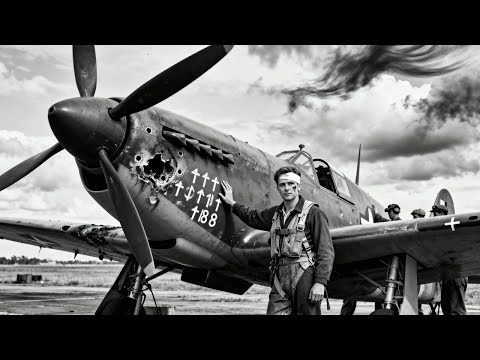
March 8, 1944, became Mahurin’s finest day. Escorting bombers to Berlin, he intercepted a formation of Fw 190s positioning for frontal attacks. In the span of twelve minutes, Mahurin destroyed three enemy fighters using pure head-on interception. His aircraft took multiple hits. Cannon shells punched through the wings. Shrapnel peppered the fuselage. But the P-47 kept flying.
When Mahurin landed at Halesworth, ground crews counted 27 bullet and shell holes in his aircraft. “Sir,” his crew chief said, “you can’t keep flying like this. One day your luck is going to run out.”
Mahurin shrugged. “Then I’d better make every mission count.”
His victory total reached 19, but the Germans were learning. Luftwaffe intelligence analyzed American fighter tactics and issued new guidance. American P-47 pilots were now engaging offensively during frontal attacks. German pilots were instructed to expect head-on interception and adjust accordingly. Combat became even more violent. Both sides now willing to fly straight toward mutual destruction, betting they’d score killing hits first.
The difference: American pilots in P-47 Thunderbolts could absorb more punishment. Flight Lieutenant Josef “Pips” Priller, a German ace with over 100 kills, later recalled the shift. “In late 1943, American fighters changed. They stopped running. They started hunting us. The P-47 pilots especially—they would fly through hell itself to get a shot. We had to respect that. It made our work much more difficult.”
Another German pilot, interviewed after the war, put it bluntly: “When the American fighters started attacking us head-on, we knew the tide had turned. They were using our own tactics against us, and their aircraft could take more hits than ours. It became a war of attrition we couldn’t win.”
The data supported this. In August 1943, before Mahurin developed his tactics, the 56th Fighter Group averaged 2.1 kills per mission with a kill ratio of 3:1. By March 1944, after widespread adoption of offensive head-on tactics, those numbers jumped to 4.7 kills per mission with a kill ratio of 7.5:1. Bomber losses declined dramatically in missions escorted by fighters employing Mahurin’s tactics. B-17 loss rates dropped from 12 percent to 4 percent. That’s real lives saved. Real families who got their sons and husbands back.
One bomber pilot, Captain James Howard of the 100th Bomb Group, later wrote in his diary: “I don’t know the name of the P-47 pilot who drove off those Fw 190s on March 5, but he saved my crew. We were dead if he hadn’t turned into them. The Germans scattered like scared rabbits when they saw him coming. That crazy bastard flew straight at them like it was a game of chicken. God bless him.”
March 27, 1944. Mission to Bordeaux, France. Mahurin intercepted a German Dornier Do 217 bomber attacking a straggling B-17. He destroyed the German bomber—his 21st kill. But the Dornier’s rear gunner scored hits on Mahurin’s P-47. Engine failing. Controls sluggish. Mahurin radioed: “I’m hit bad. Going down.” He bailed out at 8,000 feet over occupied France.
The parachute opened below him. German soldiers rushed toward his landing spot. Capture seemed certain. But Mahurin landed in a haystack. German soldiers searched within yards of his position. For three hours, he didn’t move, didn’t breathe. Finally, darkness fell. The Germans left. Mahurin crawled from the haystack and ran.
For five weeks, French Resistance fighters hid him. They moved him from safe house to safe house, always one step ahead of the Gestapo. He witnessed the courage of ordinary French citizens risking their lives to save an American pilot they’d never met. On the night of May 6-7, 1944, an RAF Westland Lysander—a small, unarmed reconnaissance plane—landed in a moonlit field in occupied France. Mahurin sprinted across the field. The Lysander took off under German fire, tracers arcing through the night sky. They made it.
When Mahurin landed in England, he expected to return to combat. Instead, he was grounded permanently. Intelligence feared that if he was captured again, torture might force him to reveal the French Resistance networks that saved his life. His war in Europe was over.
Walker “Bud” Mahurin finished World War II with 20.75 confirmed aerial victories in Europe, plus one more in the Pacific theater flying P-51 Mustangs—21 total kills across two theaters. He was the first American pilot to become a double ace in Europe, the sixth-highest P-47 ace of the war. But the numbers don’t tell the full story. By war’s end, offensive head-on fighter tactics pioneered by Mahurin became standard doctrine throughout the Eighth Air Force. Fighter groups across multiple theaters adopted variations of his techniques. Training programs added offensive head-on interception to the curriculum. Gun camera footage of Mahurin’s attacks was studied at fighter schools.
The 56th Fighter Group—Zemke’s Wolfpack—ended the war with 665.5 aerial victories, the highest-scoring fighter group in the Eighth Air Force. Over 100 kills more than the second-place group. The bomber crews remembered.
After the war, at a veterans reunion in 1947, an elderly B-17 pilot approached Mahurin. The man’s voice shook. “I flew 30 missions over Germany. On my seventh mission, February 20, 1944, I watched your P-47s turn into the Germans when they were lining up on us. You saved my crew that day. Because of you, we came home. Because of you, I got to meet my grandson. Thank you.”
Mahurin didn’t know what to say. He never thought of himself as a hero—just a pilot doing his job.
But the Germans remembered, too. Josef Priller wrote in his post-war memoir: “The American pilot who changed the air war was a P-47 driver from the 56th Fighter Group. I never learned his name, but I remember his tactics. He turned our own weapon against us. The head-on attack, which we had perfected against bombers, became our greatest vulnerability when he used it against fighters. It was brilliant, suicidal, and effective.”
That pilot was Walker Mahurin.
Mahurin continued serving after World War II. He fought again in Korea, shooting down 3.5 MiG-15s, bringing his career total to 24.25 aerial victories across two wars. He was shot down and captured by North Koreans in 1952, spending 16 months as a prisoner of war, enduring brutal interrogation and torture. He survived, returned home, and retired as a colonel.
The tactics he pioneered remain relevant into the jet age. Modern fighter doctrine still teaches offensive BFM—Basic Fighter Maneuvers—based on principles Mahurin discovered in 1943. Surprise the enemy by doing what they don’t expect. Commit fully to the attack. Make every shot count. F-15, F-16, and F-22 pilots study World War II gun camera footage. Mahurin’s head-on interceptions are still shown at the US Air Force Weapons School.
Walker “Bud” Mahurin died on May 11, 2010, at age 91 in Newport Beach, California. He is buried at Arlington National Cemetery with full military honors. He never sought fame. Never wrote a best-selling memoir. Never promoted himself. When asked about his tactics, he simply said: “Someone had to figure out how to stop them. It happened to be me.”
But here’s the lesson that transcends tactics and aircraft. Sometimes the solution to an impossible problem isn’t better technology or more resources. Sometimes it’s one person willing to question conventional wisdom. One person willing to do what everyone else calls suicidal. One person who looks at the same problem everyone else sees—but sees a different solution.
The Germans pioneered the head-on attack and used it to devastating effect for over a year. It took one American captain—a college dropout with adequate grades and no family military pedigree—to turn that weapon against its creators. Walker “Bud” Mahurin proved that in war, as in life, the greatest victories often come from the most unexpected heroes. The men who refuse to accept that the way things have always been done is the way they must always be done.
The men who turn into the attack.
So here’s the question for you: In a world that constantly tells us to play it safe and follow the rules, are you willing to be the one who turns into the attack when everyone else says it’s impossible?
Report this article
Select a reason for reporting:






