The fog in the Hurtgen Forest was so thick that Obergefreiter Wilhelm Hartmann could barely see the man next to him, let alone the enemy. But he didn’t need to see them. He could hear them. And what he heard made no sense.
A metallic hammering tore through the pines—fast, relentless, sustained. It wasn’t the methodical chatter of an MG 42. It wasn’t the slower thud of a Browning. It was something else entirely. Something that came from individual riflemen scattered across the forest floor, each one firing with a speed that defied everything Hartmann had learned in five years of war.
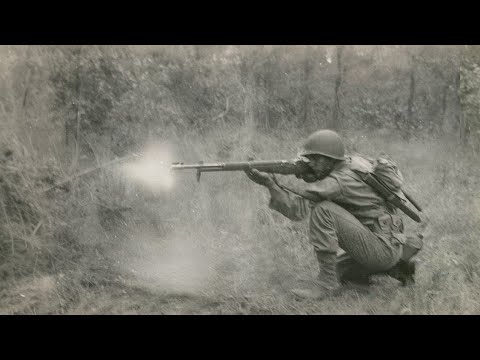
He pressed his face into the frozen earth as wood chips exploded from the tree above his head. Eight rounds impacted in less than five seconds. Then came that sound—a sharp, metallic ping that rang through the forest like a bell. Hartmann braced for the pause, for the fumbling fingers on stripper clips, for the precious seconds of reload that every bolt-action rifle demanded.
The pause never came.
Another eight-round volley erupted from the same position. The American soldier hadn’t moved. Hadn’t ducked behind cover. Hadn’t done anything except keep firing with a speed that should have been impossible.
“What kind of weapon is that?” Hartmann hissed to the man beside him, a fellow grenadier who had survived Stalingrad and Normandy and had never once looked afraid. The man’s face was pale.
“They say every American has an automatic rifle,” he whispered. “They say the whole company is armed with them.”
It wasn’t a machine gun. It was something far more terrifying—a rifle that could fire as fast as a man could pull the trigger, reload in the blink of an eye, and never, ever jam. The Germans called it that damned automatic rifle. The Americans called it the M1 Garand.
What Hartmann and his comrades were experiencing in the Hurtgen Forest was not just a tactical surprise. It was a revolution in infantry warfare, one that had been decades in the making. The story of how the M1 Garand came to exist begins not on the battlefields of Europe, but in the quiet workshops of Springfield Armory, where a Canadian-born engineer named John Cantius Garand had spent twenty years fighting a different kind of war—against military bureaucracy, budget constraints, and generals who couldn’t imagine anything better than a bolt-action rifle.
In 1919, the United States Army was still armed with the Springfield M1903, an excellent weapon by the standards of the First World War. But Garand had watched American soldiers struggle to work their bolt actions while German machine guns poured out sustained fire, and he understood that the future belonged to self-loading rifles. The technical challenges were immense. A semi-automatic rifle required a mechanism that could harness the violent forces of cartridge ignition, extract and eject a spent case, chamber a new round, and reset the firing mechanism—all in a fraction of a second, all while surviving mud, sand, rain, and snow.
His first prototype failed spectacularly. So did his second, third, and fourth designs. The Army was lukewarm about the entire concept. Bolt actions were proven and cheap. Semi-automatics were experimental and expensive. The military budget of the 1920s was microscopic, and Congress saw no reason to fund expensive weapon development when the nation wasn’t at war.
But Garand persisted. Through the 1920s and early 1930s, working on a shoestring budget, he refined his design. The breakthrough came in 1932 with a gas-operated rotating bolt system fed by an eight-round en bloc clip. The cartridge he designed it around was the standard .30-06 Springfield round—a powerful cartridge that could remain lethal at 800 yards. By using existing ammunition, Garand ensured his rifle wouldn’t require a complete overhaul of the Army’s logistics system.
The en bloc clip was his most controversial innovation. Instead of a detachable box magazine, the M1 used a self-contained eight-round clip that inserted from the top of the receiver. When the last round was fired, the empty clip was automatically ejected with that distinctive metallic ping. Critics argued that eight rounds weren’t enough, that the ping would alert enemies when a soldier was empty, that the clip system was unnecessarily complex. Garand defended his design by pointing out that the clip was lighter than a magazine, less prone to damage, impossible to lose, and that eight rounds of rapid semi-automatic fire provided more effective firepower than a larger magazine on a slower rifle.
Army testing through the mid-1930s was exhaustive. The M1 prototype fired thousands of rounds in dust chambers, cold rooms, and mud pits. It was frozen, baked, dropped, and deliberately abused. Competing designs failed one test after another. The M1 kept firing. In January 1936, the United States Army officially adopted the M1 Garand as its standard service rifle, making the American military the first major power to issue semi-automatic rifles to all infantry soldiers.
Production began slowly. Springfield Armory manufactured the first M1s by hand, using skilled workers to fit individual parts. Early production rates barely exceeded 100 rifles per day. But Garand and Springfield’s engineers understood that war was coming. They redesigned the M1 for mass production, simplifying manufacturing processes and creating interchangeable parts that could be produced by contractors across the country. By 1940, production had accelerated to several hundred rifles daily. After Pearl Harbor, it became an avalanche.
At peak production in 1943 and 1944, American industry was producing 4,000 M1 Garand rifles every single day. Each rifle contained 67 precisely machined parts, required 43 separate manufacturing operations, and had to meet tolerances measured in thousandths of an inch. Yet American workers—many of them women who had never seen a rifle before Pearl Harbor—turned out weapons with precision and reliability that exceeded peacetime standards.
The first American soldiers to carry M1s into combat were Marines landing on Guadalcanal in August 1942. The jungle environment immediately tested every claim made about the rifle’s reliability. Humidity corroded metal, sand abraded moving parts, and mud caked every surface. The M1 kept firing. Japanese soldiers, armed with bolt-action Arisaka rifles, discovered that they were facing an impossible rate of fire from American positions. A Marine squad of twelve men, each armed with an M1, could deliver 96 aimed rounds in under a minute without reloading. A comparable Japanese squad would fire perhaps 30 rounds in the same time.
By 1943, every branch of the American military was receiving M1s as fast as factories could produce them. Army infantry divisions in North Africa carried them against German and Italian forces. Paratroopers jumped with them into Sicily and Italy. And in June 1944, when American soldiers stormed ashore on the Normandy beaches, virtually every rifleman carried an M1 Garand.
The German army that met the Americans in Normandy was the most experienced military force in the world, battle-hardened by five years of continuous combat. But German infantry were armed primarily with the Karabiner 98k, a bolt-action rifle that was essentially an improved version of the Mauser 98 from 1898. It was an excellent weapon by bolt-action standards—accurate, reliable, and well-made. But it required the soldier to manually work the bolt after each shot, a sequence of motions that took even well-trained soldiers at least two seconds, often longer under combat stress.
The tactical implications became apparent within days of the Normandy landings. American squads could put out sustained fire that German units couldn’t match without deploying their belt-fed MG 42 machine guns. In firefights at typical engagement ranges of 100 to 300 yards, the volume of fire from American M1s often forced German soldiers to take cover before they could return effective fire. The psychological effect was significant. German troops reported facing what they believed were entire squads armed with automatic weapons.
Captured German documents from late 1944 revealed the Wehrmacht’s growing concern. A tactical assessment from the German 352nd Infantry Division noted, “The enemy rifleman is armed with a semi-automatic weapon of considerable effectiveness. Rate of fire appears comparable to submachine guns at close range. All infantry attacks must account for sustained fire from enemy rifle positions that cannot be suppressed by small arms fire alone.”
But the M1’s advantages extended beyond raw firepower. The semi-automatic action significantly reduced fatigue compared to bolt-action rifles. A soldier working a bolt action fifty or sixty times during a firefight would experience tired arms and slowed reactions. An M1 operator simply pulled the trigger, allowing him to maintain faster reactions and better accuracy over extended engagements. The reduced recoil impulse compared to bolt-action rifles helped as well. The gas-operated system absorbed some of the recoil energy, making follow-up shots faster and more accurate.
The M1 wasn’t perfect. That distinctive ping when the en bloc clip ejected after the eighth round became legendary, with stories circulating that German soldiers would wait to hear the ping before attacking. In reality, the sound was rarely heard over battlefield noise, and any soldier who assumed an American was empty after eight shots would often meet his end from the soldier’s rapidly reloaded rifle or from his squadmates who were still firing.
The en bloc clip system did have one genuine limitation. The rifle couldn’t be topped off during a lull in fighting. Once a clip was inserted, it stayed until all eight rounds were fired. Soldiers learned to count their shots and reload during appropriate moments, but this required more attention than simply swapping magazines. The rifle also required more maintenance than bolt actions. The gas system needed regular cleaning to prevent carbon buildup that could slow the action. The operating rod could bend if the rifle was dropped on its muzzle at the wrong angle. But American logistics and training compensated for these issues. Every soldier received instruction on field stripping and maintaining the M1. Armorers at the company level could replace damaged parts, and the sheer quantity of spare parts flowing through the supply system meant that a damaged rifle could be quickly repaired or replaced.
The Battle of the Bulge in December 1944 provided the ultimate test of the M1’s reliability in extreme cold. Temperatures dropped below zero, snow caked everything, and weapons froze. German forces, betting on winter weather to ground Allied air power, launched a massive counteroffensive through the Ardennes Forest. American units, many of them green replacements rushed to the front, found themselves outnumbered and surrounded in frozen forests. At Bastogne, the 101st Airborne Division, surrounded and cut off, held against repeated German assaults. The paratroopers, armed primarily with M1 Garands, maintained disciplined fire against attacking German infantry and armor. The semi-automatic fire from hundreds of M1s created defensive firepower that German commanders couldn’t overcome without artillery support.
Captain Charles Coco, commanding Easy Company of the 502nd Parachute Infantry Regiment, reported, “The M1 gave us the firepower to hold positions that would have required twice as many men with bolt-action rifles. Even under sustained assault, our fire never slackened because individual soldiers could maintain effective rates of fire without exhausting themselves working bolt actions.”
In the Pacific Theater, the M1 proved equally effective under completely different conditions. The jungle fighting on islands like Peleliu, Iwo Jima, and Okinawa occurred at close ranges where the M1’s rapid-fire capability was decisive. Japanese defensive tactics emphasized close-range ambushes and sudden counterattacks designed to negate American firepower advantages, but Marines and soldiers with M1s could respond instantly with sustained fire that broke up these attacks before they closed to hand-to-hand range.
By early 1945, the American military had fielded over four million M1 Garand rifles. They armed infantry divisions across Europe and the Pacific, equipped paratroopers and Rangers, and served with Marine Corps units on every Pacific island. The industrial achievement this represented was staggering—four million complex semi-automatic rifles, each manufactured to exacting standards, distributed across global supply lines, supported by millions of spare parts and billions of rounds of ammunition.
German intelligence assessments of captured M1s were uniformly impressed. A technical evaluation by German ordnance specialists in late 1944 praised the rifle’s robust construction, the elegance of its gas system, and the reliability of its action. The report concluded that the M1 represented a significant advantage in infantry firepower that German forces could not match with current equipment.
Some German officers recommended immediate development of a comparable semi-automatic rifle. But by 1945, Germany lacked the industrial capacity, raw materials, and time. The war was ending, and the M1 had already written its verdict.
In the Hurtgen Forest, Hartmann finally understood. “They are not supermen,” he whispered to himself. “They just have better rifles.”
The M1 Garand didn’t win the war alone, but it gave American infantry a decisive edge in thousands of firefights. John Garand’s decades of quiet persistence had created something truly revolutionary—a rifle so effective that enemy soldiers couldn’t believe it was just a rifle.
What would YOU have done, hearing that metallic ping echo through the trees?
Report this article
Select a reason for reporting:






