The sun hung high over the Song Ve Valley, casting a golden haze over the rice paddies. It was a summer day in 1967, and the heat was unbearable. The farmers moved through the fields with the quiet rhythm of generations, unaware that this day would be their last in the valley of their ancestors. In the distance, a group of men in uniform emerged from the tree line. They were American soldiers—but not just any soldiers. They were the Tiger Force, the most ruthless combat unit the United States had ever sent to Vietnam.
“They were men bold enough to agree to be sent to the most dangerous areas of the country, to wage an all-out war against Uncle Sam’s enemies.” Created by Major David Hackworth, a veteran of two wars, the Tiger Force was designed to mimic the guerrilla tactics of the Viet Cong: brief, brutal strikes that vanished into the jungle. But without oversight, without generals to restrain them, they became something far darker.
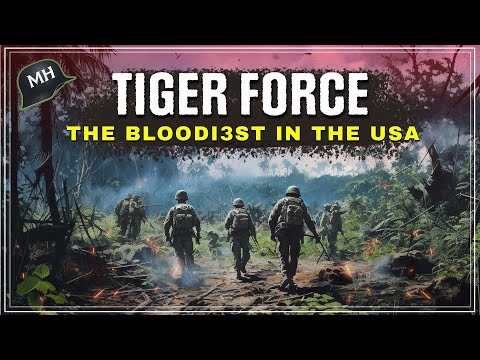
By the summer of 1967, the Tigers were sent to the Song Ve Valley to clear civilians and search for Viet Cong. Intelligence suggested the valley was a hideout. But what they found were stubborn farmers who refused to leave their homes. The Americans were tired, irritated, and eager for blood.
An argument erupted. A peasant pulled a gun and fired. The Tigers responded with a volley that killed him—and a woman and her newborn baby. They called it collateral damage. Then they set the huts ablaze, forcing the villagers out. “Everything you see in this Valley belongs to us,” Lieutenant James Hawkins would later say, justifying the slaughter.
Among the Tigers was 21-year-old Private Sam Ybarra, a man who enjoyed watching huts burn and farmers cry. He dragged a hiding man from under a table, beat him unrecognizable, and slit his throat. No one stopped him. “It’s time for you to lose your virginity,” a sergeant told a medic, ordering him to execute a prisoner. When the medic refused, the sergeant shot the man himself.
The descent into madness was swift. Blind elders were executed as spies. A Buddhist monk was shot and blown apart with a grenade. Ybarra wore a necklace of human ears, carrying a jar of vinegar to preserve them. After his best friend was killed by a sniper, he murdered a Vietnamese baby and threatened his own comrades. The Tigers laughed about their crimes, boasting of the evil they had caused, classifying every victim as Viet Cong.
In 1971, a former member reported the atrocities. The Army investigated, found evidence of torture, rape, mutilation, and murder. Eighteen Tigers could have been tried for war crimes. But the Army chose not to prosecute, fearing damage to America’s image. “It was preferable that nothing be known about this.” Sam Ybarra died of pneumonia in 1982, a free man. The victims’ families never saw justice.
Today, the Tiger Force is remembered as a warning—of what happens when soldiers are left unchecked, when the line between hunter and monster blurs beyond recognition.
But the story of the Tiger Force did not end with the Army’s silence. In 2002, two reporters from the Toledo Blade, Michael Sallah and Mitch Weiss, stumbled upon a trail of declassified documents that mentioned a secret investigation. The Army had admitted the probe existed, but refused to release the records, citing the privacy of soldiers. “That’s the kind of response reporters want to hear,” Sallah later said, “because they realize they’re hiding something.”
What Sallah and Weiss uncovered was a paper trail of horror—testimonies from soldiers who had broken their silence out of guilt. One veteran described how Ybarra had kicked a Vietnamese infant in the head, then laughed. Another recalled a sergeant who ordered his men to throw grenades into a bunker full of wounded civilians. “We were told they were all VC,” one soldier testified. “But we knew. We knew some were just farmers.”
The journalists tracked down surviving members of the unit. Some were dead. Others refused to speak. But a few, like Lieutenant James Hawkins, agreed to meet—not to apologize, but to defend themselves. “We were fighting a war,” Hawkins said, his voice steady. “You weren’t there. You don’t know what it was like.” When asked about the old man he had shot point-blank, he shrugged. “He was in a free-fire zone. That’s the rule.”
The reporters also found families of the victims. In the village of Song Ve, an old woman named Tran Thi Mai, now in her seventies, remembered the day the Tigers came. “They burned my house,” she said, her eyes distant. “They killed my husband. My son. I hid in the rice field with my baby. We never got anything back. No apology. Nothing.”
When the Toledo Blade published its series in 2003, the reaction was immediate. Congress demanded answers. The Pentagon launched a review. But the statute of limitations had long expired, and most of the Tigers were either dead or too old to prosecute. The Army offered a formal apology—not to the families, but to the American public, for the “isolated incidents” that had occurred.
Sam Ybarra, the most notorious of the Tigers, had died two decades earlier, never having faced a courtroom. His grave in Tacoma, Washington, bears no mention of Vietnam. “He was a monster,” one of his former comrades said in 2003. “But he was our monster. And we let him loose.”
Today, the Song Ve Valley is quiet again. The rice paddies are green, the sky a brilliant blue. But the scars remain—in the memories of the survivors, in the unmarked graves of the victims, and in the declassified files that remind us of what happens when men are given absolute power and no accountability.
As the sun sets over the valley, a new generation of farmers works the fields, unaware of the ghosts that linger beneath the soil. The Tiger Force is gone, but its legacy is a warning: When the line between soldier and killer disappears, justice must not be allowed to disappear with it.
But the silence that followed the Toledo Blade series was not the end of the reckoning. In the years after 2003, historians and investigators kept pulling at the loose threads the Army had tried to bury. Declassified after-action reports from the 101st Airborne Division revealed something the Pentagon had never publicly acknowledged: senior commanders had received informal warnings about the Tigers as early as 1967. One memo, dated August of that year, described the unit’s conduct as “exceeding the bounds of normal combat operations”—a phrase so mild it might have referred to a paperwork error rather than a string of murders.
The men who wrote those reports were not monsters. They were bureaucrats, officers, career soldiers trained to protect the institution above all else. When a junior officer named William Doyle filed a formal complaint after witnessing Ybarra execute a bound prisoner, the complaint vanished into a filing cabinet. Doyle was reassigned to a desk job in Saigon within a week. “They didn’t want to know,” he told a historian decades later. “And I stopped wanting to tell them.”
What the documents made clear was that the Tiger Force was not an aberration born of a single madman. It was a system. Hackworth had built the unit to operate outside the normal chain of command, to move fast and strike hard without waiting for approval. That freedom was the point. But freedom without accountability is a breeding ground, and the men who filled the Tigers’ ranks were often the ones other units did not want—the violent, the unstable, the ones who had already shown a taste for cruelty.
In 2004, a Vietnamese journalist named Nguyen Van Thanh traveled to the Song Ve Valley with a camera crew. He had read the Toledo Blade series and wanted to find the survivors the American reporters had missed. What he found was a community still fractured by grief. “We don’t talk about it,” one farmer told him. “Not because we forgot. Because no one ever asked.”
Thanh’s documentary, broadcast on state television, showed something the American coverage had not: the descendants of the victims. A young woman named Pham Thi Lan, whose grandmother had been killed in the initial volley that day in 1967, held up a faded photograph. “This is all I have of her,” she said. “No grave. No justice. Just a picture and a story my father told me.”
The documentary sparked a brief diplomatic controversy. The Vietnamese government demanded an official apology. The American embassy issued a statement expressing “regret for all civilian casualties during the conflict”—a phrase so broad it could have covered a traffic accident. No names were mentioned. No compensation was offered. The story faded from the news cycle within a week.
But something else was happening, quieter and slower. In 2006, a group of American veterans—none of them Tigers—founded an organization called Project Renew, dedicated to clearing unexploded ordnance from the Song Ve Valley and building schools for the children of the villages the Tigers had destroyed. “We can’t undo what happened,” said the group’s founder, a former Marine named Thomas Reilly. “But we can make sure the next generation doesn’t grow up in a graveyard.”
Reilly had never met a Tiger. He had fought in a different province, in a different year. But he had heard the stories, and he had seen the way the war’s ghosts refused to stay buried. “There’s a saying in Vietnam,” he said. “The past is never really past. It just waits for you to turn around.”
In the valley today, the rice paddies stretch to the horizon, green and gold under the same unbearable sun. Children ride bicycles along the dirt roads. The huts are gone, replaced by concrete houses with tin roofs. But in the shade of a banyan tree at the edge of the village, an old woman still lights incense every morning for the family she lost. She does not know the names of the men who killed them. She does not know that one of them died in comfort in Washington State, or that the others were never punished. She only knows that they came from the sky, and that they took everything.
And somewhere in the archives, in a file marked with a classification stamp that no longer means anything, the truth sits waiting—not for justice, which has long since passed, but for remembrance. The Tiger Force is a name most Americans have never heard. But in the Song Ve Valley, it is a wound that has never closed. The soldiers went home. The war did not.
In 2015, a small delegation of American veterans returned to the Song Ve Valley—not Tigers, but men who had served elsewhere and felt the weight of a war that never truly ended. They came with a simple gift: a granite plaque bearing the names of the villagers who died that summer day in 1967.
The old woman who lit incense each morning ran her fingers over the carved letters. “You came back,” she whispered, not to the soldiers but to the stone. “After all this time, someone came back.”
No government official attended. No cameras rolled. The plaque now stands beneath the banyan tree, where the rice paddies stretch green and gold under the same unbearable sun. The Tiger Force is gone. Its victims are not forgotten.
But the question remains: when a nation refuses to prosecute its own, who carries the burden of justice—the courts that failed, or the memory that refuses to die?
Report this article
Select a reason for reporting:






