June 6th, 1944. Normandy. A young American private lies motionless in a hedgerow, his cheek pressed against a walnut stock worn smooth by a thousand hands before his. Through a 2.75 power Weaver scope, he watches four German soldiers setting up a machine gun nest 350 yards away. They have no idea he exists. They have no idea that in the next 30 seconds, none of them will exist either. He exhales slowly, squeezes the trigger. The bolt action rifle bucks against his shoulder. He works the action, acquires the next target, fires again. Four shots, four enemy soldiers neutralized before they can return a single round.
The rifle in his hands cost the United States government approximately $56. The semi-automatic M1 Garand carried by the infantry around him cost $85. And yet, when precision mattered most, when one shot meant the difference between life and death, America turned to something older, simpler, and devastatingly more accurate. This is the story of the M1903 A3 Springfield, the budget bolt action rifle that became America’s primary sniper platform in the deadliest war in human history.
December 7th, 1941 changed everything. When Japanese aircraft struck Pearl Harbor, the United States military faced an immediate and catastrophic problem. The nation needed to arm millions of soldiers, sailors, and Marines almost overnight. The M1 Garand, adopted in 1936 as the standard service rifle, was revolutionary. Eight rounds of .30-06 ammunition fed from an en bloc clip, semi-automatic fire as fast as a soldier could pull the trigger. General George Patton would later call it the greatest battle implement ever devised. But in December 1941, America did not have enough of them.
Springfield Armory was producing M1 Garands at capacity, but capacity was not nearly enough for a two-front global war. The military needed rifles now, millions of them. And the Garand, with its complex gas-operated system and precision-machined components, could not be produced fast enough to meet the demand. The solution lay in the past.
The M1903 Springfield, the bolt action rifle that had served American doughboys in the trenches of World War I, was still in limited production. Its design dated back to 1903, but that design had one enormous advantage. It could be manufactured faster and cheaper than the Garand. In September 1941, Remington Arms received a contract to produce M1903 rifles using tooling from Rock Island Arsenal that had been sitting in storage since 1919. The machinery was over two decades old. The rifles they produced were nearly identical to those made at the end of the First World War.
But as production ramped up, Remington engineers identified a problem. The original M1903 design required extensive machining, milled parts, precisely fitted components. In a wartime economy where every hour of factory time mattered, every dollar spent on manufacturing mattered, the old Springfield was still too expensive, too slow to produce. They needed to simplify.
By early 1942, Remington had received Army approval for a continuous number of changes to the original M1903 design. Milled parts were gradually replaced with stamped steel components. The elegant finger grooves on the stock disappeared. The finely machined trigger guard assembly became a stamped and welded unit. The precision-polished metal surfaces were replaced with a simpler parkerized finish. The most visible change was the rear sight. The original M1903 featured a complex ladder-type sight mounted on the barrel, a precision instrument designed for long-range volley fire. Remington replaced it with a simpler aperture sight mounted on the receiver, similar to the sight on the M1 Garand. This served a dual purpose. It was cheaper to manufacture, and it helped soldiers already trained on the Garand transition more easily to the Springfield.
At approximately serial number 3,330,000, the Army and Remington recognized that the cumulative changes warranted a new designation. The rifle was redesignated the M1903 A3. The cost savings were significant. While exact wartime production costs varied, the M1903 A3 could be manufactured for approximately $56 per unit. The M1 Garand cost around $85 at the start of the war. For a military arming millions of soldiers, that nearly $30 difference per rifle represented an enormous sum. But the A3 was not just cheaper. It retained something the Garand could never match: inherent accuracy.
To understand why the military chose a $56 bolt action rifle over the $85 semi-automatic Garand for sniper work, you have to understand the physics of accuracy. A bolt action rifle has fewer moving parts than a semi-automatic. When a soldier fires a bolt action, the bolt is locked rigidly in place for the entire firing sequence. There is no gas system siphoning energy from the barrel, no bolt carrier group moving backward and forward, no springs compressing and releasing. The barrel remains perfectly stable from the moment the firing pin strikes the primer until the bullet exits the muzzle.
The M1 Garand, brilliant as it was for infantry combat, had inherent limitations for precision shooting. Its gas-operated system required slightly looser chamber tolerances to ensure reliable cycling. The movement of internal components during firing introduced variables that affected shot-to-shot consistency. The en bloc clip system meant the rifle had to be loaded from the top, making it difficult to mount a scope directly over the bore.
The Springfield had none of these limitations. Its bolt locked up solid. Its chamber could be cut to tighter specifications. Its internal magazine allowed clear access for mounting optics. In the hands of a skilled marksman, the M1903 could consistently place shots inside a group small enough to cover with a silver dollar at ranges where the Garand would scatter them across a dinner plate.
For the average infantryman in a firefight, the Garand’s rapid semi-automatic fire was infinitely more valuable than theoretical accuracy advantages. But for a sniper, lying motionless for hours waiting for a single perfect shot, the bolt action Springfield was the superior tool.
The United States Army entered World War II without a dedicated sniper rifle. There was no formal sniper training program, no standardized sniper weapon. When American troops began seeing combat in the Pacific, requests started flowing back to the War Department. The soldiers needed a precision rifle. They needed it immediately.
The newly adopted M1 Garand presented challenges for sniper conversion. Its top-loading en bloc clip made mounting a center line scope problematic. The complexity of the gas system meant any modifications might compromise reliability. The rifles were needed desperately for standard infantry use.
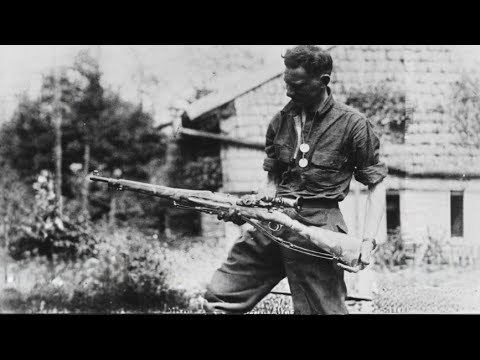
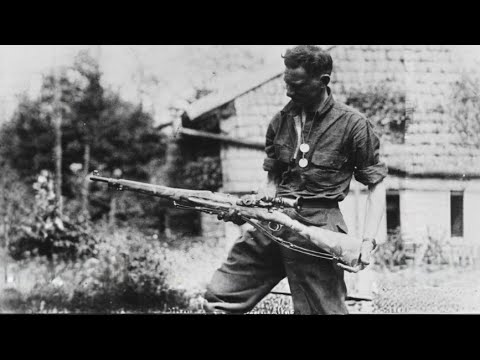
On January 14th, 1943, the Army standardized a solution. The M1903 A4. Remington would take M1903 A3 rifles from the production line and convert them for sniper use. The iron sights were removed. The bolt handle was modified with a concave section to clear a mounted optic. A Redfield scope mount was installed on the receiver. The scope itself was a Weaver model 330 or 330C, a commercial hunting scope given the military designation M73B1. It offered 2.75 power magnification with a simple crosshair reticle.
The rifles were not hand-tuned match weapons. They did not receive special barrels or precision triggers. Receivers were selected from production that met specifications, and barrels were chosen that fell within exact tolerances, but they were not individually accurized like a competitive target rifle. The cost for this conversion came to approximately $64 per rifle, including the scope and mount. Still cheaper than a standard M1 Garand, the government initially ordered 20,000 M1903A4 sniper rifles. By the time production ended in June 1944, 28,365 had been delivered.
In October 1942, a typewriter company in Syracuse, New York, began manufacturing military rifles. The LC Smith and Corona Typewriter Company had been building office equipment since the 1880s. Their factory had turned out millions of typewriters that sat on desks across America. But in 1942, the government suspended non-essential typewriter production. The nation needed weapons more than it needed correspondence machines.
Smith Corona partnered with High Standard Manufacturing Company, which supplied the rifle barrels. The typewriter factory retooled for war production. By November 1942, the first Smith Corona M1903A3 rifles rolled off the assembly line. At peak production, the Syracuse factory manufactured 23,000 rifles per month. They tested every single one, firing them deep within the factory before shipping them to war. By the time rifle production ceased on February 19th, 1944, Smith Corona had manufactured 234,580 M1903A3 rifles. Remington produced over 700,000 more. Combined with the sniper variants and earlier production models, more than 1.3 million M1903 series rifles served in World War II. A typewriter company had helped arm an army.
From its standardization in January 1943 until the end of the war, the M1903A4 saw action in every theater of operations. In the rugged mountains of Italy, American snipers used the Springfield to engage enemy positions at ranges that negated the Germans numerical advantages. A single skilled marksman with an A4 could pin down an entire squad, force them to seek cover, disrupt their movement for hours.
Private First Class Edward Foley of the 143rd Infantry Regiment, 36th Division, carried his M1903A4 through the Italian campaign in 1944. Near the town of Velletri, he and other American snipers worked to neutralize German observation posts and machine gun positions. The dense terrain and mountainous country were ideal for precision shooting.
In Normandy, the weapon proved invaluable in the bocage country. The thick hedgerows that crisscrossed the French countryside provided perfect concealment for snipers. Private First Class Ray Register, a young soldier from Alabama, demonstrated what the rifle could do in skilled hands. From his concealed position in a hedgerow, he spotted four German soldiers setting up a machine gun 350 yards away. Four shots, four enemy soldiers neutralized. When a fifth enemy revealed his position while trying to locate the source of fire, Register eliminated him as well. Five targets in under a minute.
The M1903A4 was not a perfect weapon. Soldiers complained about the Weaver scope. It fogged in humid conditions, the magnification was too low for long-range work, the windage adjustment screws were fragile and easy to damage. Without the scope, the rifle was completely sightless since no iron sights were fitted. But it was available. It worked. And in the hands of a skilled marksman, it could eliminate enemy soldiers at ranges where they had no hope of responding.
In the Pacific theater, the M1903A4 faced different challenges. High humidity wreaked havoc on the Weaver scopes. Moisture seeped into the tubes, blurring lenses and obscuring crosshairs. The jungle terrain often meant engagement ranges were far shorter than in Europe. But the rifle still served.
The Marines had their own approach. Rather than using the Army’s M1903A4 with its Weaver scope, Marine armorers built sniper rifles using M1903A1 National Match actions and mounting powerful eight-power Unertl scopes. Marine snipers reported confirmed eliminations at ranges up to 1,000 yards on Peleliu, on Iwo Jima, on Okinawa.
The M1903A4 did not retire when World War II ended. When North Korea invaded South Korea in June 1950, M1903A3 Springfields were pulled from storage and issued to soldiers. The A4 sniper variant continued its service in the frozen mountains and rice paddies of Korea. The rifle served into Vietnam. Technical manuals for the weapon were printed as late as 1970.
The M1903 design saw combat from the Philippine-American War through Vietnam. Five major conflicts spanning seven decades. No other American rifle served longer. It was not revolutionary. It was a bolt-action rifle based on a 40-year-old design, simplified for mass production, built by factories that normally made typewriters. It cost $56, and it out-sniped every semi-automatic rifle America had ever built.
Some weapons are great because they are complex. The M1903A3 Springfield was great because it was simple, reliable, accurate, affordable. A $56 rifle that changed the mathematics of warfare. From the trenches of the Western Front to the islands of the Pacific, the arsenal of the past holds more secrets than you realize.
So here is the question for you: in an age of smart weapons and precision-guided munitions, is there still a place for the simple, proven, and devastatingly effective tools of the past? Let us know your thoughts in the comments below.
Report this article
Select a reason for reporting:






