On a crisp October afternoon in 1893, deep beneath the Elk Mountains of Colorado, a miner’s pick struck something that should not have existed. The sound that rang out was not the familiar crack of coal—it was the dull, metallic clang of iron. What Tomaš Kastelic unearthed that day would haunt everyone who saw it for the next century.
The object was impossibly large: a double-crescent blade over 17 feet long, its handle so thick that the strongest man on the crew couldn’t wrap his arms around it. And it was buried deep inside a coal seam formed 70 million years ago—long before humans walked the earth.
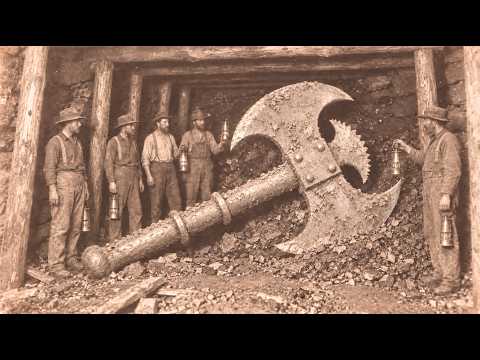
But the strangest part wasn’t the tool’s size. It was the coal itself. The bands of anthracite bent around the iron like tree rings around a nail, and a perfect mold of the handle remained in the stone. The coal had formed around it. The tool was already there, waiting, when the swamp that became coal was still soft mud.
Mining engineer Walter H. Ashby measured every inch of the relic, filling 11 pages of his field book with sketches and figures. He noted the 13 teeth on the smaller crescent, the 3-inch hole through the pommel, the whetstone marks along the blade’s edge. He estimated its weight at 10 tons. And at the bottom of one page, he underlined a single sentence: The coal formed around it.
No one could explain how it got there. But 43 years later, 300 miles away in Utah, an old Ute elder would describe the same tool to an anthropologist—a tool he had never seen. He called it “the moon with teeth.” He said it was not lost, but put to sleep. And he warned that the miners had woken it.
The mine superintendent ordered the heading sealed. The tool was left in place, buried again in darkness. For 26 years, no one went back. But in 1919, a young geologist named Everett Sear would descend into that same tunnel and find something even more disturbing: grooves in the coal, arranged in sets of 13, matching the teeth of the crescent exactly. The tool had been used inside the mountain—not once, but four times.
Today, the portal is filled with concrete. The field books and notebooks sit in archives across three states, never published, never connected. And the question remains: who made a 10-ton blade too large for any human hand, and why was it sleeping inside a mountain that the Ute had warned their children to avoid?
But the records do not end with Sear’s grooves. They never do. Because in the autumn of 1893, there was one witness whose testimony has never been fully weighed—the man who first heard the ring of iron on iron, and who lived another forty-four years without ever speaking of it to anyone but a stranger with a notebook.
Tomaž Kastelic died in 1937. His obituary in the Crested Butte paper was three lines long. It mentioned his wife, his four children, and the fact that he had been a miner for fifty years. It did not mention the North Heading. It did not mention the thing he had held a lamp beside for three days while an engineer measured it. And it did not mention what he said to Everett Sear in 1919, when he pulled off his glove, laid his bare hand on the rust, and spoke a few short words in Slovene.
Sear never asked what those words meant. He wrote only, TK spoke to it. But in 1974, a Slovenian-American folklorist named Mary Pucelj was collecting mining songs in the carbon counties of Utah. She interviewed an old woman in Helper named Ana Kastelic, a distant cousin by marriage, who remembered a story her grandmother had told. The grandmother had heard it from her husband, who had heard it from Tomaž himself, on a visit to Colorado in the 1920s.
The story was this. When Kastelic touched the rust that day in 1919, he did not pray. He did not cross himself. He said, in Slovene, “I know you are not mine. I know you are not theirs. Go back to sleep.” And then he put his glove back on and walked out of the heading without looking back.
Pucelj wrote the story down in her field notes, but she never published it. It sat in a box at the University of Utah until 2011, when a graduate student cataloguing the collection found it and recognized the name. She sent a copy to the Steel Works Center of the West in Pueblo, where Ashby’s field book was kept. The archivist there, a man named Dennis O’Rourke, read it and went very quiet.
Because O’Rourke had been the volunteer who opened the Anthracite boxes in 2009. He had found Ashby’s field book in a folder labeled Ventilation, 1893. And in the same box, behind a bundle of ventilation surveys, he had found something else—something that had never been listed in the finding aid, something that had no business being there at all.
It was a single sheet of paper, folded twice, brittle at the edges. The handwriting was not Ashby’s. It was blocky, careful, the letters formed by someone more comfortable with a pick than a pen. At the top, in Slovene, were three words: Jaz sem ga videl. I saw it.
Below that, in the same careful hand, was a drawing. Not an engineer’s drawing—no measurements, no scale figure, no numbered parts. Just a shape. Two crescents back to back, the larger one smooth, the smaller one jagged with teeth. And beneath the drawing, one sentence, written in Slovene, which O’Rourke had to have translated by a librarian in Pueblo who spoke the language of her grandmother.
The sentence read: “It was not sleeping. It was waiting.”
O’Rourke sat with the paper for a long time. He compared the handwriting to the few known samples of Kastelic’s signature—the marriage record from 1888, the naturalization papers from 1892. It matched. The paper was old, the ink faded to brown. There was no date on it, no signature at the bottom. But tucked into the same bundle was a scrap of newspaper, yellowed and torn, with a single paragraph circled in pencil.
The clipping was from the Crested Butte Chronicle, dated November 1893. It read: “Work on the north heading at the Anthracite mine has been suspended indefinitely. Superintendent Wheeler cites safety concerns. The heading will be sealed.” In the margin beside the circled paragraph, in the same blocky hand, someone had written two words in Slovene. O’Rourke had those translated, too.
“Too late.”
O’Rourke sat back in his chair. The reading room in Pueblo was silent except for the hum of the fluorescent lights. He had spent twenty years in this archive, and he had learned to distrust easy mysteries. But this was not easy. This was a miner’s own hand, saying what no one else had said.
He went back to the boxes. The finding aid listed the Ashby field notes and the ventilation surveys, but it did not list the loose sheet. That meant it had never been catalogued. It had simply been there, waiting, like the tool itself. O’Rourke began opening every box from the Anthracite mine that had not yet been processed. There were eleven of them.
In the third box, he found a letter. It was dated November 10, 1893, and it was addressed to H.C. Wheeler, superintendent. The signature was Michael Tully’s. The letter was two pages long, written in a cramped, careful hand. Tully was not a man of many words, but that day he had made an exception.
He wrote that he had worked the Anthracite for twenty years. He had seen men killed by gas, by falls, by their own carelessness. He had never been afraid of a mine. But he was afraid now. Not of the tool—he was afraid of what the tool meant. “There is a thing in the north heading that was not put there by any man,” Tully wrote. “I do not know what it is. I do not want to know. But I know this: the coal grew around it. That means it was there before the coal. That means it was there before the mountain. And that means we are not the first ones here.”
He asked Wheeler to seal the heading and to say nothing about it to anyone. He asked him to burn the maps that showed the north heading. He asked him to forget. At the bottom of the second page, in a different ink, Wheeler had written a single word: Agreed.
O’Rourke set the letter down. He thought about the Ute elder’s words, spoken forty-three years later and three hundred miles away: It is not lost. It was put to sleep. The miners woke it. Tully had not used those words, but he had understood the same thing. He had not wanted to wake anything. He had wanted to put it back to sleep.
But there was more. In the same box, wrapped in a piece of canvas that had once been a miner’s jacket, O’Rourke found a small notebook. It was not Tully’s pit book—that was long gone. This was something else. The cover was black leather, cracked with age, and inside, on the first page, a name was written in pencil: Llewellyn Price.
Price. The biggest man on the crew. The one who had wrapped both arms around the shaft and could not reach around it. O’Rourke turned the pages carefully. Price had written in Welsh, not English, and O’Rourke did not speak Welsh. But there were drawings. Page after page of them. The tool, from every angle. The mold in the coal. The grooves that Sear would find twenty-six years later. And on the last page, a single sentence, written in English, as if Price wanted to be sure someone would understand it.
“I have seen the old ones’ work in the mines of Wales. But this is not the work of old ones. This is the work of something that was here before the old ones. And it is not finished.”
O’Rourke closed the notebook. He looked at the clock on the wall. It was past six. The archive was empty. He should have gone home. Instead, he went back to the finding aid and looked up the 1986 reclamation file. The form said the tool was left in place. The box for photographs was checked. But there were no photographs. O’Rourke had always assumed that meant they had been lost. Now he wondered if they had ever existed at all.
He picked up the phone and called the state office in Denver. He asked for the Inactive Mine Reclamation Program. A woman answered. He gave her the file number and asked if there were any other records from that site. She put him on hold. When she came back, her voice was different. “I don’t know what you’re looking at,” she said, “but the file you’re asking about was flagged in 1987. There’s a note in the system. It says, ‘Do not release photographs. Do not discuss with public. Refer all inquiries to the director.’”
O’Rourke asked who had written the note. The woman paused. “The director,” she said. “The director of the program. In 1987.”
He asked for the director’s name. She gave it to him. And when he hung up, he sat very still, because the name was familiar. It was the name of a man who had spent his entire career in Colorado mining, a man who had written papers on mine safety, a man who had died in 2003. But it was also the name of a man who had been born in Crested Butte in 1921, the son of a Slovenian miner, the grandson of a man who had worked the Anthracite in 1893.
The grandson of Tomaž Kastelic.
O’Rourke closed his eyes. The fluorescent hum seemed to grow louder. He thought of Kastelic’s hand on the rust, the words in Slovene, the warning that had been passed down not as a legend but as a duty. The grandson had not sealed the heading to forget. He had sealed it to keep the promise.
He opened the 1986 file again. The form was signed with initials. He matched them to the director’s name. They were the same. The man who had ordered the concrete poured had known exactly what he was covering.
O’Rourke sat back. The tool was still there, under the mountain. The records were scattered across five cities. The Ute elder’s words echoed: It was put to sleep. The miners woke it. But Kastelic’s grandson had done what he could. He had put it back to sleep.
Now the question is yours. If you found a sealed heading, a field book, and a warning in three languages, would you open it—or would you leave it alone? Tell us in the comments.
Report this article
Select a reason for reporting:






