At 2:43 AM on August 17, 1966, the night exploded over Nui Dat. Shells and mortar bombs rained down on the Australian base in Phuoc Tuy province, shattering the darkness for 22 minutes. When the guns fell silent, 24 Australians were wounded, seven vehicles and 21 tents were hit, and the enemy had vanished into the jungle.
Nobody knew who had fired—or why. But the answer would come decades later, and it would rewrite everything the world thought it knew about the Battle of Long Tan.
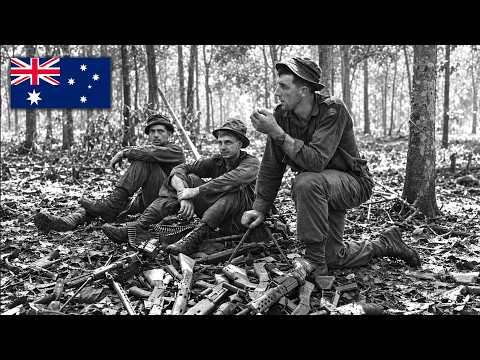
The Vietnamese had a plan. Nguyen Nam Hung, deputy commander of the 274th Regiment, described it in 2005: “First, to draw them into and destroy them in an ambush, and then attack the weakened base at Nui Dat.” The shelling was bait. And it worked—almost.
At 10:05 AM on August 18, Major Harry Smith received orders to take D Company out to relieve B Company. Smith was 33, a veteran of Malaya, and he trained his men hard. “I trained the company the way I wanted to train them,” he said later.
His force was small: 105 Australians and three New Zealanders. 108 men. Many were national servicemen, barely 20 years old. Second Lieutenant Gordon Sharp, commanding 11 Platoon, was just 21. So was Second Lieutenant Dave Sabben of 12 Platoon.
At 11:00 AM, D Company walked out of Nui Dat. By 1:00 PM, they met B Company at the edge of the Long Tan rubber plantation. The enemy had left. Each rifleman carried about 120 rounds—a reasonable load for a patrol chasing a mortar crew.
At 3:00 PM, D Company started down a track heading northeast. At 3:15, they entered the rubber. The plantation was quiet in a way that men who walked through one describe again and again. Long rows, gray trunks, light coming down in strips. Every row looked like the last.
Just after 3:30, half a dozen Viet Cong soldiers wandered across the right flank of 11 Platoon. They seemed not to have seen the Australians. Sergeant Bob Buick fired. One man fell. The rest scattered. The Australians picked up an AK-47. It looked like a small contact.
Sharp’s platoon pushed forward in pursuit. At 4:08 PM, the plantation opened up. At least two machine guns hit 11 Platoon from the front and flank. Two Australians were killed in the first bursts. The platoon went to ground among the rubber trees.
At 4:10, Sharp called for artillery. At Smith’s side, Morrie Stanley started sending fire missions back to Nui Dat. 24 guns were there—Australian, New Zealand, and American. At 4:12, 61 Battery fired the first rounds.
The shells came down into the rows beyond 11 Platoon. The machine guns kept firing. Then the enemy infantry came forward. Not a squad this time. Lines of men moving through the trees.
The first wave hit 11 Platoon from three sides. The Australians fired in the measured way Smith had trained into them: aimed shots, short bursts from the machine guns, grenades when the shapes came too close.
At 4:33, Gordon Sharp lifted his head to direct the guns. He was shot and killed. He was 21. Bob Buick took over the platoon.
Two minutes later, a bullet cut away the antenna of 11 Platoon’s radio. Over in 10 Platoon, the radio operator, Private Brian Hornung, was hit and the round wrecked his set. Two platoons had lost their voice to the company commander within minutes of each other.
At 5:00 PM, the sky opened. Monsoon rain came down so hard that the men described the plantation turning to mud and noise and sight shrinking to a few meters. The red earth ran. Smoke from the shells hung in the trees. Sabben, years later, summed up that afternoon in five words: “Nothing could prepare you for it.”
In the downpour, the company medic, Corporal Phil Dobson, set up an aid post. By the end of the day, he and the men around him would treat 23 wounded Australians.
The second wave came in the rain. It was heavier. 11 Platoon was nearly surrounded. Smith sent 10 Platoon forward to reach them—and it was driven to ground. Then 12 Platoon went under Sabben, and it, too, was stopped short, fighting through the trees toward the sound of Buick’s men.
At 5:02, Smith asked for air support and ammunition. At 5:09, smoke grenades went up to mark the Australian position. The jets overhead could not see them through the cloud and rain.
By 5:15, 11 Platoon was described in the company record as “desperate, almost surrounded, heavy casualties, nearly out of ammunition.” The 120 rounds each man carried out of Nui Dat were going. 90, 60, 30. Men stripped magazines from the dead and wounded beside them.
At 6:00 PM, two RAAF Iroquois helicopters from Number 9 Squadron lifted off from Nui Dat into the storm. Visibility was about 50 meters. They flew at treetop height, looking for colored smoke in a plantation full of shellfire. They found it.
At 6:08, the crews pushed out ammunition boxes wrapped in blankets. The veterans’ reconstruction says the boxes landed almost into the lap of Jack Kirby.
What happened next is the image every survivor seems to keep. Jack Kirby stood up. He walked the perimeter in the rain, carrying ammunition from the boxes to the men in the mud. He tore open the cases. He handed out magazines. He moved on to the next man.
Harry Smith, decades later: “How that big man never got hit we were quite amazed, but he just went around distributing ammunition.”
Bob Buick: “His common ability and his gallantry of walking around under fire kind of built up the morale of the soldiers.”
At 6:13, 12 Platoon and the survivors of 11 Platoon finally pulled back into the company position. Buick had brought out the men he could move. Others stayed where they lay among the rubber trees.
At 6:20, Smith ordered the company to shrink its perimeter and form a ring around the wounded. The artillery was now landing 50 to 80 meters from the Australian line. The enemy was massing for a third wave.
Stanley called for the fire to come closer still—within 30 to 50 meters. The gun line at Nui Dat refused. It was too close. A shell falling short would land on D Company.
Smith took the handset. His reply, as the veterans remember it, cannot be repeated on a broadcast. Its meaning was simple: Give us the guns.
The guns fired. The shells came down between the two forces. Trees split. Mud lifted. The enemy lines broke apart in the rows.
At 6:25, a machine gun crew set up less than 50 meters from the perimeter. Kirby saw it. He killed the crew. Then he went back to checking on his men.
By now, the artillery regiment supporting D Company had fired, according to later counts, more than 3,000 rounds. Some guns fired so long their crews worked stripped to the waist in the rain. And still the third wave built in the gloom.
The ring of men lay in the mud around its wounded. Ammunition counted by the magazine. Light going. Nobody from Nui Dat in sight.
Around 7:00 PM, 28 men of B Company reached the position on foot. A few minutes later, from the west, came engine noise. Lieutenant Adrian Roberts and 3 Troop, 1st Armored Personnel Carrier Squadron, had crossed a flooded creek with an infantry relief force aboard.
The carriers broke into the plantation and drove straight into the enemy forming up for the next assault. Their machine guns fired into the massed troops. Most accounts place their arrival a little before or a little after 7:00 in the evening. The minutes differ. The effect does not. The attackers broke. By 7:30, they were pulling back into the dark, carrying wounded and dead with them.
The Australian official history concluded that the Viet Cong had been massing for an assault that would likely have destroyed D Company, and that the firepower and mobility of the armor broke their will. Ashley Eakins, later head of military history at the Australian War Memorial, called the battle “a very close thing indeed.”
That night, D Company and the relief force pulled back to a landing zone. The wounded were flown out. Nobody went back into the rubber in the dark.
At 7:05 the next morning, D Company returned on the carriers. At 10:25, they found Private Barry Mellor of 11 Platoon. He was wounded, alive, leaning against a rubber tree. Ten minutes later, they reached 11 Platoon’s last position. The veterans’ timeline records what they saw in one line: “The men were still in the firing positions with their fingers still on the triggers.”
By 11:05, all 15 missing Australians were accounted for. 13 dead, two wounded and alive. Around them, the bodies of the enemy. 113 by late morning, 68 by mid-afternoon. By August 20, 245.
The final Australian toll: 18 killed, 17 from D Company, one from 3 Troop. 24 wounded. No prisoners lost.
The men of D Company did not cheer on that ground. They searched it. They counted. They carried their own out.
Now, the delayed answer. The direction they were walking. In 1988, the Australian official historian interviewed former Vietnamese officers who had fought there. Among them, Nguyen Van Hong, a staff officer of the Viet Cong 5th Division, who is thought to have held overall control of the operation.
Hong explained the plan: positions in the rubber, forces to hold the Australians in place while D445 attacked from the northwest. Then he explained why it failed. His soldiers had fired on 11 Platoon before the whole Australian force had entered the killing zone. The trap went off early.
Sau Thu, the D445 company commander, said something else that has stayed in every serious account since. “We didn’t know how many had in Nui Dat,” he said. And then, of D Company: “They went the wrong way and came behind us.”
D Company had not walked into the ambush from the front. It had walked into its flank while it was still being set. The second half of the plan—the attack on a weakened Nui Dat—never came.
Then there are the numbers they gave for their own side. And there, nothing agrees. The Australian count is 245 enemy dead found on the field. Official Vietnamese figures give 47 killed and 100 wounded. In 1988, Hong put their total losses at roughly 30, mostly from artillery, and said the Australian figure of 245 was exaggerated by a factor of 10. A captured diary recorded 500 dead. The D445 history published in 1991 admits 33 killed and 80 wounded.
30, 47, 150, 245, 500. The gap cannot be closed from the records that survive. Each side counted what it could see, and each had reasons to count the way it did.
What the Vietnamese sources share is a picture of the afternoon. They believed an entire Australian battalion had fought them, with two squadrons of armored carriers and reinforcements. In fact, for most of the battle, it was one company of 108 men, and at the end, one troop of carriers.
Of the men who led those 108, the Vietnamese records say nothing. In Australia, his men’s names took decades to be fully honored. Gordon Sharp never left the plantation. He was 21. The cross that would later stand there marks the ground where his platoon fought its last stand.
Jack Kirby was recommended by Harry Smith for the Victoria Cross. He received the Distinguished Conduct Medal. On February 6, 1967, less than six months after Long Tan, a salvo of 12 New Zealand artillery rounds fell by mistake on D Company. Kirby was hit in the chest and died soon after. The guns that had saved his company at Long Tan killed him in error.
Bob Buick spent the following decades as one of the men who kept telling what had happened among the rubber trees—and kept naming Kirby. Morrie Stanley later became Major Morrie Stanley, MBE. Harry Smith received the Military Cross in 1967, angered that few of the decorations he had recommended for his men were granted. In 2008, his own award was upgraded to the Star of Gallantry. He insisted to the end that the soldiers were the heroes. He died on August 20, 2023, aged 90—two days after the 57th anniversary of the battle.
So why is the Vietnamese side of this story so little known? In Vietnam, Long Tan was folded into a long war full of larger battles. The historian Mia Martin Hobbs, writing in 2016, found that many ordinary Vietnamese had never heard of it. For the 50th anniversary that year, Vietnamese authorities cited deep sensitivities. They canceled planned events, limited access to the site, and asked for low-key ceremonies without medals, uniforms, or regalia.
In Australia, the name became a day. The 18th of August is now Vietnam Veterans Day. Yet the story most Australians carry is their own side of it. The words of the men who planned the ambush stayed in translated unit histories, interview notes, and the footnotes of the official history.
And the cross took its own route. On August 18, 1969, three years after the battle, the 6th Battalion flew a concrete cross by helicopter into the plantation. It had been built by a New Zealand corporal, Barry McGuinness, a former cabinet maker. Ten men who had fought there in 1966 stood at the dedication.
After the fall of Saigon in 1975, the cross was taken from the plantation. For a time, it served as a memorial to a Catholic priest. In 1984, the Dong Nai Museum recovered it. A replica went up on the battlefield in the mid-1980s. In November 2017, the provincial authorities of Dong Nai handed the original cross to Australia’s ambassador at a small ceremony in Bien Hoa. On December 6, 2017, it went on permanent display at the Australian War Memorial in Canberra. The object that marks Australian grief came home as a gift from the former enemy.
Go back now to the bulletin read out over Radio Hanoi on August 27, 1966. Over 500 Australians, two full companies, three carriers in flames. Set it beside the words of the men who were actually in the rubber that day. A trap sprung before it was closed. A company that came the wrong way and arrived behind them. Guns that did not stop. A relief force that broke the last assault. A base that was never attacked.
That is the answer to the question. The more an announcement inflated Australian losses, the more clearly it revealed how far the afternoon had departed from the plan. 500 was the size of what the planners had needed to happen. 18 was what happened.
Forty years on, in 2006, a Vietnamese speaker named Nguyen Minh Ninh gave the most candid summary from that side: “You won, but we won also. Tactically and militarily you won, but politically we won.” He did not dispute the plantation. He moved the argument somewhere else.
The men of D Company never needed a radio bulletin. Their record is 18 names on a concrete cross that traveled from a rubber plantation to a museum in Bien Hoa and finally to Canberra. Facts outlast propaganda—provided someone keeps repeating them.
So here is the question that remains: when the last veteran of Long Tan is gone, who will keep telling the story—and will they tell both sides of it?
Report this article
Select a reason for reporting:






